
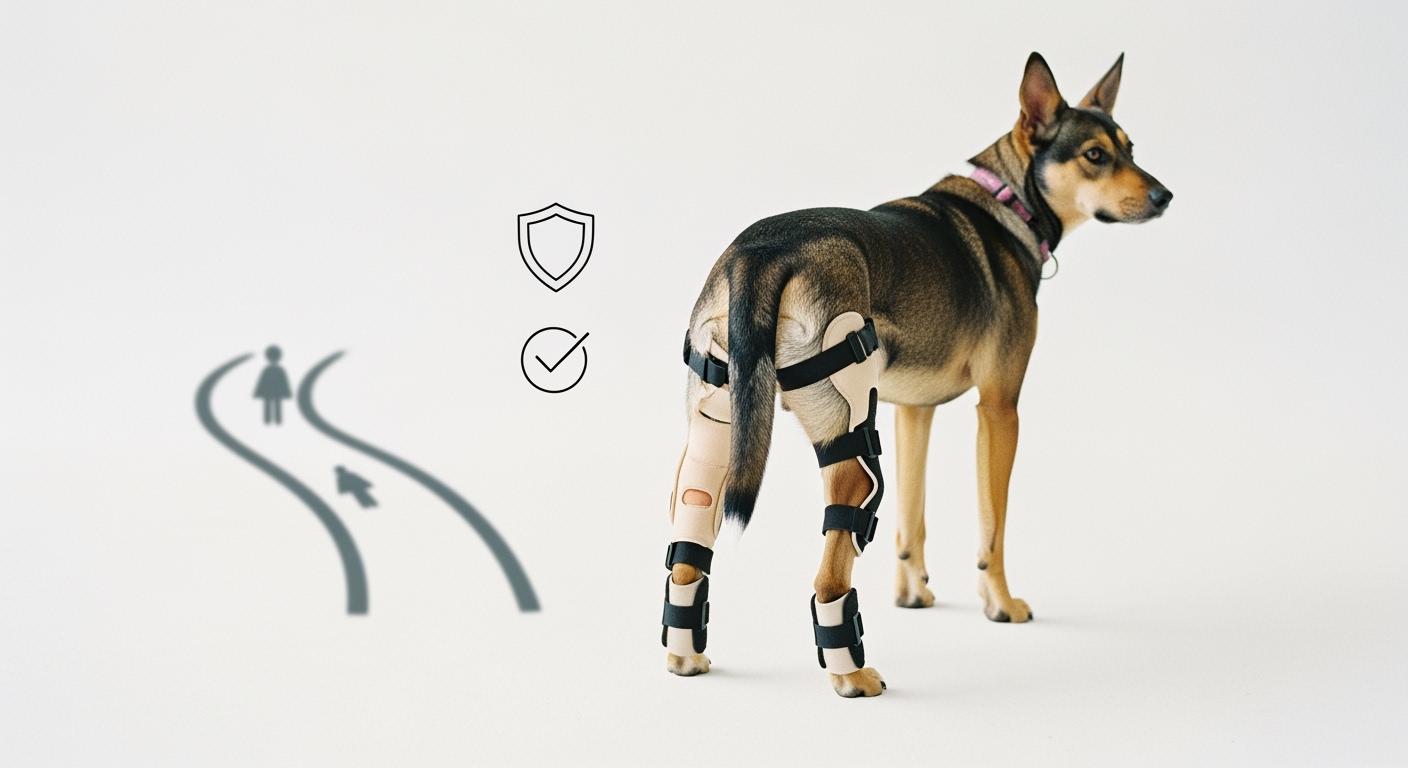
Dog rear leg knee brace hock vs knee support should be judged by one practical question: is the stability problem centered higher at the knee, lower at the hock, or across both parts of the rear leg. A dog with knee-based instability usually needs a different support path than a dog with lower hock weakness, dropped hock posture, or paw-placement problems. If you want a broader starting point before comparing support paths directly, begin with the GaitGuard guides hub.
Key Takeaways
- Knee support usually makes more sense when instability, pain, or reduced function is centered around the stifle joint.
- Hock support usually makes more sense when weakness, dropped posture, knuckling, or instability appears lower in the rear leg.
- Some dogs need a broader stability path because the problem is not isolated to one joint alone.
Dog Rear Leg Knee Brace Hock vs Knee Support: What’s the Difference?
Dog Leg Braces and Joint Focus
When you compare dog rear leg knee brace hock vs knee support, the first job is to identify which joint actually needs stabilization. Some dogs need support centered at the knee, some need lower-joint support at the hock, and some need a broader rear-leg solution because the movement problem spans more than one area. For a broader rear-leg overview, see what a dog rear leg brace is and when your dog needs one.
- Hock braces support the lower rear leg and ankle-like joint.
- Knee braces support the stifle joint higher up the rear leg.
- Some cases need more than one support point because stability loss is not isolated.
Here is a clearer comparison:
| Support Type | Main Joint Focus | Usually Best For |
|---|---|---|
| Hock support | Lower rear leg / tarsal joint | Lower-leg weakness, dropped hock posture, hyperextension, paw-placement instability |
| Knee support | Stifle joint | CCL/ACL-related support, luxating patella, knee-centered instability |
| Broader rear-leg support path | More than one joint or more global rear-leg weakness | Complex cases where one-joint support is not enough |
For product-side comparison after this section, review the products hub and the dog knee brace category.
Hock vs Knee: Anatomy and Function
The knee and hock do different jobs during rear-leg movement, so support needs should not be treated as interchangeable. The knee mainly handles higher-level flexion, extension, and shock control during walking and turning. The hock mainly influences lower-leg stability, paw placement, and push-off mechanics.
| Joint | Main Function | Movement Clues When It May Need Support |
|---|---|---|
| Knee / stifle | Higher-level rear-leg control, shock absorption, stepping stability | Limping higher up, trouble with stairs, reluctance to jump, stifle-centered pain |
| Hock / tarsal joint | Lower-leg alignment, push-off, ankle-like stability | Dropped hock posture, lower-leg wobble, knuckling, dragging, ankle-area instability |
You should choose support based on where the movement problem shows up most clearly. If the weakness is centered higher in the rear leg, knee support usually makes more sense. If the instability is lower and closer to paw placement or ankle control, hock support is usually the better fit. For a broader support path, compare this article with the Solutions by Condition page.
Identifying Support Needs for Your Dog
Signs of Canine Knee Injuries
You want to spot knee-centered signs early, because rear-leg problems are often misread as “general limping.” Watch for symptoms that are centered higher in the leg and tied to stifle function.
- lameness or reduced weight-bearing higher up the rear leg
- swelling or sensitivity around the knee area
- difficulty rising, sitting, or climbing stairs
- reduced willingness to jump or accelerate
- stiffness after rest or after walks
- muscle loss in the affected rear leg over time
| Knee-Focused Sign | Why It Points Higher Up the Leg |
|---|---|
| Reluctance to jump or climb stairs | These activities load the stifle more heavily than the lower hock. |
| Stiffness after rest | Knee discomfort often shows after inactivity or after longer walks. |
| Reduced push-off with visible upper-leg guarding | This often reflects knee pain or knee-based instability. |
If these signs are present, knee support usually deserves stronger consideration than hock-only support. For broader knee-support education, compare this article with the dog knee braces guide.
When to Consider Hock Support
You should consider hock support when the problem is clearly lower in the rear leg. Typical signs include dropped hock posture, ankle-area wobble, paw dragging, knuckling, or instability that looks closer to the tarsal joint than to the stifle. In these cases, knee-only support may not address the main source of instability.
If your dog shows signs in both the knee and hock, a broader support path may make more sense than isolating one joint too early. For conservative-support logic that can help frame that discussion, compare this article with non-surgical dog ACL brace options.
Tip: Write down exactly where you see the instability start. “Rear-leg weakness” is much less useful than “drops lower at the hock” or “guards higher at the knee.”
Dog Rear Leg Brace Selection: Hock vs Knee
Picking the right rear-leg brace means matching the support path to the real movement problem. A brace can improve comfort and stability, but only if the joint focus is correct and the dog can actually tolerate the support during daily use.
When to Use a Dog Rear Leg Knee Brace
Dog knee braces support the stifle joint and usually make more sense when the instability is centered above the hock. This often includes CCL/ACL-related support, luxating patella management, post-surgical rehab support, or knee-centered arthritis patterns.
Use a dog rear leg knee brace when:
- the main pain or weakness is centered around the stifle joint
- your dog guards the leg higher up during walking or stairs
- the support goal is knee stability rather than ankle stabilization
- your veterinarian confirms the knee is the primary joint driving the problem
For product-side comparison, continue to the dog knee brace category.
When to Use a Hock Brace
A hock brace supports the lower rear leg and usually makes more sense when the instability is centered near the ankle-like tarsal joint rather than the knee. These cases often look lower, more distal, and more related to paw placement or push-off mechanics.
Common reasons to use a hock brace:
- instability or swelling is centered near the hock
- the dog drags the paw or knuckles over more from lower-leg weakness
- there is dropped hock posture or ankle-area collapse
- your veterinarian identifies the tarsal joint as the main support target
Hock support is most helpful when lower-joint control is the missing piece. If the dog still looks unstable higher up after hock stabilization, that usually suggests the support path needs to be widened.
Multi-Joint and Adjustable Dog Leg Braces
Some dogs need support for both knee and hock because the problem is not limited to one joint. That can happen in more complex injuries, post-surgical recovery, chronic weakness, or cases where one-joint bracing improves only part of the gait problem.
Multi-joint or adjustable support is more relevant when:
- stability loss appears across more than one part of the rear leg
- single-joint support improves comfort but not overall movement quality
- the dog’s support needs change as rehab progresses
- the veterinary plan calls for broader rear-leg control instead of isolated joint support
These options matter because some dogs do not really have a “knee versus hock” problem. They have a stability-path problem that needs wider coverage.
Practical Comparison Table
Here is a simple guide to help you pick the right brace:
| Movement Problem | Usually Better Support Path | Main Reason |
|---|---|---|
| Pain, instability, or swelling centered at the stifle | Knee support | The knee is the main joint driving the gait problem. |
| Dropped hock posture, paw drag, lower-leg wobble | Hock support | The lower rear leg needs more stabilization. |
| Mixed signs above and below the hock | Broader rear-leg or multi-joint path | One-joint support may be too narrow for the case. |
| Post-surgical or changing rehab needs | Adjustable or staged support path | The best support target may shift during recovery. |
Tip: Always measure your dog’s leg for the best fit. A brace that fits well gives more support and comfort.
When picking a dog rear leg brace, think about your dog’s injury and comfort. Ask your vet to check the injury and talk about the best treatment. Look at all brace choices, including single-joint and multi-joint braces, to find what works best for your dog.
For more info on joint support and rehab, visit our pages on rear-leg braces and orthopedic braces.
Fitting and Comfort for Dog Leg Braces
Measuring for the Right Fit
You want the brace to fit well enough that it actually stabilizes the correct joint. That means measuring should follow the support target instead of using one generic rear-leg process for every brace type.
- Measure your dog while standing in a calm, natural posture.
- For knee support, focus on thigh, knee, and knee-to-hock dimensions.
- For hock support, focus on lower-leg, hock, and lower-joint alignment points.
- Use a soft tape and keep it flat against the leg without gaps.
- Write down all numbers and double-check them before choosing a size.
Tip: A brace can only stabilize the right joint if the measurements match the right part of the rear leg.
You can find more help in our fitting guides and pages about support for different conditions.
Ensuring Comfort and Mobility
A brace that fits well should support the target joint without making the dog move worse. If the brace is too loose, the support path becomes unreliable. If it is too tight, you create a new comfort problem that can reduce wear tolerance and slow progress.
Look for features that improve both comfort and function:
| Feature | Why It Matters |
|---|---|
| Breathable materials | Improve daily wear tolerance. |
| Adjustable straps | Allow smaller fit corrections as the dog moves. |
| Secure alignment | Keeps support centered on the intended joint. |
| Low-friction contact points | Reduce rubbing and irritation during repeated use. |
Watch for skin irritation, slide-down, twisting, or reduced willingness to walk. Those signs usually mean the fit or support path needs correction.
Note: Introduce brace wear gradually. Early tolerance matters more than immediate long-duration wear.
For more advice, check our fitting guide and look at support resources for different conditions to help your dog feel its best.
Common Mistakes and Best Practices
Avoiding Misidentification
Picking the wrong joint target is one of the biggest mistakes in rear-leg bracing. Many owners see limping and go straight to knee support, even when the instability is lower. Others see paw drag and assume a hock problem, even when the real issue begins higher up.
Common misidentification risks include:
- using knee support when the lower joint is the real source of instability
- using hock support when the stifle is actually driving the gait problem
- missing multi-joint instability because the dog shows mixed signs
- focusing on the product type before confirming the movement problem
Write down where the pain, swelling, hesitation, or instability appears during daily movement. That gives your veterinarian much better information than “rear leg limp” alone.
Tip: If the gait still looks wrong after supporting one joint, reassess whether the support path is too narrow.
Importance of Professional Guidance
Veterinary guidance matters because braces do not replace diagnosis. Your vet can determine whether the support need is centered at the knee, the hock, or across more than one joint.
A more useful decision framework looks like this:
| Support Path | Usually Considered When |
|---|---|
| Single-joint knee support | The stifle is the main problem site. |
| Single-joint hock support | The lower rear leg is the main problem site. |
| Broader or adjustable rear-leg support | The dog shows multi-joint instability or a changing rehab pattern. |
Always ask your vet before starting a new support plan. That helps make sure the brace type matches the real stability path instead of just the most obvious symptom.
Learn More About Dog Rear Leg Braces
Internal Links to Related Content
You can make this topic easier to navigate by moving through your site in a more useful order: rear-leg overview first, condition logic second, then product comparison.
- Start with what a dog rear leg brace is and when your dog needs one for the broader rear-leg support picture.
- Use the Solutions by Condition page to compare injury-driven support paths.
- Use the dog knee brace category for stifle-focused product comparison.
- Use the products hub for broader rear-leg support options when one-joint support may not be enough.
This keeps the page focused on hock versus knee support instead of drifting into unrelated brace types.
When to Seek Specialist Help
You should seek specialist help when the dog’s movement problem is worsening, unclear, or no longer responding to simple support. Look for these signs:
- the dog will not bear weight after resting
- limping lasts more than 24 to 48 hours or keeps returning
- swelling or tenderness appears higher or lower in the rear leg and you cannot localize it clearly
- the dog struggles to rise or loses confidence during walking
- mobility continues to worsen even with support
- one-joint bracing does not improve the gait pattern enough
If you see these signs, contact your veterinarian or a canine rehab specialist. Early reassessment helps confirm whether the problem really needs knee support, hock support, or a wider rear-leg plan.
Choosing dog rear leg knee brace hock vs knee support becomes easier when you stop treating all rear-leg limping as the same problem. The better decision path is to identify where the instability starts, choose the right joint target, and widen the support plan only when one-joint bracing is not enough.
- Knee support usually fits better when the stifle is the main source of instability.
- Hock support usually fits better when lower-leg weakness or ankle-like collapse is the main issue.
- Some dogs need a broader stability path because the problem spans more than one joint.
| Outcome | What Helps Most |
|---|---|
| Better movement quality | Choosing the correct joint target instead of a generic rear-leg brace. |
| Better comfort | Secure fit, correct support level, and daily rechecks. |
| Better rehab progress | Reassessing when one-joint support does not solve the whole gait problem. |
For next steps, continue to the rear leg brace guide, the GaitGuard guides hub, the Solutions by Condition page, the dog knee brace category, or the products hub depending on whether you still need education, condition planning, or product comparison. Data authenticity note: This article is for educational purposes only. It is designed to help readers compare hock support and knee support for dogs, not to replace veterinary diagnosis or individualized treatment advice.
FAQ
How do I know if my dog needs a hock brace or a knee brace?
Watch where the instability appears most clearly. If the problem is lower near the ankle-like joint, hock support may make more sense. If it is higher around the stifle, knee support is usually the better first comparison.
Can my dog wear both a hock and knee brace at the same time?
Yes. Some dogs need support for both joints or a broader rear-leg support path, especially when one-joint bracing does not improve the whole gait pattern enough.
What signs show my dog needs rear leg support?
Look for limping, swelling, instability, stair hesitation, jumping avoidance, paw drag, or lower-leg wobble. Those signs help show whether the support need is general, knee-centered, or hock-centered.
How do I measure my dog for the right brace?
Use a soft tape measure and match the measurement points to the joint you are actually trying to support. Knee support and hock support do not use the exact same sizing priorities, so measure for the intended support path rather than using one generic rear-leg estimate.
Will a brace help my dog walk better?
Yes, a well-fitted brace can improve stability and comfort, but only when the brace targets the correct joint and the dog can tolerate it during real daily movement.
