A dog brace for hips should be adjusted, removed, or stopped based on what you see after each wear session: skin response, brace position, gait quality, and willingness to move. Hip dysplasia and hip-related osteoarthritis can cause exercise-related lameness, stiffness after rest, and a bunny-hopping gait, so a brace should be treated as one support tool within a broader veterinary plan, not as a diagnosis or cure.
Note: The safest first question is not “How long can my dog wear this?” It is “What did the brace do to skin, movement, comfort, and confidence during the last session?”
Key takeaways
- Adjust the brace when it slips, twists, bunches, rubs lightly, or changes how your dog sits or turns.
- Remove the brace for rest, night, unsupervised time, or any session where skin needs to recover.
- Stop use and contact your veterinarian when pain, swelling, heat, hair loss, cold toes, worsening lameness, repeated chewing, or refusal to move appears.
- Track each session with a short log. Owner observation is an important part of chronic pain and mobility assessment in dogs.
Start with the support goal, not wear time
A hip brace can help some dogs move with more confidence during controlled activity, but it cannot correct hip anatomy, reverse arthritis, or replace a veterinary pain-management plan. Start by defining the support goal: short supervised movement, better rear-end stability, a calmer break-in period, or a safer way to monitor whether the brace is helping.
If the dog has new severe pain, sudden loss of function, dragging, collapse, or signs that may involve the spine or nerves, do not make a brace adjustment the main plan. Remove the brace and get veterinary guidance first.
Workflow tip: condition first, support goal second, product fit third. That order reduces poor-fit use and helps you notice when a brace is no longer the right tool.
Adjust, remove, or stop: the quick decision table
Use this table after each session. It is a practical starting point, not a substitute for product instructions or veterinary advice.
| What you see | Decision direction | Why it matters | Main limitation |
|---|---|---|---|
| Brace slides, rotates, or bunches | Adjust fit before the next session | Movement support fails when the brace is not aligned | Tighter is not always better |
| Light rubbing line that fades after removal | Shorten the next session and recheck straps | Early pressure signs can become sores if ignored | A fading mark still needs monitoring |
| Redness, swelling, heat, hair loss, or sore skin | Remove and stop until advised | Skin damage means the wear plan is no longer safe | Do not pad over a wound and continue |
| Calm walking and normal skin after removal | Continue gradual break-in | The brace appears tolerated during controlled use | Good tolerance does not prove the condition is improving |
| Worse limp, refusal to move, repeated chewing, or pain signs | Stop use and contact a veterinarian | These signs may reflect pain, poor fit, or a different problem | Do not troubleshoot severe signs through strap changes |
Quick decision rule: Adjust for mild fit problems, remove for rest or skin recovery, and stop when pain, swelling, worsening gait, or refusal to move appears.
A safer first-week wear plan
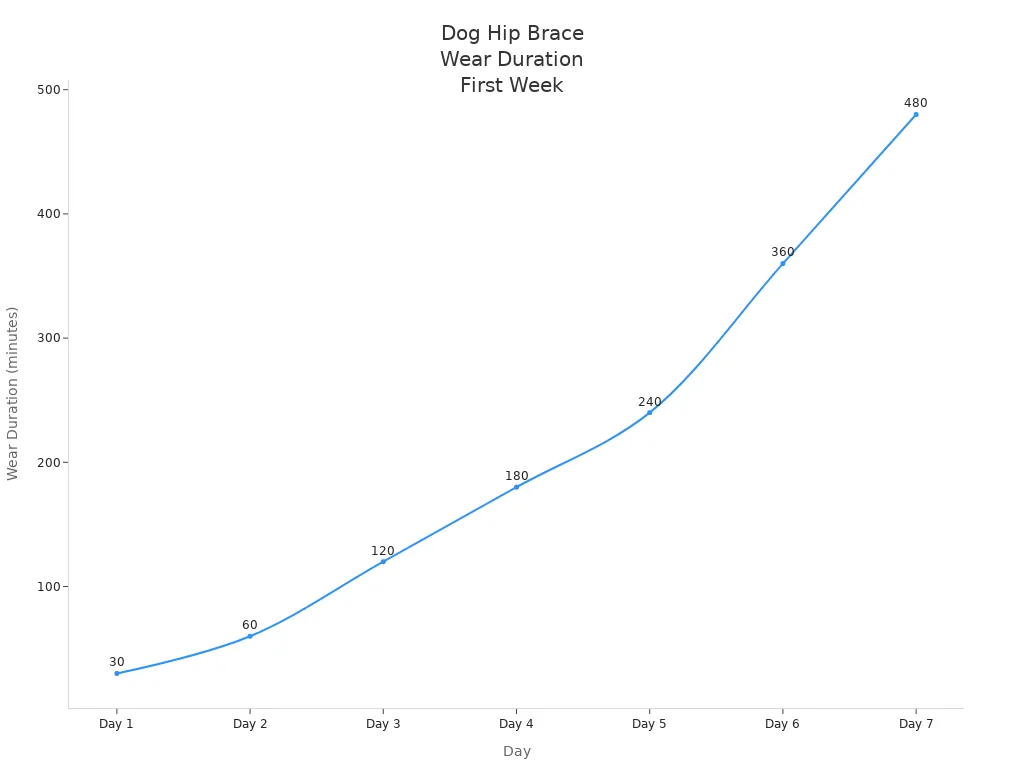
The first week should build tolerance gradually. A brace can support controlled movement, but it cannot protect a dog from overuse if the session is too long, too active, or poorly supervised.
| Day range | Wear approach | Pass signal | What to watch |
|---|---|---|---|
| Day 1 | Short indoor sessions only | Calm standing, short steps, normal skin | Stress behavior, slipping, groin rubbing |
| Days 2-3 | Several short supervised sessions | Comfortable walking and sitting | Chewing, hesitation, strap pressure |
| Days 4-5 | Controlled daily activity if earlier checks passed | Stable alignment during turns | Delayed soreness after removal |
| Days 6-7 | Gradual increase only with clean skin checks | Similar or better movement than earlier sessions | Fatigue, worse limp, skin heat |
| Night or unsupervised rest | Remove the brace | Skin can recover | Never use long rest time to force adaptation |
For most dogs, the break-in plan should move from quiet indoor wearing to short flat walks before normal routes. If you are also comparing support categories, hip brace fit and support needs should be matched to the dog rather than chosen only by how much structure the product appears to provide.
Fit and skin checks every time you remove the brace
Skin checks matter because pressure points often appear before the dog clearly acts painful. Look under the brace, around the groin, along the hip wrap, across the thigh, and under any belly strap after every session.
A good fit can reduce slipping and uneven pressure, but it cannot make an unsuitable support category safe. If a dog needs lifting help, neurological assessment, surgery discussion, or professional rehab, a strap adjustment is not enough.
- Check for redness, rubbing, swelling, heat, hair loss, or wet irritated skin.
- Compare both sides of the body when possible.
- Watch whether the dog sits, turns, and stands normally after removal.
- Record whether the brace slipped, twisted, pinched, or changed stride length.
Tip: Do not over-tighten a hip brace to stop movement. A brace should feel stable in use, but over-tightening can create rubbing, pressure, and a more guarded gait.
Hip brace, hip support harness, or lift harness?
A hip brace and a lift harness solve different problems. A brace may help some dogs during controlled walking, while a lift harness gives the handler immediate assistance for standing, stairs, car entry, and bathroom trips. For dogs with rear-end weakness, lift harness support for stairs and hind-leg weakness may be more practical than asking a brace to do lifting work.
| Support need | Better direction | Why it matters | Main limitation |
|---|---|---|---|
| Dog can walk but needs light hip-area support | Hip brace trial with supervision | May support controlled daily movement | Does not correct hip dysplasia or arthritis |
| Dog needs help standing, stairs, or car entry | Lift harness or assisted support | Handler support reduces the load of transfers | Requires active owner assistance |
| Dog has worsening pain or sudden function loss | Veterinary reassessment first | The problem may not be a fit issue | Product changes can delay proper care |
| Dog tolerates support but skin reacts poorly | Remove, adjust, and shorten sessions | Skin response sets the safe wear boundary | Repeated irritation means the plan must change |
If the dog has diagnosed hip dysplasia, the brace discussion should stay connected to the overall condition plan. home mobility support for hip dysplasia can be useful when it is paired with realistic expectations, weight management, controlled activity, and veterinary guidance.
Daily record: turn vague comfort into a decision
A short daily record helps you avoid guessing. Canine osteoarthritis staging and pain-management guidance both emphasize observable function, owner input, and response over time, not just a single moment of lameness.
| What to record | Why it matters | Decision use |
|---|---|---|
| Wear time and activity type | Shows whether problems follow longer or more active sessions | Shorten or slow the break-in plan |
| Skin after removal | Identifies pressure or rubbing early | Adjust, rest skin, or stop |
| Walking, sitting, turning, and rising | Captures function the owner can see at home | Continue only if movement stays comfortable |
| Brace position after movement | Shows whether fit holds during real use | Reposition or resize if alignment fails |
| Pain signs or refusal | Separates mild adaptation from a stop-use signal | Remove and contact the veterinarian |
For detailed fit, comfort, and safety checks across rehabilitation-style use, brace fit and comfort signals should be reviewed before extending wear time.
Stop-use signs that should not wait
Stop using the brace and contact your veterinarian or brace provider if your dog shows any red signal. These signs can mean the brace is irritating tissue, changing movement poorly, worsening pain, or hiding a problem that needs a different plan.
- Swelling, heat, open sores, hair loss, or skin that stays red after removal.
- Cold toes, paw dragging, sudden weakness, or a major change in coordination.
- Worse limping, yelping, guarding, trembling, or repeated refusal to walk.
- Chewing, frantic licking, or repeated attempts to remove the brace.
- Any new spine, knee, hock, or neurological sign that was not part of the original plan.
Disclaimer: A hip brace is a support tool, not a diagnostic test. If symptoms change quickly, get veterinary guidance before trying longer wear time or stronger tightening.
FAQ
How often should you check your dog’s skin with a hip brace?
Check your dog’s skin every time you remove the brace, especially during the first week, because early redness, rubbing, swelling, heat, or hair loss should change the next wear session.
Can a dog wear a hip brace overnight?
Most dogs should not wear a hip brace overnight or during unsupervised rest unless a veterinarian gives a specific reason. Night removal gives skin a recovery window and helps you notice irritation before the next session.
What means the brace should be adjusted instead of stopped?
Adjustment is reasonable when the issue is mild slipping, twisting, bunching, or a light rubbing line that fades after removal. Stop instead if the dog shows pain, swelling, heat, hair loss, worse lameness, cold toes, or refusal to move.
How do you know if the brace fits correctly?
The brace should stay aligned during short controlled movement, allow the dog to stand, sit, turn, and take short steps comfortably, and leave the skin looking normal after removal. A good fit supports movement but does not force the hip into a position or change weight-bearing awkwardly.
What if your dog refuses to walk with the brace?
Remove the brace, check skin and strap position, and try a shorter calm session only if there are no pain signs. If refusal continues or appears suddenly, contact your veterinarian before continuing.
Data authenticity note: This article is educational and product-side in nature. It does not replace diagnosis, treatment, rehabilitation planning, or advice from your own veterinarian.