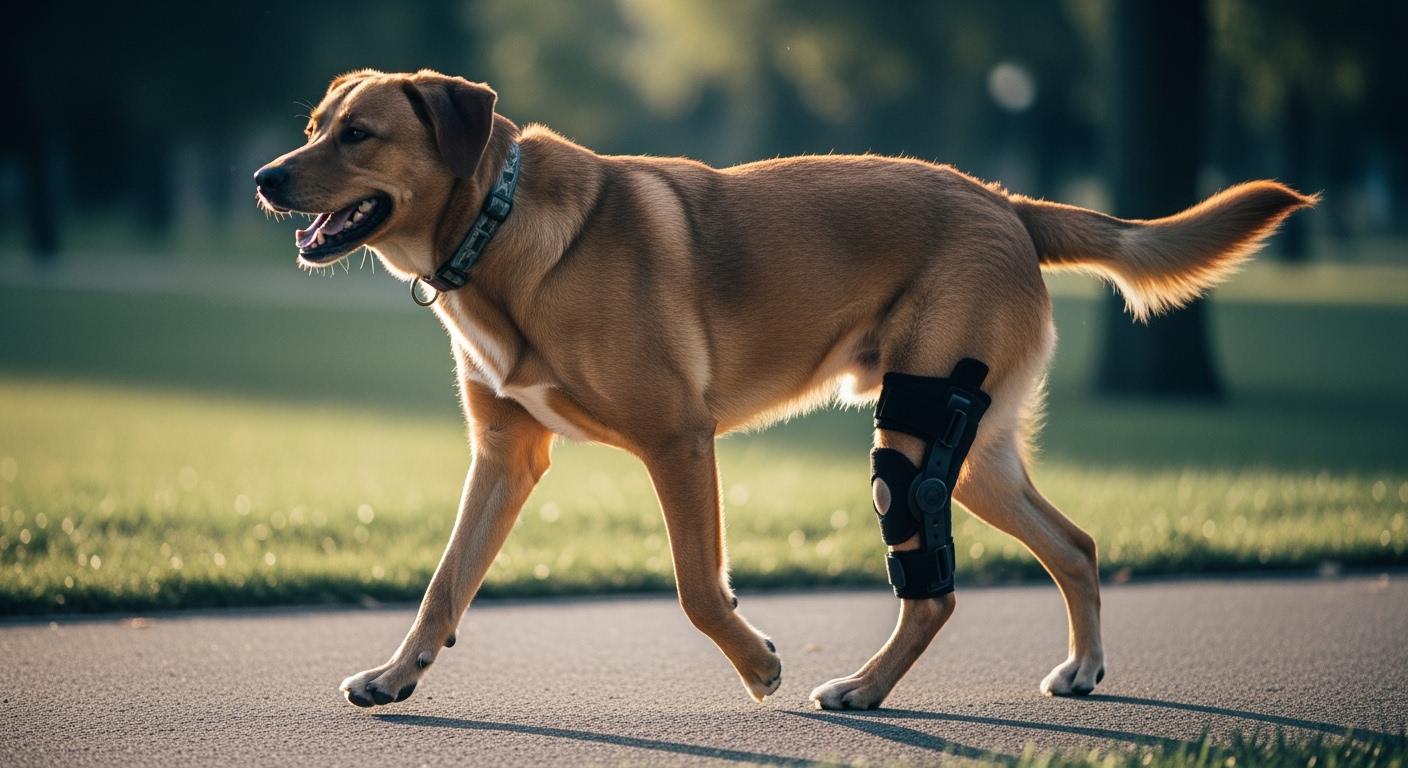
A dog knee brace can look supportive on a table and still fail on a dog. The brace slides down the leg after half a block. The straps bunch behind the knee. The hinge sits a quarter inch forward of where the joint actually bends. And the kneecap—the one thing the brace was supposed to stabilize—keeps drifting sideways. None of this is visible when the brace is first strapped on. It shows up in motion.
That gap between static appearance and moving performance is where most knee braces for luxating patella come apart. A brace has to do two things at once: stop the kneecap from slipping laterally and let the knee bend through a full stride. Most designs solve one and sacrifice the other. Understanding why—down to the strap width, hinge-axis placement, and panel material—is what separates a brace that supports daily movement from one that ends up in a drawer.
When a Knee Brace Slides or Rotates—the Most Common Failure
The most frequent complaint about knee braces for luxating patella is not that they lack support. It is that they will not stay where they were put. A brace migrates down the leg within minutes of walking. It rotates medially when the dog turns. By the time the walk ends, the side panel that was supposed to block lateral patellar movement has drifted off target entirely.
Why this happens is mechanical, not just a matter of tightening straps. When a dog walks, the thigh muscles expand and contract with each stride. A brace that relies on circumferential compression—pulling a sleeve or wrap evenly tight around the leg—has no mechanism to resist the directional forces of muscle movement. The leg changes shape underneath the brace. The brace, with no rigid anchor point, follows gravity and the path of least resistance downward.
The deeper problem is rotation. During a turn, the dog’s leg generates lateral force. A narrow strap, maybe three-quarters of an inch wide, presents a thin contact edge against the leg. That edge has almost no anti-rotation surface. Force concentrates along the strap border, the border rolls, and the entire brace twists with it. Once the brace rotates, the side stabilizer—if there is one—no longer lines up with the lateral side of the knee. The kneecap is unguarded.
This failure chain—compression loss leading to migration, then rotation, then patellar exposure—is the reason a brace that felt snug at the front door can be functionally useless by the corner. And it is observable. After a 10-minute walk on a flat surface, check whether the brace has shifted more than half an inch from its starting position relative to a bony landmark like the tibial crest. If it has, the fit or the strap configuration is not holding under real load.
A brace that slips and rotates does more than lose support—it creates new pressure points as the inner surface moves against skin that was not meant to bear load in that spot. Rubbing behind the knee, where straps pass through the flexion crease, tends to be the first place red marks appear.
Hinge Placement, Strap Width, and Why Side Panels Matter More Than Tightness
A knee brace for luxating patella is not primarily a compression device. It is a side-control device. The patella dislocates medially or laterally—meaning the force vector that matters is sideways, not circumferential. A sleeve that squeezes the leg evenly provides warmth and mild proprioceptive feedback. It does not create a directional barrier against patellar drift.
Three structural features determine whether a brace actually controls lateral patellar movement.
Hinge-axis alignment
The knee does not bend like a door hinge. In a dog, the stifle joint has a complex roll-and-glide motion with a shifting instantaneous center of rotation. A single-pivot hinge placed even half an inch forward or rearward of the true joint axis introduces a lever arm that fights the dog’s natural motion. The result is not subtle. The dog shortens its stride to reduce the conflict between the hinge path and the joint path. Over days, that compensation pattern becomes a limp—not from the underlying patellar issue, but from the brace itself.
The pass/fail check is straightforward: film the dog walking without the brace, then with it, from the side. If the stride length visibly shortens or the dog hesitates before fully extending the knee, the hinge position is probably off. A correctly placed hinge follows the knee rather than steering it.
Strap width and edge design
A strap that is less than an inch wide concentrates retention force along a narrow band. Under lateral load—when the dog turns or walks across a slope—that narrow band acts as a pivot line, not a stable anchor. Wider straps, particularly those with a contoured inner face, spread force across more skin surface area and resist edge-rolling. In production terms, a strap with a rolled or folded edge seam is more dimensionally stable through repeated load cycles than a flat-cut edge that softens and curls with moisture exposure.
The observable test: after removing the brace, look at the strap impression pattern on the leg. A clean, even impression that fades within 5 to 10 minutes suggests distributed pressure. A deep, red line that lingers longer points to concentrated edge loading—the strap is digging, not holding.
Side panel structure versus compression-only designs
A side-stabilized brace uses rigid or semi-rigid panels positioned along the medial and lateral sides of the knee. These panels create a physical boundary that the patella cannot cross, regardless of compression tightness. A knee brace built around side stabilization does not need to be cinched tight to control lateral drift—the panel geometry does the work. A compression sleeve, by contrast, must be tight enough to resist patellar movement through friction alone. That level of tightness often crosses into discomfort before it achieves meaningful control.
| Brace structure | What it supports | Where it can fail | Best-fit situation | Warning sign |
|---|---|---|---|---|
| Soft compression sleeve | Mild warmth, proprioception | Slides, rotates, no lateral patellar control | Grade 1, short-duration wear | Brace migrates, kneecap drifts |
| Strap-only knee wrap | Light circumferential support | Bunches, concentrated pressure, no tracking | Mild intermittent symptoms | Bunching behind knee, rub marks |
| Hinged side-stabilized brace | Lateral patellar containment, guided flexion | Stiff if hinge misaligned, rub at panel edges | Grade 1–2, active dogs | Shortened stride, hinge-area redness |
| Custom/semi-custom brace | Contoured fit, high lateral support | Rigidity limits sit/tuck, cost, break-in tolerance | Atypical leg shape, repeated off-the-shelf failure | Refusal to sit, swelling above brace edge |
The practical trade-off is consistent across designs: more lateral control tends to come with more structure, and more structure raises the stakes on fit precision. A side-stabilized luxating patella knee brace that matches the dog’s leg profile can provide directional patellar containment without excessive tightness—but the sizing step cannot be skipped or approximated.
When a Knee Brace Is Not the Right Fit
A knee brace is a mechanical support for a mechanical problem—the patella slips out of its groove. But not every patellar luxation presentation can be addressed with a brace, and forcing the issue tends to produce worse outcomes than no brace at all.
Braces are least likely to help when the luxation is Grade 3 or 4 and the patella spends most of its time out of the trochlear groove. At that severity, the soft-tissue structures that a brace relies on for passive stabilization are already stretched beyond their functional range. The brace can hold the patella in position only while the dog is static. Once the leg loads during walking, the forces overpower what external panels can contain. A dog that walks with a permanently dislocated patella may need a different approach—luxating patella support solutions that combine bracing with controlled exercise modification tend to have clearer use boundaries than brace-only approaches for advanced grades.
Dogs with angular limb deformities, very deep chests, or leg proportions far outside the breed norms that standard brace patterns are built around present a different category of risk. A brace patterned for a typical terrier leg will not distribute pressure evenly on a dog whose femur is externally rotated or whose tibial plateau angle is unusually steep. The fit checks described here—stride comparison, strap-impression assessment, migration measurement—may miss pressure points that develop only after an hour of wear on an atypical leg shape.
Disclaimer: If the dog’s leg conformation falls outside the breed norms this brace was patterned for—particularly dogs with angular limb deformities, very deep chests, or leg proportions that differ significantly from the standard size chart—the fit checks described in this article may not catch every pressure point. Hand-checking the skin under every strap and panel edge after the first 15-minute session, then again after 45 minutes, is the minimum precaution for non-standard leg shapes.
Other conditions rule out bracing regardless of fit quality. Open wounds, active skin infections, or dermatitis under the brace footprint make any enclosed support unsafe until the skin is intact. Dogs that cannot tolerate anything on the leg—not from poor fit but from temperament—will not habituate even to a well-fitted brace. And a brace worn during daily walking should be removed for extended rest, overnight, and any period when the dog is unsupervised. Continuous wear, even of a well-ventilated brace, traps moisture against the skin and creates the conditions for irritation that looks like a fit failure but is actually a wear-schedule failure.
| Signal level | What you see | What to do |
|---|---|---|
| Green — continue | Brace stays aligned after 10-minute walk, skin looks normal, dog walks with unchanged or improved stride | Continue supervised sessions, check skin and position after each removal |
| Yellow — adjust | Mild migration under half an inch, light redness that fades within 20 minutes, brief hesitation at walk start, dog mouths brace once or twice | Shorten session, reposition straps, recheck skin after next wear; if signs persist more than two sessions, reassess fit |
| Red — stop | Worsening limp, swelling, heat, redness lasting over 30 minutes, open skin, cold toes, refusal to bear weight, repeated chewing at brace | Remove brace, discontinue use, contact a veterinarian before reattempting |
FAQ
Can a knee brace replace surgery for a luxating patella?
A brace does not deepen the trochlear groove or reposition the tibial tuberosity—the two structural corrections most surgeries address. It provides external lateral containment. For Grade 1 and selected Grade 2 cases where the patella stays in the groove most of the time, bracing can reduce the frequency of dislocation episodes during activity. For grades where the patella is out more than it is in, bracing alone is unlikely to restore functional stability.
How long can a dog wear a knee brace in one session?
Start at 15 to 20 minutes on flat ground under direct supervision. If skin checks after removal show no marks lasting beyond 10 minutes and the dog moves without compensation, sessions can extend gradually to 45 to 60 minutes. The limiting factor is usually moisture buildup under the brace, not support fatigue. Remove the brace, dry the leg, and let the skin breathe between sessions.
What is the first sign that a brace is causing problems rather than helping?
A change in gait that appears only when the brace is on—most commonly a shortened stride, a stiffer knee, or reluctance to sit. These changes almost always precede visible skin damage. The dog compensates for discomfort in the brace before the skin shows marks. If the brace fit and slippage are not addressed at this stage, the compensation pattern can persist even after the brace is removed.
Does a side-stabilized brace work for both medial and lateral luxation?
Yes, because the side panels create containment in both directions. The patella is blocked from moving too far medially or laterally regardless of which direction it tends to dislocate. The key variable is panel placement relative to the patella’s resting position, which is why sizing and strap configuration matter more than the brace category label.
Why does my dog’s brace fit fine indoors but fail outside?
Indoor surfaces are flat and predictable. Outdoor movement adds turning, slope changes, speed variation, and uneven terrain—all of which generate the lateral and rotational forces that expose poor strap design and hinge misalignment. A brace that passes a living-room walk test can still fail in the conditions that matter. The outdoor walk is the real test.