
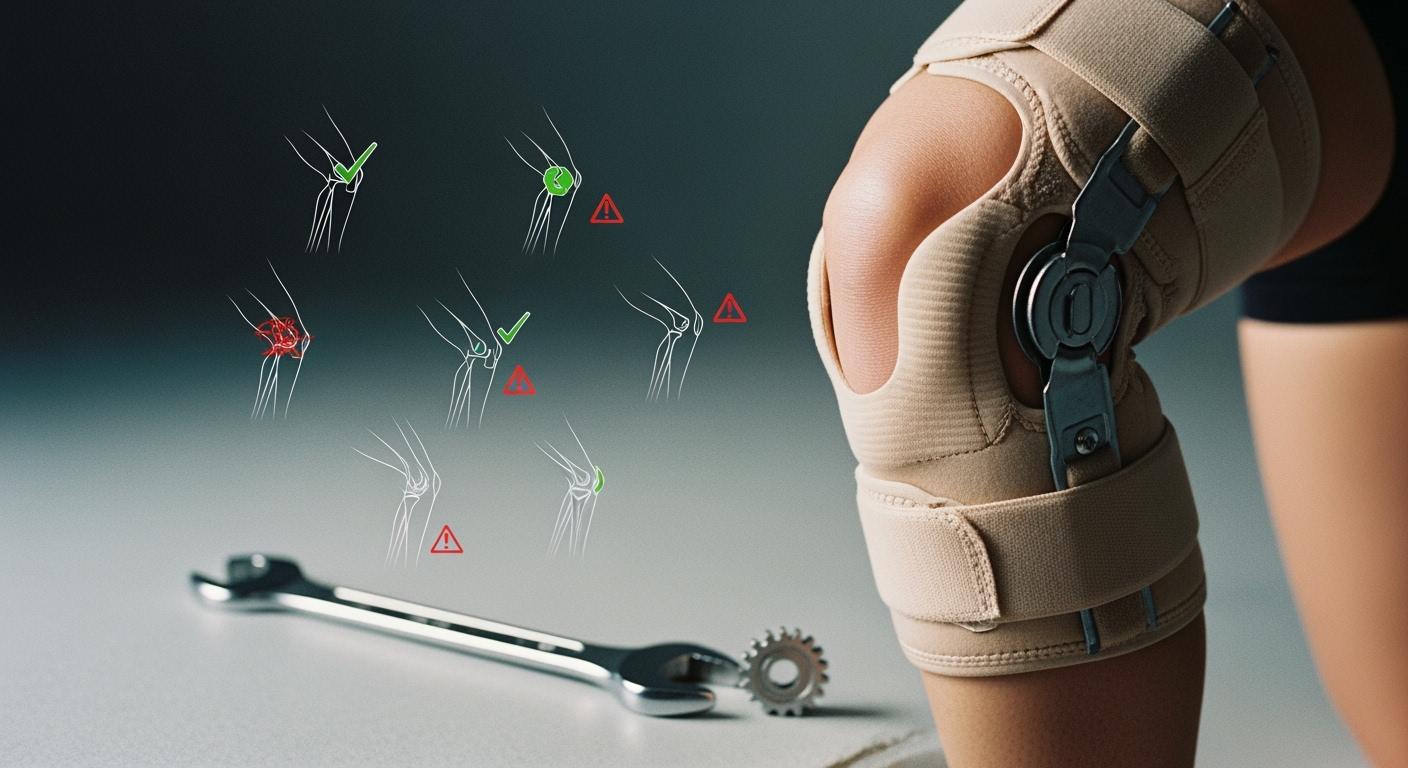
A luxating patella brace can feel reassuringly snug the moment you strap it on. Your dog stands steady. The knee looks aligned. And yet two hours later the dog will not sit. Will not climb a single stair. That gap between standing comfort and real-world failure is where most brace problems hide.
Why a Luxating Patella Brace Can Feel Supportive but Still Fail
Support is not useful if the knee cannot bend
Standing support is easy. Any sleeve with enough compression can make a knee feel stable while the leg is straight. The problem starts when the dog needs to flex the stifle to sit, climb, or turn. A brace that wraps tightly around the knee joint can feel secure in extension while blocking the 40-plus degrees of flexion those movements demand.
Here is why. A rigid or semi-rigid side panel that sits flush against the leg in extension creates a straight-line force path from thigh to calf. When the knee bends, that straight path breaks. The panel cannot shorten, so it resists the bend. Force concentrates at the panel’s top and bottom edges instead of distributing across the leg. The hinge — if there is one — takes the load off-axis. Within minutes the dog compensates: shorter strides, hip hiking, reluctance to sit. Within days the surrounding muscles stiffen. The brace has not failed structurally. It has failed functionally. It blocked the movement it was supposed to protect.
This is not a tightness problem. Loosening the straps does not fix a hinge placed half an inch above or below the femoral-tibial contact point. That hinge fights the knee’s natural arc every time the leg bends. The dog feels that fight and stops bending.
In practice: Watch your dog rise from a sit while wearing the brace. Hesitation, a sideways scoot, or using the other leg to push up all point to the brace resisting flexion — not the dog being uncooperative.
Why sitting, stairs, and turns expose what walking hides
Straight-line walking is the easiest test a brace faces. The knee moves through a narrow flexion arc. Side loads are near zero. A brace that drifts, bunches, or rubs during stairs and turns can look perfect during a hallway walk. That is why walking-only checks miss the failures that matter.
Sitting demands deep flexion. The brace must shorten along the back of the knee and stay flat against the leg. Material that bunches behind the stifle acts like a wedge — each sit cycle drives it into the soft tissue at the joint fold. Stairs add vertical loading on top of flexion. Turning introduces rotation; the brace must resist twisting while the femur and tibia rotate relative to each other.
You can verify fit quality in ten minutes. After the dog walks, sits, climbs one low step, and turns both ways, take the brace off. Run your fingers along the inside of the liner. Damp spots concentrated at the top and bottom edges of the side panels indicate edge pressure during flexion — the liner trapped moisture where the panel dug in. Dry and even across the whole surface means pressure distributed properly through the range of motion.
A structured movement check catches what casual observation misses:
- Static alignment. The brace sits above the stifle without drifting. Support bars align with the joint center.
- Flat-surface walk. Even stride length, no stiff stepping, no audible rubbing.
- Sit and rise. The knee bends without hesitation. No sideways sitting.
- One low step. The brace stays in position — no sliding below the stifle.
- Turn both ways. No twisting, no gapping at the top or bottom edge.
- Remove and inspect. Marks that fade within 20 to 30 minutes are normal. Marks that persist, swell, or feel hot are not.
Note: Swelling, heat, sharp pain, or refusal to bear weight means stop using the brace and contact your veterinarian immediately.
What a brace cannot fix
A brace does not reshape bone. It does not deepen a shallow trochlear groove or realign a tibial crest. What it can do — when the structure and fit are right — is provide external guidance that keeps the patella tracking within its groove during daily movement. That support is mechanical, temporary, and dependent on the brace staying in position.
For grade 3 or 4 luxations where the patella lives outside the groove, a brace provides surface-level containment at best. The underlying instability remains. Muscle atrophy can develop if the dog relies on the brace for structural support the leg muscles should provide. The decision path for luxating patella support narrows sharply as severity increases — the same hinge and strap configuration that helps a grade 1 case can mask worsening instability in a progressing grade 2.
Brace Structures That Help Without Blocking the Knee

Low-bulk support around the stifle
Bulk behind the knee is a flexion blocker. Every millimeter of material at the popliteal fold reduces the knee’s ability to close fully. Low-bulk designs trade blanket coverage for targeted support — they wrap the stifle without filling the joint crease. The practical difference: whether the dog sits fully or perches awkwardly with the leg extended.
Perforated neoprene and spacer-mesh liners serve two functions. They reduce bulk and they move moisture. A liner that holds sweat against the skin softens the epidermis and increases friction during movement. That friction becomes shear force at the skin surface every time the brace shifts. Low-bulk construction with a moisture-moving liner cuts both problems.
Stable thigh and calf anchoring
Anchoring determines whether the brace stays where you put it. The thigh above the stifle and the calf below it are the two anchor zones. If either zone sits on a tapered section of the leg — common in deep-chested breeds — the strap has no mechanical stop against downward migration. Each step pulls the brace a fraction of an inch lower. After ten minutes the hinge sits below the joint line and the patella pad presses on the tibial crest instead of the patella.
You can verify anchor stability directly. Mark the brace’s top edge on the fur with a small clip. Walk the dog for ten minutes. Check whether the brace edge has moved relative to the mark. More than half an inch of migration means the anchor geometry does not match this dog’s leg shape — strap tension alone is unlikely to fix it.
Wide straps with a slight contour that follows the muscle belly resist migration better than narrow, straight straps. The contour gives the strap a surface to push against when downward force hits it. A straight strap on a tapered leg has no such surface. The relationship between stifle anatomy and brace anchoring is where generic sizing charts fall apart — two dogs with the same stifle circumference can have completely different thigh tapers.
Soft edges and breathable padding
Edge finish is not a comfort detail. It is a pressure-distribution feature. A narrow edge concentrates force into a line. That line becomes a pressure point within the first hour of wear. Folded, padded edges spread the same force across a wider surface — the difference between a mark that fades in 20 minutes and a welt still visible the next morning.
The ventilation check is straightforward. After 20 minutes of wear, flip the liner back and touch the skin. Dry and cool means ventilation is working. Damp and warm means moisture is trapped — reduce wear time or look for a liner with higher vapor transmission.
Side support that stabilizes without over-compressing
Side panels guide the patella. They do not need to clamp it. Over-compression at the sides of the knee increases intra-articular pressure without improving tracking. The patella needs a path, not a vise.
The mechanism that matters is medial-lateral containment — keeping the patella from slipping toward the inside of the leg. A side panel that sits flush against the medial stifle provides that containment passively. It does not push. It blocks. When the quadriceps contract and pull the patella upward, the panel prevents medial excursion. The dog’s own muscle action tracks the patella; the panel sets the boundary. A luxating patella knee brace with contoured side panels uses the femoral condyle profile as the positioning reference — that contour determines whether the panel contacts the patella at the correct angle or digs in at the edges.
| Brace structure | Performance difference | Main limitation | Where it works |
|---|---|---|---|
| Soft compression sleeve | Warmth and light pressure; no directional control | Bunches behind knee during flexion; zero rotational stability | Mild intermittent luxation, short daily wear |
| Semi-rigid with side panels | Medial-lateral containment plus flexion freedom | Side panels shift if thigh anchor sits on a tapered section | Grade 1–2 luxating patella, active dogs |
| Rigid or hinged frame | Maximum positional control | Blocks deep flexion; hinge misalignment creates off-axis joint loading | Short-term post-injury stabilization only |
| Double knee configuration | Bilateral symmetry | Doubles the fit variables; one side failing stresses the other | Dogs with confirmed bilateral luxation |
More stiffness does not equal more protection. As structural rigidity increases, flexion freedom decreases. The right choice is the softest structure that provides adequate containment for the dog’s luxation grade and activity level. A dog that jogs off-leash needs different side-panel stiffness than a dog taking three short leash walks a day. When a knee brace slips or rotates, the cause is rarely insufficient tightness — it is usually a mismatch between brace structure and movement profile.
When to Stop Using a Luxating Patella Brace
Red signs after removal
Not every problem announces itself while the brace is on. Some show up only after you take it off. Post-removal inspection is the most important fit check — and the one most often skipped.
Persistent redness lasting more than 30 minutes means sustained pressure exceeded capillary refill in that area. The skin was compressed hard enough and long enough to restrict blood flow. Swelling at a pressure point means tissue fluid accumulated from mechanical irritation. Heat localized to one spot — not general warmth from insulation — signals inflammation. These are early-stage pressure injuries.
A worsening limp after brace removal carries a different warning. If the dog moves worse without the brace than before wearing it, the brace may have fatigued the stabilizing muscles or irritated the joint capsule.
- Sudden or worsening lameness after brace use
- Swelling or heat localized to one spot
- Redness lasting more than 30 minutes after removal
- Audible clicking or popping from the stifle
- Refusal to move or play after brace removal
Movement refusal and worsening limp during use
A brace that worked last week can stop working this week. Dogs gain or lose weight. Muscle mass changes. Coat thickness shifts seasonally. A fit that was acceptable in winter can loosen in summer. The brace has not changed but the leg inside it has.
When a dog that previously tolerated a brace starts planting, freezing, or lying down and refusing to rise, check whether the hinge position still matches the joint line. Palpate the stifle with the brace on. Find the joint space between femur and tibia. Compare it to the hinge center. A shift of half an inch changes the loading pattern entirely.
| Signal | What you see | Action |
|---|---|---|
| Green | Dog walks, sits, turns, rises without brace drift; skin marks fade within 20–30 min | Continue use, maintain daily checks |
| Yellow | Mild hesitation, light rubbing, brace drift under half an inch, redness fading in 30–60 min | Adjust fit, reduce wear duration, recheck next session |
| Red | Refusal to bear weight, swelling, heat, sharp pain, skin breakdown, worsening limp | Stop brace use, contact your veterinarian |
When another plan may be safer
Bracing has a use boundary. Grade 1 and mild grade 2 luxations often respond to external support combined with muscle conditioning. But when the patella dislocates multiple times per day, when the dog holds the leg up for steps at a time, or when conservative management has been tried for weeks without improvement — the brace is no longer the right tool. This is not a design failure. External support cannot substitute for internal joint stability when the structural deficit exceeds what a passive device can compensate for. The line between mild and severe luxating patella cases is not always obvious — a dog that walks normally on flat ground may still have a patella that spends most of its time out of the groove.
Disclaimer: The fit checks and pressure-point inspection methods described here assume a short-coated dog where skin is visible and accessible. Double-coated breeds may hide rub marks under dense fur — hand-checking by running fingers along the skin surface under the coat at each anchor point and panel edge is necessary rather than relying on visual inspection. For dogs with angular limb deformities, very deep chests, or leg conformation that falls outside typical breed norms, the anchor-position and hinge-alignment checks described may not catch every pressure concentration — these dogs need individualized fit assessment that accounts for their specific skeletal geometry.
FAQ
How do you know if the brace fits correctly?
The dog walks, sits, rises, and turns without limping, hesitation, or brace drift. After removal, any marks on the skin fade within 20 to 30 minutes. If the dog sits sideways, refuses to bend the knee, or the brace shifts below the stifle after movement, the fit is not working — regardless of what the size chart says.
Can a dog wear a luxating patella brace all day?
No. Start with 15 to 30 minutes and increase gradually over a week. Remove the brace at night. Twice-daily skin checks are not optional — pressure injuries develop faster under a brace than on exposed skin because moisture and friction combine with sustained contact. The goal is intermittent support during activity, not continuous immobilization.
What does it mean if the dog refuses to move with the brace on?
It almost always means flexion is blocked, a pressure point has formed, or the hinge is loading the joint off-axis. Stop use immediately. Inspect the leg for swelling, heat, or persistent redness. Try the ten-minute anchor-drift check: mark the brace position, walk the dog, measure the shift. More than half an inch of migration means the anchoring geometry does not fit this dog.
What makes brace fit fail over time even when it starts out right?
Weight change, muscle gain or loss, seasonal coat shifts, and liner material fatigue all alter the fit. A neoprene liner that compresses permanently after weeks of use provides less fill in the anchor zones. The straps reach the same notch but the limb inside is different. Regular fit reassessment for patellar luxation braces — not just initial sizing — catches this drift before it becomes a pressure injury.
