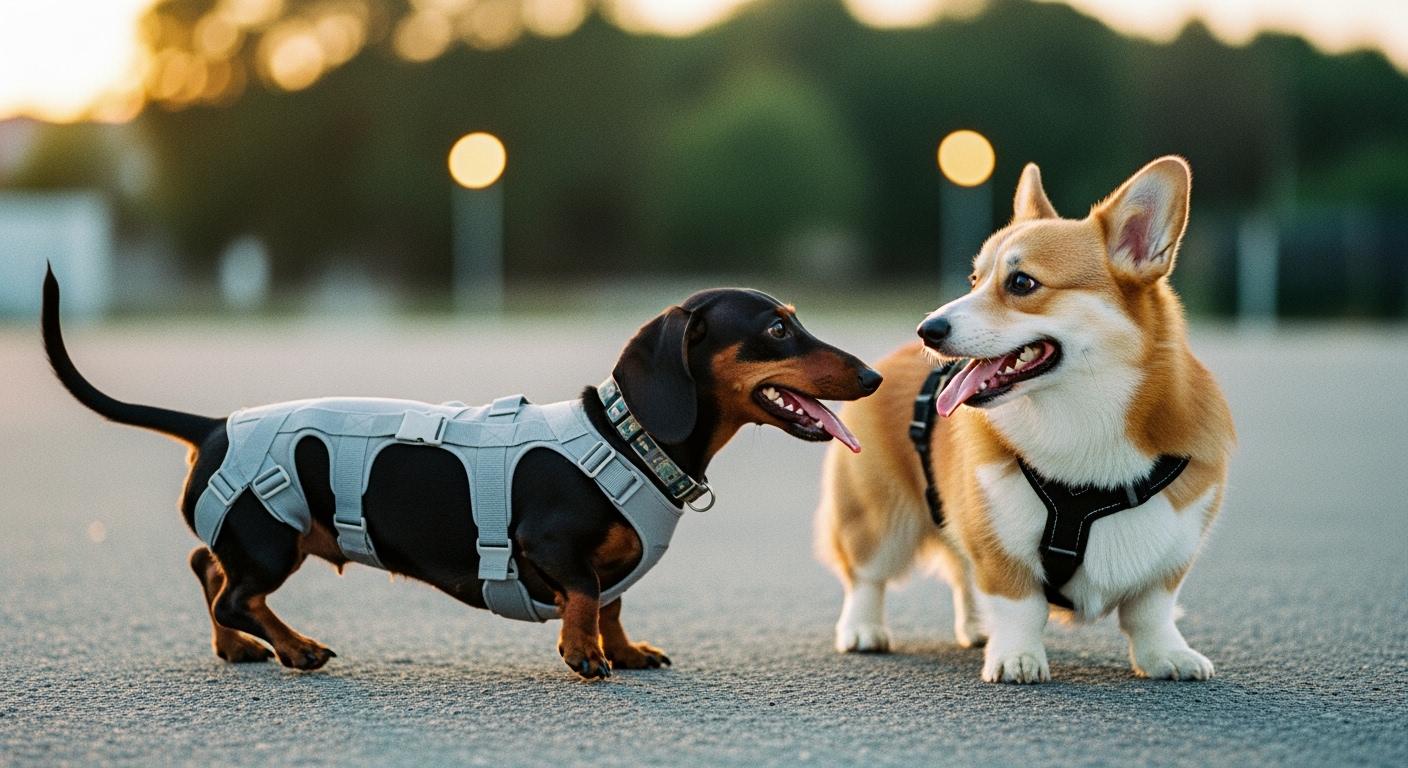
You put the brace on your Dachshund. It centers. The straps feel snug. Ten steps later the panel has drifted toward the hips, the chest strap has rolled into a cord, and fabric is bunched into a ridge behind the shoulders. The brace is not staying where the spine needs it. That is not a sizing mistake. It is a structural mismatch between a short, generic panel and a back built long and low.
A back brace fails on a long-backed dog for reasons that have nothing to do with whether the circumference measurement was correct. The failure is mechanical: when the panel does not span enough vertebral segments to create a stable anchor, any lateral force from turning, sitting, or shifting weight rotates the brace around its narrowest contact point. That rotation moves support away from the spine and concentrates pressure where the straps cinch tightest. Understanding that chain is what separates a brace the dog tolerates from one the dog resists.
Why a Back Brace Slides, Rotates, or Bunches on a Long-Backed Dog
The first fit check most owners do is wrong. They measure the chest, match a size chart, and assume the brace will stay where they placed it. On a long-backed body, chest circumference has almost no relationship to whether the panel will anchor across the thoracic and lumbar spine. A Dachshund’s back can measure nearly two-thirds of its total body length from shoulder to hip, yet most standard brace panels cover less than half that span. The gap between panel coverage and the actual vertebral column length is where every major fit failure begins.
A long back shortens the effective anchor zone
Standard braces are patterned on a proportional body — a roughly square torso where the distance from shoulder to last rib is comparable to chest depth. On a Dachshund or Corgi, that ratio does not hold. The back runs long, the chest drops deep, and the distance from the shoulder blades to the hip point is unusually extended. When a short panel sits across only the mid-thoracic region, the brace has no mechanical purchase on the lumbar spine behind it or the shoulder girdle in front. A brace that anchors across too few vertebral segments cannot resist rotation — the panel acts like a short lever arm, and any twist from the dog’s gait applies torque the anchor cannot counter.
Here is what that looks like in daily wear:
| What happens | Why it happens | What it does to support | Pass signal | Fail signal |
|---|---|---|---|---|
| Brace slides toward hips | Panel too short for vertebral span, anchor zone too narrow | Exposes thoracic and lumbar vertebral segments | Panel stays centered after 20 steps, a sit, and a turn | Panel shifts more than half an inch toward the tail within 2 minutes of walking |
| Fabric bunches behind shoulders | Soft unstructured panel folds under compression when dog lowers head or sits | Creates a ridge that rubs skin and gaps the spinal contact line | Panel lies flat along the spine line after sitting and standing 3 times | Visible ridge of folded material behind shoulder blades after one sit-stand cycle |
| Straps dig into chest and belly | Narrow webbing concentrates tension along a thin line with no load distribution | Pressure points cause skin marks, redness, and brace avoidance behavior | After 30 minutes, skin under straps shows no indentations lasting more than 2 minutes | Red lines, hair compression rings, or dog flinches when strap area is touched |
| Panel lifts away from spine during turns | Poor contour match to the dorsal curve; brace patterned on a flatter-backed body | Support contact breaks during lateral movement when support is needed most | Panel remains in contact with the spine line through a full walk-turn-sit sequence | Visible air gap between panel and coat when dog turns or curves body |
Narrow straps cannot resist lateral rotation
Here is the mechanical chain that matters. A strap that is 0.75 inches wide contacts the dog’s body along a thin line. When the dog turns, lateral force vectors push sideways against the brace body. The narrow strap has almost no surface area perpendicular to that lateral force, so the force concentrates along the strap edge. The edge rolls. Once the strap edge rolls, its effective width halves, the roll propagates along the strap length, and the entire brace rotates. A 1.5-inch strap distributes the same lateral force across roughly four times the resisting surface area because both edges contribute to anti-rotation stability. This is not a comfort preference. It is a structural difference that determines whether the brace stays aligned through a full gait cycle or drifts with every step.
You can observe this yourself. After walking the dog for 10 minutes on a slight incline — which forces more lateral weight shift — check whether the strap edges have rolled inward toward the buckle line. Rolled edges mean the lateral load exceeded the strap’s anti-rotation capacity. The brace has already begun to fail.
What Panel Length, Anchor Width, and Strap Design Change in Daily Wear
The difference between a brace that fails and one that holds is not about brand. It is three structural decisions at the pattern and material level, each determining how force moves through the brace during real use.
Longer shaped panels span enough vertebrae to resist rotation
A panel that runs from the shoulder girdle to the hip point engages more vertebral segments as anchor surface. That longer contact path creates a longer lever arm for anti-rotation — the same physics that makes a wide-stance tripod harder to tip than a narrow one. For a Dachshund, that means the panel needs to cover roughly 70 to 80 percent of the distance from scapula to iliac crest, not the 50 to 60 percent that a standard proportional pattern delivers. A brace pattern built for spinal support on long-backed bodies starts with that extended dorsal panel as the primary structural element, not an afterthought added to a generic size run.
The observable check is straightforward. Put the brace on, walk the dog 15 steps, then run your fingers along the spine line from shoulders to hips. You should feel panel material, not coat, the entire length. If your fingers find bare coat at either end, the panel is too short for this body.
Wider anchor zones replace pressure lines with load distribution
A chest-and-belly anchor that wraps across 3 to 4 inches of torso surface area spreads the same retention force that a narrow strap concentrates into a thin line. The wider anchor resists edge rolling under lateral force, reduces the per-square-inch pressure on the skin, and keeps the brace from pivoting when the dog transitions from walking to sitting — a movement that shifts the chest profile and changes strap tension dramatically on narrow straps. This matters most during the sit-to-stand transition, where the shift between spinal support and lift-assisted movement can expose fit gaps that were invisible during static standing.
Adjustable tension without fixed pressure bands
Fixed elastic bands or single-position buckles apply one level of tension regardless of what the dog is doing. That tension might be correct while the dog stands square on a level floor and completely wrong when the dog curls up to rest or stretches into a downward-dog posture. Adjustable strap systems let tension track the dog’s position — looser during rest, snugger during movement — without creating the hard pressure rings that fixed bands leave after an hour of wear.
After the first 30-minute session, remove the brace and check the skin under every strap line. Marks that fade within 2 minutes are acceptable. Marks that hold shape for 5 minutes or longer mean the tension at that strap is exceeding what the tissue can tolerate — reduce it at the next session or redistribute the load to a wider contact surface. A brace built with distributed anchor panels tends to leave shallower strap impressions under the same retention force compared to narrow-strap designs.
| Design detail | What fails in daily use | What holds up | Main limitation |
|---|---|---|---|
| Back panel length | Short generic panel; lumbar spine left uncovered | Extended panel shaped to span shoulder-to-hip on long-backed breeds | Extended panels add material weight; may retain more heat in warm climates |
| Chest and belly anchor | Narrow strap; rolls under lateral force, creates pressure lines | Wide contoured anchor zone; distributes load, resists edge rolling | Wider panels require more precise contour matching to avoid gapping at the sternum |
| Strap system | Thin webbing with single fixed buckle; one tension fits all positions | Wide padded straps with adjustable tension; tension tracks dog position changes | More adjustment points mean more points to check during a fit routine |
| Edge finish | Raw or rough binding; rubs skin during lateral movement | Smooth bound edges; no abrasive contact even when brace shifts slightly | Smooth binding adds a production step; not all edge materials maintain softness after repeated washing |
| Panel structure | Unstructured soft fabric; folds and bunches under compression | Firm contoured panel with enough rigidity to hold spinal line without folding | Firmer panels feel less forgiving during initial wear-in; gradual introduction necessary |
When a Back Brace Is Not the Safer Choice
A brace can support the spine during controlled movement. It cannot stabilize an actively deteriorating disc, restore lost nerve function, or replace crate rest when a disc episode is acute. Knowing when to stop using the brace is as important as knowing how to fit it.
Pain, weakness, or nerve signs need veterinary care
If the dog shows sudden hind-leg weakness, knuckling of the paws, loss of coordination, collapse, or loss of bladder or bowel control, the brace is not the intervention. These are signs of a neurological event, not a mechanical support gap. Remove the brace immediately. A veterinarian needs to assess disc compression, nerve involvement, and whether medical or surgical intervention is indicated. The distinction between when a brace helps and when it delays necessary care is not always obvious in the first few hours of a flare-up — err on the side of a vet exam if any neurological sign appears.
When strict rest or a lift harness fits the situation better
During a confirmed acute disc episode, 3 to 6 weeks of strict crate rest is often the core of the recovery plan. In that window, a back brace may add pressure to inflamed tissue or mask the dog’s pain signals by restricting movement that would otherwise tell you the disc is not ready for activity. A lift harness used only for bathroom breaks can provide the limited support needed during rest periods without the continuous pressure and heat retention of a full back brace. The brace becomes useful later — after the acute inflammation resolves and the goal shifts to controlled, supported movement during rehab.
Stop-use signs during brace wear
Remove the brace and do not reapply it the same day if you observe any of the following:
- Redness, sores, or hair loss under any strap or panel edge
- Swelling or heat where the brace makes contact
- Labored breathing, panting that starts only when the brace is on, or new anxiety behaviors
- Any new weakness, dragging, or loss of coordination that appears while the brace is worn
- The dog freezing, refusing to move, or repeatedly trying to rub the brace off against furniture
Disclaimer: The fit checks and failure signals described here assume a short-coated dog where skin contact is visible and strap impressions are easy to read. Double-coated breeds may show subtler rub marks beneath the undercoat — hand-check by parting the coat and feeling for heat or tenderness along strap lines rather than relying on visual inspection alone. If the dog’s leg or spinal conformation falls outside typical breed norms — particularly dogs with angular limb deformities or unusually deep chests relative to back length — the fit checks described here may not catch every pressure point. In those cases, a shorter initial wear session of 10 to 15 minutes with a full skin inspection afterward is the safer starting point.
FAQ
How do I know if the back brace panel is long enough for my Dachshund?
Run your fingers along the spine line from shoulder blades to hip points while the dog stands. The panel should contact coat the entire distance. If your fingers find bare coat at either end — particularly at the lumbar region near the hips — the panel span is too short. A gap at the lumbar end is the more dangerous one because it leaves the lower spine unsupported where disc loads are highest during sitting and turning.
Can a dog wear a back brace all day?
No. Extended continuous wear traps heat, restricts the skin’s ability to breathe, and can mask developing pressure points until they become sores. A reasonable starting schedule is 2 to 4 hours of supervised wear followed by a full skin check, with at least an equal rest period between sessions. Remove the brace at night and any time the dog is crated unattended.
Will a back brace cure IVDD?
A back brace will not cure intervertebral disc disease. It provides external mechanical support that can limit spinal movement during daily activity and rehab. The underlying disc condition requires veterinary management — medication, rest protocols, weight control, and in some cases surgery. The brace is a support tool within that larger plan, not a standalone treatment.
What is the difference between a back brace and a lift harness for a dog with spine issues?
A back brace wraps the torso and limits spinal flexion and extension during movement. A lift harness provides a handle or strap system for the owner to take weight off the hind legs during transfers, stairs, or short walks. They serve different moments: the brace for controlled spinal support during independent movement, the harness for owner-assisted weight relief when the dog cannot bear full hind-leg load. Many rehab plans use both at different stages.
How do I clean a dog back brace without damaging the structure?
Hand wash in cool water with mild detergent. Do not wring or twist the panel — squeezing deforms structured panels and can crack internal stays if present. Press water out between towels, reshape the panel to its intended contour while damp, and air dry away from direct heat. Machine washing and machine drying degrade edge binding, shrink neoprene layers, and loosen strap stitching over time.