A dog elbow brace for dysplasia can slip, rotate, or leave deep marks even when it looks like it should stay put. The problem is rarely the dog. It is the gap between how a brace holds on a standing dog and what happens the moment that dog takes a step. A brace that shifts under load does not just lose support — it creates uneven pressure that concentrates at the strap edges, the hinge housing, or wherever the shell drifts off the joint axis. Understanding which design details control that shift is what separates a brace that works from one that causes new problems.
Where the Support Fails First — Slipping, Rotation, and the Alignment Problem
Most elbow brace failures trace back to two mechanical events that happen within the first few minutes of movement. Neither is visible at rest.
The first is anchor drift. When a dog bears weight, the upper arm and forearm rotate relative to each other around the elbow’s axis. A strap anchored above and below the joint must resist the torsional force that tries to twist the brace around the leg. Narrow straps concentrate that resistance along a thin contact line. Under side load — the kind generated every time a dog turns or shifts weight laterally — the strap edge acts as a pivot. The brace rotates. Once it rotates more than a few degrees, the support structure no longer aligns with the joint it is meant to stabilize.
The causal chain is straightforward. Lateral force enters the brace shell → transfers to the nearest strap edge → the narrow strap lacks anti-rotation surface area → the edge rolls → the entire brace shifts → the hinge or support panel drifts off the elbow axis → joint loading becomes asymmetric. What started as a support tool becomes a lever arm pressing into one side of the joint.
The second is hinge-axis offset. The canine elbow is not a simple hinge. It has a humeroulnar articulation that restricts motion to the sagittal plane, collateral ligaments that block lateral movement, and an anconeal process that locks into the olecranon fossa for rotational stability. A brace hinge that sits even a half-inch forward or behind the true elbow axis does not just track poorly — it introduces a bending moment the joint was never designed to absorb. The dog compensates by stiffening the entire limb, which changes gait and shifts load to the shoulder and carpus.
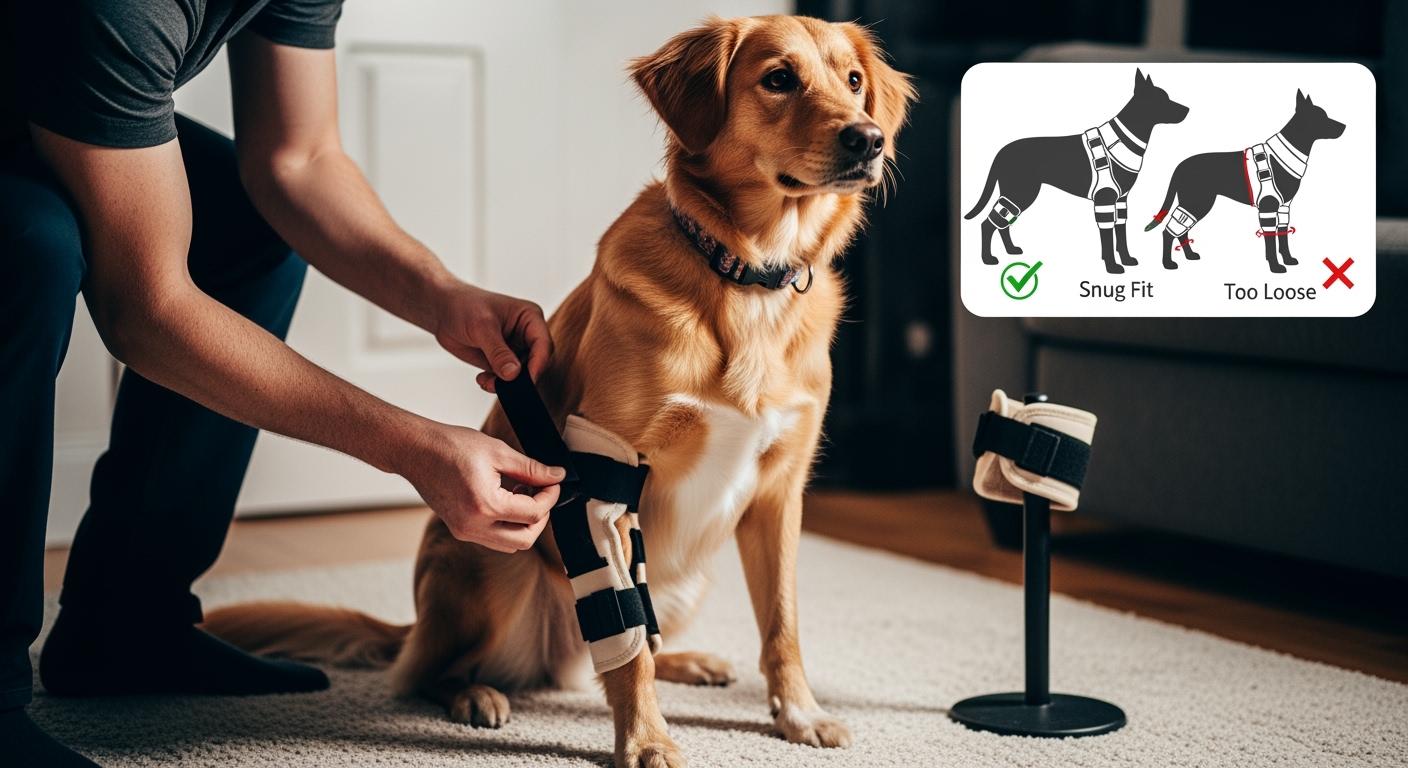
You can verify both problems without special equipment. After 10 minutes of leash walking, check whether the brace has shifted more than half an inch from its starting position. Then run a finger along the inside of the brace shell where it contacts the leg — warmth concentrated on one side signals uneven pressure from axis misalignment, not just normal wear heat.
| Real-use problem | Likely product reason | Pass signal | Fail signal |
|---|---|---|---|
| Brace slides down | Weak upper anchor, strap lacks grip surface | Brace stays within 0.5 in of start position after 10 min walking | Brace drops visibly, top edge sits below original mark |
| Brace rotates outward | Narrow straps, smooth inner lining, no anti-rotation panel | Strap orientation unchanged after turning and sitting | Closure buckles migrate to the side or front of the leg |
| Dog walks stiffly | Hinge offset from elbow axis, shell too rigid for the dog’s elbow arc | Dog bends elbow naturally at walk and trot | Leg swings as a straight unit, shoulder hikes |
| Strap edges leave deep marks | Strap width under 1 in, padding too thin or compresses fully under tension | Skin shows even color after brace removal, no indentations lasting over 5 min | Red lines with defined edges, indentations persist beyond 10 min |
| Elbow point does not match brace bend | Brace shaped for a different elbow angle or sized without bend measurement | Elbow point sits centered in the brace’s flex zone | Elbow visible above or below the brace’s intended bend point |
| Padding traps heat or moisture | Closed-cell foam, non-wicking liner fabric | Skin dry and cool to touch after 20 min wear | Skin damp, warm, or red under the padding contact area |
Reading this table against a specific brace takes about 15 minutes of observed use. The signals are concrete: position, warmth, marks, gait. If two or more fail signals appear, the brace’s design is not matching the dog’s movement pattern, regardless of how secure it felt when first strapped on.
Anchor Design, Hinge Placement, and Padding — Three Variables That Control Real-World Performance
Anchor geometry determines whether the brace stays where it was strapped
A strap that wraps perpendicular to the limb provides circumferential tension but almost no resistance to rotation. When the dog plants the leg and rotates the body, the force vector has a lateral component that acts across the narrowest dimension of the strap. A thin strap edge has nothing to push against — the edge rolls, and the brace follows. Wider straps, especially those with a structured inner panel that contacts the limb across a broader surface, create a rotational resistance plane. The force distributes across the panel width instead of concentrating at the edge.
This is why a dog elbow brace with multi-point upper and lower anchoring tends to hold position better than a single-strap design. The anchor points create a triangular force distribution — upper strap, lower strap, and the brace body itself form three contact zones that resist rotation in more than one plane. A single-strap design has one axis of resistance. When force enters off that axis, nothing stops the turn.
After a walk, mark the strap position with a small piece of tape. Come back after the dog has sat down and stood up three times. If the tape has moved relative to the fur beneath it, the anchor geometry is insufficient for that dog’s movement pattern.
Hinge placement is more important than hinge strength
A strong hinge in the wrong position amplifies the problem it is meant to solve. The elbow’s axis of rotation runs through the humeral condyles — a line that is roughly perpendicular to the long axis of the humerus. A brace hinge that sits anterior to this line pulls the joint into extension. One that sits posterior forces flexion. Either introduces a bending load the collateral ligaments must resist, which they are not structured to do over repeated cycles.
The manufacturing implication is that hinge placement must be keyed to bend measurement, not just limb circumference. Two dogs with the same girth can have elbow axes that differ by half an inch or more depending on breed conformation. A front-leg support solution that accounts for this variation — through adjustable hinge positioning or shell geometries matched to breed categories — reduces the likelihood of axis mismatch compared to a one-shape-fits-all hinge location.
A correctly placed hinge tracks the elbow through its range without the dog fighting it. You can observe this by watching the brace shell during a slow sit: the hinge should stay centered over the elbow point through the entire motion. If the shell lifts away from the leg or presses harder at the extremes of the movement, the hinge axis and the joint axis are not aligned.
Padding that compresses fully under load is not padding
Padding serves two mechanical functions: pressure distribution and shear isolation. When a brace shifts slightly during movement — and all braces shift slightly — the padding layer should absorb that micro-movement at the fabric-skin interface rather than transmitting it as friction. Open-cell foams and wicking liner fabrics handle this better than closed-cell foams, which compress to a hard stop and then transmit force directly. Closed-cell foam also traps moisture, which softens the skin and makes it more vulnerable to friction damage over wear sessions longer than 30 minutes.
An elbow support guide focused on daily wear typically emphasizes that padding condition is as important as strap tension. Foam that has taken a permanent set — compressed and failed to rebound — creates hard spots that concentrate pressure exactly where the brace needs to distribute it most evenly.
The observable check: press a finger into the padding after the brace has been worn for 20 minutes. It should spring back within 2–3 seconds. If the depression stays, the foam has bottomed out and is no longer distributing pressure. Replace the liner or the brace.
| Performance Difference | Why it matters | Main limitation | Where it works |
|---|---|---|---|
| Soft sleeve — light compression, full skin coverage | Protects against calluses and hygromas without restricting movement | Zero rotational control; slips under any lateral load | Mild elbow calluses, pressure sore prevention during rest |
| Strap-only wrap — simple compression, quick adjustment | Easy to apply and remove for short controlled sessions | Rotates if strap width is under 1 in or fabric lacks grip backing | Short-duration use where constant supervision is possible |
| Reinforced brace — structured shell, multi-point anchors | Controls rotation and limits joint movement within a safe range | Hinge must match elbow axis precisely or the brace introduces new loading | Dysplasia-related instability where rotational control matters |
| Hinged brace — articulating joint, movement control | Follows elbow bend when aligned correctly | Poor fit or axis mismatch causes rubbing, stiffness, or refusal | Elbow dysplasia with measurable instability during weight-bearing |
| Padded washable brace — wide pressure distribution, replaceable liners | Spreads load and reduces skin breakdown during longer wear | Heat buildup if liner is closed-cell or non-breathable | Daily tolerance for dogs needing extended support hours |
When an Elbow Brace Is Not the Right Tool

An elbow brace is a mechanical support tool. It is not a replacement for veterinary care, and it has clear use boundaries. Crossing those boundaries turns a support device into a source of harm.
Stop use immediately if the dog shows any of the following: new or worsening lameness, swelling or heat around the elbow, sores or raw skin under any contact point, cold toes or a paw that feels cooler than the other three, repeated chewing at the brace, or complete refusal to bear weight. These are not “break-in period” signals. They indicate the brace is causing tissue damage, nerve compression, or circulatory restriction.
A brace that fits well on a standing dog can still fail when the dog moves. The fit checks described above — position tracking, warmth distribution, padding rebound — must be repeated daily. Conditions change. A dog that loses muscle mass in the affected leg changes the geometry the brace was fitted to. A liner that compresses over multiple wear sessions changes the pressure distribution. What worked last week may not work today.
Not every elbow problem calls for the same brace category. A soft sleeve serves a different purpose than a structured brace — one protects, the other controls. Using a hinged brace for mild callus protection is over-engineering that adds weight and heat without benefit. Using a soft sleeve for rotational instability leaves the joint unprotected against exactly the movement pattern that causes pain. The distinction between elbow and carpal support matters equally — a brace designed for the wrist cannot stabilize the elbow, and attempting that substitution places the hinge in entirely the wrong anatomical position.
For dogs with arthritis-driven elbow pain rather than instability-driven dysfunction, the performance priorities shift. A brace that prioritizes warmth and light compression may serve better than one built for maximum rotational control. The same brace design can succeed for one condition pattern and create problems for another.
Disclaimer: The fit checks described here assume a short-coated dog where skin and strap position are visible without parting the coat. Double-coated or very thick-furred breeds may show subtler rub marks that require hand-checking rather than visual inspection — run fingers under every strap edge and along the full inner shell contact area. If the dog’s leg conformation falls well outside the breed norms this brace category was patterned for — particularly dogs with angular limb deformities or very deep chests that alter front-leg loading angles — the position-tracking and pressure-distribution checks described here may not catch every pressure point. In those cases, more frequent skin checks and shorter initial wear sessions are warranted.
FAQ
Why does the brace stay in place at rest but slide during a walk?
Static fit and dynamic fit are different measurements. At rest, only gravity and strap tension act on the brace. During walking, the leg generates torsional and lateral forces with every stride and turn. If the straps lack enough surface area to distribute these forces — particularly lateral forces that hit the narrow edge of the strap — the brace rotates or slides. A brace that passes a standing fit check but fails a 10-minute walking check has an anchor geometry problem, not a sizing problem.
How can I tell if the hinge is aligned with the elbow or just looks like it is?
Watch the dog perform a slow sit. The brace hinge should stay centered over the bony point of the elbow through the entire motion. If the shell lifts away from the leg at the top or bottom of the movement — or if the dog hesitates, stops mid-sit, or shifts weight to the other leg — the hinge and the joint axis are not tracking together. No amount of strap tightening fixes axis misalignment.
Can a soft sleeve provide enough support for elbow dysplasia?
A soft sleeve provides compression and skin protection. It does not control rotation or limit joint range of motion. For mild elbow irritation, callus prevention, or light compression during rest, a sleeve can be adequate. For dysplasia-related joint instability — where the elbow shifts laterally under load — a sleeve offers no mechanical resistance against that movement. The support type must match the specific failure mode the joint exhibits.
How often should fit be rechecked once a brace seems to be working?
Daily. A brace that fit correctly last week can become problematic if the dog’s leg muscle mass changes, the liner compresses, or the dog’s movement pattern adapts — which it often does as the dog learns to compensate for the brace itself. The position-track test and padding-rebound check described above take under two minutes and catch most problems before skin damage or gait changes appear.