
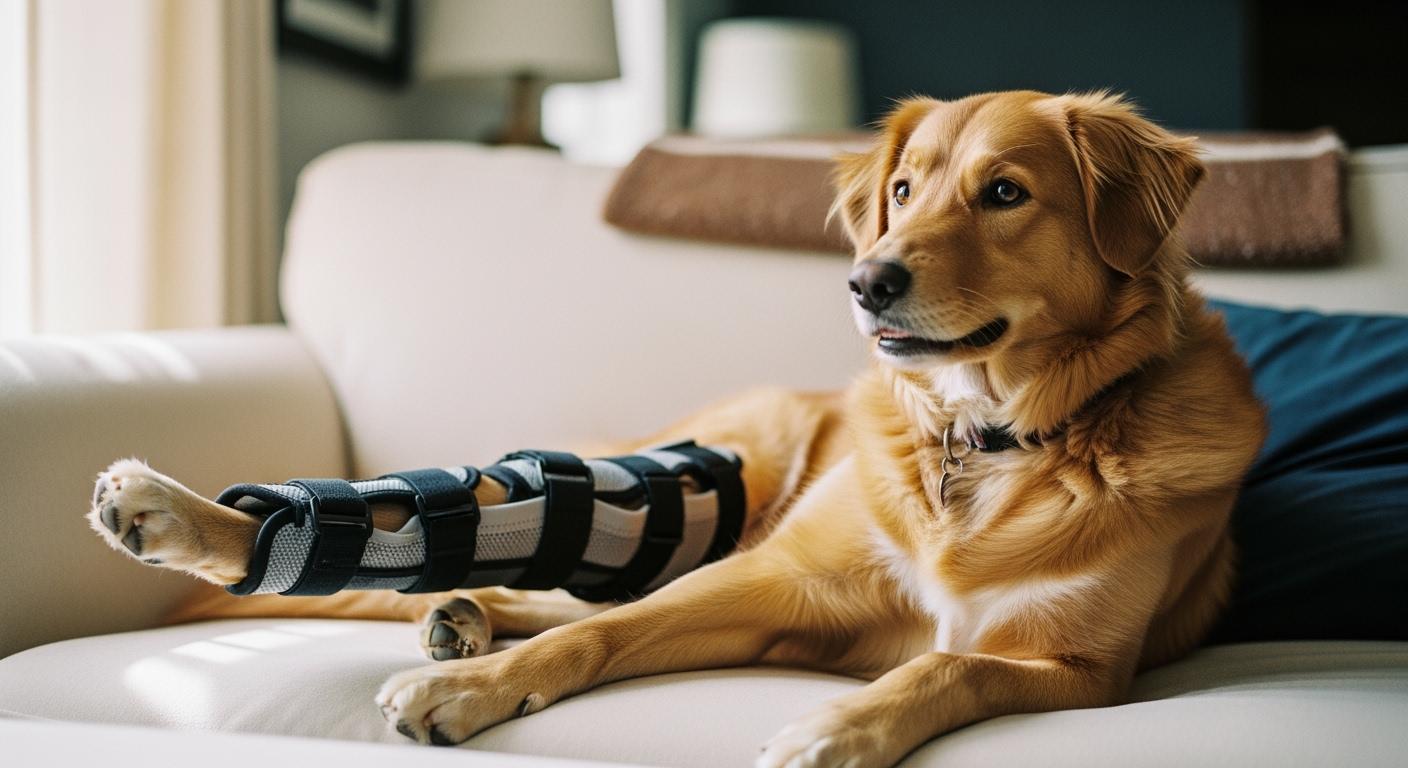
You strap the brace on, pull the straps to what feels right, and watch. The brace stays put. But when your dog shifts weight to turn, the knee still wobbles. That wobble is not about strap tightness. It is a structural problem hiding inside the brace.
A knee brace can look perfectly secure from the outside while the joint inside continues to move in ways the brace was supposed to prevent. Understanding why this happens turns on two product design realities most brace descriptions skip: compression does not equal joint control, and hinge position relative to the actual knee axis determines whether the brace stabilizes or merely squeezes.
Why a Snug Knee Brace Still Lets the Joint Shift
Tightness feels like security. It is easy to believe that if the brace fits snug, the knee must be stable. That assumption fails for the same reason a tight sleeve on a door hinge does not stop the door from swinging: the force path is wrong.
Compression does not control tibial rotation
Circumferential pressure — the kind a sleeve or wrap-style brace produces — squeezes tissue evenly around the leg. That pressure can reduce mild swelling and provide sensory feedback. It cannot, however, block the rotational force that drives tibial internal rotation in a dog with a compromised cranial cruciate ligament.
Here is the mechanical chain that matters. When a dog plants the foot and turns, the ground reaction force travels up through the paw, into the tibia, and reaches the knee joint at an angle determined by the hip and hock position. If the CCL is partially or fully torn, the tibia rotates inward relative to the femur because the primary restraint against that rotation is gone. A compression sleeve applies normal force perpendicular to the skin surface. That force vector runs radially inward — it points toward the center of the leg. Tibial rotation, however, happens in the transverse plane, perpendicular to that compression vector. The brace squeezes radially while the joint shifts rotationally. The two forces are nearly orthogonal. That is why a brace that feels tight can still let the knee rotate: the direction of the force the brace applies is wrong for the job.
You can see this for yourself. After your dog walks for ten minutes with the brace on, watch the knee from the front during a slow turn. If the tibial tuberosity — the bony ridge just below the knee — tracks visibly inward while the brace shell stays in place, the compression is not controlling rotation. That is a structural mismatch, not a fit problem.
When turning and sitting expose the hinge problem
A dog standing still in a brace can look stable. The real test is the transition: standing to sitting, sitting to rising, walking into a turn. These movements combine knee flexion with rotation. A single-axis hinge — one that opens and closes in one plane only — cannot follow that combined motion. The dog’s stifle does not move like a door hinge. It rolls, glides, and rotates through its range.
Polycentric hinges attempt to replicate this by using multiple pivot points, letting the center of rotation shift as the joint flexes. But a polycentric hinge only works if it sits at the right height relative to the joint line. If the hinge center is half an inch above or below the knee’s actual axis, every step turns the brace into a lever. The hinge pivots around its own fixed point while the knee pivots around a different one. The resulting force pushes the joint off-center — one side of the joint surface takes more load, the other side unloads. That asymmetric loading concentrates pressure on one compartment of the knee. Over hours of wear, that pressure can irritate the joint capsule, inflame the synovial membrane, and make the dog refuse to bear weight.
This is also why a soft brace without a rigid hinge often fails differently than a hinged brace with poor alignment. The soft brace never attempts to control the joint axis, so the knee floats inside fabric. The misaligned hinged brace actively steers the joint wrong. Both fail. The failure modes are different, and knowing which one you are seeing changes what you do next.
| Brace type | What it supports | Where it can fail | Better use case |
|---|---|---|---|
| Soft compression sleeve | Mild swelling, warmth, sensory feedback | No control of knee shifting, fabric stretches out with repeated wear | Minor sprains, temporary comfort, very small dogs with mild instability |
| Wrap-style brace | General compression, basic positioning | Slides down the leg within minutes, does not stop tibial rotation | Short-term use, mild instability where drift is not a concern |
| Single-axis hinged brace | Controls flexion and extension in one plane | Hinge axis mismatch creates off-center joint loading, restricted natural motion | Cases where the knee’s motion is already limited to a single plane |
| Polycentric hinged brace with upper and lower anchors | Multi-plane motion control, joint alignment, rotational resistance | Fit precision required; hinge height relative to joint line must be correct | Moderate to significant instability, daily walks, dogs with partial or complete CCL tears |
When a Knee Brace Is Not the Right Support Tool
A brace that matches the joint well can reduce pain and help a dog move with more confidence during daily activity. But the brace does not replace a ligament. It does not fix severe angular deformities at the knee. And it does not work equally well across all dogs, all tear types, or all activity levels.
What the brace can and cannot address
An ortho dog ACL knee brace can — when the hinge aligns with the joint and the thigh and calf anchors hold position — limit the anterior drawer motion and internal rotation that make a CCL-deficient knee feel unstable. It can reduce the mechanical stress that walking places on an already irritated joint capsule. It can give a dog enough confidence to use the leg, which slows the muscle atrophy that compounds instability.
It cannot regenerate a torn ligament. It cannot correct a tibial plateau angle that is naturally steep enough to make the joint inherently unstable. It cannot stop degenerative changes inside the joint if those processes are already underway. And in a dog with a complete CCL tear and a high activity level — particularly a large, young, active dog — bracing alone often provides insufficient restraint for the forces the dog generates. This is not a design flaw. It is a physics limit.
Getting the hinge height right relative to the joint line is more important than how tight the straps feel. A brace positioned even a quarter-inch too high or too low changes the effective lever arm on the knee and can make wobbling worse rather than better.
Disclaimer: The fit checks and stability observations described here assume a dog with a typical leg conformation for its breed. Dogs with angular limb deformities, very deep or very narrow chests, or breeds with naturally steep tibial plateau angles may not be adequately served by a standard knee brace pattern. In those dogs, off-axis joint loading can persist even when the brace appears well-positioned, and the observable checks below may miss pressure points that require a veterinary exam to identify.
Signal table for daily monitoring
| Signal level | What the caregiver sees | What to do next |
|---|---|---|
| Green | Brace stays aligned through standing, walking, and sitting; skin is dry and normal after removal; dog loads the leg more evenly | Continue use, check fit before and after each wear session |
| Yellow | Mild brace rotation or downward drift within 20 minutes; faint rub marks that fade within 15 minutes of removal; brief hesitation during turns | Adjust anchor straps, check hinge height, reduce wear duration, monitor for escalation |
| Red | Visible joint wobble with brace on; skin that stays red or indented beyond 15 minutes after removal; heat, swelling, cold toes; sudden worsening of the limp; panic or persistent chewing at the brace | Remove the brace, do not reapply, contact a veterinarian |
The transition from green to yellow is usually gradual. The transition from yellow to red can happen in a single wear session. The difference often comes down to whether the brace is controlling joint position or merely compressing the leg while the joint drifts inside.
Checking Whether the Brace Is Actually Working
Most brace assessments focus on whether the straps are tight and whether the dog seems comfortable. Those matter. But they do not tell you whether the brace is doing its structural job — controlling joint motion without creating new problems. Two observable checks, done consistently, give you that information.
Check one: joint tracking during movement
Put the brace on. Let the dog stand. Mark the position of the hinge center relative to a visible landmark on the leg — a bony prominence, a skin fold, a color change in the coat. Walk the dog at a slow, steady pace for ten minutes on a flat surface. Include at least three turns in each direction.
After ten minutes, stop and look at the hinge position relative to your landmark. If the hinge has drifted up or down by more than the width of your thumb, the thigh and calf anchors are not holding. The brace is migrating, and the knee is getting less support with every step.
Now watch the knee itself during a slow turn. Keep your eyes on the tibial tuberosity. If that bony point shifts visibly inward while the brace shell stays still, the hinge is not controlling rotation. The brace is tight on the outside and loose on the inside — tight against the skin, loose against the joint. That is the compression-without-control problem in action.
Large-breed dogs generate enough ground reaction force that even small amounts of uncontrolled rotation can accelerate joint surface wear. In a 70-pound dog, a millimeter of unchecked tibial translation per step adds up to measurable cartilage stress over hundreds of steps.
Check two: skin condition after removal
Remove the brace after a wear session. Run your fingers along the skin where the edges of the brace and the straps sat. The skin should feel dry and the same temperature as the surrounding area. If the skin is damp with trapped moisture, the padding material is not breathing adequately under load — a common issue with closed-cell foams that look soft on the shelf but trap heat against the leg during real use.
If you find firm, defined indentations that remain visible more than fifteen minutes after brace removal, the pressure distribution is uneven. That can mean the padding is too thin at the edges, the strap tension is too high, or the brace shell was shaped for a different leg profile than your dog’s.
A dog with a double coat may not show rub marks visibly. In those dogs, run your fingertips against the grain of the fur to feel for warm or tender spots that visual inspection misses.
In practice: The most overlooked signal is a dog that refuses to sit squarely while wearing the brace — weight shifted to one hip, the braced leg held slightly out to the side. That posture often means the hinge is restricting full flexion, and the dog is compensating to avoid the pinch point. Check hinge height and calf anchor position if you see this pattern.
When to stop and seek veterinary input
Some signs mean the brace should come off immediately and stay off until a veterinarian evaluates the leg:
- Swelling, heat, or cold toes on the braced leg
- Sudden worsening of the limp or complete refusal to bear weight
- Open sores, raw skin, or persistent redness at any contact point
- Toe dragging, panic behavior, or obsessive chewing at the brace
These are not fit-adjustment problems. They are stop-use problems. A knee brace is one piece of a broader stability and recovery approach, and it works best when the structural checks above are done consistently and the stop-use signals are respected immediately.
The difference between a knee brace that helps and one that creates new problems often comes down to whether the hinge, the anchors, and the padding are doing three separate jobs: guiding joint motion, holding position against gravity and shear, and protecting skin over hours of repeated movement. When any one of those three systems fails, the brace as a whole fails — regardless of how snug the straps feel.
FAQ
How long should a dog wear an ACL knee brace per session?
Start with 30 to 60 minutes under direct supervision. Watch joint tracking and skin response during and after that first session. If both checks pass, gradually extend wear time over several days. There is no universal wear-duration number — it depends on the dog’s tolerance, the brace’s fit stability, and the activity being supported. A brace that drifts after 45 minutes is not safe for a two-hour wear window, even if the dog seems comfortable.
Can a dog wear the brace outdoors?
Yes, for short walks and bathroom breaks on controlled surfaces. Check that the brace has not shifted after returning indoors. Wet or muddy conditions can accelerate strap stretch and reduce anchor grip, so check fit more frequently in those conditions.
What is the difference between a brace that slips and one where the joint wobbles inside?
Slipping means the whole brace migrates down or rotates around the leg — that is an anchor problem. Wobbling means the brace stays in position but the knee moves inside it — that is a hinge alignment or structural control problem. The fix for slipping is adjusting thigh and calf anchors. The fix for wobbling is checking hinge height relative to the joint line. Tightening the straps will not fix wobbling and can make slipping worse by creating a tapered pressure gradient that pushes the brace downward.
How is the brace cleaned?
Wipe the brace with a damp cloth after each use. Let it air dry completely before the next wear session. Do not submerge the brace in water, use harsh cleaners, or machine-wash it. Moisture trapped in the padding between uses can degrade both the foam structure and the skin environment on the next wear.
