
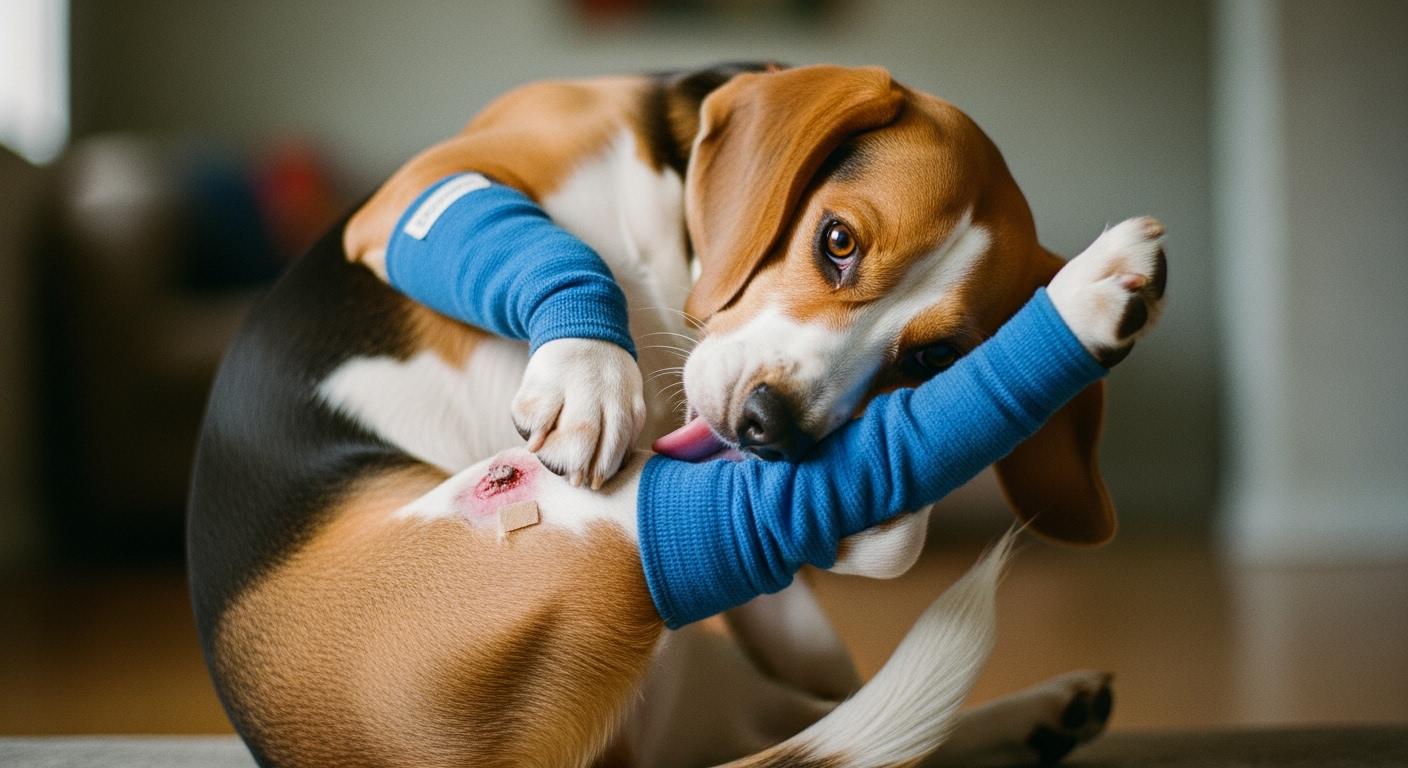
A dog anti licking protection sleeve looks right when you first slide it on. The fabric covers the limb. The closure holds. The wound disappears from view. Then the dog sits, shifts, or bends — and the tongue finds a gap. The sleeve did not fail because it was defective. It failed because the coverage zone did not match the wound location across every position the dog takes.
Three failures repeat across sleeve designs: the wound sits outside the real coverage zone, the upper anchor shifts and drags the fabric down, or the edge lands close enough to the wound that the dog chews past it. Each of these can be spotted before the sleeve becomes useless — if you know what to check and when.
| Failure Point | Why It Happens | Better Product Direction |
|---|---|---|
| Wound not fully covered | Licking target outside sleeve zone | Full target coverage, adjustable closure |
| Sleeve slides or rolls | Weak upper anchor, poor stretch | Stable upper anchor, enough stretch, low-bulk edge |
| Moisture under sleeve | Non-breathable or slow-drying fabric | Breathable, quick-drying, washable material |
Why a Dog Anti Licking Protection Sleeve Can Still Fail
A sleeve that looks secure at first application can fail within minutes of movement. The fabric does not tear. The stitching holds. But the dog still reaches the wound because the protective zone — the actual area the sleeve keeps covered through motion — is smaller than the visible fabric suggests. For a dog anti lick solution to hold, the coverage zone must stay intact when the dog stands, sits, turns, and lies down. Dogs exploit gaps the moment they appear.
The Wound Sits Outside the Real Coverage Zone
The visible fabric of a sleeve creates an illusion of protection. What matters is not how much fabric exists, but where the coverage zone begins and ends relative to the wound. A hind-leg sleeve typically protects from the upper thigh to above the hock. If a wound sits on the paw, the toe, or the pad, the dog bends and reaches past the distal opening. The sleeve is on — and the tongue is on the wound.
This is not a sizing error. The sleeve covers exactly the zone it was patterned for. The mismatch happens because the wound location was never inside that zone to begin with. Checking coverage means watching the wound’s visibility during standing, sitting with the leg tucked, and lying with the leg extended. If the wound appears in any of these positions, the sleeve’s coverage zone does not match the target.
| Coverage Area | Description |
|---|---|
| Hind Leg Sleeve | Protects from upper thigh to above the hock |
| Paw or Toe Wound | Not protected; dog can reach past sleeve opening |
Anchor Sliding and the Edge Problem
The upper anchor is the single point that determines whether the sleeve stays put or migrates. A top cuff uses friction alone — fabric gripping fur. On dogs with slick coats, oily skin, or dense undercoat, friction fails. The cuff slides millimeter by millimeter. Each millimeter of slide shifts the entire sleeve downward. The wound creeps toward the edge. The dog notices.
Here is the causal chain: a narrow friction cuff under side load from leg movement concentrates force at the cuff edge. With no anti-rotation surface — nothing wider than the cuff itself to resist torque — the edge rolls. Rolling turns the cuff into a bead that slides more easily along the fur. The sleeve drops. The wound moves from fully covered to edge-adjacent. Then the dog chews the exposed edge and pulls the sleeve back. A hind-leg sleeve that slips during sitting or turning exposes the wound incrementally, and the dog acts on the gap before the owner sees it.
A shoulder anchor resists this differently: it cannot slide past the shoulder, so the entire sleeve is locked at a fixed anatomical point. The anchor spreads load across a wider contact area, which reduces per-square-inch pressure and makes rotation less likely. That is not just “a better strap.” It is a different anchoring mechanism — anatomic lock instead of friction hold.
In practice: Walk the dog for 10 minutes on leash, then check whether the sleeve’s upper edge has moved more than half an inch from its original position. If it has, the anchor is failing under real load.
Match the Sleeve to the Wound Location

A sleeve that fits the leg does not necessarily cover the wound. The two measurements are independent. Matching a lick sleeve to the wound location means confirming that the wound sits inside the coverage zone during every position the dog takes — not just standing still. A sleeve positioned correctly at rest can shift during motion and leave the wound exposed within minutes.
Location-Specific Fit Limits
Each wound location creates a different set of coverage requirements. Lower-leg wounds are often the best match for a sleeve because the limb is relatively straight and the coverage zone is easy to maintain. Knee or stifle wounds sit near a joint that bends, which opens edge gaps when the dog sits. Elbow wounds sit at a point where fabric naturally bunches. Paw and toe wounds are almost never fully covered by a sleeve alone — the dog can simply bend and reach past the opening.
| Wound Location | Decision Direction | Main Limitation | Better Option if Sleeve Fails |
|---|---|---|---|
| Knee or Stifle | Often suitable with careful edge monitoring | Edge gap opens when sitting or bending | Cone or vet-approved wrap |
| Hock or Ankle | Sometimes suitable if sleeve stays centered | Bunching, sliding, pressure on bony points | Cone, boot, or custom wrap |
| Lower Leg | Often the best match for a sleeve | Twisting, riding up, strap loosening | Cone, boot, or vet plan |
| Paw / Toe / Pad | Rarely enough on its own | Dog can bend and reach paw past sleeve opening | Boot, bandage, cone, or vet plan |
| Open/Infected Wound | Not suitable for sleeve use | Traps moisture, hides infection progression | Vet-directed wound care only |
Edge Placement Determines Success
The distance between the sleeve edge and the wound is the single most important measurement — more than overall fit, more than fabric softness. When the edge sits close to the wound, the dog has a starting point. Chewing begins at the edge and works toward the wound. A low-bulk edge with a smooth finish gives the dog less to grip, but edge placement — not edge finish — is what determines whether the dog can reach the wound at all. After the dog walks, sleeps, or attempts to lick, run a finger along the edge. If the edge has crept closer to the wound than its starting position, the anchor is losing ground.
Fit Details That Decide Whether the Sleeve Stays in Place
Sleeve protection coverage depends on a handful of design details that most owners never examine until the sleeve fails. A sleeve that fits at rest but slides during movement has a fit problem, not a sizing problem. Sizing addresses the static leg. Fit addresses the leg in motion. And fit is what determines whether the wound stays covered.
Upper Anchor Mechanics
The difference between a shoulder anchor and a top cuff is not subtle. A top cuff relies on radial compression — it squeezes the leg evenly, hoping friction holds. A shoulder anchor ties the sleeve to an anatomical structure that does not change circumference when the dog moves. The shoulder is bone and tendon wrapped in skin; the thigh changes shape with every step. Anchoring to the stable structure means the sleeve’s position is set by anatomy, not by how well the cuff happens to grip on a given day.
- Check the anchor area after the first hour of wear for red marks or rubbed fur. Marks that persist past 20 minutes of rest signal excessive pressure.
- Adjust the fit if the anchor feels tight enough to leave an indentation.
- Pressure spread across a wide contact area leaves no marks after extended use. Narrow anchors concentrate force and are more likely to cause irritation.
Stretch, Breathability, and Material Behavior
Fabric choice changes how the sleeve behaves in three ways that matter for protection: stretch affects whether the sleeve moves with the dog or against it; breathability determines whether moisture builds under the fabric; and edge finish determines whether the dog finds something to grip. High-stretch fabric with smooth or raw-cut edges flexes with the leg and removes bulky seams from high-friction zones like the armpit. But stretch alone is not enough — thin, scratchy material that stretches can still irritate, and fabric that does not breathe traps heat and moisture.
Moisture under a sleeve does more than cause discomfort. Damp fabric against skin softens the stratum corneum, making the skin more vulnerable to friction damage — the same mechanism that causes blistering. A breathable, quick-drying fabric limits this by keeping the skin dry. Polyester-spandex blends tend to dry faster and retain less moisture than cotton-heavy fabrics. The observable check: after 20 minutes of wear, lift the sleeve edge and touch the skin. Dry skin means the fabric is moving moisture. Damp or tacky skin means it is not.
| Design detail | Comfort benefit | Watch out for |
|---|---|---|
| High, body-following armhole | Moves with the shoulder and reduces sliding | Too high or tight can pinch the axilla |
| Armhole edge set behind the front leg fold | Clears the sensitive crease where rubbing happens | Sitting directly in the fold causes friction |
| Stretchy fabric with smooth or raw-cut leg edges | Flexes with movement and removes bulky seams | Thin but scratchy or stiff materials can irritate |
When a Sleeve Is Not the Right Tool
A dog anti licking protection sleeve works best for localized limb wounds where the coverage zone can fully enclose the target and the dog cannot bypass the sleeve by bending past the distal opening. Persistent chewing, wet or exudative wounds, severe skin irritation, infected wounds, or wounds outside any limb sleeve’s coverage area are all conditions where a sleeve is the wrong approach. Anti-lick sleeve designs vary in coverage zone, anchor type, and material, but no sleeve design solves for a wound the dog can reach by bending a different joint.
When a front-leg sleeve still lets licking persist despite correct placement, the problem is almost always edge proximity or coverage zone mismatch — not insufficient tightness. Tightening a poorly positioned sleeve increases pressure without closing the gap.
Disclaimer: This check assumes a short-coated dog where rub marks and pressure points are visible on the skin surface. Double-coated breeds may show subtler friction signs that require hand-checking rather than visual inspection — run your fingers under the sleeve edge rather than relying on what you can see. If the dog’s leg conformation falls outside breed norms this sleeve pattern was built for — particularly dogs with angular limb deformities or very deep chests — the fit checks described here may not catch every pressure point. Veterinary instructions always override product guidance for wound protection and sleeve use.
FAQ
How often should you check a dog anti licking protection sleeve?
At least twice daily, and always after walks, naps, or any observed licking attempt. A sleeve that was secure two hours ago can shift enough in one nap to expose the wound.
What signs show the sleeve is no longer protecting the wound?
The dog licks or chews near the sleeve; the sleeve edge has moved closer to the wound than its starting position; the fabric feels damp against the skin when you lift the edge; the skin around the wound looks redder or more irritated than at the last check.
When should you stop using the sleeve entirely?
Stop and contact a veterinarian if you see swelling, discharge, increasing redness, or if the dog successfully reaches the wound despite adjustment. A sleeve that cannot maintain coverage through normal movement is the wrong tool for that wound.
A sleeve that covers the wound at rest but exposes it during movement is not working. The check is not whether the sleeve looks right — it is whether the wound stays covered through standing, sitting, turning, and lying. If the anchor slips, the edge creeps, or the dog finds the gap, the sleeve needs adjustment or replacement. The product cannot do its job if the wound sits outside the coverage zone the sleeve was actually built to protect.
