
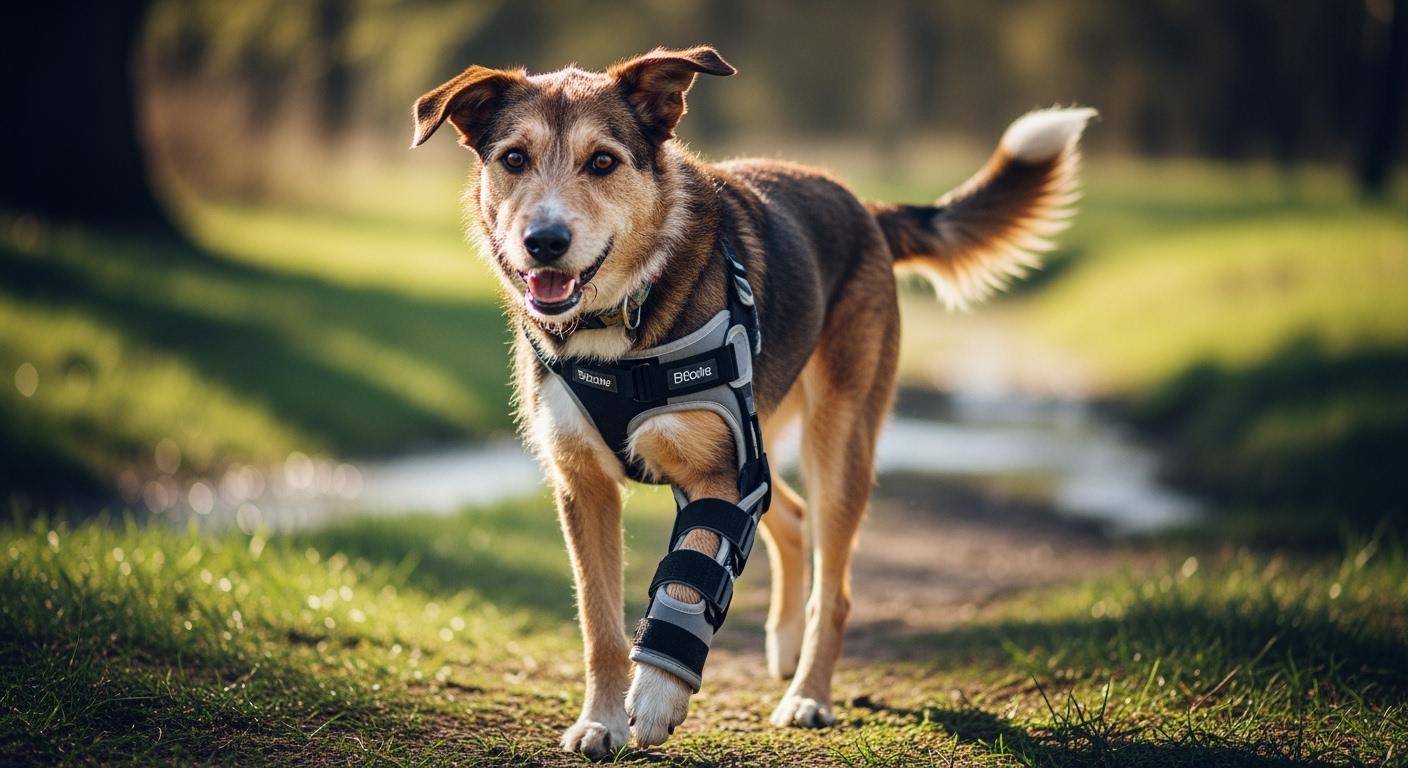
A brace goes on snug. Ten minutes into a walk, it has drifted half an inch down the leg. By the time the dog turns a corner, the top edge digs in while the bottom gap opens — the hinge no longer tracks the joint. This is not a strap-tightening problem. It is a structure problem.
Most slipping, rubbing, and support loss in pet orthopedic braces traces back to how the brace interacts with joint geometry under load, not how hard someone pulls the straps. When the hinge sits off-axis from the joint, every step introduces a rotation moment. That moment concentrates force at one edge while the opposite side lifts. The result is a predictable cascade: pressure concentration, skin breakdown, and a brace that no longer stabilizes anything. Understanding which design features cause or prevent that cascade is what separates a brace that works from one that gets abandoned after three days.
Why Pet Orthopedic Braces Slip or Rub in Daily Use
Three structural failures account for most real-world brace problems. Each one starts with a design decision made long before the brace reaches a dog’s leg.
Slipping is a hinge-alignment problem, not a tightness problem
Tightening straps on a misaligned brace does not fix it. It makes things worse.
Here is why. A joint rotates around a single axis. A brace hinge also rotates around a single axis. If those two axes sit even a quarter-inch apart, the brace cannot follow the joint through its range of motion. Instead, each step forces the brace to find its own path — usually by pivoting around the tightest strap. That pivot action converts a straight-line load into a rotating one. The brace twists. The lower anchor slips first, since it has less soft tissue to grip. Once the lower anchor goes, the entire brace rotates, the hinge drifts further from the joint, and whatever support the brace was supposed to provide disappears.
You can verify this without waiting for failure. After a 10-minute walk on a flat surface, check whether the hinge still sits directly over the joint line. If it has drifted more than half an inch in any direction, the hinge-joint axis mismatch is the root cause — not strap tension. A related breakdown of how brace rotation correlates with patellar instability is covered in the context of knee braces that slip under rotation.
Stable anchors above and below the joint matter more than strap tightness. The anchor points need to match the limb’s taper — wider at the thigh, narrower at the lower leg — so that natural leg shape resists downward migration. Diagonal strap routing, roughly 30 to 45 degrees off horizontal, counteracts both vertical slip and axial rotation simultaneously. Straight-across straps only fight one direction.
Rubbing starts where pressure and motion intersect
Rubbing is not random. It occurs at predictable locations: under strap edges, along the brace rim, and anywhere the shell transitions from rigid to flexible. These are the points where a moving dog generates shear between brace material and skin.
The mechanism is straightforward. A brace edge compresses fur and skin during limb loading. When the limb unloads, the brace should lift slightly. If the edge is rough, squared-off, or stitching creates a raised ridge, that edge catches instead of releasing. Over hundreds of steps, the caught-and-release cycle abrades the skin surface. Add moisture — from humidity, a wet walk, or the dog’s own heat output — and skin softens, making abrasion faster and deeper.
The pass/fail check is simple. After a 20-minute wear session, run a finger along the inside edge of every strap and every shell rim. Any ridge you can feel, the dog’s skin will feel multiplied by movement. Then flip the lining back and touch the skin underneath. Damp and warm means the padding is trapping rather than moving moisture — the conditions for skin breakdown are already in place. The pattern holds across brace types, from hind-leg braces where rubbing compounds arthritis discomfort to carpal supports where wrist flexion multiplies edge contact.
Breathable padding — open-cell structures that allow air to circulate rather than sealed foams that trap heat — changes the equation. So does a rolled or beveled edge finish versus a blunt-cut one. The difference in production cost between a beveled edge and a straight cut is minimal. The difference in skin tolerance after two weeks of daily wear is not.
Support can fail even when the brace looks secure
A brace can appear to fit and still provide no meaningful joint support. The failure mode here is invisible from the outside: the hinge and the joint move through different arcs.
When the brace hinge sits anterior or posterior to the joint axis, the dog compensates by altering its gait — high-stepping to clear the brace, shortening stride to avoid full extension, or shifting weight to the opposite leg. These compensations are the opposite of what a brace is meant to achieve. The brace becomes a movement constraint rather than a support aid.
Watch the dog walk on a hard surface for 30 seconds. Count whether the footfall pattern is even. If the dog consistently shortens the stride on the braced leg or lifts it higher than the unbraced leg, the hinge is misaligned regardless of how well the straps appear to fit.
Common Real-Use Failures by Joint Zone
| Brace zone | Performance difference | Why it matters | Main limitation |
|---|---|---|---|
| Knee/stifle | Hinge alignment controls rotation stability | Off-axis hinge creates pivot point → brace twists and slides | Requires precise joint-line matching; off-the-shelf sizing often misses |
| Hock | Shell contour determines edge pressure distribution | Flat shell on curved hock concentrates force at rim edges | Contouring must accommodate flexion without creating pinch points |
| Carpal/wrist | Open-paw vs. closed-toe design changes paw interference | Closed toe blocks natural paw placement → dog alters gait | Open-paw designs reduce interference but reduce debris protection |
| Hip/back | Anchor width determines load distribution | Narrow anchors concentrate force → hot spots under straps | Wider anchors add material weight and heat retention |
What You See vs. What the Design Is Doing
| What you see | Likely structural cause | Pass signal | Fail signal |
|---|---|---|---|
| Brace slides down | Anchor contour does not match limb taper | Brace stays within 0.5 inch of original position after 10-min walk | Lower edge migrates past the intended anchor zone |
| Strap edges leave marks | Strap edge finish is square-cut, not beveled | Skin shows even pressure distribution, no linear marks | Red lines persist 10+ minutes after brace removal |
| Dog high-steps | Hinge axis offset from joint axis | Stride length even between braced and unbraced legs | Braced leg lifts visibly higher or stride shortens |
| Padding feels damp/hot | Closed-cell foam traps moisture | Skin under padding is dry and cool after 20-min wear | Padding feels wet; skin is warm or pruned |
| Dog chews or refuses | Pressure point or edge irritation | Dog moves freely, ignores brace after initial acclimation | Persistent pawing, biting at brace, or refusal to walk |
These checks are not about evaluating brands or comparing suppliers. They are about reading what the product is actually doing on the dog’s leg. The brace either passes or fails each signal. The full framework for matching support type to specific mobility challenges appears in the broader discussion of brace support patterns across different activity demands.
Matching Brace Design to the Joint Zone
A knee brace and a hock brace solve different mechanical problems. Using one where the other is needed produces more than poor support — it introduces new stress at the wrong joint. Each joint zone imposes distinct demands on shell geometry, hinge placement, and anchor configuration.
Knee and stifle braces: rotation control over compression
The stifle joint is not a simple hinge. It rotates and translates through its range of motion, which means a knee brace must control both flexion angle and rotational stability. The most common design shortfall is a hinge that allows too much medial-lateral play. When the hinge has slop, the tibia can rotate internally under load — exactly the motion a knee brace is supposed to limit.
The product decision that matters here is hinge type. A single-pin hinge provides one axis of rotation and tends to develop play after repeated loading. A dual-pin or polycentric hinge tracks the joint’s natural instantaneous center of rotation more closely and resists developing side-to-side slop over time. This is not about “better” in the abstract — it is about which hinge design maintains its axis relationship with the joint through the wear life of the brace. The distinction between hinge types and how they perform under daily loading is examined in detail in the orthopedic knee brace fit and support guide.
Hock braces: hyperextension is the primary failure mode
The hock joint bears peak load at full extension during push-off. The brace must stop the joint from extending past its anatomical limit without blocking the flexion needed for a normal stride. The structural variable that determines this balance is the shell’s posterior stop angle. Too aggressive a stop, and the dog cannot complete a push-off. Too shallow, and the joint hyperextends anyway — the brace becomes decorative.
Contoured shells that follow the natural angle of the hock distribute force across the back of the leg. Flat-backed shells concentrate it at the top and bottom rim edges.
Carpal braces: paw clearance changes everything
The carpal joint sits millimeters above the paw. A brace that extends even slightly too far distally interferes with paw placement, forcing the dog to alter how it loads the entire front limb. Open-paw designs preserve natural paw contact but sacrifice the protective coverage a full boot provides. The trade-off is real: more natural gait versus more environmental protection. Which matters more depends on whether the dog walks primarily on pavement or rough terrain.
Hip and back support: wide anchoring distributes force
Hip and back braces operate on a different mechanical principle than limb braces. A limb brace can grab above and below a single joint. A hip brace must stabilize across the pelvis and lumbar region — a much larger surface area — which means narrow straps create pressure concentrations rather than distributing force.
The features that determine real-world performance in hip and back braces are anchor width, panel flexibility, and moisture management. Wide anchor bases spread load across a larger area, reducing lbs-per-square-inch at any single point. Flexible support panels allow sitting and lying down without the brace edges digging into the flank. Moisture-wicking inner layers prevent the damp-heat cycle that accelerates skin breakdown under large-area coverage. A brace that covers 30% of the dog’s torso traps proportionally more heat than one covering 5% of a leg — so breathability matters more here, not less.
A knee brace design with integrated temperature management — like a gel-pack-compatible shell — illustrates the principle of designing for heat as a controllable variable rather than an afterthought.
| Feature | Performance difference | Main limitation |
|---|---|---|
| Wide anchor base | Spreads force across pelvis/lumbar area instead of concentrating under straps | Adds coverage area — heat and weight scale with surface area |
| Moisture-wicking inner layer | Pulls sweat away from skin; reduces softening that accelerates abrasion | Wicking performance degrades if not cleaned regularly |
| Flexible support panels | Allows sitting and lying without edge-dig or panel buckling | Flexibility trades off against maximum support rigidity |
| Multi-point strap system | Distributes retention force across 3–4 points instead of 1–2 | More straps mean more edges to check for rubbing |
Fit Details That Determine Whether Support Holds
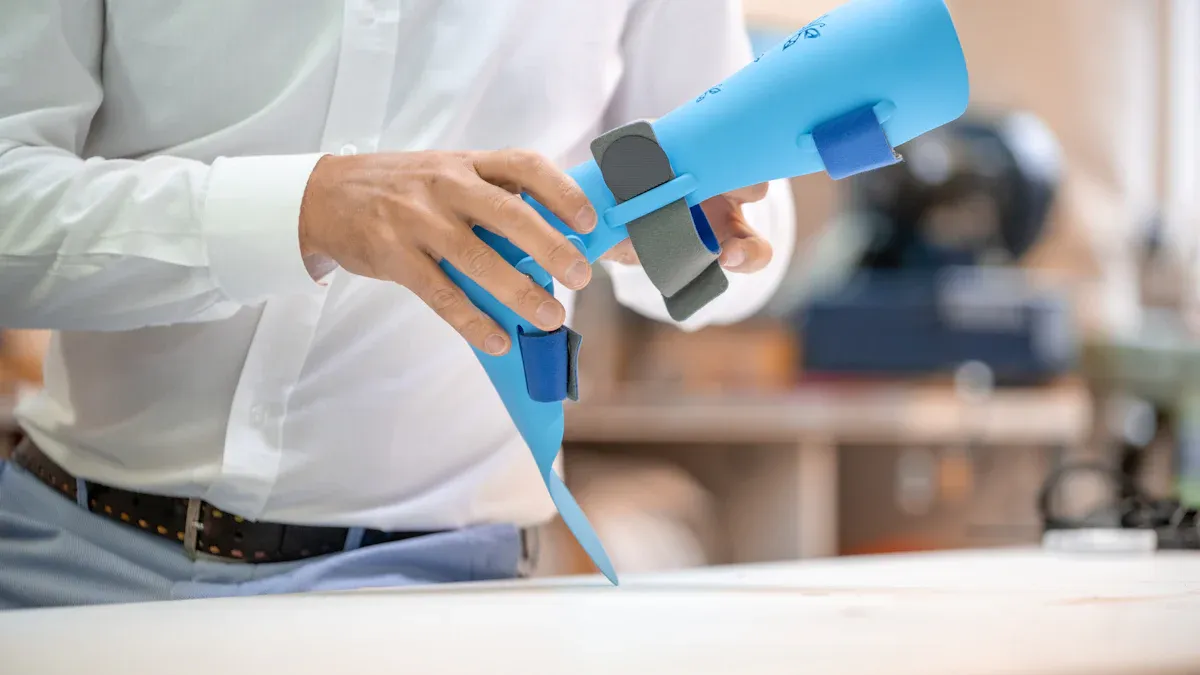
A brace can have the right hinge and the right shell contour and still fail. The interface between the brace and the dog — strap geometry, padding behavior under load, edge treatment — is where most designs succeed or fail in daily use.
Strap angle controls both slip and rotation
Straps routed horizontally resist downward slip only. They offer no resistance to rotational forces, which means any twist in the brace goes unchecked until the strap edges themselves become the rotation stops — at which point they dig in.
Diagonal strap routing creates a vector with both vertical and horizontal components. The vertical component resists slip. The horizontal component resists rotation. The wider the strap, the more evenly that force distributes across the skin. Narrow straps concentrate retention force at a thin contact line, which is why strap-width marks are among the earliest signs of fit problems.
In practice: On a short-coated dog, strap marks that fade within 5 minutes of brace removal indicate even pressure distribution. Marks that persist as defined red lines 15 minutes later indicate concentrated edge pressure — adjust strap angle before increasing wear time.
Padding thickness and the heat-moisture trap
Padding serves two opposing functions: it must cushion pressure points and it must not trap heat. Thick padding cushions better but insulates more. Thin padding breathes better but transmits more shell pressure to the skin.
The material choice matters more than the thickness. Open-cell polyurethane foam allows air and moisture vapor to move through the structure. Closed-cell neoprene blocks both — it insulates well, which is useful for therapeutic heat retention in cold conditions, but it traps moisture against the skin in warm or active conditions. Neither material is universally better; each matches a different use condition.
Note: After any wear session where the dog has been active, flip the lining back. Moisture beading on the inside surface means the material is not passing vapor — reduce session duration or switch to a more breathable option for active use.
Edge finish determines whether skin survives repeated motion
The edge of a brace is where pressure, motion, and material stiffness all meet. A beveled or rolled edge distributes the transition from rigid shell to skin across a wider contact zone. A square-cut edge presents a sharp transition line — the entire force gradient lands on a millimeter-wide strip of skin.
Reinforced stitching along edges introduces another variable: stitch density. Tight, closely spaced stitches create a smoother surface. Loose or widely spaced stitches create ridges — and each ridge is a potential abrasion point. This is a manufacturing consistency issue that becomes visible only during use.
Sizing beyond body weight
Body weight is a poor proxy for limb dimensions. Two dogs at 60 pounds — a Greyhound and a Bulldog — have fundamentally different thigh circumference, joint width, and limb taper. A brace sized by weight alone will fit one and fail the other.
The measurements that matter are limb circumference at the joint, limb length from above-joint anchor to below-joint anchor, and the taper ratio between the upper and lower anchor points. A dog whose upper anchor circumference is more than 40% larger than the lower anchor circumference needs a brace designed for conical limbs — straight-tube designs will slide regardless of strap tension. For practical fit evaluation across different hind-leg configurations, the approach detailed in the discussion of slipping patterns in hind-leg braces provides a structured comparison.
| Fit detail | Performance difference | Why it matters | Main limitation |
|---|---|---|---|
| Strap angle | Diagonal (30–45°) resists slip + rotation; horizontal resists slip only | Rotation unchecked → hinge drifts off joint axis → support lost | Diagonal routing requires longer strap length; may not work on very short limbs |
| Anchor configuration | Above-and-below joint anchors create closed force loop | Without lower anchor, brace acts as single-point lever arm → pivots and slides | Below-joint anchors add bulk near paw; may interfere on short-legged breeds |
| Padding material | Open-cell breathes; closed-cell insulates | Wrong material for activity level → heat/moisture cycle → skin breakdown | Open-cell absorbs external water; closed-cell repels it — outdoor use favors closed-cell |
| Edge treatment | Beveled/rolled distributes pressure gradient; square-cut concentrates it | Concentrated edge pressure is the single most common cause of skin marks | Beveled edges require more manufacturing steps; quality varies between production runs |
| Limb sizing | Circumference + length + taper ratio vs. weight-only | Weight ignores limb geometry; taper ratio predicts slip risk before first wear | Requires 3 measurements instead of 1; user error in measuring is a real variable |
When a Brace Should Be Adjusted, Replaced, or Stopped
Not every brace problem means the brace is wrong. Some are fit-adjustable. Some point to a design mismatch. Some signal that the use condition falls outside what the product is built for. Distinguishing between these categories determines whether a brace gets adjusted, swapped for a different type, or discontinued.
Fit-adjustable problems vs. design-mismatch problems
Problems that respond to fit adjustment: strap-angle repositioning, moving anchor points up or down within the intended zone, switching from a straight to diagonal strap path, adding or removing a thin liner layer. If the problem resolves after one of these adjustments and does not return, the design is compatible with the dog — the initial fit was simply off.
Problems that indicate a design mismatch: the brace cannot anchor above and below the joint simultaneously on this dog’s limb proportions, the hinge consistently drifts regardless of strap configuration, or the shell contour creates a gap at one end when the other end fits. These are not fixable through adjustment. The brace shape and the dog’s limb shape are incompatible.
Problems that signal the use condition exceeds the product’s scope: the dog’s activity level generates more heat than the padding material can manage, the brace gets wet repeatedly in conditions where it cannot dry between uses, or the dog’s movement patterns include motions — sharp pivoting, sustained running — that the brace’s hinge design was not built to track.
Disclaimer: This check assumes a short-coated dog where skin marks are visible on inspection. Double-coated breeds may show subtler rub marks that require hand-checking rather than visual inspection — run fingertips along every contact edge after removal rather than relying on what you can see. For dogs with angular limb deformities or very deep chests that fall outside the breed norms this brace was patterned for, the fit checks described here may not catch every pressure point.
Skin changes and what they signal
Skin tells the story faster than gait does. Redness that fades within 10 minutes of brace removal is normal — the skin is adapting to contact pressure. Redness that persists or darkens indicates pressure exceeding capillary refill. Hair loss in a defined line under a strap edge means that edge is sawing through the coat with each step. Damp, softened skin with a distinct odor means the moisture-trapping cycle is already established.
| Skin change | What it indicates | Pass signal | Fail signal |
|---|---|---|---|
| Redness fading within 10 min | Normal pressure adaptation | Skin returns to normal color and temperature | Redness persists or deepens after 10 min |
| Linear hair loss under strap | Edge abrasion from strap movement | Coat is undisturbed under strap path | Visible thinning or broken hairs in a line |
| Damp, warm skin with odor | Moisture trapped against skin surface | Skin is dry and matches unbraced leg temp | Skin is wet, warm, or has sour smell |
| Open or weeping skin | Pressure exceeded tissue tolerance | Skin is intact at all contact points | Any break in skin — stop use immediately |
When soft support is not enough
Soft wraps and sleeves provide compression and light stabilization. They do not control joint rotation or limit range of motion. If a dog continues to limp, shows gait asymmetry, or avoids loading the leg despite proper soft-wrap fit, the support type is insufficient for the mechanical demand — a rigid or semi-rigid brace with defined hinge control is the next logical step, not a tighter wrap.
The decision tree is straightforward. If the dog loads the leg evenly and the gait is symmetrical, soft support may be adequate. If the dog short-strides, high-steps, or rotates the leg externally during loading, the joint needs rotational control that only a structured brace can provide. The observable signal: watch the dog walk away from you on a hard floor. If the braced leg’s paw rotates outward compared to the unbraced leg, rotational instability is present regardless of how comfortable the dog appears.
FAQ
Why does the brace slide down even when the straps feel tight?
Because tightness does not fix a shape mismatch. If the brace shell is a straight tube and the dog’s leg tapers, tightening the straps creates a pivot point — the top strap becomes a fulcrum around which the lower portion of the brace swings. The lower anchor slips, the hinge drifts, and the brace rotates. The fix is not tighter straps but a brace whose contour matches the limb’s taper.
How quickly should skin marks fade after removing the brace?
Pressure marks from even contact should fade within 5 to 10 minutes. Linear red lines that persist beyond 15 minutes indicate concentrated edge pressure. If the same lines appear in the same location after two consecutive wear sessions, the brace edge at that location needs to be addressed — pad it, adjust strap angle, or switch to a design with a different edge finish.
Can a brace cause problems that were not there before?
A brace that shifts the dog’s weight distribution can create secondary soreness in compensating limbs. If the dog begins limping on the opposite leg after brace introduction, the brace may be altering gait enough that the unbraced leg is taking abnormal loads. This is not the brace “causing” an injury but rather revealing that the support configuration is changing load patterns in unintended ways.
What is the difference between a knee brace and a stifle brace?
They target the same joint — “stifle” is the anatomical term, “knee” is the common term. The meaningful distinction is not in the name but in the hinge design. A true stifle brace positions the hinge to track the joint’s instantaneous center of rotation through flexion and extension. A simple sleeve with a side bar labeled “knee brace” may provide compression without controlling the rotational plane the stifle actually moves through.
Does fur density change how a brace should be checked?
Yes. Short, single-coated dogs show skin marks quickly and clearly. Double-coated breeds — Huskies, Shepherds, Retrievers — have undercoat that can mask pressure points. On these dogs, visual inspection alone is not reliable. Run fingertips under every strap and along every edge after removal. Feel for heat, dampness, or skin texture changes rather than looking for color changes.
How do I know if the hinge is correctly positioned?
Mark the joint line on the dog’s leg with a small piece of tape before putting the brace on. After fastening, check whether the brace hinge sits directly over that mark. Then walk the dog 20 steps and check again. If the hinge has moved relative to the mark, the brace is shifting during gait — the fit or the shell contour is wrong regardless of how secure it felt at standstill.
