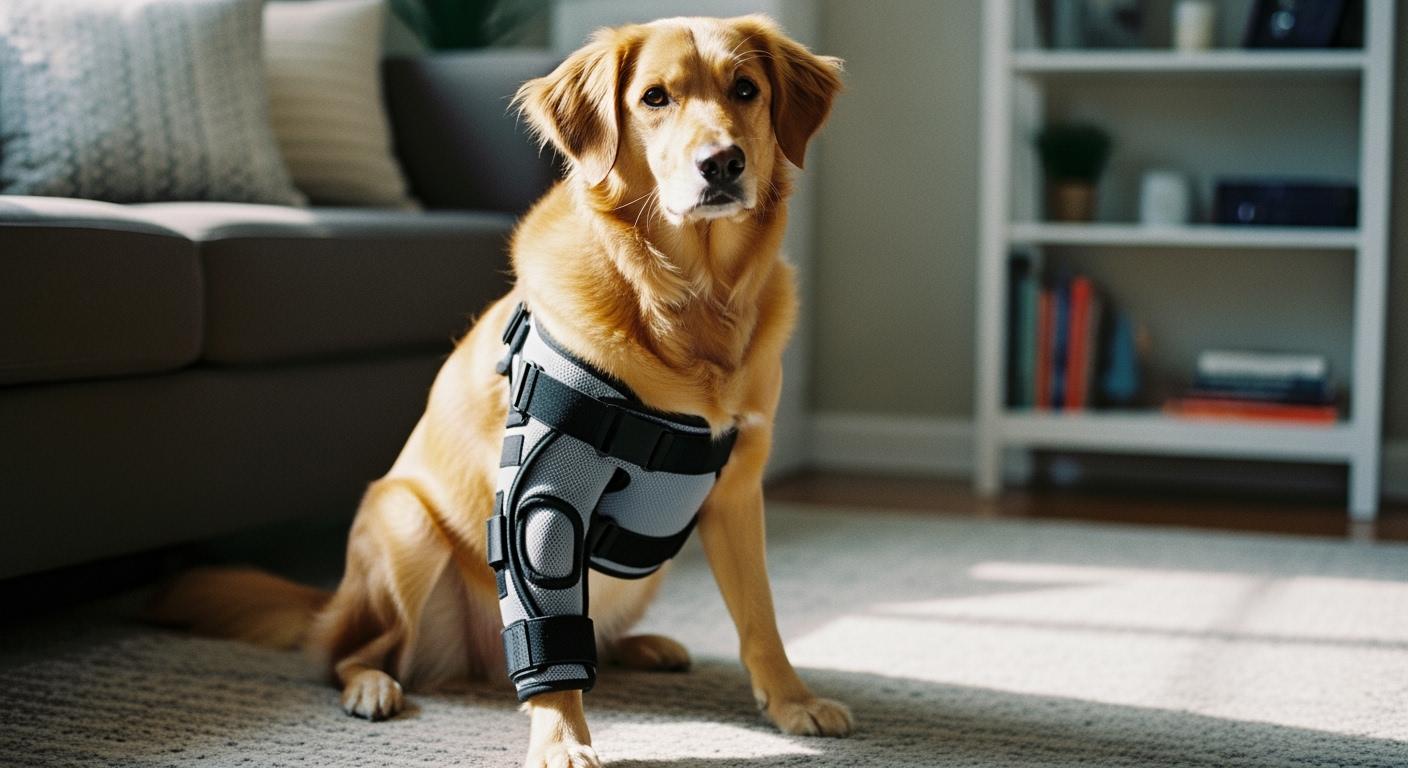
A torn ACL strips the knee of its primary stabilizer. The tibia slides forward under the femur with every step, and the dog compensates by shortening the stride or refusing to load the leg. A knee brace is supposed to restore enough constraint to make walking tolerable. But constraint alone is not the answer. Over-rigid braces for dogs with torn ACL introduce a different set of failures — ones that are harder to spot during a standing fit check and only become visible once the dog moves through a full stride cycle.
The question is not whether a brace provides support. It is whether the support arrives at the right axis, under the right load distribution, without creating new pressure concentrations that the dog will refuse within the first week of wear.
Where Over-Rigid Knee Braces Fail During Real Movement
Hinge drift off the stifle axis
A hinge that looks aligned while the dog stands can drift the moment the knee flexes under load. The stifle joint does not rotate on a single fixed pin — its instantaneous center of rotation shifts through the gait cycle. When a brace hinge is rigidly positioned at one estimated axis point, side loads during turning or sit-to-stand motion push the hinge away from the joint. Half an inch of drift is enough.
Here is the causal chain: off-axis hinge input → uneven joint surface loading → pressure concentration on one side of the femoral condyle → the dog shortens the stride to reduce contact time on that surface → the shortened stride reduces the very loading the brace was designed to permit. The brace does not “fail to support.” It fails because the support it delivers lands at the wrong point in the motion arc, and the dog’s own compensation negates the intended mechanical effect.
Observable check: after a 10-minute walk that includes at least two direction changes and one sit-to-stand cycle, mark the hinge position relative to the bony landmark on the lateral stifle. If the hinge has migrated more than half an inch from its starting point, the axis alignment has drifted. A low-profile hinge that permits a small amount of polycentric tracking tolerates this migration better than a single-pivot rigid hinge does.
Strap pressure concentration behind the knee
Narrow straps create a force-per-unit-area problem that is invisible at rest. A strap that feels secure in standing distributes load across a contact patch only a few millimeters wide. During knee flexion, the soft tissue behind the stifle compresses, the effective strap tension increases, and the contact pressure spikes. The result is not gradual discomfort — it is a rapid escalation to refusal.
Dogs signal this failure predictably: sitting becomes hesitant, then avoided entirely. The dog stands for longer periods rather than cycling through sit-stand transitions. Licking targets the back of the knee. These are not training issues. They are pressure-distribution failures that wider independent strap zones with smooth inner faces prevent by spreading load across a broader contact area.
Skin heat, moisture, and early refusal
Thick padding that feels plush to human touch becomes a liability against canine skin under a brace shell. The padding traps heat, the liner cannot vent moisture, and the skin macerates within a single wear session. Refusal often starts here — before the hinge alignment or strap pressure even come into play.
Observable check: after 20 minutes of indoor wear on a non-slip surface, remove the brace and press the back of a hand against the skin under the liner. If the skin feels damp or noticeably warmer than the same spot on the opposite leg, the liner is not venting adequately. A breathable liner with a smooth contact surface keeps the skin dry enough to prevent maceration within a typical wear window. If the skin stays dry, the material stack is working. If not, no amount of strap adjustment will fix it — the liner material itself is the limitation.
Structural Differences That Change Daily Performance
Controlled-range hinges versus locked frames
A hinge that permits 15 to 25 degrees of controlled flexion and blocks hyperextension does two things a fully rigid shell cannot. First, it lets the stifle move through enough of its normal range that the dog does not compensate by hiking the hip or dragging the leg. Second, it prevents the cranial drawer motion — the forward slide of the tibia — that the torn ACL can no longer restrain.
The distinction matters because muscle atrophy accelerates when a joint is fully immobilized. A stifle brace with controlled-range hinges maintains enough motion to preserve quadriceps and hamstring engagement. A locked frame removes that engagement and transfers the load upward to the hip — a tradeoff the dog pays for weeks after the brace comes off.
Anchoring design and rotational stability
A brace that stays put during straight-line walking can rotate 30 degrees or more during a turn. The failure mechanism is simple: narrow proximal and distal anchor bands lack the surface area to resist rotational torque. When the dog pivots, the leg rotates inside the brace, the hinge no longer aligns with the joint, and the brace becomes a passive sleeve rather than an active constraint.
Wide anchoring zones above the stifle and below the tibial crest resist this rotation by distributing torque across a larger contact patch. Independent strap routing — where proximal and distal straps are tensioned separately rather than sharing a single cinch point — prevents one adjustment from pulling the entire brace off-axis. This is not about “more secure.” It is about anchor geometry that matches the rotational loads the leg generates during multi-directional movement. A hinged brace with independent anchor zones handles turns without the rotational drift that single-band designs cannot avoid.
| Performance Difference | Why It Matters | Main Limitation |
|---|---|---|
| Controlled-range hinge vs. locked frame | Preserves muscle engagement during gait; prevents cranial drawer without freezing the joint | Hinge must track stifle axis within a few millimeters; off-axis drift negates the benefit |
| Wide independent strap zones vs. narrow single-band straps | Spreads pressure across a larger contact patch; resists rotational torque during turns | Independent zones require careful tension balancing; uneven tightening creates new pressure asymmetries |
| Breathable smooth liner vs. thick padded liner | Prevents skin maceration within typical wear windows; reduces heat-refusal threshold | Smooth liners may need more frequent cleaning to maintain skin-safe surface properties |
| Polycentric hinge vs. single-pivot hinge | Tolerates the stifle’s shifting center of rotation better; reduces off-axis pressure spikes | More complex assembly; hinge debris ingress can affect tracking consistency over time |
When a Knee Brace Is Not the Right Tool
A knee brace constrains the stifle. It does not repair a ligament. If the ACL tear is complete and the joint shows significant drawer motion even at rest, a brace can reduce the translation but cannot eliminate it. The dog may still off-load the leg at higher speeds or on uneven ground.
Knee braces also redistribute load upward. A dog with pre-existing hip sensitivity may find that a stifle brace trades one source of discomfort for another — the constrained knee feels more stable, but the hip now absorbs the gait compensation that the knee previously handled. This is not a design defect. It is a biomechanical tradeoff inherent to any single-joint orthotic on a multi-joint limb.
Disclaimer: The fit checks and wear observations described here assume a short-coated dog where skin contact and hinge alignment are visually verifiable. Double-coated breeds may show subtler rub marks and pressure signals that require hand-checking rather than visual inspection — parting the coat and palpating along strap lines and hinge edges is the only reliable method. Dogs with angular limb deformities or chest conformations that fall well outside breed norms may not match the leg geometry these braces are patterned for, and the hinge alignment tests described here may not catch every pressure point.
Three signals that suggest the brace is the wrong match, regardless of adjustment:
- Stride remains shortened after three separate wear sessions with hinge and strap adjustments between each.
- Redness along strap lines does not fade within 15 minutes of brace removal, tested on two different days.
- The dog refuses to sit while wearing the brace but sits readily without it — even after the hinge angle is adjusted to a more permissive range.
These are not fitting errors. They are mismatch signals. Continuing to tighten or reposition a brace that consistently triggers refusal creates aversion that can extend to any leg-handling, making future bracing harder regardless of design quality. A rehab-oriented knee brace works within a defined envelope of joint presentation, leg geometry, and skin tolerance. Outside that envelope, the correct answer is to recognize the mismatch, not to force the fit.
FAQ
Why does a knee brace that looks fine standing fail during walking?
Standing loads are axial and low-magnitude. Walking introduces shear, rotation, and dynamic joint surface translation. The hinge drifts, the straps shift under tension cycling, and the liner friction pattern changes. A standing fit check reveals static positioning. It says nothing about what happens when the stifle moves through 20 degrees of flexion under body weight.
What is the difference between a controlled-range hinge and a locking hinge?
A locking hinge freezes the joint at a fixed angle. A controlled-range hinge permits flexion and extension within a set arc — typically blocking hyperextension and cranial drawer while allowing enough motion for a near-normal gait pattern. The controlled-range design preserves muscle activation. The locked design trades muscle engagement for maximum static constraint, which has downstream effects on strength retention during the wear period.
How quickly do fit problems become visible during use?
Most hinge drift and strap migration become observable within the first 10 to 15 minutes of active walking that includes turns. Skin heat and moisture buildup can be evaluated at the 20-minute mark by removing the brace and checking the skin directly. If the brace passes both checks — hinge position stable, skin dry — a longer wear session is reasonable. If either check fails at the short interval, it will not improve with more time.
Can a knee brace be used alongside other mobility support?
A knee brace constrains the stifle specifically. It does not support the hip, hock, or back. If the dog shows gait asymmetry that originates above or below the knee, adding a stifle brace to the equation will not address it — and may shift compensatory loading in ways that obscure the underlying problem. Each joint-level constraint changes the load path through the entire limb. Stacking supports without understanding the cascading load redistribution can create new failure modes at the adjacent joints.