
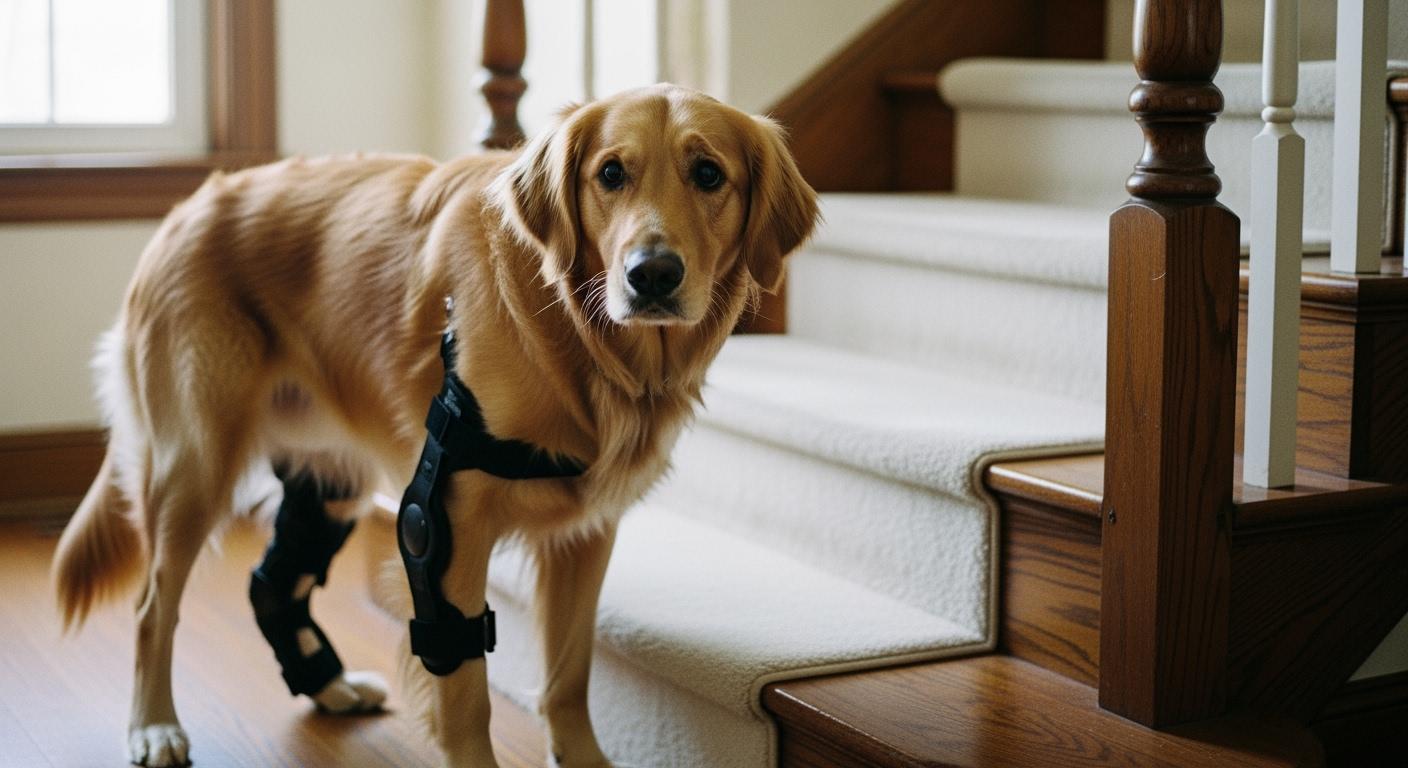
A knee brace for dogs hind leg looks secure when the dog stands still. The straps sit flat. The hinge lines up over the stifle. Then the dog takes three steps, drops into a squat, or pivots to sniff something behind them. The lower shell slides toward the paw. The hinge drifts offline. The back edge bunches into the fold behind the knee. The dog hesitates mid-stride. That moment—seconds after movement starts—is where most braces reveal their limits.
Static fit and moving fit are different problems. A brace cinched tight enough to pass a standing check can become a source of skin heat, pressure sores, and joint misalignment within a single short walk. Understanding why that gap exists changes which design details you pay attention to.
Why a Hind-Leg Knee Brace Fails Once the Dog Starts Moving
Standing fit versus moving fit
A brace strapped onto a standing leg distributes force evenly. The hinge sits over the joint center. The straps pull perpendicular to the limb. None of those conditions survive the first step.
When the dog sits, the thigh strap rides upward as the quadriceps shorten and the leg angle changes. The top edge of the brace shell tilts into the thigh, concentrating pressure into a narrow band. The dog compensates by shifting posture or refusing to sit fully.
Standing back up triggers tibial thrust—the femur pushes forward and down against the tibial plateau. That forward shear drives the lower shell toward the paw, dragging the hinge away from the stifle. Turning introduces rotational load. The brace shell, pressed against a leg that is now twisting beneath it, rotates around the limb axis. The hinge ends up medial or lateral to the joint line instead of centered over it.
| Movement | Effect on brace position | Why the standing fit cannot predict it |
|---|---|---|
| Sitting | Thigh strap shifts upward; top edge digs into thigh | Quadriceps shortening changes leg profile—no static adjustment replicates this |
| Standing up | Lower shell slides downward; hinge drifts distally | Tibial thrust creates a shear vector absent when the leg is loaded statically |
| Turning | Brace rotates around leg; hinge misaligns medially or laterally | Rotational torque meets no counter-surface in a straight-strap design |
Fit cannot be judged while the dog is stationary. A brace that holds position through a full sit-stand-turn sequence is anchored differently from one that merely passes a standing inspection. This anchoring difference is structural, not a matter of tightening.
Why stairs and squats expose weak anchoring
Stairs force the knee through deep flexion—often exceeding 45 degrees. The hind leg profile changes shape as the stifle angle closes. The lower anchor, which relied on the leg being relatively straight to hold position, now sits on a tapered, angled surface. It slides. The hinge drifts distally. The back edge of the brace compresses into the popliteal region—the soft tissue behind the knee—bunching fabric and creating a mechanical block that resists further flexion.
Squatting compounds this. Full knee closure pushes the posterior shell edge hard into compressed soft tissue. If that edge is even slightly raised or rigid, it concentrates pressure into a line contact instead of distributing it across a surface. Line contact against moving tissue produces friction burns within minutes. The dog responds by avoiding deep squats—altering potty posture, hesitating on stairs, or shifting weight to the unaffected leg.
These failures are not random. They are predictable from two design variables: how far the hinge projects outward from the shell, and how much surface area the lower anchor distributes load across. A hinge that sits proud of the shell acts as a lever arm—the farther it projects, the more torque it applies to the anchor points during deep flexion. A narrow lower shell concentrates shear force into a small contact patch, exceeding the skin’s tolerance faster.
Why tightening the straps makes some problems worse
The obvious response to a slipping brace is to tighten the straps. That instinct is worth questioning.
Tightening increases the normal force between the brace shell and the skin. Up to a point, that increases friction and resists sliding. Past that point, it creates a different failure mode: the brace no longer slides because it is locked against the skin, but the underlying joint still moves relative to the brace. The hinge, fixed to the shell, no longer tracks the joint center. The leg flexes inside a rigid cradle that is cinched to the skin but decoupled from the skeleton.
The result is a condition where the brace stays put on the fur while the joint moves independently underneath it—producing exactly the instability the brace was meant to prevent, now hidden under a deceptively stationary shell. Add rigid shell materials or narrow strap beds to this equation, and the concentrated pressure points become heat and friction sources that can mark skin within a single wear session.
Check after movement, not before. Walk the dog on flat ground for five minutes, include two or three turns, then remove the brace and run your hand along the skin under each strap bed and shell edge. Warmth is normal. Localized heat that stays hot to the touch after 60 seconds is not. Red marks that fade within 20 minutes are acceptable. Marks that remain raised or visibly irritated after 30 minutes mean the pressure distribution is failing at that location.
Design Details That Change Whether the Brace Anchors or Drifts
The difference between a brace that stays aligned through movement and one that fails within minutes comes down to a handful of structural decisions. None of them are visible on a size chart.
Hinge profile and joint tracking
A hinge that projects outward from the brace shell creates a moment arm. When the knee flexes, soft tissue behind the joint pushes against the brace. That force, acting at a distance from the shell surface, generates torque that tries to lever the anchor points away from the leg. The taller the hinge profile, the longer that lever arm—and the more the straps must fight just to keep the hinge near the joint.
A hinge that sits nearly flush with the shell surface shortens that lever arm to near zero. The force from soft-tissue contact transmits almost directly into the shell instead of rotating it. The brace follows the leg contour through the full flexion arc without the hinge drifting offline.
In practice: after 10 minutes of stair practice, check whether the hinge center still aligns with the palpable joint space on both sides of the leg. A shift of more than a quarter-inch means the hinge profile or anchor design is not holding during deep flexion.
Strap layout and anti-rotation geometry
Straps that run straight across the leg—perpendicular to the limb axis—create resistance in one direction: vertical pull. They resist downward slip. They offer almost nothing against rotation. When the dog turns, the leg twists inside the brace. The shell, lacking any feature that counters torque, rotates with the skin until the straps reach their angular limit, then snaps back when the turn ends. Each turn produces a micro-shift. After a dozen turns on a short walk, the hinge has migrated far enough from the joint line to make the brace functionally decorative.
This is the causal chain: perpendicular straps resist only axial displacement → torque from turning meets no counter-surface → shell rotates around the limb → hinge drifts offline → joint load goes asymmetric → one side of the knee takes concentrated pressure → the dog shortens stride or refuses to turn toward that side.
Angled straps—set at roughly 30 to 45 degrees from horizontal—generate a force vector with both vertical and rotational components. A single anchor point resists slip and twist simultaneously. When combined with a shell contour that follows the natural taper of the hind leg (wider at the thigh, narrowing toward the hock), the leg itself acts as a wedge that opposes downward migration.
| Design feature | What it resists | How it fails when absent |
|---|---|---|
| Angled strap layout (30–45°) | Simultaneous slip and rotation | Brace twists during turns; hinge walks offline within a single walk |
| Tapered shell contour | Downward migration | Lower shell slides toward paw; strap tension cannot compensate |
| Wide strap beds | Pressure concentration and rolling | Narrow straps roll at edges under side load; rolling edge becomes a friction line |
Strap layout determines whether the brace stays coupled to the skeleton or merely stays coupled to the skin. The two look similar at a standstill. They diverge the moment the dog turns. How knee brace rotation undermines joint stability during everyday movement is visible in how quickly the hinge drifts from the joint line after a few direction changes.
Contact surface width and pressure distribution
Force concentrated into a small area exceeds tissue tolerance faster than the same force spread across a wider surface. A narrow shell edge pressing into the leg under strap tension creates a high-pressure line contact. Blood flow to that strip of skin reduces. Heat builds. Within 20 to 30 minutes, the dog feels discomfort. Within longer wear sessions, the skin breaks down.
A wider contact surface changes the pressure equation without changing the total force. The same strap tension, distributed across two or three times the surface area, produces a proportionally lower pressure at any single point. Skin tolerates it longer. The dog accepts longer wear sessions. For small dogs, where leg surface area is already limited, fit checks for slipping and rubbing on small breeds are particularly sensitive to contact width because a narrow shell on a small leg concentrates force into an even smaller absolute area.
Breathable padding matters only if it stays breathable under compression. Some perforated foams collapse when strapped tight, closing the air channels that give them their name. The padding becomes a moisture barrier instead of a vent. After a 15-minute walk in warm weather, lift the brace shell edge and touch the skin underneath. Dry and cool means the padding is venting. Damp or tacky means it is trapping—regardless of what the material label says.
When the Brace Is Not the Right Tool
A knee brace supports the stifle joint by limiting excessive motion and providing mechanical reinforcement during weight-bearing. It does not replace a ruptured ligament. The distinction matters because pushing a brace beyond its structural capability produces a specific failure pattern: the dog seems stable for the first few days, then regresses—limping worsens, the leg loses muscle tone faster, or pain signals return during previously tolerated activities.
Red marks, skin heat, and what they signal
Skin response after brace removal is the most reliable real-time indicator of pressure distribution failure. Orthopedic knee brace fit and daily wear management starts with consistent post-wear skin checks, because the skin registers pressure problems before the dog shows behavioral signs.
| Observation | What it indicates | Response |
|---|---|---|
| Mild pinkness fading within 20 minutes | Normal pressure distribution; tissue tolerated the session | Continue current wear schedule |
| Redness persisting beyond 30 minutes, or localized heat | Pressure concentration exceeding tissue tolerance at that site | Adjust strap tension or add a thin barrier layer; reduce wear time by half and recheck |
| Open skin, blistering, or punktate bleeding | Friction burn or pressure necrosis; structural fit failure | Stop brace use immediately; contact a veterinarian before resuming |
Worsening limp and when the brace is working against the leg
A limp that was mild before bracing and becomes more pronounced after wearing the brace points to one of two problems. Either the brace is misaligned—hinge offset from the joint center, transferring load through the wrong tissue—or the underlying ligament injury exceeds what external bracing can stabilize. Both produce the same surface symptom: the dog moves worse with the brace than without it.
Mark the brace position before a walk with a small piece of tape at the top edge of the shell. After 10 minutes, check whether the shell edge has migrated more than half an inch from the marker. Drift of more than half an inch means the anchoring mechanism is not holding during real movement—and continuing to wear the brace in that state means the joint is loading through a misaligned support structure, which can concentrate force on already compromised ligament tissue.
On slick floors, the problem amplifies. A dog that slips on tile or hardwood while wearing a brace experiences a sudden high-torque event. The brace, if it rotates, turns that slip into an asymmetric joint load. Non-slip mats and traction management reduce the frequency of these events, but they do not fix a brace that lacks anti-rotation anchoring. How ACL knee braces perform on slippery floors depends on whether the strap layout can resist torque, not just vertical slip.
Structural limits of external bracing
A complete cruciate ligament rupture leaves the knee with no passive restraint against tibial translation. The femur slides forward relative to the tibial plateau during weight-bearing. An external brace can limit the range of that motion, but it cannot restore the ligament’s native restraint because it acts from outside the joint capsule—the mechanical pathway is entirely different. The brace compresses soft tissue. The ligament, when intact, connects bone to bone. Those are fundamentally different force paths.
Signs that a brace is structurally insufficient include: inability to bear weight on the leg even with the brace on, a palpable drawer sign (forward tibial movement relative to the femur when the joint is manipulated), and progressive muscle wasting in the thigh despite consistent brace use. In these cases, knee brace solutions for stability and recovery support may still play a role in pre- or post-surgical management, but they are not a standalone replacement for surgical stabilization when the ligament is completely torn.
Disclaimer: the half-inch migration check assumes a short-coated dog where the brace edge is visible against the skin. Double-coated breeds may show subtler shifts that require hand-checking along brace edges rather than visual inspection. If a dog’s leg conformation falls outside the breed norms this brace was patterned for—particularly dogs with angular limb deformities, very deep chests, or disproportionately heavy muscling—the fit checks described here may not catch every pressure point. In those cases, a knee brace designed for CCL tears in the hind leg with individually adjustable anchor points may offer a closer baseline, but even then, professional fitting evaluation is the safer path.
Frequently Asked Questions
How long should a dog wear a knee brace each day?
Start with 15 to 30 minutes under direct supervision. Increase by 15-minute increments every two to three days only if post-wear skin checks show no persistent redness or heat. Most dogs plateau at 4 to 6 hours of cumulative daily wear split across two to three sessions. Continuous all-day wear without skin monitoring tends to produce pressure injuries that go unnoticed until the brace comes off.
Can a dog sleep with a knee brace on?
No. During sleep, a dog cannot signal discomfort from shifting brace position, and the extended immobility creates sustained pressure on the same skin patches. Remove the brace at night. If overnight support is medically necessary, that decision must come from a veterinarian with a specific monitoring protocol.
What should I do if the brace keeps slipping despite adjusting the straps?
Persistent slipping after strap adjustment means the anchoring mechanism—not the tension—is the problem. Check whether the shell contour follows the leg taper, whether the straps are angled or straight across, and whether the lower anchor shell contacts enough surface area to resist the shear from tibial thrust. If all three check out and slipping continues, the brace geometry may not match the dog’s leg conformation, and a different structural design is likely needed.
Is a knee brace a replacement for surgery?
No. A knee brace can support a partially torn ligament during conservative management or protect the joint during post-surgical rehabilitation. It cannot restore the structural function of a completely ruptured cruciate ligament because it operates from outside the joint capsule rather than connecting bone to bone. Any decision about surgery versus bracing must be made with a veterinarian who has imaged and examined the specific injury.
