
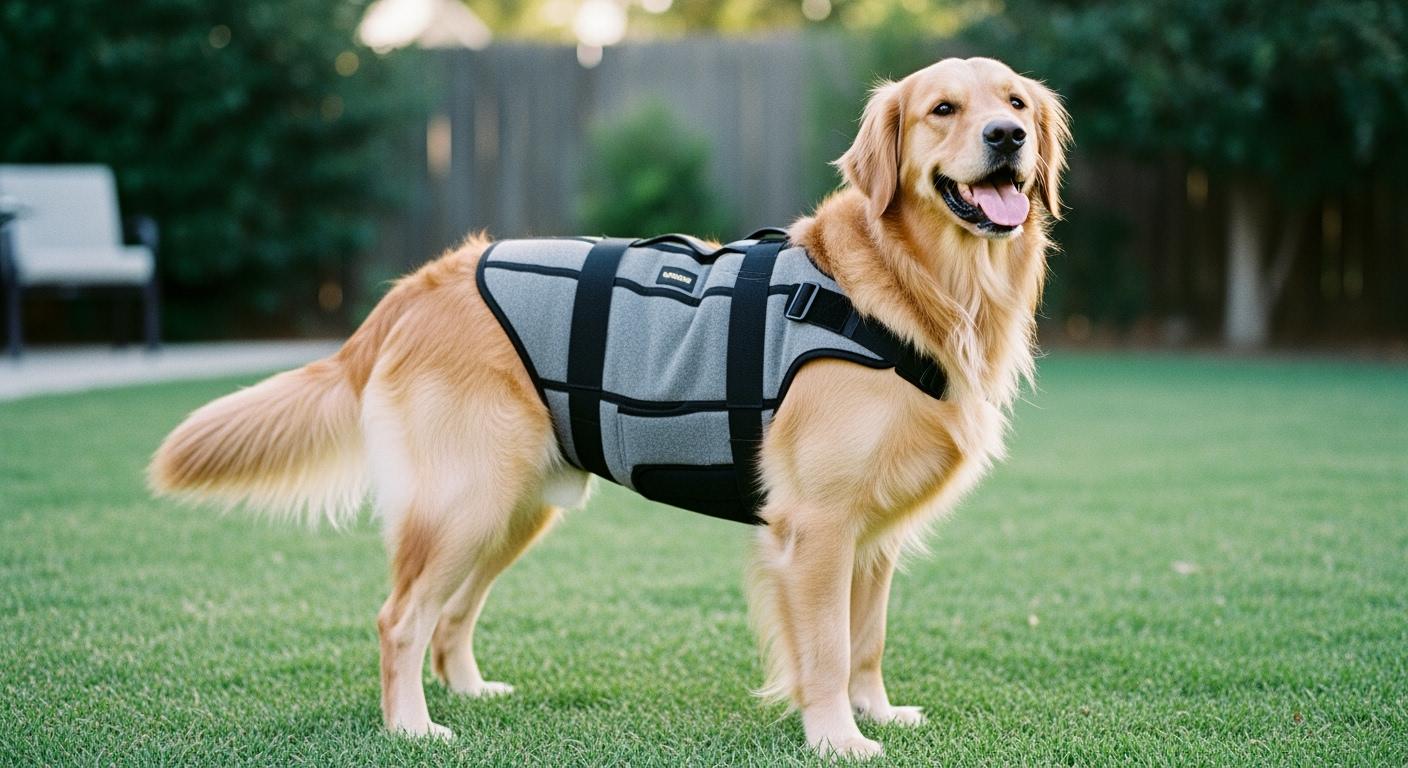
When a dog back brace for large dogs starts to roll under the belly, the problem is usually not simple sizing. The belly strap can fold into a tight cord, the back panel can slide forward toward the shoulders, and the brace may stop supporting the spine where it should. Red marks, stiff walking, or refusal to stand are signs that the brace structure is not holding position during real movement.
For large dogs, belly strap rolling and back panel sliding often come from the same design failure: too little surface area, too short a back panel, or too little structure to resist torso weight. A brace that shifts during routine standing, sitting, or turning stops being a support device and becomes a source of pressure, friction, and avoidance.
Why Back Braces Roll and Slide on Large Dogs
Three things go wrong. They often happen together, and they share a single root cause: the brace cannot hold its position when the body shape changes.
Quick Fit Check Before You Tighten the Brace
Before tightening the straps, check whether the brace is failing because of structure rather than size:
If the belly strap rolls into a narrow cord, the support area is too small for the dog’s torso load.
If the back panel slides toward the shoulders, the panel may be too short or poorly anchored for a deep-chested body shape.
If red marks appear along one edge, the pressure is being concentrated instead of distributed.
If the dog short-steps, freezes, or refuses to rise, remove the brace and reassess the fit before the next session.
Tightening the same narrow strap usually makes pressure worse. For large dogs, a wider belly panel, longer back coverage, and semi-rigid stay structure are usually more important than simply pulling the straps tighter.
Rising from Rest Changes Everything
When a dog lies down, the belly is relaxed and the spine is relatively straight. Stand up, and the belly stretches, the ribcage expands, the back arches slightly. A brace that fit ten seconds ago now sits on a different shape.
Here is what happens mechanically: a narrow belly strap under a heavy torso has almost no surface area resisting lateral force. When the dog rises and the belly elongates, the strap edge catches body contour and begins to roll. Once rolling starts, the contact patch shrinks further, concentrating the entire tension load into a thin line. That line digs in. The dog feels a sharp pressure band across the soft underside. It tightens its abdomen in response, which pulls the strap even tighter. The rolling accelerates.
In under five seconds, a flat support strap becomes a cord cutting across the belly. The back panel, now anchored to a rolling strap that has migrated forward, tilts and loses contact with the spine. Support is gone.
You can verify this pattern without waiting for red marks. After a 10-minute wear session, slide two fingers under the belly strap at its center point, then at each edge. If the tension feels even across all three points, the strap is holding flat. If the center feels tighter and the edges feel loose, the strap has begun rolling inward. That is your early warning.
Deep Chests Pull Panels Forward
Large breeds carry a structural challenge that smaller dogs do not: the chest is deeper than the waist is wide. When the dog lowers its head or steps forward, the chest wall moves forward and downward relative to the spine. A back panel that ends mid-ribcage has nothing behind it to resist this pull. The panel rides the chest forward like a sleeve on a piston.
The result: the back panel bunches behind the shoulders, the spine is exposed mid-back, and the brace is now supporting the wrong anatomical zone entirely.
This is not a chest problem. It is a panel-length problem. A back panel that extends from the shoulder zone to the hip zone distributes the forward pull across a longer anchor surface. Multi-point adjustment at the chest, belly, and rear anchor points lets you tension each zone independently, so the chest strap does not drag the entire brace with it.
| Real-use failure | What the caregiver sees | Why it happens | Better design choice |
|---|---|---|---|
| Belly strap rolls under the dog | Strap forms a tight cord, not a flat band | Narrow strap with minimal surface area collapses under torso weight | Wide contoured belly support that resists edge rolling |
| Brace slides forward toward chest | Back panel bunches at shoulders, spine exposed | Short panel cannot anchor against deep-chest forward pull | Extended back panel with independent zone tensioning |
| Back panel lifts from spine | Visible gap between brace and back | Soft unstructured panel folds or bows outward | Semi-rigid stays that hold panel contour against the back |
| Dog walks stiffly or short-steps | Hesitant gait, shortened stride | Brace edge pressure or belly constriction limits natural movement | Padded edges and wide belly band that avoids diaphragm pressure |
| Skin reddens under an edge | Redness or abrasion marks visible after removal | Edge binding concentrates friction on one narrow line | Rolled or padded edge finish with breathable inner facing |
| Dog refuses to stand or stays lying down | Avoidance behavior, reluctance to rise | Pain or pressure spike during the transition from lying to standing | Wider belly support plus gradual wear-in schedule; vet evaluation |
In practice: Run a 15-minute stand-sit-stand cycle at home. Count how many times the back panel shifts more than half an inch. More than one shift per three cycles means the panel length or anchor configuration is not holding for this dog’s body shape.
The Torso Weight Problem
Large dogs carry substantial mass through the torso. When they stand or turn, that mass creates lateral force against any encircling strap. A narrow strap presents a thin contact edge to this force. The edge catches, the strap folds, and the entire brace rotates around the fold line.
This is why belly support width matters more than strap tension. Tightening a narrow strap does not stop it from rolling; it just makes the rolled cord tighter and more painful. A wide belly panel resists rotation because its edges sit far enough apart that lateral force cannot lever one edge over the other.
After your dog wears the brace for 10 minutes, run your hand under the belly support and feel for moisture. A damp under-layer means the lining is trapping heat and humidity against the skin. Over multiple sessions, this leads to skin softening and increased friction sensitivity. A dry under-layer after the same interval tells you the breathability is working for this dog in this environment.
| Status | What you see after use | What it means |
|---|---|---|
| Green | Brace stays flat and centered, dog breathes normally, no marks or rubbing after removal | Fit is holding — safe to continue at current duration |
| Yellow | Light edge rolling, faint pressure line that fades within minutes, small forward shift, dog hesitates briefly | Adjust strap balance and panel position — recheck after next session |
| Red | Rolled strap forming a cord, skin damage or persistent redness, shallow breathing, panic, refusal to move, swelling | Stop use immediately — remove brace and consult your veterinarian |
Structure That Holds vs. Structure That Fails

Three structural decisions separate a brace that holds position from one that does not. None of them are about how tight the straps are.
Belly Support Width
A wide belly panel does two things a narrow strap cannot. First, it spreads torso weight across enough surface area that no single point bears concentrated pressure. Second, the distance between its upper and lower edges creates a mechanical resistance to rotation: the force required to roll a wide panel is proportionally larger than the force required to roll a narrow one, because the lever arm is longer.
For large dogs, this difference is not marginal. The same torso weight that collapses a 1.5-inch strap into a cord barely deflects a 4-inch contoured panel. The panel stays flat. The support stays centered. The dog breathes against the panel rather than against a tight line.
This is one reason a back support solution built around wide-panel load distribution performs differently in daily use than a strap-based design — the physics of pressure distribution change with surface area, not with strap tension.
Back Panel Length and Stay Structure
A short back panel ends before it can anchor behind the deepest point of the chest. It gets pulled forward. An extended panel that spans shoulder zone to hip zone cannot be pulled forward by chest movement alone, because the rear half of the panel is anchored against the relatively stable mid-to-lower back. The forward pull from the chest strap is distributed across the entire panel length rather than concentrated at the front edge.
Semi-rigid stays add a second layer of resistance. Without stays, even a long panel can fold longitudinally when the dog bends or twists. A fold line concentrates pressure along a crease and breaks spinal contact. Stays prevent that fold. They keep the panel flat against the back so that support is continuous from top edge to bottom edge, not intermittent where the fabric happens to make contact.
A back brace with semi-rigid stays and an extended back panel addresses both failure modes at once: the length resists forward migration, and the stays resist longitudinal folding. The combination matters more than either feature alone.
Edge Finish and Lining Choices
A bound edge that sits flat against the skin distributes friction across the binding width. A raw or thinly finished edge concentrates it on a single line. Over a 30-minute wear session on a moving dog, that concentration is the difference between a faint temporary mark and a surface abrasion that makes the dog flinch at the next session.
The inner lining matters on a different timeline. A lining that traps moisture keeps the skin damp underneath the brace. Damp skin softens and becomes more vulnerable to friction damage within a single session. A lining that wicks moisture or allows airflow keeps the skin surface dry. Dry skin tolerates contact pressure longer. This is not a comfort preference. It is a skin-integrity variable that directly controls how long a dog can wear a brace before tissue irritation begins.
| Design detail | What fails in daily use | What holds up | Main limitation |
|---|---|---|---|
| Back panel length | Short panel leaves mid-spine unsupported | Extended panel spans shoulder zone to hip zone | Adds material weight and may retain more heat |
| Chest and belly anchor | Narrow strap rolls into a cord under torso load | Wide contoured anchor resists edge rolling through surface-area advantage | Requires closer contour matching to the individual dog |
| Strap system | Thin webbing with single tension point | Wide padded straps with independent zone adjustment | More adjustment points to verify during each fit check |
| Edge finish | Unfinished or thin binding rubs skin raw | Rolled or padded edge binding distributes contact pressure | Edge material can stiffen after repeated washing |
| Panel structure | Soft unstructured fabric folds under compression and torsion | Semi-rigid stays keep panel contour flat against the spine | Firmer panels need a graduated wear-in schedule |
When a Back Brace Is Not the Right Match
A brace provides external support to the thoracic and lumbar spine. If a dog’s primary problem is in the hips, not the back, a back brace will not address it. The support ends above the hip joint. A dog with hip weakness may need a different support strategy than a dog with spinal instability, and using a back brace for a hip problem puts pressure on the wrong anatomical zone.
Breed conformation changes the equation too. Dogs with very deep chests and narrow waists, such as sight hounds, present a body shape where the chest-to-waist diameter change is steep. A brace that grips the chest adequately may be too loose around the narrower waist, creating a gap behind the ribcage where the panel loses contact. Conversely, barrel-chested breeds may need more panel flex than a stiff brace provides, because the ribcage expands significantly with each breath cycle.
A back support brace fitting guide can walk you through the measurement points that matter for these shape differences. But some conformations simply fall between available size breaks. When that happens, forcing a brace to work by overtightening straps creates pressure problems faster than it solves support problems.
The wear environment determines how long a brace can stay on safely. A brace worn indoors on a resting dog faces different demands than one worn during outdoor movement in warm weather. Heat buildup under the panel accelerates skin softening. Moisture from humidity or the dog’s own perspiration changes how the lining behaves against the skin. A back brace used during structured rehabilitation sessions may perform well in 20-minute indoor intervals but become uncomfortable after 10 minutes outdoors on a warm day. The brace did not change. The conditions did.
Disclaimer: The fit checks and observations described here assume a short-coated dog where skin contact and pressure marks are visually observable. Double-coated breeds may show subtler rub marks that require hand-checking rather than visual inspection — run your fingers under the brace edges slowly rather than relying on sight alone. If the dog’s leg or spinal conformation falls outside typical breed norms, particularly dogs with angular limb deformities or pronounced swayback, the standard fit checks described here may not catch every pressure point.
Frequently Asked Questions
How do I know if a back brace is the right support type for my large dog?
Match the brace type to the anatomical zone that needs stabilization. A back brace supports the thoracic and lumbar spine. If the problem is in the hips, a hip brace addresses a different set of joints. If the dog drags paws or knuckles, that is a neurological symptom that a back brace alone cannot resolve. A veterinarian can identify which zone needs support, and that diagnosis determines which brace type fits the situation.
Why does my dog’s back brace fit fine at first, then shift after a few minutes?
Body heat softens the materials and the dog’s body shape changes as it moves from a standing pose into walking and turning. Straps that were tensioned against a static standing shape loosen when the dog exhales fully or rounds its back. This is a strap-architecture problem, not a slipping problem. Multi-point tensioning with wide anchor panels resists this better than single-point strap tightening.
Can a back brace be used alongside other support devices?
Only if the devices do not overlap or interfere. A back brace combined with a lift harness may create stacked pressure zones where the rear strap of the harness sits directly under the back panel’s edge. That double layer concentrates force. Check for clearance between each device’s contact zones, and introduce any combination in short supervised sessions first.
How long can a large dog safely wear a back brace in one session?
There is no single number. Duration depends on the lining’s moisture management, the ambient temperature, the dog’s activity level, and the fit quality. The practical limit is the point where the skin under the brace transitions from dry to damp, or where the dog begins to shift its movement pattern. Start with 10 to 15 minutes and extend gradually, checking skin condition and brace position after every session.
What is the most common reason a back brace fails on a large dog?
The belly anchor is too narrow for the torso weight it carries. When a large dog stands, turns, or changes position, a narrow strap rolls under the load, the back panel tilts, and support is lost. This is a structural limitation of the strap design, not a fit error. Wider belly panels resist rolling because their edge-to-edge distance creates mechanical resistance to rotation.
For pet brands, rehabilitation product distributors, or private-label programs comparing dog back brace designs, GaitGuard can help review belly support width, back panel structure, edge finish, and size-range planning for large-dog brace products. See our custom dog brace manufacturer options or send an RFQ with your target size range and use scenario.
