
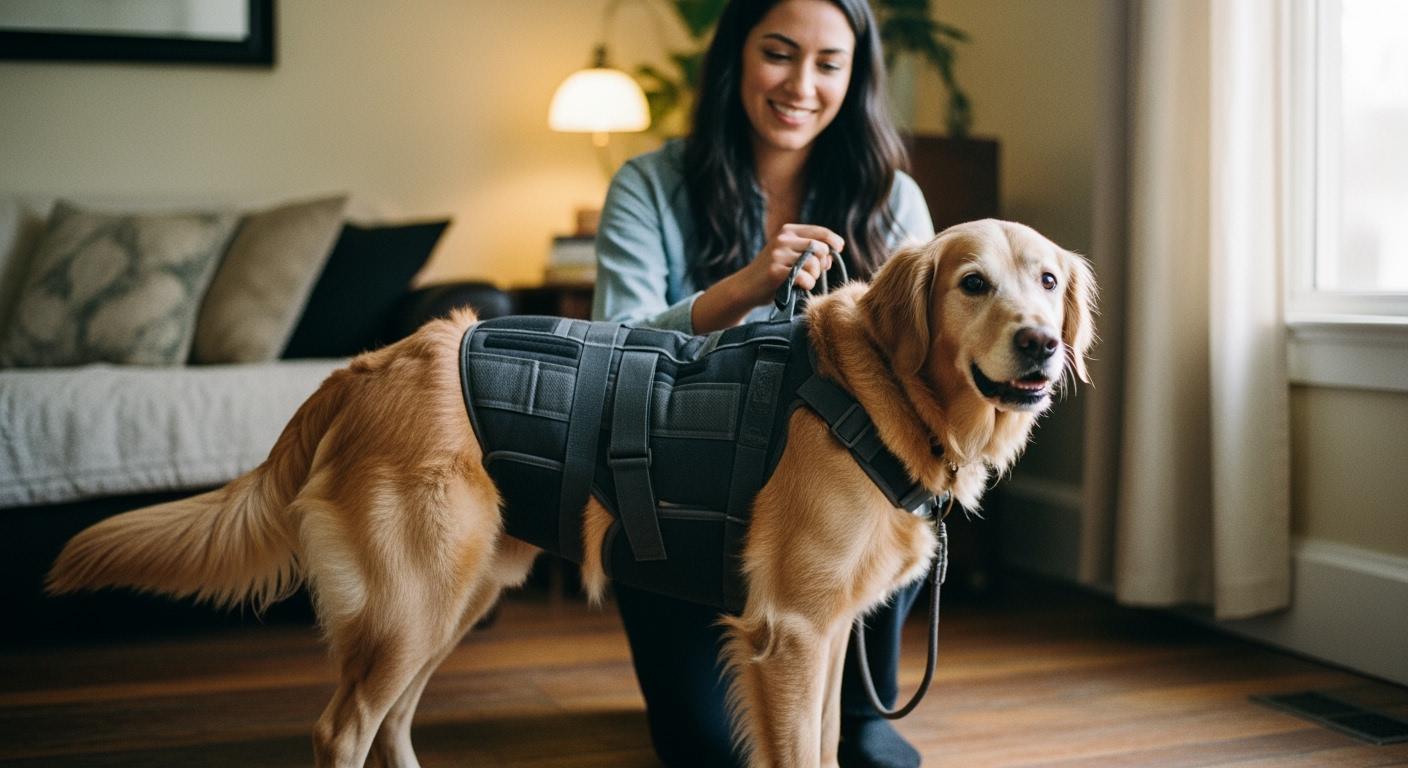
The back sags. Steps shorten to half their old length. The dog moves across the room like every stride costs something. A bulky brace goes on—and the dog freezes. Refuses to walk. That is not a fit problem. That is a structural mismatch between what the brace demands and what an arthritic spine can tolerate. A dog back brace for arthritis that fights the dog’s movement instead of guiding it has already failed. This article covers why lightweight structure, stable anchoring, and materials that breathe matter more than how tight the straps go. It does not cover IVDD emergencies or sudden paralysis.
Where a Dog Back Brace for Arthritis Fails in Real Use
Bulky panels make a stiff dog freeze
A panel that feels supportive in your hands can become a problem the moment the dog takes a step. Here is the chain: a thick, rigid back panel resists flexion. The dog initiates a stride, the spine tries to bend, the panel says no. Force concentrates at the panel edges—typically the lumbar and shoulder transitions—where the rigid zone meets the flexible body. The dog feels that resistance as a block, not a guide. Freezing is the predictable result. The same panel, thinned to a semi-rigid profile and paired with flexible side zones, distributes the same stabilizing force across a larger transition area. The spine still gets guidance. The panel no longer acts like a wall. Dogs with arthritis need that difference—they have lost the muscle mass to push through resistance, so the brace must work with what movement remains rather than against it.
When the brace slides backward mid-stride
Backward drift is one of the most common failure modes and one of the easiest to miss during a quick fit check in the living room. A brace looks centered at a standstill. Ten strides in, it has crawled an inch toward the tail. The lumbar region—often where arthritic changes concentrate—loses coverage. The brace is now sitting over a part of the spine it was not designed to stabilize. Why does this happen? Most back braces anchor at a single plane: around the belly. Walking generates forward-and-back shear with every stride. A single anchor plane has no geometry to resist that shear—fabric slides over fur, the brace migrates. A chest-and-belly dual-anchor design creates two fixed points. Shear force at one anchor gets countered by the other. The brace stays where it was put. Walk the dog 10 minutes, then check whether the back edge of the panel has moved more than half an inch. That is the only fit test that matters.
Heat, pressure, and why soft fabric alone is not enough
Two separate problems converge under a poorly designed back panel. Heat builds because non-breathable laminate traps body warmth against the coat. Within 15 to 20 minutes, skin temperature under the panel rises enough to make the dog restless. Moisture follows—either from ambient humidity or light sweating—and softens the skin. That softened skin, pressed by even moderate strap tension, develops red marks faster than dry skin would. Soft fabric wraps feel gentle in the hand but do nothing to control lateral back sway, which is the movement pattern that matters for an arthritic spine. When the dog walks, the back oscillates side to side. A purely soft wrap stretches with that oscillation instead of limiting it. The dog’s muscles still do all the work, and the brace becomes a warm blanket rather than a support device. A semi-rigid spine panel paired with breathable neoprene splits the job: the panel controls sway, the neoprene manages heat and contact comfort. After a 20-minute walk, lift the brace and touch the skin beneath. Dry and cool means the ventilation is working. Damp or hot means the material is not moving air—regardless of what the product description says.
In practice: Run your fingers under the brace edges after every walk for the first week. Damp heat in one spot, repeated across multiple walks, predicts a pressure sore within days. Adjust or stop before the skin breaks.
Real-Use Failure vs. Better Structure
| Real-use failure | Why it happens | Better structure |
|---|---|---|
| Back sag during slow walks | Weak support or poor fit | Lightweight semi-rigid support over the spine |
| Brace shifts backward | Loose or unstable anchoring | Stable chest and belly anchoring |
| Dog freezes or resists walking | Bulky or stiff panels block movement | Low-profile back panel with flexible side zones |
| Heat builds under the panel | Non-breathable fabric traps warmth | Breathable neoprene or ventilated lining |
| Strap edges leave pressure marks | Thin straps or rough edges | Wider strap contact and smooth edge binding |
What Back Brace Structure Works Better for Stiff Walks
Lightweight semi-rigid support over the spine
The difference between a brace an arthritic dog tolerates and one it rejects often comes down to a few ounces and a few millimeters of panel thickness. A semi-rigid panel—firm enough to hold shape under load, thin enough to flex with the spine’s natural curvature—hits a middle ground. It limits lateral sway and excessive flexion without locking the back into a single position. That matters because arthritic joints stiffen further when immobilized. A spine held rigid for hours becomes harder to move, not easier. The best back brace designs guide the spine through its remaining range rather than freezing it at one angle. After a walk, watch the dog lie down. If the brace forces a straight-back posture that the dog immediately wriggles out of, the panel is too stiff for daily use. A dog that settles into a natural curl without fighting the brace has a panel profile that fits its actual movement needs.
Chest and belly anchoring: why two-point fixation matters
A brace that only wraps the belly is a single-point anchor on a moving cylinder. The mechanical problem is straightforward. Each stride the dog takes generates a forward shear vector at the contact surface—fur and fabric slide past each other. Without a counteracting force at the front of the torso, the brace walks itself backward, stride by stride. A chest strap creates that counteracting force. Tension at the chest pulls forward. Tension at the belly resists rotation. Together they lock the brace in place without requiring excessive strap tightness. That last part matters. Tighter straps do not compensate for missing anchor points—they just concentrate pressure. A properly anchored back brace uses strap tension to prevent migration, not to squeeze the dog into submission. Check this after a 10-minute walk on a slight incline. If the brace rides up at the shoulders or down at the hips, the anchor geometry is wrong for that dog’s build—no amount of strap tightening will fix it.
Materials that breathe and edges that do not dig in
Neoprene gets chosen for back braces because it provides cushioning and conforms to body contours. But not all neoprene is equal. Closed-cell neoprene blocks airflow entirely—heat and moisture have nowhere to go. Open-cell or perforated neoprene allows some air exchange while keeping the cushioning benefit. The trade-off is durability: more breathable neoprene breaks down faster under repeated moisture exposure. For a brace worn 30 to 60 minutes daily on dry walks, breathability wins. For a brace that will get wet regularly, a denser material with a ventilated liner may hold up longer. Edge binding matters just as much. A raw-cut neoprene edge rubs against the skin with every stride. Folded and stitched binding distributes that contact across a smooth surface. Run a finger along the inner edge of the brace before putting it on. Any roughness you feel, the dog will feel amplified over a thousand strides.
| Feature | Low-profile support | Bulky brace |
|---|---|---|
| Movement | Allows natural flexion | Blocks or restricts motion |
| Skin tolerance | Reduces rubbing and heat buildup | Increases friction and warmth |
| Weight | Lightweight | Heavy |
| Position stability | Fits close to body | May shift or bunch up |
| Support style | Guides the back gently | May force stiff posture |
When a Back Brace Is Not the Right Answer
Fit testing during short supervised walks
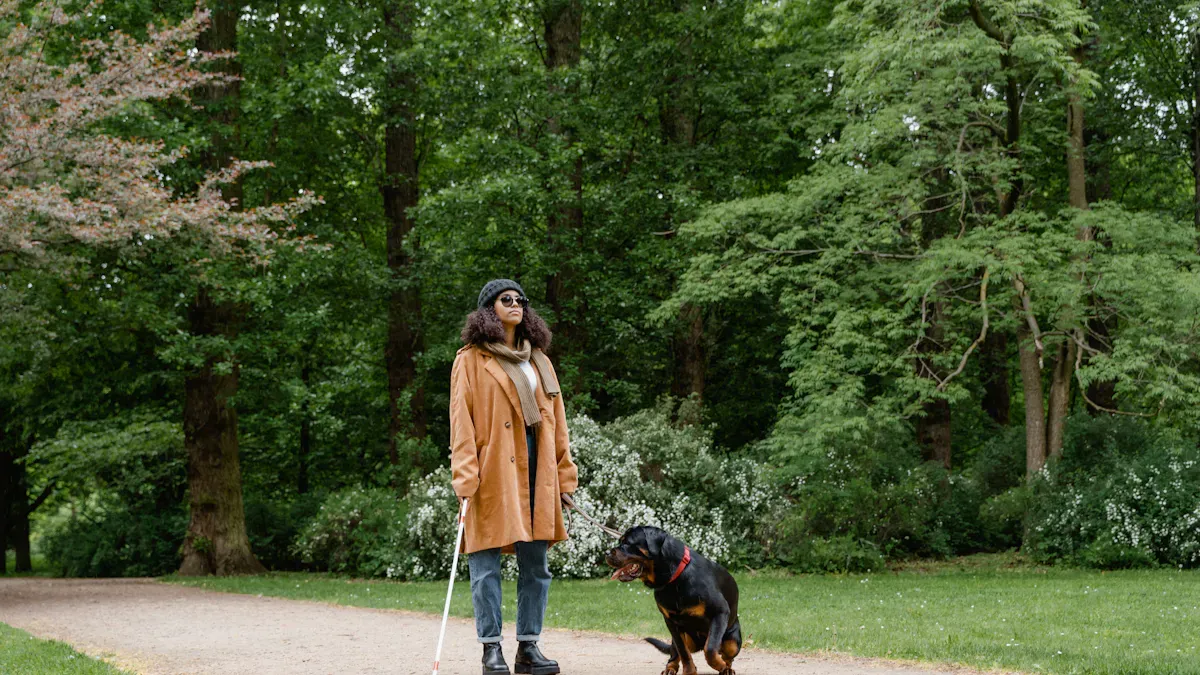
A standing fit check tells you almost nothing. The brace must prove itself in motion. Start with a 15-minute walk on flat ground. Watch three things: whether the back edge of the panel stays within half an inch of its starting position, whether the dog’s stride length looks roughly normal for its condition, and whether the dog shows signs of distraction by the brace—repeated turning to sniff it, sitting down mid-walk, or pressing against walls. Stride change is the most reliable early signal. A dog that shortens its stride by a visible margin within the first five minutes is telling you the panel is interfering with normal spinal mechanics. The fix is not more wear time to “get used to it.” The fix is a different panel profile or lower strap tension. After the walk, remove the brace and check the skin along the spine, behind the shoulders, and under the belly band. Pink marks that fade within 15 minutes are normal. Marks that stay red past 30 minutes or feel warmer than surrounding skin are pressure warnings. Do not extend wear time until those warnings stop appearing.
Disclaimer: These fit checks assume a short-coated dog where skin changes are visible at a glance. Double-coated breeds—Huskies, Malamutes, Shepherds, and similar—hide rub marks under dense fur. For these dogs, replace visual skin checks with a hand-check: run your palm slowly along the spine and under every strap edge after each walk. Feel for heat, dampness, or the dog flinching at light pressure. A visual-only check on a double coat misses early pressure sores. This brace guidance also assumes a dog whose body conformation falls within typical breed proportions. Dogs with angular limb deformities, very deep or very narrow chests, or pronounced spinal curvature may experience pressure points that the standard fit checks described here will not catch.
Safety signals: continue, adjust, or stop
| Signal | What the caregiver sees | Action |
|---|---|---|
| Green | Dog walks calmly, brace stays centered, no skin change | Continue use and monitor |
| Yellow | Mild shifting, light rubbing, mild reluctance, warmth under fabric | Adjust fit, shorten wear time, check skin |
| Red | Worsening pain, toe dragging, sudden weakness, repeated collapse, hot red skin, swelling, panic, or breathing stress | Stop use and contact veterinarian |
Low-impact movement that supports brace use
A back brace works best paired with the right kind of movement—short, flat, predictable walks where the dog sets the pace. Swimming or hydrotherapy provides support through water buoyancy while the brace adds stabilization above the surface, a combination that works for dogs who tolerate both. What does not work: stairs, sudden turns on slick floors, rough play with other dogs, or any activity where the dog might twist sharply. The difference between a back brace and a lift harness also matters here. A brace stabilizes the spine for independent walking. A lift harness offloads weight when the dog cannot support itself. Using a brace when the dog needs weight offloading—or vice versa—produces the wrong outcome regardless of how well either device is made. Match the device to what the dog can still do, not to what the condition label says.
FAQ
How long should a dog wear a back brace for arthritis each day?
Start with 15 minutes. That is enough time for fit problems to surface and short enough that minor issues do not become injuries. If the dog tolerates the brace with no skin changes and no gait disruption, extend to 30 minutes after three to five successful sessions. Most arthritic dogs do well with 30 to 60 minutes of supported walking per day, broken into two sessions. A brace is a walking aid, not a resting device—it should come off when the dog is lying down or unsupervised.
Can a back brace make arthritis stiffness worse?
It can, if the panel is too stiff or the dog is forced to wear it too long. An overly rigid brace holds the spine in one position. Arthritic joints need some movement to stay functional. The wrong brace—or the right brace worn too long—can increase stiffness by preventing the small spinal motions that keep joint fluid circulating. A brace worn past the point of fatigue also encourages compensatory movement patterns, where the dog shifts weight to other joints. That is how a back support device ends up stressing hips or shoulders that were not the original problem.
What is the difference between a back brace for arthritis and one for IVDD?
Arthritis braces focus on guiding movement and reducing strain during walking. IVDD braces focus on restricting spinal motion to protect a disc that has already herniated or is at high risk. The structural demands are different. An IVDD brace typically uses a more rigid panel and stricter motion limitation because the consequences of a wrong move—disc compression into the spinal cord—are severe. An arthritis brace prioritizes comfort, breathability, and partial support during low-impact movement. Using an IVDD-level brace on an arthritic dog can cause the freezing and resistance described above.
