
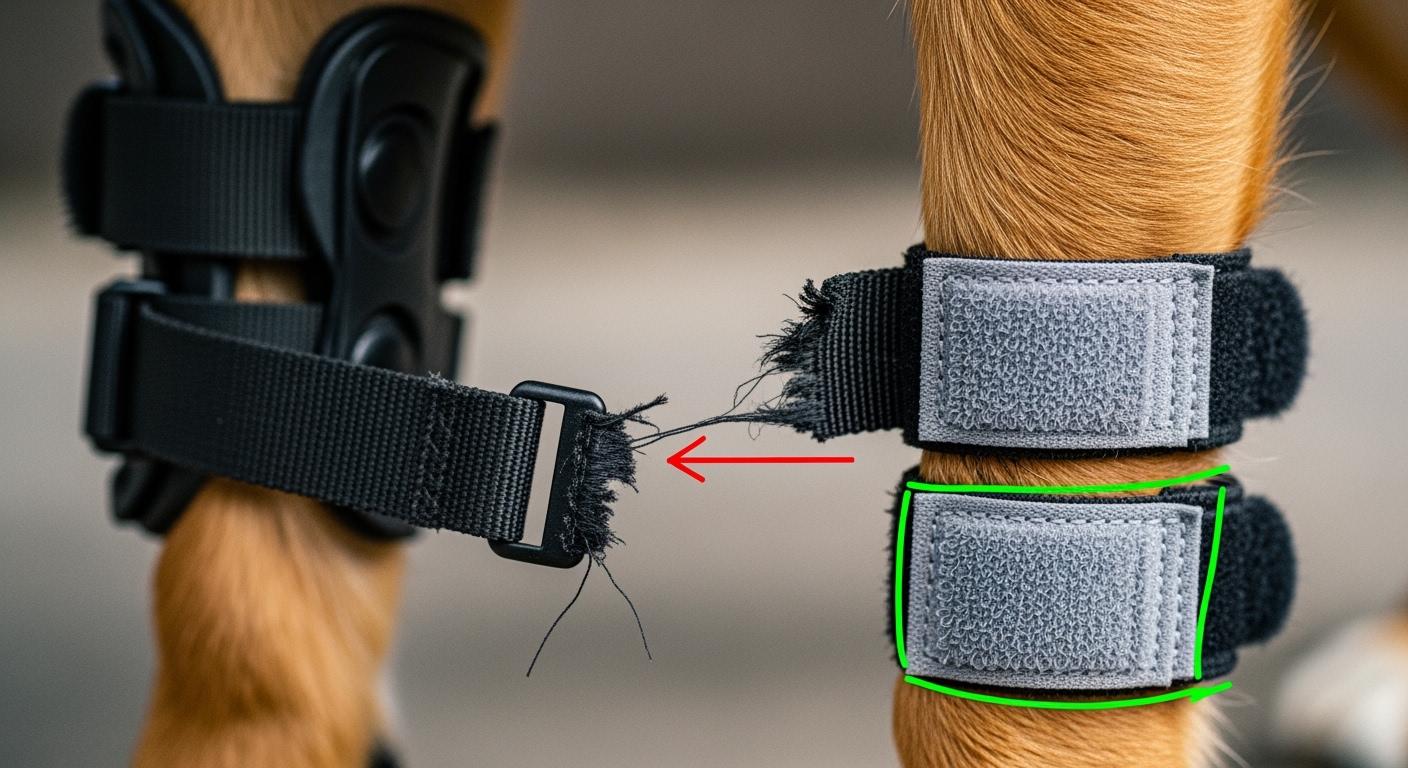
A brace that sits flush while the dog stands still can slide three inches down the leg within ten minutes of walking. The straps are not loose. The closure is not failing. The problem is anchor geometry — the contact patch where the brace grips the limb is too narrow to resist the forces generated during a stride cycle. When that patch cannot hold, the brace shifts. And when the brace shifts, support vanishes at the exact moment the joint needs it most.
This is dog brace anchor point failure. It is not a matter of pulling straps tighter. It is a matter of contact area, strap path, and how force moves through the brace-and-limb system once the dog is in motion.
Why Anchor Points Fail During Movement
A static fit check tells you almost nothing about anchor stability. Standing still, the limb is fully extended and the muscle bellies are relaxed — the brace contact surface sits against a different contour than it does mid-stride. Once the dog walks, the thigh and shoulder muscles engage, the ribcage expands and contracts with each breath cycle, and the belly tucks and releases with every hind-leg push-off. These shape changes cycle roughly twice per second at a walking pace.
Here is the causal chain that turns a standing-fit brace into a sliding one: a narrow anchor strap wraps a limb segment that changes circumference during gait → the strap cannot maintain uniform contact pressure across the full cycle → contact pressure peaks at the leading edge of the strap where the limb is narrower → that edge becomes a pivot point → rotational force around the pivot edge rotates the entire brace around the limb → the hinge or support panel drifts off the joint line → the dog compensates by altering gait → the opposite leg takes excess load.
This sequence is not visible from a standing inspection. It unfolds over steps, not seconds. And it explains why wider anchor zones — shaped to match the limb’s taper, not just cut wider from the same flat pattern — resist rotation in a way that strap tension alone never can. A wide zone creates an anti-rotation plane: two parallel edges separated by enough distance that lateral force cannot pivot the brace around a single edge. The physics is straightforward. The design execution is not.
Why tapered limbs defeat narrow straps
Most dogs have limbs that taper from proximal to distal — the thigh is thicker than the ankle, the upper foreleg broader than the carpus. A strap anchored on a tapered segment sits against a slope, not a cylinder. Under tension, it wants to slide toward the narrower end. The steeper the taper, the stronger that migration force.
Breeds with pronounced taper — Dachshunds, Greyhounds, Dobermans — amplify this effect. A circumference change of 30% or more between anchor points means the brace is gripping two different limb profiles with the same strap geometry. One end bites. The other floats. Floating leads to rotation. Rotation leads to failure.
After a 10-minute walk, flip back the brace edge and feel the skin underneath. Dry and mark-free means the contact pressure stayed distributed. Damp with a defined red crease line along the strap edge means pressure concentrated there — the strap was pivoting, not gripping. This is an observable check that costs nothing and reveals more about anchor stability than any static fit test.
Comparison: Failure Patterns and Design Responses
| Failure pattern | Likely anchor problem | Why tightening may fail | Better design choice |
|---|---|---|---|
| Upper strap slides down | Narrow anchor zone | Pressure focuses on small area | Wider contact zone, shaped to limb |
| Brace rotates around limb | Weak anchor points | No anti-rotation plane | Anti-rotation strap geometry |
| Strap edge digs into skin | Thin strap, poor padding | Skin breakdown from pressure | Softer edge binding, distributed padding |
| Closure loses tension | Poor closure placement | Repeated adjustment needed | Adjustable closure, clear tightening order |
| Hinge drifts off joint line | Misaligned support panel | Brace shifts during movement | Joint-aligned hinge, stable anchor zone |
Signal Table: What to Watch and What to Do
| Signal level | What the user sees | Action |
|---|---|---|
| Green | Brace stays aligned, skin clean, dog moves naturally | Continue use, check fit twice daily |
| Yellow | Mild drift, light rubbing, repeated adjustment needed | Adjust fit, shorten wear time, monitor |
| Red | Swelling, heat, cold toes, open sores, worsening limp, refusal to walk, chewing through straps | Stop use, check skin, contact veterinarian |
The Real Failure Signs
Anchor failure announces itself through a handful of signals. None of them are subtle once you know where to look. But they are easy to misread as a simple adjustment issue — one more crank on the strap, one more repositioning of the panel. That misreading is where skin damage and gait compensation start.
Sliding after short walks
The brace begins in position. Ten minutes later, the upper strap has migrated half an inch toward the paw, or the knee hinge has drifted above the joint line. Half an inch may not sound like much. But a hinge offset by half an inch changes the lever arm through which force enters the knee — the joint sees a twisting load it was not designed to handle. The dog shortens stride in response. The opposite leg absorbs the difference.
Mark the strap position with a small piece of tape at the start of a walk. Check it at ten minutes. If the strap has moved more than half an inch relative to the tape, the anchor zone is not holding — regardless of how tight the strap felt at the start.
Rotation during turns and sitting
Rotation is harder to catch than sliding because the brace may return to near-normal position when the dog stands square again. Watch the dog during a direction change, or when transitioning from a sit to a stand. If the brace panel twists around the limb during that movement and does not self-correct, the anchor lacks an anti-rotation plane.
The fix is not more tension. Tension on a single narrow strap increases the pivot effect — more force on the same small edge. The fix is a wider anchor footprint with at least two separate attachment points spaced far enough apart to resist the twisting moment. A single wide strap backed by a second stabilizing strap above or below the joint changes the force equation from a pivot to a distributed grip.
Strap-edge pressure marks
Remove the brace after a walk and check the skin along the strap path. Mild pinkness that fades within 20 minutes is normal — the skin needs time to rebound from contact pressure. Red crease lines that persist longer, damp padding, or any broken skin mean the strap edge is concentrating force instead of spreading it.
Dogs with thin skin, short coats, or little subcutaneous fat — Greyhounds, Whippets, senior dogs with muscle loss — are more vulnerable. The same strap pressure that a thick-coated Labrador tolerates may abrade a thin-skinned breed within a single session. For double-coated breeds, the marks may be harder to see — you will need to part the fur and check by feel rather than by sight.
Disclaimer: This visual check assumes a short-coated dog where strap marks are visible against the skin. Double-coated breeds may show subtler rub marks that need hand-checking rather than visual inspection. Part the fur along the strap path and feel for heat, swelling, or texture change — what you cannot see may still be developing.
Gait changes that signal the brace is fighting the dog
A brace that cannot hold anchor forces the dog to adapt. Common compensations include a shortened stride on the affected leg, rear paws rotating outward as the dog tries to stabilize against the twisting brace, and hesitation when shifting weight onto the braced limb. Some dogs high-step. Some freeze mid-walk. Others chew at the straps.
These gait changes are not evidence that the dog “needs to get used to” the brace. They are evidence that the brace is introducing load patterns the dog’s body was not designed to manage. A dog that walks differently with the brace than without it is telling you something about anchor stability — listen before the compensation becomes a secondary injury.
Note: If the dog refuses to walk, drags a paw, or shows swelling, heat, or cold toes, stop brace use and contact a veterinarian. These are not fit-adjustment issues.
Anchor Design: Why Geometry Beats Tension
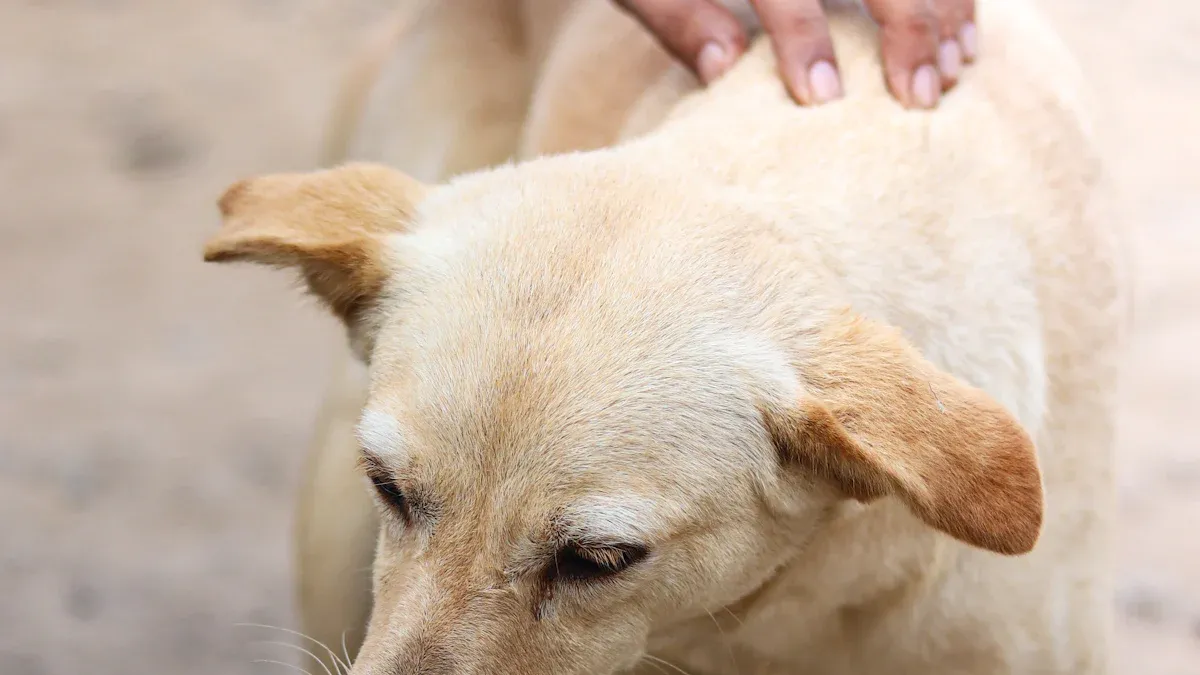
The difference between a brace that stays put and one that migrates is rarely the strap material or the closure type. It is the anchor geometry — how wide the contact zone is, how many attachment points share the load, and whether the strap path crosses stable or compressible tissue.
Narrow single straps act as pivots, not anchors
A single narrow strap under tension behaves like a fulcrum. Lateral force — from a turn, a stumble, a shift in weight — pushes against one edge of the strap. With no second edge separated by meaningful distance, the strap becomes the axis around which the entire brace rotates. The tighter the strap, the sharper the pivot edge. The sharper the edge, the faster skin breakdown begins.
This is why brace fit decisions that ignore anchor zone width tend to produce the same outcome: a brace that passes a static inspection and fails within the first walk. Fit is not just circumference matching. It is anchor footprint matching.
Weak upper anchor zones create a cascade of problems
When the upper anchor — typically the top strap of a leg brace or the chest strap of a leg brace design — cannot hold position, every strap below it inherits an unstable reference point. The brace migrates downward as a unit. Belly straps drift under compression, potentially intercepting urine flow. Rear anchors twist asymmetrically, reducing clearance. Urine on brace fabric irritates the skin, progressing from redness to dermatitis and, if unchecked, bacterial infection.
The solution is an upper anchor that wraps a stable, low-taper segment of the limb with enough surface area to stay put under load. For hind-leg braces, the zone just below the stifle — where the femur meets the tibia — offers a relatively cylindrical segment that resists migration better than the highly tapered thigh or the bony hock.
Strap paths crossing soft tissue cannot anchor
Soft, compressible tissue — the belly, the inner thigh, the armpit — displaces under strap tension. The strap feels tight at application, then loosens as the tissue compresses underneath it. The user tightens again. The tissue compresses further. This cycle produces the slipping-rubbing pattern common in poorly anchored leg braces — a gradually tightening strap over gradually compressing tissue, until the skin underneath breaks down.
Strap paths should cross bony or muscular landmarks that resist compression: the tibial crest, the radius, the scapular spine. These structures do not yield significantly under strap pressure, so the anchor stays at the set tension throughout wear. Knee brace fit and anchor placement that avoids soft-tissue paths reduces the need for mid-wear adjustment by keeping the initial set tension effective.
Wider cuffs and load-spreading contact zones
A cuff that wraps two to three inches of limb spreads the same strap tension across three times the surface area of a one-inch strap. The physics is linear: triple the area, one-third the unit pressure, one-third the skin stress. But the manufacturing trade-off is real — wider cuffs need more precise patterning to avoid bunching inside the curve of the limb, and the edge finishing must be softer because the edge now contacts more skin. A poorly finished wide cuff causes more irritation than a well-finished narrow one.
Braces that address slipping and rubbing through anchor redesign tend to use multi-point strap configurations — two separate straps rather than one wide one — because independent tensioning allows the user to match the different circumferences at different levels of the limb. One strap tightens for the wider proximal segment. The other stays looser for the narrower distal segment. The brace grips both levels without pivoting.
When the Brace Is the Wrong Match
Some anchor failures are not design defects. They are match failures — the brace geometry was designed for a different limb profile, a different activity level, or a different wear condition than the dog presents.
Limb shape mismatch
A brace with a straight-cut interior profile cannot anchor on a steeply tapered limb. The contact area drops from the intended surface to a thin ring near the narrowest point of the taper, and all the anchoring load concentrates there. Breeds with a circumference change exceeding roughly 30% between the upper and lower anchor points are especially prone — the brace fits one level and floats on the other.
Knee braces that slip and rotate on small or oddly proportioned dogs often trace back to this mismatch. A brace patterned for a moderately tapered Labrador thigh will not anchor on a Greyhound’s sharply tapered leg, regardless of how carefully the circumference is measured.
Activity level mismatch
A brace that holds during a controlled leash walk may fail during a sprint, a stair climb, or a sudden direction change at the dog park. Higher activity generates higher lateral and rotational forces. If the anchor zone was only adequate for low-load conditions, it becomes inadequate under high load — and the failure can be sudden. The dog corners, the brace twists, the hinge is no longer aligned, and the leg takes an unprotected load at the exact moment it is most vulnerable.
Disclaimer: If the dog’s leg conformation falls outside the breed norms this brace was patterned for — particularly dogs with angular limb deformities, very deep chests, or muscle-wasting conditions that alter limb contour — the fit checks described here may not catch every pressure point. In these cases, a brace that passes the observable checks in this article may still develop hot spots during extended wear. Monitor more frequently and shorten wear sessions.
Closure and material mismatch
Hook-and-loop closures positioned over a skin fold or a high-flexion zone create pressure points that worsen with every step. The closure itself becomes an irritant. Stiff edge materials — unbound neoprene, hard-sewn seams — concentrate force along a line rather than a surface. The result is a red crease that exactly matches the edge geometry.
A stable brace anchors on stable tissue, distributes load across a surface rather than a line, and uses closures placed away from skin folds, tendon edges, and joint creases. These are not premium features. They are baseline requirements for a brace that is going to be worn on a moving animal for hours at a time.
When to stop use
Stop brace use and contact a veterinarian if the dog shows any of these: swelling above or below the brace, heat radiating from the skin under the brace, cold toes (suggesting circulation compromise), open sores or blisters, a worsening limp, or refusal to bear weight on the braced leg. These are not fit issues — they are medical issues that need professional assessment.
FAQ
Why does a brace that fits perfectly while standing slip after walking?
Standing fit tests a static contour. Walking fit tests a dynamic one — the limb changes shape with each stride as muscles engage and the ribcage expands. A narrow anchor zone that works on a static limb cannot maintain uniform contact pressure across a shape-changing surface. The strap edge becomes a pivot, and the brace rotates.
Will tightening the straps fix slipping?
Rarely. Tightening a narrow strap increases the pivot effect — more force on the same small edge, faster rotation, higher skin stress. The solution is a wider anchor footprint or a multi-point strap configuration that distributes load across a surface rather than concentrating it along a line.
How can I tell if anchor failure is causing my dog’s limp?
Remove the brace and walk the dog on a flat surface. If the limp improves within minutes without the brace, the brace is likely introducing rather than resolving instability. Check strap position after a short walk — half an inch or more of migration signals anchor failure.
What skin signs indicate the brace is concentrating too much pressure?
Red crease lines that trace the exact path of a strap edge, lasting more than 20 minutes after brace removal. Damp padding along the strap line. Any broken skin, blistering, or hair loss under a strap. Mild overall pinkness that fades quickly is normal; defined edge marks are not.
Are wider straps always better?
Wider straps reduce unit pressure but need more precise patterning to avoid bunching inside the limb curve. A wide strap with a poorly finished edge can cause more irritation than a narrow strap with a well-bound edge. Width alone is not the answer — edge finishing, strap path, and multi-point tensioning matter equally.
When should a brace be replaced rather than adjusted?
When the dog’s limb shape differs fundamentally from the brace’s intended fit profile — seen as persistent sliding despite correct tension, rotation that does not self-correct, or strap paths that cannot avoid soft tissue or skin folds. A brace that requires constant mid-walk adjustment to stay in position is not the right match for that dog’s anatomy.
