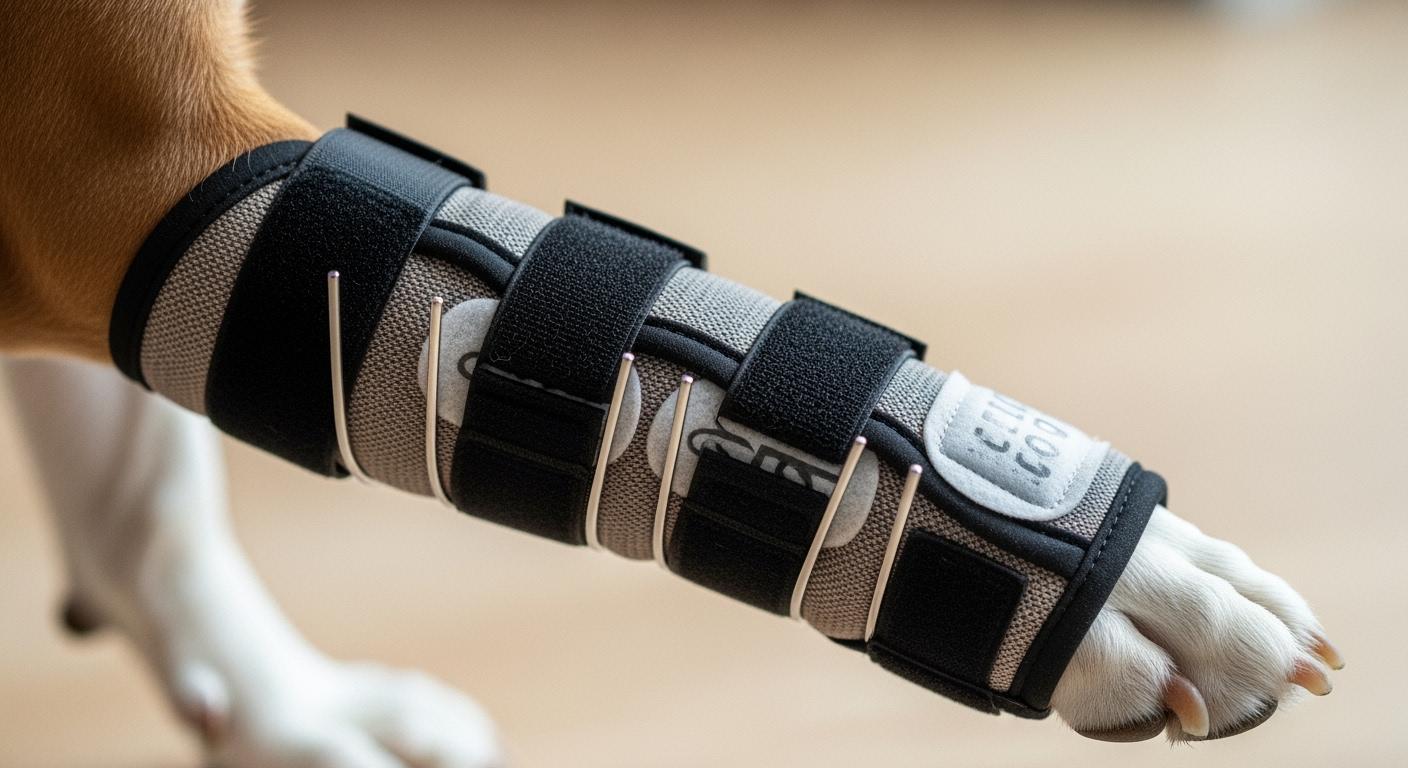
A metal stay inside a dog wrist brace is supposed to distribute support across the carpal joint. In practice, it often does the opposite. The stay concentrates force into a narrow line, the brace shifts as the wrist bends during walking, and what looked like a secure fit at rest becomes a source of focused pressure the moment the dog moves.
The problem is not always the stay itself. It is the gap between how a brace fits while standing and how it behaves once the carpal joint flexes, rotates, and changes shape with every stride. Understanding that gap is what separates a brace that supports from one that hurts.
Why a Metal Stay Concentrates Pressure Instead of Spreading It
A metal stay works by resisting bending forces across the carpal joint. In theory, that resistance transfers to the brace shell, which spreads it across the inner lining and into the skin over a broad contact patch. In practice, that chain breaks at the first link.
Most stays sit inside a narrow fabric pocket sewn flat against the brace wall. When the dog stands still, the stay rests parallel to the leg and the contact is even. Then the dog walks. The carpal joint extends and flexes. The wrist cross-section changes from near-circular at rest to an ellipse under load — the bones spread, the tendons shift, and the skin surface moves relative to the stay.
Here is the causal chain: the stay pocket constrains the metal to a straight plane → the wrist surface under the stay curves away from that plane during flexion → the stay edge lifts on one side and digs in on the other → the force that was supposed to spread across a rectangular contact patch now concentrates along a single linear edge → that edge loads the skin at pressures far higher than the surrounding tissue → the skin compresses, capillary flow slows, and within 20–30 minutes of walking a red line matching the stay profile appears.
That fails fast. And it is predictable once you understand the geometry.
In practice: Remove the brace after a 20-minute walk and run a finger along the skin where the stay sat. A uniform flat surface with no temperature difference means the load spread evenly. A warm ridge you can feel before you can see it means edge loading has already started — the red line will follow within another 10–15 minutes of wear.
Three variables determine whether this chain triggers. Carpal taper — the wrist narrows from forearm to paw, so a straight stay naturally bridges across the concave zone rather than following it. Wrist motion range — dogs with hypermobile carpal joints see greater cross-section change per stride, which amplifies the edge-dig effect. Strap tension distribution — if the upper strap is tighter than the lower, the stay tilts, and one end becomes a fulcrum that the dog’s own weight drives into the skin.
| Variable | How It Creates Pressure | Pass Signal After 30-Minute Walk |
|---|---|---|
| Carpal taper | Straight stay bridges the concave wrist zone, contacts only at ends | No hot spots at stay tips; skin temperature even across contact area |
| Wrist motion range | Greater flexion changes cross-section more, amplifying edge-dig per stride | Stay edge leaves no linear imprint; padding shows uniform compression |
| Strap tension imbalance | Uneven upper/lower tension tilts the stay, turning one end into a skin fulcrum | Both stay ends feel equally seated through the padding; no end digs deeper than the other |
Tightening the Straps Usually Makes Pressure Points Worse
The instinct is logical: the brace slipped, so close the straps tighter. But slipping is not always a closure problem. It is often an anchor problem.
Slipping can mean anchor-zone failure, not loose straps
The anchor zone is the section of the brace — typically the upper third — that grips the forearm above the carpal joint and resists the downward pull of gravity and the twisting force of each stride. If that zone is too narrow or shaped as a simple cylinder on a leg that tapers, it cannot maintain static friction through a full gait cycle. The leading edge of the anchor strap becomes a pivot point. The brace rotates around it, the stay drifts away from the joint line, and the whole assembly migrates down the leg.
Tightening the straps in response does not fix the anchor. It crushes the soft tissue under the strap, reducing blood flow and creating a second pressure zone on top of the one the stay is already causing. The brace still slips — now with more skin damage.
Wider anchor zones shaped to match the forearm’s proximal taper resist rotation because they distribute shear force across a larger surface. That is a structural difference, not a tightness difference.
Note: After a 10-minute walk, check whether the brace’s upper edge has moved more than half an inch from its starting position. Movement within that range is normal settling. More than that — especially if the stay no longer aligns with the carpal joint center — means the anchor zone is not holding, regardless of strap tension.
Over-tightening alters gait and skin load together
When a strap compresses the limb beyond the point where the underlying muscle can rebound between steps, the dog compensates. A shorter stride reduces the carpal flexion angle, which reduces the moment where the stay edge digs in. High-stepping lifts the paw higher to clear the ground with less wrist extension. Neither is a solution — both shift load to the opposite leg and change the wear pattern inside the brace.
The skin under an over-tightened strap also loses its ability to dissipate heat and moisture. Damp skin under sustained pressure develops a lower threshold for friction damage. What starts as a red mark after 40 minutes of walking can become a blister after 40 minutes of walking the next day — because the skin barrier never fully recovered.
| Problem | What It Looks Like | Why It Happens |
|---|---|---|
| Shortened stride | Dog takes smaller, quicker steps on the braced leg | Reducing carpal flexion to avoid the angle where the stay edge bites hardest |
| Swelling or cold paw | Paw feels cooler than the unbraced side; toes may appear puffy | Strap compression exceeding capillary refill pressure; venous return impaired |
| Linear red marks | Straight pink or red line matching stay edge profile | Edge-loading from stay constrained in a straight pocket against a curved, moving wrist surface |
Stay and Strap Design Features That Change Pressure Distribution

Rounded stay ends and padded stay pockets
A stay with squared-off ends creates two concentrated pressure points — one at each terminus — the moment the wrist flexes and the stay tries to piston within its pocket. Rounded ends eliminate those focal points. The curve distributes terminal force across a larger arc of skin. Combined with a padded pocket that adds at least a few millimeters of compressible foam between metal and skin, the peak pressure under the stay end can drop substantially because the load path now includes a deformable layer that increases contact area.
Not all padding works equally. Open-cell foam absorbs moisture and collapses over time — the padding thickness decreases with each wear cycle, and by week three the stay is effectively unpadded. Closed-cell foam resists compression set but traps heat. The design that holds up longest in daily use tends to pair a thin closed-cell layer for structure with a breathable open-cell top layer that can be replaced or aired out between sessions.
Bendable versus non-bendable stays
A bendable stay can be shaped to follow the individual dog’s carpal profile — matching the taper, the specific joint angle at rest, and any asymmetry between the medial and lateral sides of the wrist. This reduces the gap between the stay contour and the skin surface, which reduces the edge-dig effect because the stay no longer bridges across a concave zone.
A non-bendable stay offers consistent resistance but cannot adapt to individual anatomy. On a dog whose wrist profile closely matches the stay’s factory shape, it works. On a dog whose wrist is deeper, shallower, or more tapered than the template, the rigid stay loads unevenly — and cannot be corrected. The choice between them is not about which is “better” in the abstract. It is about whether the stay can be made to match the actual limb it sits against. A stay that cannot be shaped to the dog it is on will always have a pressure problem.
| Stay Type | Where It Works | Main Limitation |
|---|---|---|
| Bendable | Dogs with pronounced carpal taper or asymmetrical wrist profile; mild to moderate support needs | May require re-shaping after break-in as the brace settles; can be over-bent into a shape that creates a new pressure point |
| Non-bendable | Dogs whose wrist contour closely matches the factory stay profile; firm, unchanging support requirements | Cannot adapt to individual anatomy; a mismatch means permanent uneven loading with no adjustment path |
Breathable lining and smooth edge finishing
Moisture is a pressure multiplier. When the skin under a brace becomes damp — from sweat, water trapped after a walk, or condensation from a non-breathable liner — its coefficient of friction rises and its mechanical strength drops. The same amount of stay pressure that caused no issue on dry skin can abrade damp skin within a single walk.
A breathable lining allows vapor to escape rather than condensing against the skin. Smooth edge finishing — seams that lie flat, edges that are rolled or taped rather than cut raw — removes the secondary abrasion source that turns a pressure mark into an open wound. These are not comfort features. They are failure-prevention features. When choosing between designs for carpal hyperextension support during daily activity, the lining material and edge construction determine whether the brace can be worn for a full walk without skin breakdown.
Multi-point straps for tapered limbs
A single-strap closure applies one tension value across one circumferential plane. On a limb that tapers, that means the strap is either too tight at the top and correct at the bottom, or correct at the top and too loose at the bottom. Neither works. Multi-point straps solve this by letting each strap be tensioned independently to match the circumference at its specific position on the taper.
This matters for pressure distribution because it decouples the anchor function from the stay-seating function. The upper strap can be set for anchorage — firm enough to hold position — while the lower strap is set lighter to avoid constricting the narrower zone near the carpal joint. The stay stays aligned without any single strap bearing the full burden of preventing migration. Designs that pair multi-point straps with contoured carpal brace shells tend to show less rotation during off-leash movement because the shell itself resists twist rather than relying entirely on strap friction.
| Strap Design | Fit Adaptability | Pressure Risk | Adjustment Control |
|---|---|---|---|
| Single-strap | One tension for entire circumference; cannot match taper | High — tight zone and loose zone exist simultaneously | Low — tightening to fix slip over-tightens the whole plane |
| Multi-point | Independent tension per anchor level; matches taper profile | Low — each strap set to its zone’s circumference | High — problem under one strap fixed without affecting others |
When a Carpal Brace Works and When It Does Not
Where the design tends to work: dogs with carpal hyperextension or mild to moderate carpal instability where the primary need is limiting the end range of extension. The stay functions as a stop — it engages only near full extension and rides passively through the rest of the gait cycle. In this scenario, the stay spends most of each stride unloaded, which sharply reduces cumulative edge pressure.
Where the design tends to struggle: dogs that need continuous rigid immobilization across the carpal joint — for example, after a distal radius fracture or in advanced degenerative joint disease where any motion causes pain. Here the stay is loaded through the full gait cycle, every stride. Edge pressure accumulates faster, moisture builds up under constant contact, and the margin for fit error shrinks to almost nothing. A carpal brace that works well for a mild hyperextension case on a moderately active dog may fail within days on a dog whose wrist must be held rigid continuously.
Breed conformation also matters. Dogs with very short, straight forelegs and broad paws — think Bulldog or Basset Hound — have a wrist profile that is nearly cylindrical, which reduces the taper-driven edge-dig effect. Dogs with long, fine-boned forelegs — think Greyhound or Whippet — have an exaggerated taper that makes stay edge-loading far more likely with any straight-stay design. The difference between a brace built for carpal-level support versus one designed for broader forelimb coverage is not academic — it determines whether the stay sits flush against the skin or bridges across a concave gap every time the dog takes a step.
Disclaimer: This fit assessment assumes a dog with typical breed forelimb conformation. Dogs with angular limb deformities, deeply deviated carpal joints, or significant muscle atrophy on one side of the forelimb may have pressure-point patterns that the standard fit checks described here do not catch. In those cases, a stay that passes the 30-minute skin inspection may still create focal pressure during longer wear — check at multiple time points across the first full day of use, not just after the first short walk.
FAQ
How can I tell if the stay is edge-loading before visible marks appear?
Remove the brace after a 20-minute walk and run two fingers along the skin where the stay sits. A warm ridge you can feel before you can see it means edge-loading has started. Compare the skin temperature on the braced wrist to the unbraced side — a localized hot spot under the stay line means concentrated pressure, even if the skin still looks normal. The red line will follow within another 10–15 minutes of continued wear.
Why does the brace look fine at rest but cause marks after walking?
The carpal joint changes cross-section during flexion and extension. At rest, the wrist is near-cylindrical and the stay sits flush. During walking, the joint flattens and widens — the skin surface moves relative to the stay, and the stay edge that was parallel to the skin at rest now contacts at an angle. The fit that looked correct while standing becomes a pressure problem the moment the dog moves. This is why every fit assessment must happen after movement, not before.
Does thicker padding solve the metal stay pressure problem?
Only partially. Padding increases the contact area and reduces peak pressure, but it cannot fix a fundamental geometry mismatch. If the stay is straight and the wrist is deeply tapered, the stay will still bridge the concave zone regardless of how much foam sits between it and the skin. Thicker padding also adds bulk, which can change how the straps seat and introduce a new slipping problem. Padding helps most when the fit is already close — it extends the tolerance window, but does not create one where none exists.
What is the difference between anchor slipping and closure loosening?
Closure loosening means the strap itself has stretched or the fastener has backed off — the tension you set is no longer the tension on the leg. Anchor slipping means the strap tension is unchanged but the entire brace migrates because the contact patch cannot resist the shear forces of walking. If you re-tighten the straps and the brace still slips within 10 minutes, the problem is anchor-zone design, not strap tension. Continuing to tighten in that scenario increases skin damage without improving stability.