
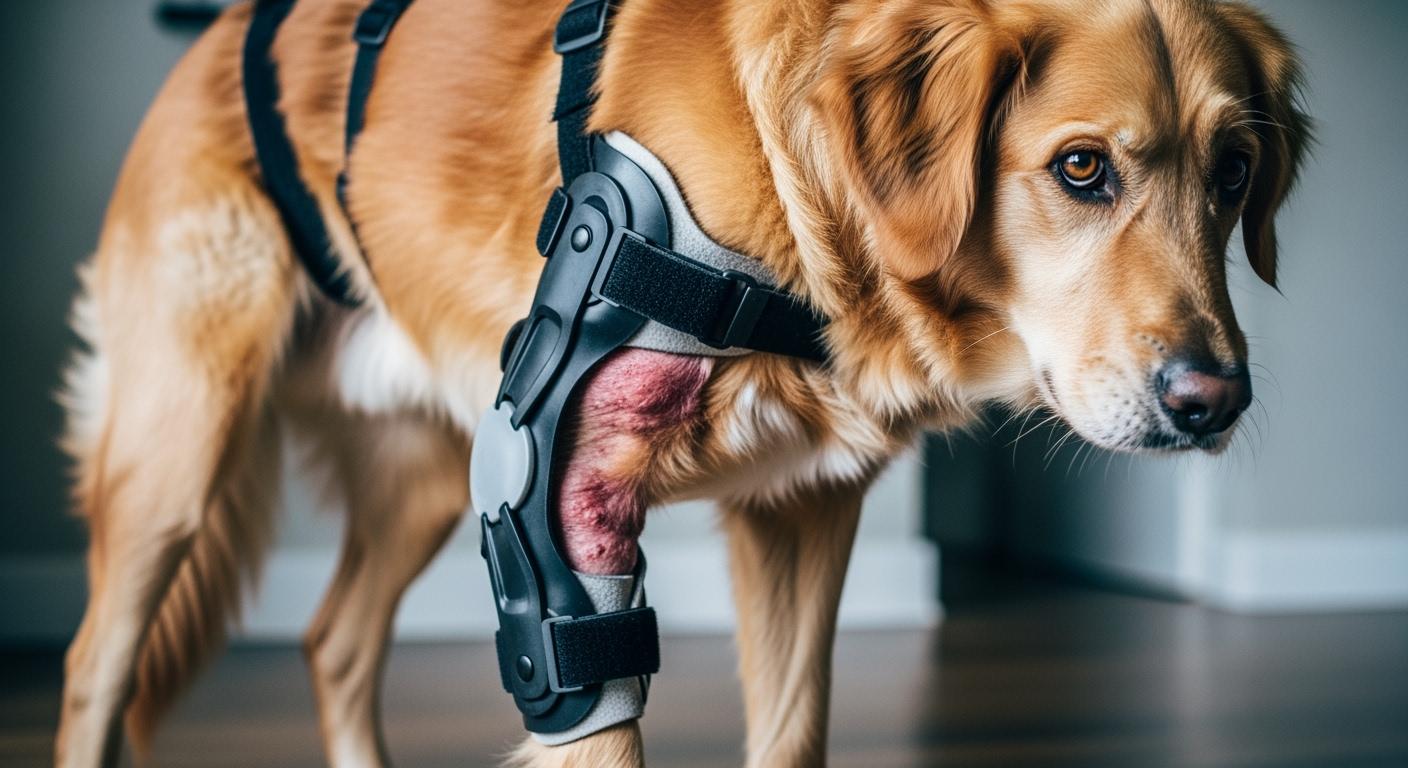
A dog brace-especially a knee brace-may not be suitable if it causes persistent redness, swelling, skin damage, increased discomfort, or a worsening limp or gait. Remove the brace and check the skin, strap position, and limb if the dog shortens its stride, repeatedly tries to remove the brace, or moves less naturally while wearing it. Stop use and contact a veterinarian promptly for marked swelling, open sores, discharge, cold toes, severe pain, or a sudden decline in mobility. This article explains which changes call for a fit check and which are warning signs that the brace should stay off until the cause is assessed.
Skin Signs That a Knee Brace Is Failing
Skin is the first place a failing brace leaves evidence. Redness behind a strap that is still visible thirty minutes after removal is not a cosmetic issue—it means sustained compression exceeded capillary refill pressure at that spot for the full wear duration. The pad underneath that strap has bottomed out, and what remains between the dog’s skin and the strap edge is effectively nothing.
Check after every wear session. Lift the liner. Run your fingers along the skin surface inside the brace footprint. Three findings demand immediate stop-use:
- Redness that persists more than 20 minutes after brace removal—sustained pressure is exceeding tissue tolerance.
- Strap marks with a clear edge imprint—the strap margin is acting as a focal pressure line, not a distributed anchor.
- Hair loss or thinning in a pattern that exactly matches a strap path or brace edge—friction has been working on that spot for days, not hours.
These are not fit tweaks. They are structural mismatches between the brace geometry and the dog’s limb shape. When the proximal strap anchor sits too narrow, the entire brace pivots around a single line of contact. That line becomes a hot spot. Tightening the strap makes it worse—you compress the already-collapsed pad further and drive the edge deeper.
When moisture turns a pressure spot into a wound
A damp liner does two things at once: it softens the stratum corneum, stripping the skin’s outermost protective layer, and it increases the coefficient of friction between the liner and the skin. More friction on weaker skin. That is the formula for a pressure sore that appears overnight.
The moisture source is rarely external water. It is eccrine sweat trapped between a non-breathable foam pad and the skin surface. Within twenty minutes of active walking, the microclimate under the liner hits near-saturation humidity. If the pad cannot vent that moisture—common with closed-cell foams and permanent bonded liners—the skin macerates. Bacteria that normally sit harmlessly on the surface now have a portal.
You can verify this without waiting for a sore to appear. After a walk, lift the liner and press the back of your hand against the inside surface. It should feel dry or only faintly warm. If it feels distinctly damp or hot, the liner is not breathing. The same check works on the skin itself—dry and cool is passing. Damp and warm is a failure signal that predicts breakdown within days if wear continues unchanged.
Signs that have already crossed from irritation to infection are unmistakable: swelling, heat radiating from the skin even after the brace is off, odor that was not present before the wear session, or any discharge—clear, cloudy, or blood-tinged. Remove the brace. Do not add padding to cover the sore; padding over infected skin acts as an occlusive dressing and accelerates bacterial growth. The brace cannot go back on until the skin is intact.
Stop-Use Decision Structure:
- 🟢 Green: Dog walks naturally, skin stays normal, brace stays aligned, no chewing.
- 🟡 Yellow: Mild slipping, light rubbing, shorter stride, increased licking, damp liner.
- 🔴 Red: Swelling, heat, sores, discharge, cold toes, worse limp, pain, refusal, breathing trouble, repeated brace removal.
Most yellow-zone problems trace to strap width and edge finishing rather than overall brace size. A narrower strap concentrates anchoring force onto a smaller skin area—the tissue underneath takes the same total load but spread across half the surface. Wider straps with rolled or folded edges reduce peak pressure and slow the positional drift that turns a minor rub into a weeping sore.
Movement Signs That Support Is Breaking Down
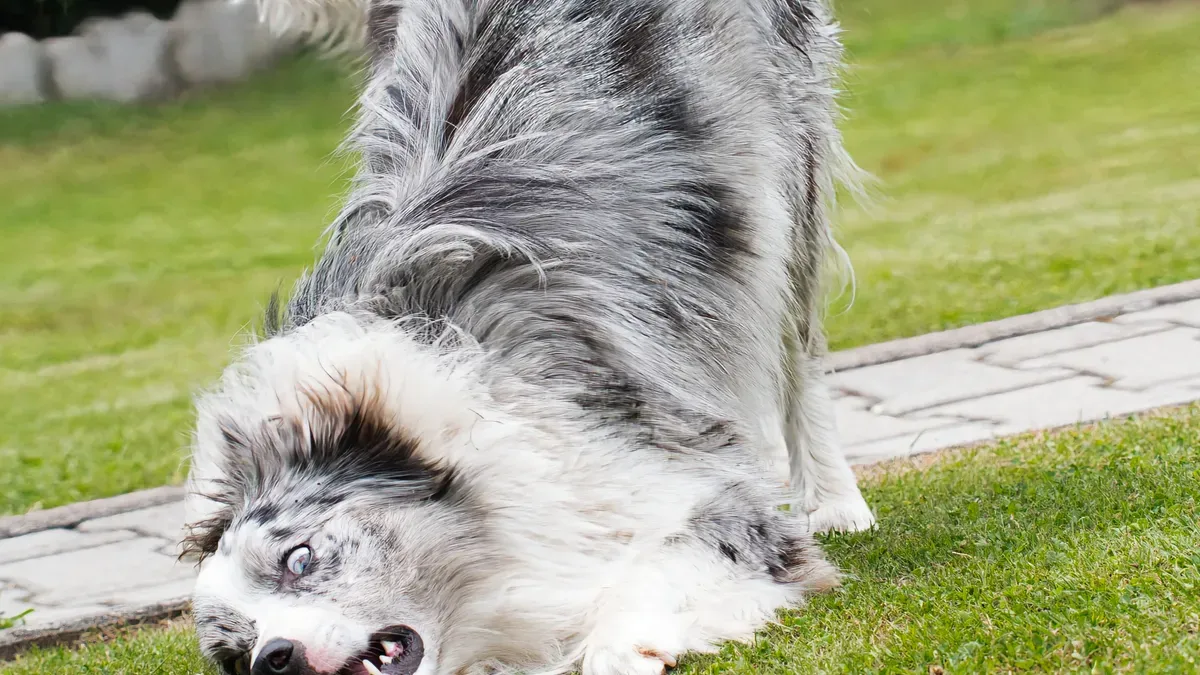
A brace that stays on but changes how the dog moves is failing just as definitely as one that leaves a sore. The signs are mechanical: a limp that was mild before wear and is now pronounced after the brace comes off, a toe that drags where it did not before, a stride that shortens on the braced side, or an outward leg swing that appears only when the brace is on.
Each of these happens for a physical reason. When the hinge pivot sits even a quarter-inch away from the knee’s true flexion axis, the brace lever arm no longer tracks the joint’s natural path. Every step forces the hinge edge into soft tissue at the end of the range of motion, creating a focal pressure zone that the liner cannot distribute. The dog compensates instantly—not out of pain necessarily, but because the limb cannot complete its normal kinematic cycle with an off-axis constraint attached.
That compensation takes predictable forms: shortened stride to avoid terminal extension where the hinge binds, external rotation of the limb to swing the leg around the restriction, or toe-dragging because the dog reduces knee flexion and lets the paw skim the ground instead. After the brace is removed, the compensatory pattern often persists for minutes to hours—the dog has learned a protective gait and does not switch back immediately.
Observable check: Walk the dog on a flat, level surface for ten minutes with the brace on. Mark the starting position of each strap relative to a bony landmark—the tibial crest or the lateral fabella work well. After the walk, check whether any strap has shifted more than half an inch. Rotation of the brace body relative to the limb is the single most reliable early signal of hinge-axis mismatch. A brace that rotates during level-ground walking will fail completely on stairs or uneven terrain.
| Failure seen in use | Why it happens | Poor design or fit pattern | Better structure or result |
|---|---|---|---|
| Brace slides down | Loose straps, wrong size | Narrow anchor, weak grip | Wider straps, adjustable anchors |
| Brace rotates around limb | Poor alignment, loose fit | No joint axis match | Joint-centered, stable design |
| Strap leaves deep marks | Over-tightening, thin padding | Sharp edges, compressed liner | Rounded edges, replaceable padding |
| Hinge presses away from joint axis | Misaligned brace | Fixed hinge, wrong angle | Adjustable hinge, joint alignment |
| Padding traps heat | Non-breathable material | Permanent, thick padding | Breathable, washable liner |
| Dog chews the brace | Discomfort, poor fit | Rough edges, trapped moisture | Smooth finish, moisture control |
| Limp becomes worse after use | Poor support, wrong brace | Slipping, rotation, pressure | Stable, joint-matched brace |
Brace sliding and rotation around the limb share a root cause: the anchor zone fails to create enough distributed friction to hold position against the shear forces of normal movement. A dog’s thigh is not a cylinder—it tapers, and the muscle bellies shift shape with each contraction. A strap that grips well on a standing dog can lose purchase the moment the quadriceps fires during propulsion. The structural answer is not more tension. It is wider load distribution across a larger contact patch, which increases static friction without increasing peak pressure.
Hinge design matters here in a way that is not visible on a product page. A polycentric or anatomical hinge uses multiple pivot points to approximate the knee’s instantaneous center of rotation as it changes through the gait cycle. A single-pivot hinge cannot do that—it forces the joint to rotate around one fixed point that matches the knee at only one angle of flexion. At every other angle, the mismatch generates a force vector that pushes the brace away from the limb. Over hundreds of steps, that push sums into rotation, slide, and skin shear.
| Design feature | Why it matters in real use | What fails without it |
|---|---|---|
| Polycentric or anatomical hinge | Tracks joint’s actual rotation axis through gait; reduces compensatory movement | Hinge fights natural movement; dog develops altered gait under brace |
| Wide proximal strap | Distributes anchoring force over larger area; reduces edge pressure; slows positional drift | Narrow strap creates focal pressure and slides under active movement |
Edge finishing is the detail most owners discover too late. Hard edge bindings act like a slow blade during stride—each step produces a micro-movement of the brace edge against the skin. Multiply that by several thousand steps per walk and the cumulative abrasion rivals a friction burn. Rolled fabric bindings and smooth edge profiles reduce the shear transferred to skin at the brace margin. A replaceable liner also matters: permanent compressed foam loses loft after weeks of wear and stops filling the gap between brace shell and skin, at which point the shell edge becomes the primary contact surface.
When a Knee Brace Is Not the Right Tool
A knee brace can distribute load and slow instability, but it cannot perform tasks outside its mechanical design envelope. Recognizing the boundary between what a brace can do and what it cannot prevents the worst failure mode of all: wearing a brace that was never the right intervention while the underlying condition worsens underneath.
A brace cannot repair a fully torn cruciate ligament. It cannot reduce a luxating patella that has already eroded the trochlear groove to the point where the kneecap will not stay seated regardless of external constraint. It cannot resolve deep joint infection, address bone-on-bone osteoarthritis pain at rest, or stabilize a limb with significant angular deformity where the mechanical axis of the leg already passes far outside the joint center. In each of these scenarios, the brace may mask symptoms briefly while the structural problem continues to advance.
Disclaimer: This check assumes a short-coated dog with visible skin. Double-coated breeds may show subtler rub marks that require hand-checking rather than visual inspection—part the fur and feel for warmth, dampness, or texture changes along strap paths and brace edges. If the dog’s leg conformation falls outside typical breed norms—particularly dogs with angular limb deformities, very deep chests, or heavily muscled thighs—the fit checks described here may not catch every pressure point, and a brace patterned for standard limb geometry may create load paths that were not accounted for in its design.
A knee brace works within a defined stability window: partial ligament tears where some passive restraint remains, mild-to-moderate patellar luxation where the groove is still deep enough to capture the kneecap with external support, post-surgical protection where the repair needs load-sharing rather than load-bearing, and conservative management for dogs who are not surgical candidates due to age or comorbidities. Outside that window, a brace is the wrong support category—and continuing to use one while hoping it fills a role it cannot fill is not caution. It is delay that costs joint surface.
FAQ
How quickly can a brace go from fitting well to causing damage?
Fast. A liner that felt dry and cool on day one can be saturated and hot by day five if the foam does not breathe and the wear schedule ramped too aggressively. The shift from yellow-zone rub to red-zone sore can happen inside a single extended wear session. The break-in period—typically the first ten to fourteen days—is when most failure patterns first surface, because that is when the pad is compressing, the straps are settling into their working positions, and the dog is moving more naturally with the brace on. Twice-daily skin checks during this window are not cautious overkill. They are the only reliable way to catch a fit problem before it becomes a wound.
Can tightening loose straps fix a brace that shifts?
Rarely. A brace that shifts during movement is almost never shifting because the straps are too loose—it is shifting because the anchor zone is too narrow, the hinge is misaligned, or the limb shape does not match the brace geometry. Pulling straps tighter compresses soft tissue, reduces venous return, and creates new pressure points without solving the root cause. If the brace rotated on a walk, tightening straps for the next walk tends to make the rotation happen under higher pressure. That is worse.
What design features reduce the risk of skin breakdown?
Three features matter most in daily use: a breathable, washable liner that can be removed and dried between sessions; wide straps with rolled or finished edges that distribute anchoring force instead of concentrating it along a cut margin; and a hinge that tracks the knee’s multi-axis rotation rather than pivoting around a single fixed point. Replaceable padding extends the usable life of the brace—permanent compressed foam stops protecting the skin long before the outer shell shows wear.
Is a brace still suitable if the dog refuses to move while wearing it?
No. Movement refusal—standing still, sitting down mid-walk, or resisting the leash when the brace is on—is a red-zone stop-use signal. Dogs do not refuse to move out of stubbornness. They refuse because something about the brace makes movement painful, unstable, or frightening. Remove the brace. Check for pressure points, hinge binding, and skin changes. Do not put the brace back on until the cause is identified and resolved.
What is the single most reliable field check for brace fit during a walk?
Mark strap positions against a bony landmark before the walk, then check for shift afterward. More than half an inch of movement in any strap means the anchor is failing and the brace is migrating. Even if the dog shows no visible limp, a migrating brace is applying shear to the skin and off-axis load to the joint with every step. It is not a matter of whether problems will appear—only when.
