
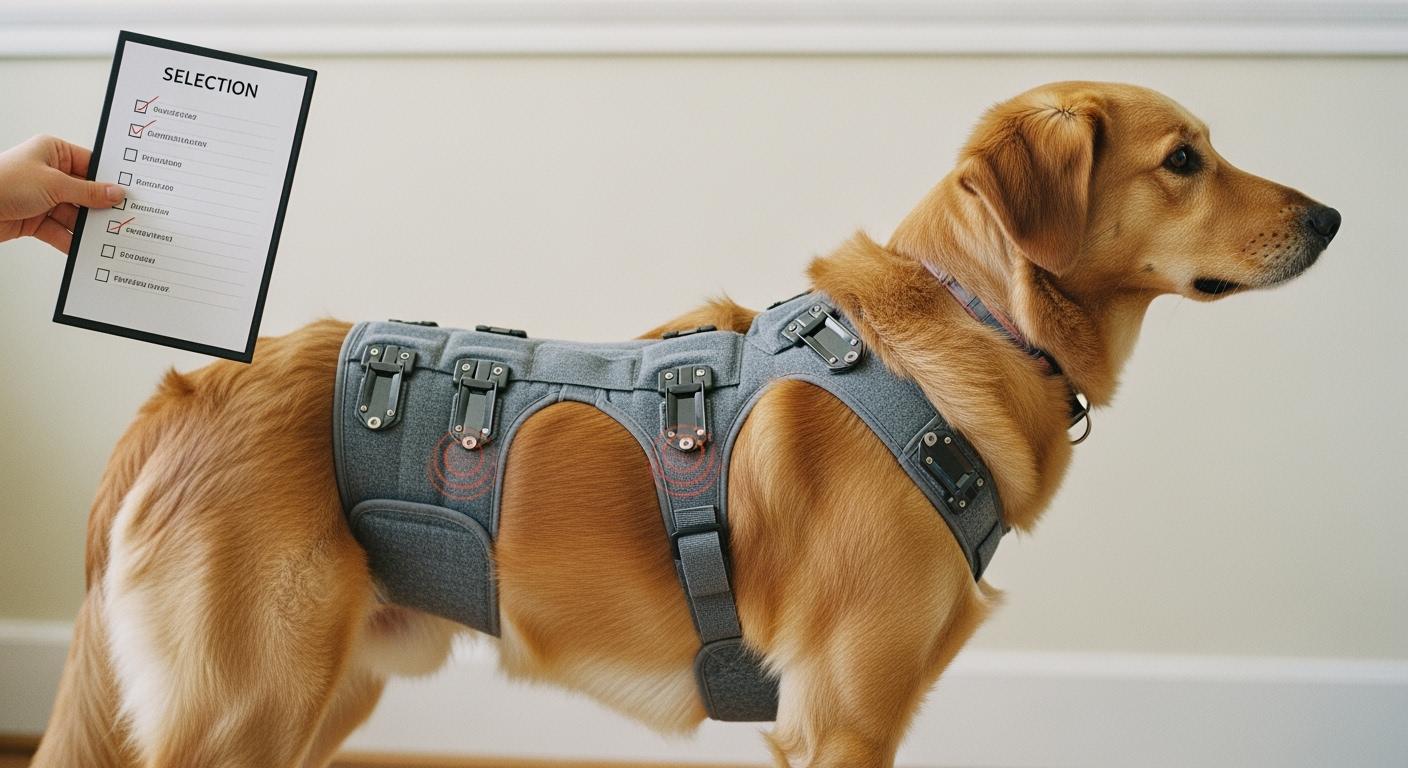
You fit a dog back brace. It looks straight and stable when your dog stands. After a 20-minute walk, you remove it and see a narrow red line running down the spinal midline. The skin feels warm. This is dog back brace hinge pressure along spine—a structural failure, not a comfort complaint. Tightening or loosening straps will not fix it. The hardware is pressing force into a place that has almost no natural padding, and every step your dog takes concentrates that load further.
Tip: Check for pressure marks after movement, not when your dog stands still. A brace that looks perfect at rest can fail the moment the dog walks.
Why Hardware on the Spinal Midline Creates Pressure That Straps Cannot Fix
A dog’s spinal midline is a bony ridge covered by little more than skin and a thin fascia layer. There is no muscle belly here to absorb load—just spinous processes projecting upward. When a hinge or metal stay sits directly on this line, every pound of brace tension translates into pressure concentrated on a surface area measured in fractions of a square inch.
The causal chain is straightforward. The stay or hinge sits on the bony ridge. Body heat and movement soften the padding beneath it. The softened foam compresses, reducing the standoff distance between hardware and bone. Meanwhile, the dog’s spine flexes with each stride—extending and laterally bending through the walk cycle. A rigid stay cannot follow that motion. Instead it resists it, and the reaction force dumps into the spinous processes at the point of contact. That is the red line you see after the walk: concentrated compressive force on tissue that was never meant to carry it.
You can verify this yourself. After 20 minutes of supervised walking, run two fingers along the spinal midline under the brace. If one spot feels warmer than the surrounding skin by a noticeable margin, the hardware is dumping force there. Warmth is the earliest signal—it appears before redness, before swelling, before hair loss. A second check: press the padding at that warm spot. If you can feel the hard stay or hinge through the foam with light finger pressure, the padding has already collapsed and is no longer doing its job.
This is not solvable by strap adjustment. The hardware position is fixed in the brace shell. No strap configuration moves a centerline hinge off the centerline. The brace either routes support away from the spine or it does not. That is a design decision made at the factory, not a fitting decision made in the living room.
Design choices that cause or prevent pressure concentration
| Design choice | What fails in real use | Better structure | Main limitation |
|---|---|---|---|
| Centerline hinge | Leaves red line along spine, causes localized pressure | Off-spine rails that route support through the epaxial muscles | Off-spine rails add width to the brace profile |
| Narrow metal stay | Pinches skin, creates a narrow load band | Broad padded bridge that spreads force across a wider zone | Wider bridges can trap more heat in warm weather |
| Flat back panel | Edge-loading—the panel rides on high points only | Contoured panel that follows the dog’s spinal curve | Contouring requires accurate sizing; one shape does not fit all breeds |
| Thin single-layer foam | Collapses after 15–20 minutes of movement | Layered foam with a spacer fabric layer and smooth inner lining | Layered construction increases material cost and drying time |
| Narrow belly strap | Rolls under tension, pulls the panel downward into the spine | Wide anchor zone that stays flat during movement | Very wide straps can restrict rib expansion during heavy panting |
| Uneven left-right strap path | Twists the brace off-center, shifting hardware onto the spine | Symmetrical strap paths with equal-length adjustment on both sides | Symmetrical paths assume symmetrical dog anatomy, which is not always the case |
When Padding Collapses and Straps Become the Problem
Padding failure hides in plain sight. You press on the foam before the walk and it feels thick. You check it again after the walk and it still feels thick—if you press with the brace off the dog. But that is the wrong test. Padding collapses under sustained load and body heat, and it rebounds when you take the brace off. The collapse happens during wear, not after.
The check that catches this: leave the brace on the dog for a full 20-minute walk, remove it, and immediately—within 30 seconds—press the foam where the hardware sits. The foam should still resist your finger. If it bottoms out with light pressure, the material has collapsed during use. That foam may look fine on the shelf. It failed on the dog.
Single-layer open-cell foam is the most common culprit. It compresses easily, holds moisture, and loses rebound after repeated cycles. A better construction uses a closed-cell foam base layer for structural standoff, an open-cell middle layer for conformity, and a smooth wicking liner against the skin. This stack maintains its thickness through a walk cycle because the closed-cell layer does not crush under the loads a dog’s back brace experiences. In production terms, closed-cell foam also degrades more predictably across batch runs—its compression set is measurable and repeatable, which makes performance more consistent from unit to unit.
Strap geometry that amplifies spinal pressure
A narrow strap does not just hold less securely. It creates a mechanical disadvantage. When you tension a strap, the force distributes across the strap’s contact area. A half-inch strap under 2 pounds of tension applies roughly 4 psi to the underlying tissue. A 2-inch strap under the same tension applies roughly 1 psi. The difference is not linear in dog comfort—it is the difference between a distributed hold and a cutting edge.
Worse, a narrow belly strap rolls under movement. As it rolls, its effective width shrinks further, the tension concentrates along a thinner line, and the strap edge digs into the soft tissue of the belly wall. The dog tenses its abdomen in response. That tension pulls the brace panel downward. The hinge presses harder into the spine. The cycle feeds itself: strap rolls, dog tenses, panel drops, pressure increases.
Wide padded anchor zones break this loop. The strap stays flat because its width resists rolling. The tension spreads across enough surface area that the dog does not reflexively guard against it. And a strap that stays flat keeps the panel in its designed position rather than driving it into the spine.
Uneven tension and off-center shift
You fit the brace and it looks centered. After 10 minutes of walking, the panel has drifted to one side. The hinge now sits off the midline—but not safely off the spine. Instead, it has shifted onto the edge of a spinous process, where the pressure per square inch is even higher because the contact area shrinks to a knife edge. Uneven left-right strap tension causes this. One side is tighter, pulling the brace toward that side with every stride.
Check for this after your dog walks: mark the brace’s centerline with a piece of tape at the start, then see if it still aligns with the spinal midline after movement. A shift of half an inch is enough to move the hinge from “tolerable on the epaxial muscles” to “digging into a vertebral edge.”
Disclaimer: This check assumes a short-coated dog where the spinal ridge is visible. Double-coated breeds may show subtler pressure marks that require hand-checking rather than visual inspection—run your fingers along the spine after each walk and note any spot that feels warmer or elicits a flinch response. If the dog’s back conformation falls outside typical breed norms—particularly dogs with pronounced roach backs or very deep chests—the fit checks described here may not catch every pressure point.
Where Back Braces Work and Where They Do Not
A back brace provides external support by limiting spinal flexion and lateral bending. It can help stabilize a dog with mild IVDD, post-surgical recovery needs, or generalized spinal weakness. The support works best when the brace routes force through the paraspinal muscles rather than the bony midline, uses padding that maintains thickness under load, and anchors with wide straps that do not roll or shift.
But a back brace is the wrong tool in several clear situations. If the dog shows neurologic signs—loss of bladder control, dragging a limb, inability to place a paw—the problem has progressed beyond what external bracing can address. Back braces do not decompress the spinal cord. They do not reverse disc extrusion. They do not restore motor function. Using one in these cases delays necessary veterinary intervention and can create a false sense that something is being done while the condition worsens.
If the dog develops open skin or a pressure sore under the brace, continued use turns a fit problem into a wound management problem. If the brace induces a worse gait—the dog moves stiffly, refuses to walk, or hunches its back more with the brace than without—the support is causing harm, not providing stability. These are stop-use signals, not adjustment signals.
| Signal | What it means | Action |
|---|---|---|
| Green | Brace stays stable, no red line, dog walks normally | Continue supervised use |
| Yellow | Light shifting, mild rubbing, short-term hesitation | Adjust fit, check skin, monitor closely |
| Red | Spinal pressure mark, heat, swelling, hair loss, pain, worse gait, repeated refusal | Stop use, consult veterinarian |
A common scenario: the brace fits acceptably at rest but shifts enough during movement to create a red mark that fades within 10 minutes of removal. This is the yellow zone. A brace that stays in the yellow zone can transition to red if the underlying cause—often a strap geometry problem or a padding that is gradually losing rebound—is not identified and addressed. Checking the skin twice daily during the first two weeks of use catches this drift before it becomes a skin injury.
Back braces with off-spine rails and broad padded bridges tend to perform more consistently across different body shapes because they route support through muscle groups that exist on every dog, rather than relying on precise alignment with a bony landmark that varies by breed. When the support structure routes force through the epaxial muscles instead of the spinous processes, the same stabilizing effect is achieved without concentrating load on unpadded bone.
Straps that remain flat during movement—typically those with a width of at least 1.5 inches and a padded inner face—do not roll. A strap that does not roll does not pull the panel downward. And a panel that stays in its designed position keeps the hardware where the designer intended it: off the spine. This chain of design dependencies means that strap width is not a comfort feature—it is a structural requirement for safe load distribution.
| Symptom | What it suggests | What to do |
|---|---|---|
| Open sore, blister, swelling | Pressure injury or circulation compromise | Stop immediately, seek veterinary care |
| Redness persists after brace removal or sharp strap line visible | Excessive pressure or poor fit distribution | Pause use, reassess fit, consider veterinarian review |
What Changes the Outcome in Daily Use
A brace that clears all static fit checks still fails if the padding loses thickness 15 minutes into a walk. That is why material selection matters more than initial fit appearance. Braces built with layered foam stacks—closed-cell base, open-cell middle, wicking liner—maintain standoff through the full walk cycle. The closed-cell layer acts as a structural spacer that does not compress under the loads a 5-kilogram dog generates during normal gait. This is the difference between padding that looks thick and padding that stays thick.
The inner lining material also changes daily tolerability. A smooth, low-friction lining reduces shear at the skin interface. Shear is the hidden variable in brace comfort—it is not the downward force that causes the worst skin damage but the sideways drag that accompanies every micromovement of the brace relative to the skin. A lining that slides rather than grips transfers less shear to the hair follicles and epidermis. In practice, this means checking the lining after a week of use: if the fabric has pilled or developed friction points, it is generating shear that the dog is absorbing silently.
Contoured panels that follow spinal curvature spread contact across the entire interface surface. A flat panel on a curved back touches only at the high points—typically the shoulder transition and the lumbar apex. The space between those contact points carries no load, which means the contact points carry all of it. A panel shaped to the dog’s dorsal profile increases the load-bearing surface by filling those gaps, which drops the pressure at any single point.
For dogs recovering from an IVDD episode, the brace provides external stabilization during crate rest and controlled movement. The support does not heal the disc. It limits the range of motion that could further aggravate an already compromised annulus. Understanding when motion restriction helps and when it is insufficient determines whether the brace plays a supporting role or becomes a false reassurance. Spinal stabilization also factors into recovery protocols where controlled loading is introduced gradually after the acute phase resolves.
FAQ
What should you check after your dog wears a back brace for a short walk?
Remove the brace and run two fingers along the spinal midline. Check for warmth first—it appears before visible redness. Then check for red lines, swelling, or hair loss. Press the padding where the hardware sits; if you feel the stay or hinge with light finger pressure, the foam has collapsed during use.
Can tightening straps fix spinal pressure from a hinge or metal stay?
No. Centerline pressure comes from hardware position, not strap tension. Tightening narrow straps often increases the pressure because the strap edge digs in, the dog tenses, and the panel is pulled downward. The fix is structural: off-spine rails or a broad padded bridge that routes force away from the bony midline.
How often should you check your dog’s skin during the first two weeks?
Twice daily. Once after the morning wear session and once after the evening session. The first two weeks are when padding break-in, strap settling, and the dog’s adaptation all interact. A fit that works on day one can drift by day five as foam takes a compression set and straps relax.
When should you stop using a dog back brace and contact a veterinarian?
Stop immediately if you see an open sore, blister, or swelling under the brace. Stop if the dog’s gait worsens with the brace on compared to off. Stop if neurologic signs appear—limb dragging, loss of bladder control, inability to place a paw. These are not fit problems; they are progression signals that bracing cannot reverse.
