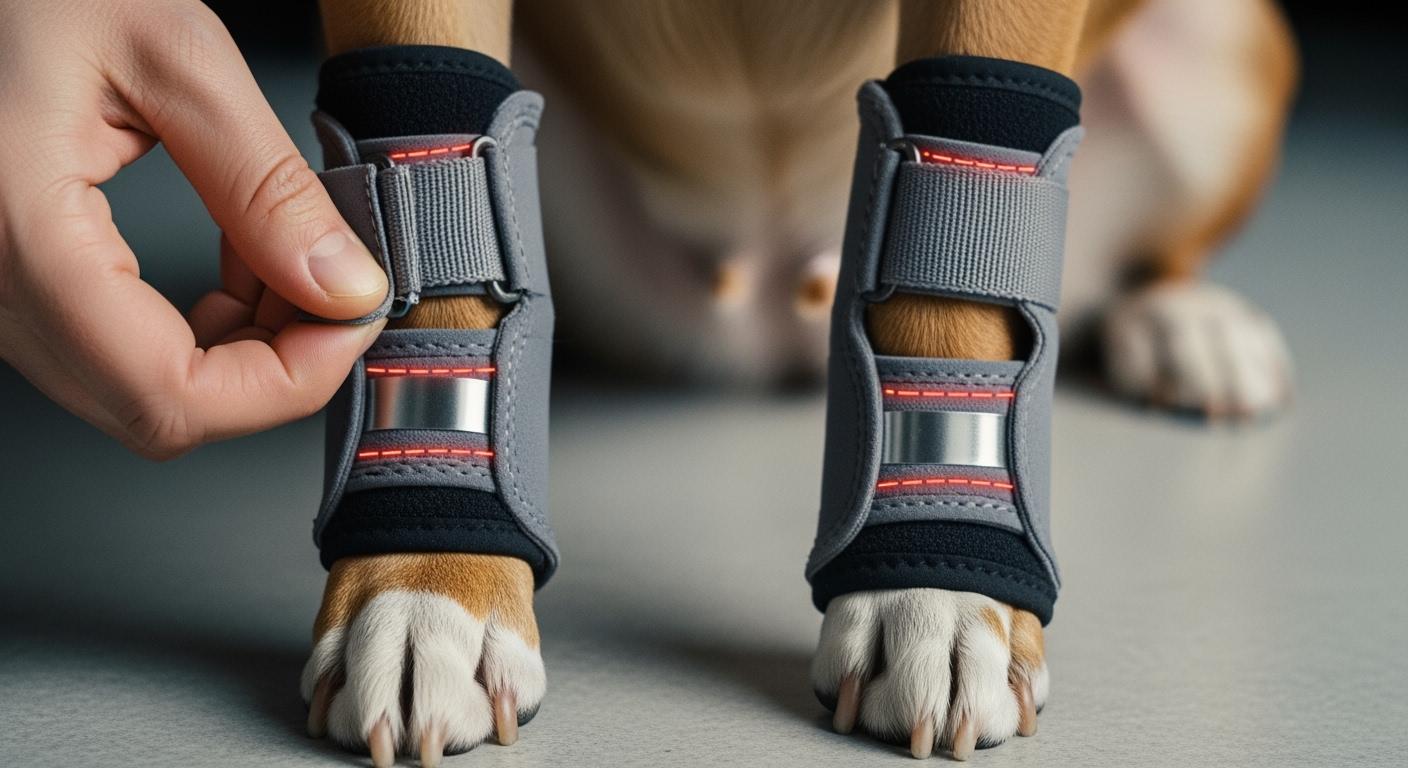
The carpal brace looks centered when you put it on. After a short walk, you remove it and see the carpus is red on one side while the other side looks normal. That is not a strap-tightness mistake. It is a structural pressure distribution failure. The support is not reaching the joint evenly.
When force concentrates on one side of the carpus, the brace is no longer stabilizing the joint. It is creating a hotspot. The problem almost always traces back to one of three mechanical failures: a metal stay edge digging into soft tissue, a strap pulling harder on one side than the other, or the brace rotating mid-stride and shifting support off-axis. None of these is fixed by cranking the straps tighter.
The carpus is narrow, bony, and takes impact with every step. That small contact area means even minor fit deviations produce concentrated pressure. If your dog has carpal hyperextension, the joint already lacks the ligament integrity to self-stabilize. A brace that loads one side compounds the problem: the unprotected side extends farther, the compressed side develops irritation, and the dog compensates with a shorter stride that shifts weight to the other leg.
Why One Side Takes More Pressure Than the Other
The brace does not fail because you tightened it wrong. It fails because of how force travels through its structure once the dog starts moving.
The Metal Stay Edge and the Padding Gap
A metal stay sits inside a fabric channel. When the dog stands still, the stay runs parallel to the carpus. But the carpus changes shape during weight-bearing. The joint angles forward slightly. The stay, being rigid, cannot follow. Instead, its edge tilts toward the skin. If the padding inside that channel is thin or has compressed over time, the stay edge becomes a fulcrum. Force that should spread across the brace’s inner surface now concentrates along a line no wider than the stay itself.
That is the causal chain: rigid stay in a non-conforming channel leads to edge tilt during joint flexion, which opens a padding gap, producing linear pressure concentration, and finally one-sided redness. The fix is not adding a sock underneath. The fix is a stay channel deep enough and padded enough that the edge never becomes the primary contact surface.
Check for this: after a 10-minute walk on flat ground, remove the brace and run your thumb along the inner channel path on the dog’s skin. A uniform pinkness across the whole contact area is normal. A single red stripe tracing the stay line is not.
Strap Pull Asymmetry
A narrow strap concentrates tension into a line. When that line runs diagonally across the carpus, the brace torques. The top edge tips outward. The bottom edge tips inward. The metal stay, now angled, digs into whichever side is closer to the carpus.
Wider straps change this. A wide strap distributes tension across a broader zone. The strap itself becomes a secondary stabilizer rather than a focused pull point. The brace is less likely to rotate when the dog transitions from standing to walking, because the tension spread resists the twisting moment. Rotation is a turning force, and a narrow strap at a diagonal gives it a long lever arm. A wide strap anchored at stable points shortens that lever arm to near zero.
You can verify strap symmetry without any tools. Walk the dog for five minutes, then look at the strap edges. If one edge has rolled under or the strap no longer sits in the same position it started in, tension is pulling unevenly. The brace is rotating, even if only a few degrees. Those few degrees are enough to move the stay edge off the joint centerline.
Disclaimer: This visual check assumes a short-coated dog. Double-coated breeds may show subtler rub marks that need hand-checking rather than visual inspection. Part the coat and feel for heat or firmness differences between the two sides of the carpus.
What Fails First in Metal-Strip Carpal Brace Design
Not all carpal braces fail the same way. But most failures trace to the same three design decisions. Understanding which one is active tells you whether to adjust, replace, or choose a different structure entirely.
| Performance Difference | Why It Matters | Main Limitation | Pass Signal | Fail Signal |
|---|---|---|---|---|
| Stay channel padding depth | Shallow padding lets the stay edge contact skin during joint flexion | Padding compresses over time; a channel adequate when new may be inadequate after 6 to 8 weeks of daily use | After 10 min of walking, skin shows uniform pinkness across the whole inner brace footprint | A single defined red line tracing the stay path on one side only |
| Strap width and anchor layout | Narrow diagonal straps create a torque arm that rotates the brace during stride transitions | Wider straps add bulk; on very small dogs the strap may overlap the joint above or below | Strap edges remain in original position after 5 min of walking, no rolling or migration | One strap edge has rolled under; strap sits visibly lower or higher than starting position |
| Brace contour vs. carpus shape | A straight brace on a naturally angled carpus leaves a gap on one side that the stay fills by digging in | Pre-contoured braces may not match every breed’s carpal angle; a mismatch shifts pressure to the contour edge | Brace inner surface contacts skin evenly across its full width when the dog stands naturally | Visible gap between brace and skin on one side when dog is standing; gap closes only when stay edge presses in during movement |
| Edge binding coverage | Unbound or partially bound edges concentrate friction at the transition point between covered and uncovered material | Edge binding adds a seam line that can itself become a pressure point if stitched too flat | No linear red mark or abrasion at any brace edge after 20 min of wear | A thin red friction line at the top or bottom edge of the brace, distinct from the stay-path mark |
Each of these failure modes is structural. They do not resolve with more padding stuffed into the brace or with tighter straps. They resolve by choosing a brace built to avoid that specific failure pathway. A carpal brace designed for front-leg hyperextension support needs the stay channel, strap layout, and contour to work together — not just in the product photo, but after the dog has walked half a mile and the materials have shifted under load.
When More Tension Makes the Problem Worse
It is tempting to tighten the straps when you see the brace moving. That impulse is backward. The carpus needs blood flow to tolerate extended brace wear. A strap tightened past the point where you can slide a fingertip under it begins to restrict circulation within minutes. The skin under the strap blanches. Sensation dulls. The dog stops giving clear feedback about discomfort because the area goes numb.
Then the real damage starts. Reduced blood flow means the skin cannot dissipate friction heat. The tissue under the stay edge warms, weakens, and breaks down faster than it would under normal circulation. What started as a red mark becomes an abrasion. What was an abrasion becomes an open wound.
More tension does not fix rotation. It accelerates the failure.
Left-Right Fit Checks That Catch Uneven Pressure Early
The only reliable way to know whether a carpal brace is distributing pressure evenly is to compare the two sides of the carpus after walking. A visual check while the brace is on tells you almost nothing. The brace hides the pressure pattern.
Start with the dog standing naturally. Place the brace so the metal stays sit evenly beside the carpus, not pressing into it. Fasten the straps from their anchor points without pulling one side tighter than the others. Walk the dog for five to ten minutes on flat ground. Then remove the brace and compare.
What you are looking for is asymmetry. If both sides of the carpus show the same faint pinkness that fades within 20 to 30 minutes, pressure distributed evenly. If one side is noticeably redder, or one side shows a distinct line while the other is uniformly pink, the brace is loading that side disproportionately. A proper carpal brace fit for daily hyperextension support depends on this left-right comparison, not on how centered the brace looked when you first strapped it on.
What separates a fit issue from a design issue is whether adjusting strap tension fixes the asymmetry. If loosening the red-side strap reduces redness on the next walk, the problem was tension. If you adjust and the same side stays red, or the redness switches sides, the brace is rotating and shifting load unpredictably — a structural mismatch, not a user error.
In practice: If the dog’s leg conformation falls outside the breed norms this brace was patterned for — particularly dogs with angular limb deformities or very deep chests that alter front-leg stance width — the fit checks described here may not catch every pressure point. In those cases, check for hot spots by touch rather than relying on visible redness alone.
Warning Signs That Mean Stop Use
Some signals are not fit-adjustment problems. They are stop-use signals.
- Swelling below the brace or around the carpal area
- Toes that feel cold compared to the other paw
- Pain when the carpus is touched after brace removal
- Redness that remains visible more than 30 minutes after removing the brace
- Skin that feels raw, blistered, or broken
- A dog that refuses to bear weight on the leg after the brace comes off
These are not signals to loosen a strap and try again. They are signals to remove the brace, contact your veterinarian, and not reapply until the cause is understood. A brace that blocks circulation or breaks skin is no longer a support device.
The distinction matters because the carpus has little soft-tissue buffering. There is not much between the brace and the bone. Pressure that would be uncomfortable but manageable on the thigh becomes dangerous on the carpus within a much shorter wear window. This is also why choosing between carpal support and upper front limb support is not just about which joint hurts — it is about which joint can safely tolerate a brace’s pressure footprint for the needed wear duration.
When a Carpal Brace Is Not the Right Structure
A soft wrap brace can work for mild instability where the carpus needs proprioceptive feedback more than rigid blocking. The wrap tells the dog where the joint is in space. It adds minimal resistance. For a dog with mild hyperextension that only appears on slippery surfaces or during sharp turns, a soft brace or a structured carpal support with flexible stays may be enough.
But a dog whose carpus drops flat to the ground with every step — full plantar grade stance — needs rigid support. The metal stays must resist collapse. The tradeoff is that rigid stays demand better fit precision. There is less room for error. The same stay that prevents hyperextension becomes a pressure weapon if the brace rotates two degrees off-axis.
Where the breed’s leg shape matters: a dog with a straight, narrow foreleg (common in sighthounds) presents a longer, flatter mounting surface. The brace has more contact area to spread pressure. A dog with a thick, rounded foreleg (common in bully breeds) has less flat surface area. The same brace that distributes evenly on the first dog may concentrate force on the second. This is not a design flaw. It is a shape mismatch. The brace was patterned for a different cross-section.
| Where It Works | Where It Typically Struggles |
|---|---|
| Straight to mildly angled carpus, moderate hyperextension | Severe angular limb deformity that changes the carpal axis |
| Dogs with a defined, flat carpal profile that gives the brace surface area | Dogs with very rounded or thick forelegs where the brace contacts a narrow strip |
| Short, controlled walks on predictable surfaces | All-day wear or rough-terrain activity where brace migration accumulates |
| Dogs that tolerate handling and allow post-walk skin checks | Dogs that panic or thrash when the brace is adjusted, making consistent fit impossible |
Disclaimer: If the dog’s carpal angle falls outside the typical range this brace type was patterned for — particularly in dogs with carpal valgus, carpal varus, or a fused carpus from prior injury — the pressure checks described here may miss a contact point that only loads during specific stride phases. In these cases, a custom-contoured brace or a wrist brace with adjustable stay positioning may distribute force more evenly than a fixed-contour off-the-shelf design.
FAQ
How quickly can uneven pressure damage the carpus?
The carpus has minimal soft tissue between the bone and the brace. A concentrated pressure point can produce visible skin changes within 10 to 15 minutes of walking. Redness that appears in a single defined line along the stay path during the first short walk is an early warning. Skin breakdown can follow within hours if the same brace is reapplied without addressing the pressure concentration.
Why does the brace look centered when the dog is standing but shift during walking?
The carpus changes shape during weight-bearing. As the joint angles slightly forward with each step, the rigid stay cannot conform. That mismatch between a fixed structure and a moving joint creates a small gap on one side. The gap closes when the stay edge tilts toward the skin. The brace did not slide. The joint moved out from under the stay’s contact path, and the stay followed by tilting into the tissue rather than remaining parallel.
Can you add padding to fix a stay edge that digs in?
Adding padding inside the brace reduces the already limited interior volume. The carpus then sits tighter against the stay, not looser. The padding may temporarily cushion the edge, but the underlying problem — the stay channel does not hold the stay in alignment during joint movement — remains. If the added padding shifts or compresses after 10 to 15 minutes of walking, the stay edge makes contact again through the compressed material.
What is the difference between fit redness and a pressure injury in a carpal brace?
Fit redness is uniform across the brace contact area and fades within 20 to 30 minutes of removal. A pressure injury shows as a defined line, a single spot, or a patch on one side that does not match the other side. Fit redness does not hurt when touched. A pressure point is tender. If the redness is still visible after 30 minutes, or the dog pulls away when you touch the area, it has progressed past fit redness.