
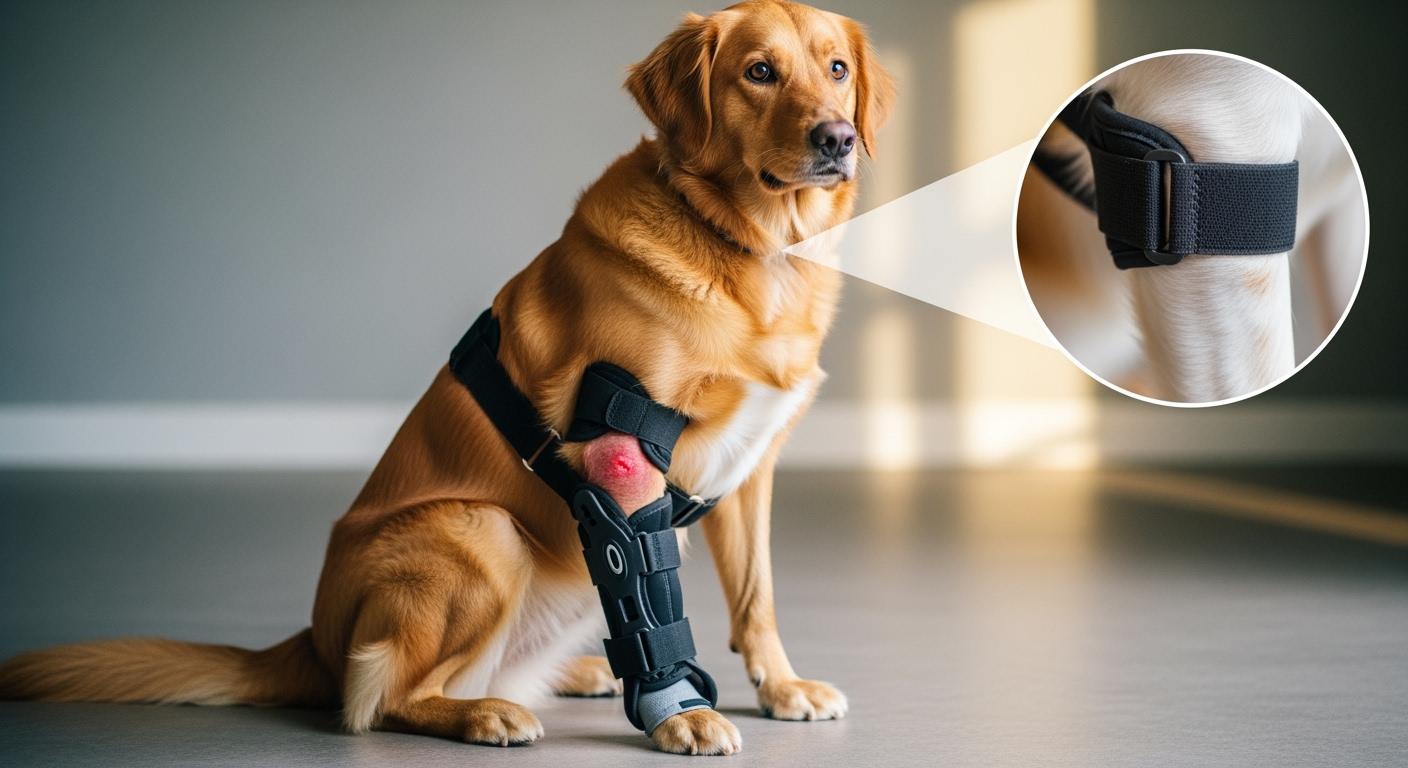
A red line sits exactly where the strap edge pressed against your dog’s hind leg. You remove the rear leg brace after a short walk, and there it is. The mark is a pressure map. It tells you where force concentrated, where friction built, and where the strap design — not just the tension you applied — shaped the outcome.
Dog rear leg brace strap edge redness is rarely about one thing. A narrow strap edge can turn moderate tension into focal pressure. Rough binding can abrade skin that flexes with every step. A strap path crossing the hock crease puts friction on tissue that has almost no natural padding. And when moisture builds under a non-breathable liner, skin that was already stressed breaks down faster.
This article walks through the product design reasons these marks appear, what separates a harmless line from a fitting failure, and which strap structures and materials perform differently under daily use.
Why the Red Line Appears After Walks — and What It Reveals
The red mark along a strap edge is not random. It traces exactly where the strap margin met the leg, and its intensity maps how much force landed there during movement.
Here is the causal chain. A strap wraps the leg and carries anchor tension. That tension distributes across the contact area between the strap inner surface and the skin. When the strap is narrow, the same total tension compresses a smaller contact zone — so pressure per square inch climbs. Add leg flexion: the hock joint cycles through roughly 30 to 45 degrees of angular change per stride. The strap edge, if it is square-cut or rough-stitched, scrapes across the skin surface instead of gliding with it. The friction is not uniform — it peaks at the leading and trailing edges of the strap, precisely where the red line forms. If the strap also crosses the hock crease, the tissue there is thin, mobile, and poorly padded. Under repeated flexion cycles, the combined pressure-and-shear load overwhelms capillary refill in the superficial skin layers. The tissue reddens. If the load repeats daily without recovery time, the redness deepens, hair thins, and the skin surface breaks down.
This is not a tightness problem in isolation. It is a contact-zone geometry problem, an edge-finish problem, and a strap-path problem interacting together.
You can verify this yourself. After a supervised 10-to-15-minute walk on flat ground, remove the brace and run a fingertip along the strap edge path. If the skin feels warmer there than on the surrounding leg by a noticeable margin, friction plus pressure were high enough to drive local vasodilation. Wait 20 minutes. If the line has faded to a faint pink or disappeared, capillary refill recovered — the tissue handled the load. If the line remains red, darkened, or feels raised, the strap edge delivered more mechanical stress than that skin zone can absorb in a single session.
Tip: Check not just for color but for texture. Run your thumb lightly across the strap path. A palpable ridge or indentation that persists past 20 minutes means the strap margin acted as a die, compressing tissue beyond its elastic recovery limit.
Why the Hock Area Multiplies the Problem
The hock region combines three unfavorable factors for strap contact: the skin is thinner than on the thigh, the subcutaneous fat layer is minimal, and the joint surface moves through a large range with every step. A strap edge positioned over or near the hock crease loads tissue that was never structured to bear concentrated interface pressure. When the dog flexes the hock, the skin stretches and shifts under the strap — so the edge does not just press; it drags.
Tightening the strap to stop perceived slipping makes this worse. As tension increases, the padding under the strap compresses. A compressed pad transmits more force through its edges — the very place the red line appears. The owner sees slipping, tightens the strap, and unintentionally converts the edge into a higher-pressure focal line. Fit checks that focus only on tightness miss this interaction — the strap structure itself, not the tension setting alone, determines whether pressure concentrates or spreads.
Normal Fading Mark or Fitting Failure?
A light pink line that fades within 20 minutes is a normal tissue response to new interface pressure — the skin adapts. A line that stays red past 20 minutes, deepens into a crease, or feels warm to the touch signals that the mechanical load exceeded tissue tolerance. Heat, swelling, hair loss along the strap path, or the dog licking or chewing at the area all indicate the strap is causing progressive skin damage, not temporary compression.
| What you see | Likely cause | What to do now | Better brace design to look for |
|---|---|---|---|
| Light pink line that fades | Early pressure, mild friction | Monitor, adjust fit | Wider strap, soft edge binding |
| Redness that stays after 20m | Sustained pressure, friction | Stop use, reassess fit | Rounded edge, breathable liner |
| Deep strap crease | Overtightening, narrow edge | Loosen, check anchor stability | Wider contact zone, stable anchor |
| Redness with heat/swelling | Tissue injury, poor design | Stop use, seek professional advice | Avoid bony points, soft liner |
| Hair rubbed away at strap edge | Prolonged friction | Stop use, change strap design | Rounded edge, soft padding |
| Dog chewing strap area | Discomfort, irritation | Stop use, check for injury | Soft liner, avoid hock crease crossing |
| Strap edge curling/digging in | Weak anchor, rough edge | Stop use, adjust or replace brace | Bound edge, stable anchor |
Strap Design Choices That Turn Pressure Into a Problem
Strap edge redness is a product of specific design decisions. Change the decisions, and the same dog wearing the same brace on the same walk gets a different result.
Contact Width: Why a Narrow Strap Edge Acts Like a Blade
Pressure equals force divided by area. A strap that is half the width delivers twice the pressure for the same anchor tension — but the real-world difference is worse than the math suggests. A narrow strap has a smaller rotational moment of inertia against lateral forces. When the dog turns, stops suddenly, or shifts weight onto the braced leg, a narrow strap rotates more easily. That rotation tilts the edge into the skin at an angle, turning a flat contact surface into a line contact. A line contact under tension behaves like a dull blade — it does not cut, but it concentrates enough pressure to collapse capillaries in the superficial dermis.
Different rear leg brace types use different strap widths, and the difference shows up in the pressure distribution across the contact zone. Wider contact zones resist rotation, keep the edge flat against the leg, and spread anchor load so no single millimeter of skin takes the full tension.
Edge Finish: The Difference Between a Fold and a Cut
A strap edge can be a raw cut, a stitched hem, a folded bind, or a rolled-and-bound finish. Each concentrates interface pressure differently. A raw-cut edge presents a 90-degree corner to the skin. A stitched hem adds a raised ridge — the stitch line itself becomes a secondary pressure line on top of the edge. A folded bind rounds the corner but can create a stiff seam if the binding material is denser than the strap body. A rolled edge with soft binding distributes pressure across a radius rather than a corner, and the absence of a raised stitch line removes the secondary pressure ridge.
The observable difference is straightforward. After a walk, run your fingertip along the strap edge on the inside of the brace — not on the dog, on the brace itself. If you can feel individual stitches or a sharp transition where the edge turns, that texture transfers directly to the skin under tension. A smooth, continuous edge radius with no palpable stitch ridge is the minimum for daily wear without cumulative friction damage.
Strap Path: Crossing the Hock Crease
The hock crease is a high-motion flexion zone. Skin there stretches and relaxes with every stride. A strap that crosses this crease at a perpendicular or oblique angle creates a shear interface — the strap stays relatively stationary while the skin under it moves. The resulting friction is not from the brace shifting position but from the leg moving inside a stationary strap. Understanding where knee support ends and hock movement begins helps clarify why strap placement relative to the joint matters more than how tightly the strap is fastened.
A strap path that stays above or below the hock crease, anchored on muscle bellies rather than over bony prominences with thin skin, reduces shear by keeping the strap on tissue that moves less relative to the brace shell.
Liner Breathability and Moisture Accumulation
Fur compresses under a strap, trapping skin oils and sweat against the epidermis. If the liner does not breathe, moisture accumulates over the course of a walk. Damp skin under mechanical load breaks down faster than dry skin — its coefficient of friction changes, its stratum corneum softens, and bacteria multiply in the warm, wet environment. A breathable liner with moisture-wicking properties pulls sweat away from the skin surface and allows evaporative cooling through the strap. Non-breathable liners do the opposite: they seal moisture in, intensify friction, and accelerate skin maceration.
| Failure design | Why it fails in real use | Better structure or material |
|---|---|---|
| Narrow strap edge | Concentrates force, leaves red line, rotates under lateral load | Wider contact zone, resists rotation |
| Rough stitched border | Stitch ridge creates secondary pressure line, rubs during flexion | Rounded or bound edge, no raised stitch |
| Strap crossing hock crease | Cuts into moving skin, shear friction at flexion zone | Adjustable strap path, avoids bony points |
| Padding only in shell | Leaves strap edge exposed, no cushion at highest-pressure zone | Soft liner at strap edge, continuous padding |
| Non-breathable liner | Traps heat and moisture, accelerates skin maceration under load | Breathable, moisture-wicking padding |
| Weak anchor point | Forces over-tightening to compensate, worsens edge pressure, brace migrates | Stable anchor, distributes load, prevents migration |
When a Rear Leg Brace Is and Is Not the Right Choice
Where Rear Leg Braces Tend to Succeed
Rear leg braces with wide, bound-edge straps, breathable liners, and adjustable strap paths that clear the hock crease perform best on dogs with relatively straight leg conformation — breeds where the hock angle follows a predictable geometry and the muscle bellies above and below the joint provide natural padding for strap contact. Rear leg brace solutions that match strap design to the dog’s leg shape avoid the common failure of applying a generic strap layout to legs with non-standard proportions. Short, supervised wear sessions with post-walk skin checks let the tissue adapt to interface pressure gradually rather than all at once.
Where Rear Leg Braces Tend to Struggle
The strap interface becomes problematic when leg conformation deviates significantly from the shape the brace was patterned for. Dogs with very angular hocks, deep chests that alter weight distribution through the hind limbs, or angular limb deformities present leg contours that a standard strap path cannot follow without crossing high-movement zones or bony prominences with minimal soft tissue coverage. In these cases, choosing between knee-focused and hock-focused rear leg support becomes a question of which joint the strap system can actually clear — because a strap that crosses the wrong landmark will cause problems regardless of how carefully it is tensioned.
Dogs with double coats present a subtler challenge. Compressed undercoat under a strap creates a dense, insulating mat that holds moisture and hides early redness. What looks like a clean strap path from the outside may conceal skin that has been damp and irritated for the duration of the walk.
Disclaimer: This check assumes a short-coated dog where skin redness is directly visible. Double-coated breeds may show subtler rub marks — the undercoat can obscure skin-level discoloration. For these dogs, rely on hand-checking the skin surface by parting the fur along the strap path, rather than visual inspection alone. If the dog’s leg conformation falls outside the breed norms this brace was patterned for — particularly dogs with angular limb deformities or very deep chests — the fit checks described here may not catch every pressure point. In those cases, a professional fit assessment is warranted before extended wear.
A Practical Fit Check Sequence
Before committing to a longer wear schedule, verify the strap interface in a controlled session:
- Place the brace for a supervised 10-to-15-minute walk on flat ground.
- Remove the brace and inspect the strap edge path immediately — note any red line, crease, or warmth.
- Wait 20 minutes and re-inspect. If the mark has faded, the tissue tolerated the load.
- If redness persists, deepens, or the dog shows discomfort, stop use and reassess the strap path, edge finish, and contact width.
The strap system is the only part of the brace that directly contacts the dog’s skin under tension. Its design determines whether daily wear is sustainable or whether the brace becomes unusable after the first few sessions. Leg brace options with wider strap contact zones and breathable edge padding address the most common failure point — the interface — before it becomes the reason the brace stays in the closet.
FAQ
Why does the red line appear exactly at the strap edge and not under the whole strap?
The strap edge is a pressure discontinuity. Under the center of the strap, force distributes across the full contact surface. At the edge, the contact transitions to zero — creating a pressure gradient where the tissue directly under the margin takes disproportionately more mechanical load. This is why wider straps produce less intense edge marks: the same total anchor tension spreads across a longer edge perimeter, reducing the per-millimeter load along the margin.
Can a strap that fits correctly still leave redness?
Yes, if the edge finish is poor. A correctly tensioned strap with a rough stitched border can still abrade because the friction comes from the edge texture, not the tension level. Check the inside edge of the strap with your fingertip — if it feels sharp or gritty, it will produce redness even at low tension.
How long should a red mark take to fade before it is considered a problem?
Twenty minutes is the practical threshold. A mark that fades within that window indicates the skin experienced transient compression it could recover from. A mark that persists past 20 minutes, feels warm, or leaves an indentation means the mechanical load exceeded the tissue’s recovery capacity for that session.
Does a wider strap always solve the redness problem?
Not always. Width reduces pressure per square inch, but if the wider strap still crosses the hock crease, or if its edge binding is rough, or if the liner is non-breathable, redness can persist. Width is one variable in a system — edge finish, strap path, liner material, and anchor stability all contribute to the final interface result.
