
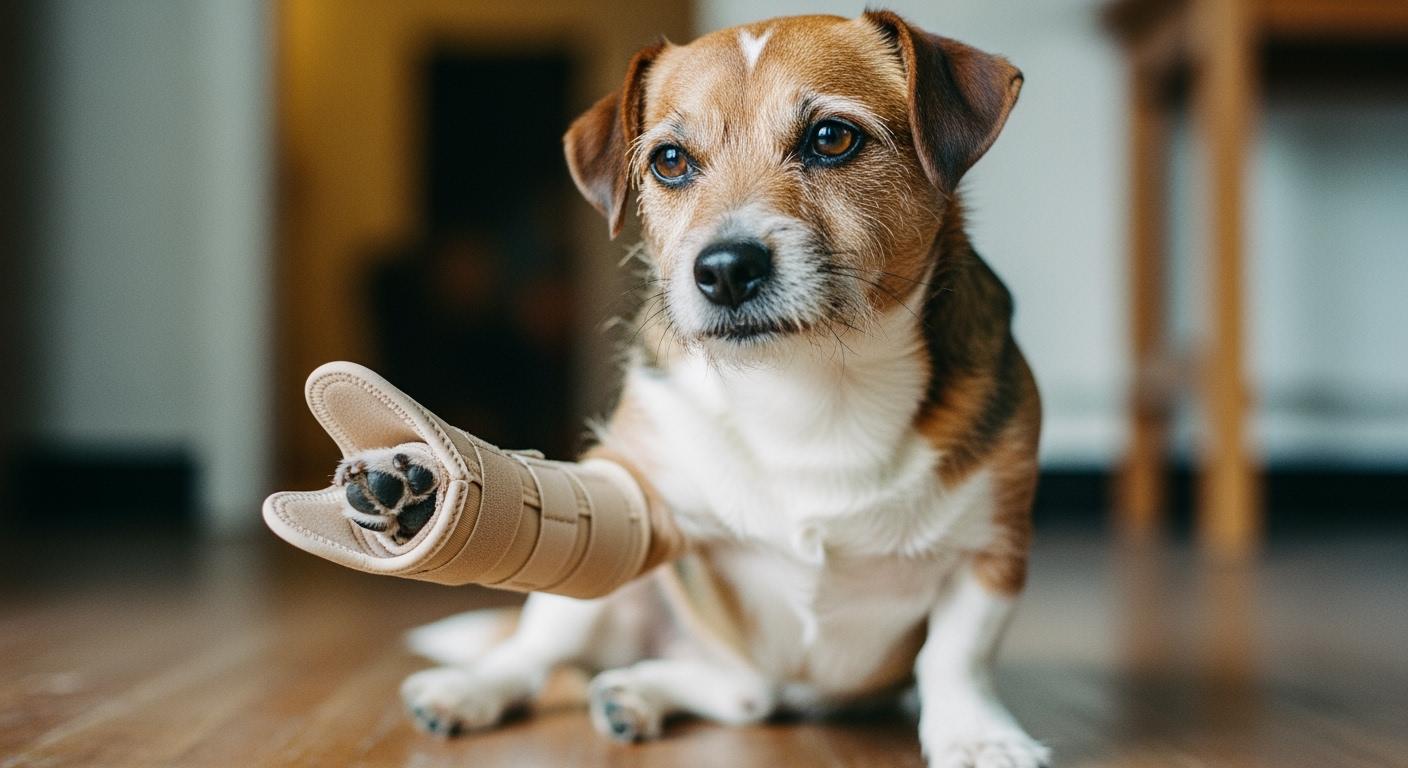
A small dog can measure into the smallest available brace size and still end up with a carpal brace that sits too wide across the wrist. This is not a measuring error. It is a structural mismatch between the brace body profile and the limb it is supposed to wrap.
When a brace bridges over the carpal area instead of closing around it, tightening the straps does not solve the problem. The panel floats. Rotation starts. The edge digs in. Support shifts where it should hold steady.
Why a Carpal Brace Sits Too Wide on a Small-Dog Wrist
Small-dog front legs do not scale down evenly from larger breeds. The limb tapers sharply from elbow to wrist. On breeds like Chihuahuas, Italian Greyhounds, and miniature Poodles, the circumference above the carpal joint can be over 30% larger than the circumference just below it. That difference is where the fit breaks.
Most carpal braces are built on a straight-cut profile — the brace body runs as a near-cylinder from the upper anchor point to the lower edge. On a large dog with a more uniform leg diameter, that cylinder contacts the limb along most of its inner surface. On a small dog with a steep taper, the same cylinder touches only at the top and bottom rims. The middle bridges.
That bridge is the width mismatch. It is not that the brace circumference is wrong. It is that the brace profile does not follow the cone shape of the leg. The result is a gap on each side of the wrist that no amount of strap cinching can close. Readers evaluating carpal brace fit for front leg support often discover this mismatch only after the first trial walk.
| Anatomical Factor | How It Creates Width Mismatch |
|---|---|
| Sharp limb taper | A straight-cut brace contacts only the top and bottom rims on a cone-shaped leg; the middle bridges over the narrowest point at the wrist. |
| Circumference difference exceeding 30% | The brace must span two very different diameters; a single cylinder cannot wrap both anchor points closely. |
| Narrow carpal width relative to upper limb | The brace body may fit the upper anchor point but float entirely over the wrist crease, leaving the joint unsupported. |
What Tightening the Straps Cannot Fix
It is tempting to pull the straps tighter. That fails for a mechanical reason that has nothing to do with strap length.
Strap force runs circumferential — it pulls the two edges of the brace panel toward each other around the leg. If the panel arc radius already matches the wrist radius, the force distributes across the inner surface and the brace seats evenly. But if the panel arc radius is larger than the wrist radius, tightening only brings the edges closer together without pushing the middle of the panel inward. The panel forms an arch, not a wrap.
The contact area shrinks to two narrow lines: one along the top rim, one along the bottom. Each step the dog takes introduces a lateral moment at those edge lines. With no surface area to absorb and distribute that moment, one edge rolls. That roll becomes rotation. The brace twists off-axis relative to the carpal joint. At that point, whatever support the brace was designed to deliver is gone.
The load path is worth tracing: wide panel → bridge over wrist → strap force cinches edges only → contact reduces to rim lines → lateral step force hits a narrow contact line → edge rolls → rotation → joint alignment lost. That sequence plays out in under ten steps on a short walk.
You can verify this directly. Let the dog walk on a flat surface for 10 to 15 minutes. Watch the brace from the side as the dog takes short steps. If the panel shifts inward or outward relative to the joint crease, the brace is rotating — and rotation means the panel arc radius does not match the wrist. After the walk, remove the brace and check the skin at the top and bottom rim lines. Redness or a defined pressure line along those rims, with pale skin in between, confirms the bridge pattern.
Over-tightening to compensate makes it worse. The strap edge digs into the soft tissue near the carpal crease on one side while the opposite side stays loose. That creates a pressure differential across the joint. The dog may lift the paw, freeze mid-stride, or bite at the brace. A brace that fits correctly does not need to be pulled tight to stay in place — it stays because the panel curve and the limb curve are close enough that friction distributes across the inner surface, not along two rim lines. How wrist brace fit determines daily support performance turns on this arc-radius match more than on strap tension.
| Fit Issue | Why It Happens on Small Dogs | Better Design or Next Step |
|---|---|---|
| Side gap after tightening | Brace body too wide for narrow wrist; panel bridges instead of wrapping | Narrower graded size with smaller panel arc radius |
| Brace rotates during walking | Straight brace profile cannot anchor on a tapered limb | Curved brace shell or soft structured panels |
| Strap edge digs into carpal crease | Over-tightening to close a side gap concentrates force at rim line | Softer edge binding, micro-adjustable strap placement |
| Brace presses into paw area | Brace height too tall for a short lower limb segment | Shorter brace body height |
| Dog lifts paw or freezes | Edge pressure, rotation, or both causing discomfort | Stop use, check rim-line contact pattern, reassess fit |
| Redness persists after removal | Uneven pressure from bridge pattern concentrating at rim lines | Stop use, seek narrower profile or professional fit advice |
When a Standard Carpal Brace Is Not the Right Choice
A brace that bridges the wrist cannot be fixed by adjusting straps, adding padding, or shortening the wear schedule. If the panel arc radius is larger than the wrist radius, the bridge pattern returns every time the brace is put on. Continuing to use a brace under these conditions can cause more harm than going without one.
Stop tightening when side gaps remain after the straps reach gentle tension. Stop using the brace entirely if you see rim-line redness that stays visible more than 15 minutes after removal, swelling or heat near the carpal crease, hair loss under the top or bottom rim, or if the dog repeatedly lifts the paw, freezes, or tries to remove the brace. These signals mean the brace body cannot distribute force across enough surface area to provide support without concentrating pressure.
| Signal Level | What You See | What to Do |
|---|---|---|
| Green | Brace stays centered, no rim-line marks, dog walks without gait change | Continue use, check skin after each wear session |
| Yellow | Mild shifting, faint rim-line marks that fade within 15 minutes, small side gap | Short trial only, recheck panel-to-wrist contact, adjust strap tension |
| Red | Swelling, heat, rim-line marks lasting over 15 minutes, paw lifting, limping, repeated brace removal | Stop use immediately, consult a veterinarian |
Some small dogs have leg conformation that falls outside the proportional norms these braces are patterned for. Dogs with angular limb deformities, very deep chests that shift weight distribution forward, or double-coated breeds where thick fur obscures skin reactions all present fit challenges that standard size grading may not resolve. The distinction between a carpal brace and an upper front limb brace matters here — a carpal brace is designed for the wrist joint specifically, and if the limb shape does not give the brace a conical surface to seat against, even the correct brace type may not fit.
Disclaimer: The fit checks described here assume a short-coated dog where rim-line redness is visible on the skin surface. Double-coated breeds may show subtler rub marks that require hand-checking — run your fingers under the top and bottom rims after each wear session rather than relying on visual inspection alone. If the dog’s leg conformation falls outside typical breed proportions, particularly with angular limb deformities or unusually steep carpal angulation, the standard fit checks may not catch every pressure point.
If standard sizes consistently bridge, a narrower graded size or a brace with a curved shell profile tends to match tapered limbs more closely. When the structural demands of carpal hyperextension support require a brace that holds the wrist at a fixed angle, the panel-to-wrist contact pattern becomes even more critical — any bridge amplifies misalignment because the joint is under constant positioning force.
Design Details That Change Fit on Narrow Wrists
Panel arc radius. A brace body with a smaller arc radius — more curved in cross-section — contacts more of the limb surface on a small dog. Straight-cut panels with a flatter profile work on larger, more cylindrical legs but bridge on cones. Curved shells and soft structured panels that follow a tighter radius reduce the bridge gap at the wrist. When evaluating carpal brace designs, the panel curvature across the wrist is the single most predictive feature for fit on narrow limbs.
Graded sizing. Broad size categories collapse too much dimensional variation into too few options. A small dog that measures into “XS” may still have a wrist 20% narrower than another dog in the same size bucket. Narrower graded sizing — multiple increments within the small-dog range — lets the panel arc radius scale with the circumference, so the brace wraps rather than bridges. Three small sizes beat one “small” every time.
You can check this at home. Place the unfastened brace against the inside of the dog’s wrist. If the panel touches only at the top and bottom edges with daylight visible through the middle, the arc radius is too large. A closer match shows the panel touching along most of its inner surface before any strap is fastened.
Strap configuration. Low-profile straps with a wide adjustment range let tension distribute across the panel rather than localizing at the strap edges. A wide strap spreads the closure force over a broader area, which reduces the rim-line pressure that causes redness and rotation. Narrow straps on a wide brace body concentrate pull force at two discrete points — that is where the edge roll starts.
Edge finishing and liner material. Even a well-matched panel arc can cause problems if the rim edges are stiff or the liner traps moisture. Soft edge binding prevents the rim from cutting into skin when the dog flexes the wrist during a step. Breathable mesh liners let moisture escape, which matters because damp skin under a brace softens and becomes more vulnerable to friction damage within a single wear session. After a 15-minute walk, peel back the liner and feel the skin. Dry and cool means the liner is venting moisture. Warm and damp means it is not — and that dampness will turn into a rub mark within a few more steps. The interplay between wrist brace stability and material comfort is not a tradeoff — a brace that irritates the skin will be rejected by the dog long before its structural support can do any good.
| Design Feature | How It Affects Fit on Narrow Wrists | Main Limitation |
|---|---|---|
| Tighter panel arc radius | Increases surface contact on tapered limbs; reduces bridge gap | Too tight a radius can pinch if the limb has irregular contour |
| Narrower graded sizing | Matches panel geometry to actual wrist dimensions instead of broad categories | Requires more precise measuring; not all size runs go small enough |
| Wide low-profile straps | Distributes closure force across more liner area; reduces rim-line pressure concentration | Wider straps add bulk on an already short limb segment |
| Curved shell or soft panels | Follows the cone shape of the leg instead of forcing the leg into a cylinder | Curved shells with rigid hinges may misalign if the joint axis does not match |
| Breathable liner with soft edge binding | Keeps skin dry and prevents rim cutting during wrist flexion | Mesh liners wear faster than solid fabric under repeated friction |
In practice: A brace that passes the standing fit check can still fail during movement. Always run a 10-to-15-minute walking trial before deciding the fit is acceptable. Watch for rotation, listen for the sound of the panel edges rubbing, and check rim-line skin condition immediately after removal.
FAQ
Can I fix a carpal brace that is too wide by adding padding inside?
Padding fills volume but does not change the panel arc radius. If the brace bridges the wrist, adding liner material pushes the panel farther from the limb and can increase the bridge height. The contact pattern may shift from rim lines to pad edges, but the underlying mismatch between a cylindrical panel and a conical leg remains. A narrower brace profile addresses the geometry directly.
How soon after putting the brace on should I check for fit problems?
Check side gaps before fastening the straps — that is the bridge test. Check again after 5 minutes of standing to see if the panel has shifted. Run the full 10-to-15-minute walking trial, then remove the brace and check rim-line skin condition. Redness that fades within 15 minutes is acceptable in the first few wear sessions. Redness that deepens or persists past 15 minutes signals a fit problem.
What is the difference between a brace that is too loose and one that is too wide?
A loose brace shifts because strap tension is insufficient — the panel may still match the limb contour. A too-wide brace shifts because the panel arc radius is larger than the wrist radius — the geometry itself prevents full contact regardless of strap tension. The bridge test distinguishes them: place the unfastened brace on the wrist and look for daylight through the middle. Gap with straps loose = possibly loose fit. Gap that remains with straps snug = width mismatch.
Do smaller dogs always need custom carpal braces?
Not always. Narrower graded sizing with smaller panel arc radii can fit many small dogs without custom fabrication. The key variable is whether the brace profile follows a cone shape rather than a cylinder. If standard small sizes still bridge, a custom-molded shell or a brace with a curved panel designed for tapered limbs often resolves the mismatch without requiring full custom manufacturing.
How long should a dog wear a carpal brace per session while I am checking fit?
Start with a 10-to-15-minute supervised walking trial on a flat, non-slip surface. Do not leave the brace on unattended during fit evaluation. If the brace passes the bridge test, the walking trial, and the rim-line skin check with no concerning signals, session length can extend gradually. Most dogs need breaks between wear sessions to let the skin recover from contact pressure, even with a well-fitted brace.
