
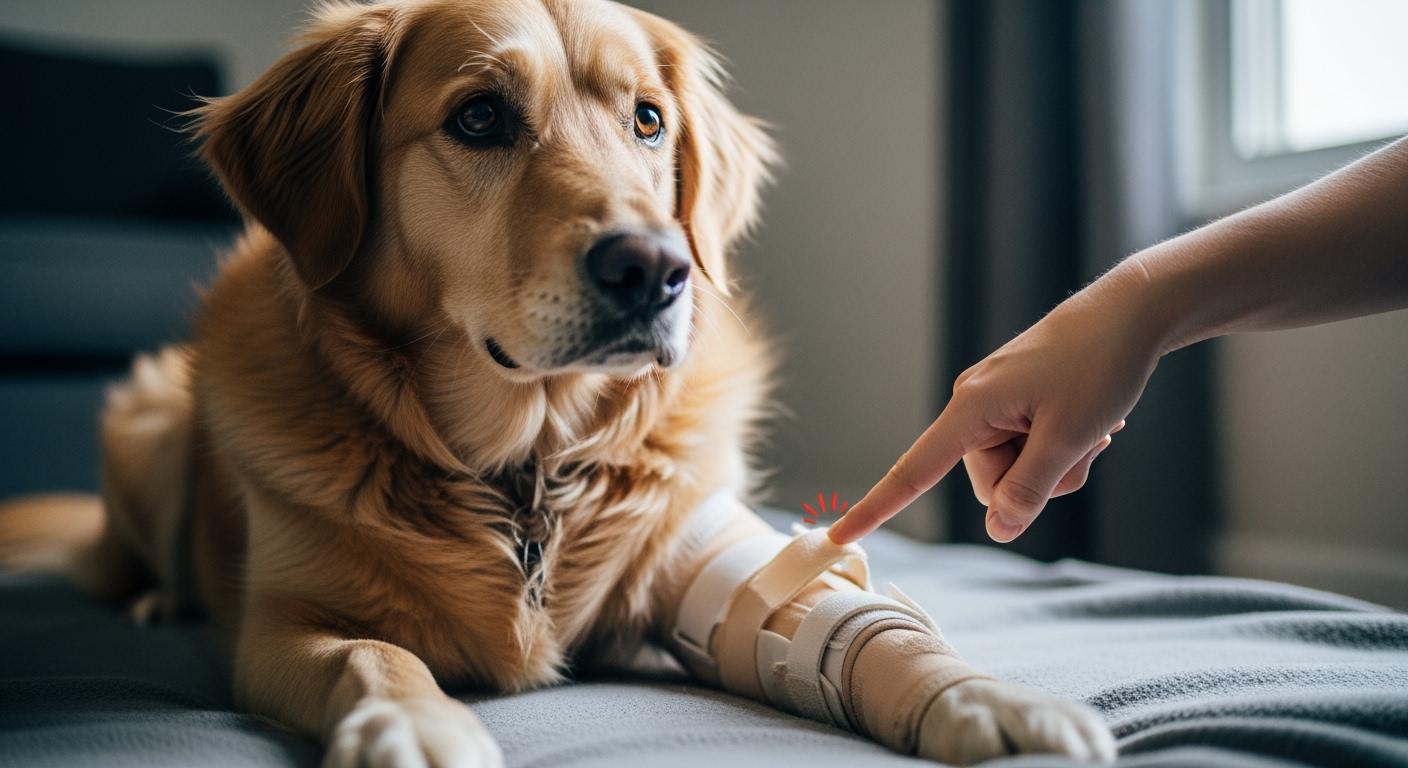
A brace that looks centered on a standing dog can slide three inches down the leg within sixty seconds of walking. The sleeve bunches below the elbow. The joint sits exposed. The dog still unloads the front limb. This is not a measuring mistake — it is a structural mismatch between a straight tube and a joint that flexes roughly 40 degrees with every stride. Understanding that mismatch is what separates a brace that stabilizes from one that becomes dead weight.
The elbow is a bad candidate for a simple sleeve. The forelimb tapers below the joint. There is no bony landmark below the elbow to catch a sliding brace the way the carpal pad anchors a wrist wrap. Every flexion cycle pushes the sleeve downward. If the brace lacks contoured geometry and multi-point anchoring, migration is not a possibility — it is the default outcome. Recognizing where support breaks down lets you judge whether a brace can work for a specific dog, or whether the fit boundary has already been crossed.
Where a Dog Elbow Brace Fails During Real Movement
Three failure patterns repeat across elbow braces regardless of brand or price point. Each traces back to a specific structural decision made at the design level.
The Sleeve Slides Below the Joint
A flat sleeve has one shape: a cylinder. The canine forelimb has another: a cone that narrows from elbow to paw. When the elbow flexes, the muscle bellies above the joint expand and the limb below tapers further. The sleeve has no mechanical feature to resist this — no contoured pocket, no differential compression zone, no upper anchor point that converts limb taper into a locking surface.
The physics is straightforward. Each stride applies a downward shear vector. Without a shaped elbow cup that wraps the olecranon or multi-angle strapping that creates counter-tension, that shear translates directly into sleeve migration. After five minutes of walking, the brace sits an inch or more below the joint line. What was meant to stabilize the elbow is now compressing soft tissue on the upper forearm — providing zero joint support.
Check this yourself: fit the brace, walk the dog on flat ground for ten minutes, then mark the brace position with a piece of tape on the fur above the top edge. Walk another ten minutes. If the tape-to-brace gap has grown beyond half an inch, the anchoring has failed.
The Strap Rubs at the Flexion Crease
The elbow crease opens and closes with every step. A strap crossing that crease undergoes repeated pinch cycles — tissue gets compressed between strap edge and underlying bone on each flexion. Narrow straps concentrate that compression into a thin line. The edge acts like a dull blade under cyclic loading.
Wider straps change the pressure math. Doubling strap width halves the force per unit area for the same tension. A 1.5-inch strap distributes load across roughly triple the skin contact area of a half-inch strap. The edge still exists, but the pressure at any single point drops below the threshold that triggers capillary shutdown and skin breakdown. This is why dogs tolerate wider straps for longer wear periods — not comfort in the abstract, but sub-threshold tissue pressure.
Remove the brace after the first supervised session and check the skin along the crease. Press a finger against any red marks. If the redness blanches white and refills within two seconds, circulation is intact but the pressure is borderline. If the mark stays red under finger pressure or the skin feels tacky with trapped moisture, the strap configuration needs changing.
The Dog Still Unloads the Front Leg
Persistent off-loading despite a well-positioned brace means the internal joint forces exceed what external compression can redirect. Elbow dysplasia involves incongruent joint surfaces, fragmented medial coronoid processes, or OCD lesions — mechanical problems inside the joint capsule. A fabric-and-strap brace applies circumferential pressure and limits end-range motion. It does not change contact pressures between the radius, ulna, and humerus.
If the dog consistently holds the paw off the ground or shifts weight to the opposite leg within minutes of brace application, the fit boundary has been crossed. The brace may still serve a role — skin protection, proprioceptive feedback, post-activity compression — but it is not functioning as a joint stabilizer for that dog under those loads.
Better Structure for Elbow Dysplasia: What Changes the Outcome
Three design variables separate a brace that holds position from one that does not. None of them are about “quality” in the abstract. Each addresses a specific failure mechanism.
Contoured Coverage Replaces a Flat Sleeve
A contoured elbow zone does two things a flat sleeve cannot. First, it cups the olecranon — the bony point of the elbow — creating a mechanical stop against downward migration. Second, it provides differential compression: snugger around the joint capsule where support is needed, looser above and below where circulation matters.
This is not about more padding. It is about geometry matching. A sleeve cut from a single rectangular panel sewn into a tube will always fight the limb’s natural taper. A multi-panel construction with a shaped elbow dart follows it. In production terms, this means more seams and a more complex cutting pattern — which is why flat sleeves dominate the low end. But for dogs that have already failed a flat sleeve — and the distinction between sleeve protection and brace support often gets blurred — that extra construction is the difference between a brace that stays put and one that needs readjustment every few minutes.
The test is repeatable: fit the brace with the dog standing square. Mark the olecranon position through the brace with a small dot of chalk. Walk ten minutes. If the chalk dot has shifted relative to the brace’s elbow zone, contoured coverage is not doing its job.
Wider Straps and Multi-Point Anchoring
A single strap above the elbow is an anchor. A single strap below the elbow is a stop. Together with a third mid-brace strap at an opposing angle, they create a tension triangle that resists rotation in three planes. Remove one anchor point and the brace can pivot around the remaining straps — rotating during turns, bunching during flexion, or sliding during extension.
Strap width matters independently of strap count. A narrow strap under tension creates a high-pressure band. When the dog flexes the elbow, the muscle belly expands proximal to the strap, increasing local pressure further. Wider straps spread that expansion force across more skin area. The difference is visible: narrow straps leave deep linear impressions that persist for minutes after removal; wide straps leave diffuse compression that fades within seconds. Guidelines for daily elbow support fit and comfort checks emphasize this distinction because strap marks are the earliest warning that pressure is crossing into tissue-damage territory.
Strap angle matters too. Straps set perpendicular to the limb axis resist vertical migration. Straps set at a slight downward angle from front to back convert some of the downward shear into circumferential tension — wedging the brace against the limb taper rather than sliding with it.
Non-Slip Lining Without Heat Trapping
A lining that grips the coat keeps the brace from rotating. A lining that traps heat and moisture breaks down the skin barrier within hours. The trade-off is real: high-friction materials like raw neoprene grip well but do not breathe; open-cell mesh breathes but slides on short-coated dogs.
Perforated neoprene splits the difference. The perforations create air channels that allow moisture vapor to escape while the remaining neoprene surface provides friction. It is not as breathable as mesh or as grippy as solid rubberized lining — but under real wear conditions where a dog moves, pants, and generates body heat, it avoids the failure mode that kills compliance: a hot, damp, itchy leg. For front-leg support across different conditions, understanding the difference between elbow and carpal support helps clarify why lining requirements differ — an elbow brace worn during activity generates more heat than a carpal brace worn for standing support.
| Performance Difference | Why It Matters | Main Limitation |
|---|---|---|
| Flat sleeve vs. contoured coverage | Flat sleeve migrates under flexion; contoured cup locks onto olecranon | Contoured construction requires more seams and accurate sizing |
| Narrow strap vs. wide strap | Narrow straps concentrate pressure into a line; wide straps distribute below capillary-shutdown threshold | Wider straps can overlap the flexion crease if placement is not precise |
| Single anchor vs. multi-point strapping | Single anchor allows rotation; a tension triangle resists migration in three planes | More straps mean more adjustment points and a longer fitting routine |
| Solid neoprene vs. perforated lining | Solid neoprene traps moisture and heat; perforations allow vapor escape while retaining grip | Perforated lining has lower structural tear strength at seam lines |
| Straight strap angle vs. angled strap path | Perpendicular straps resist vertical slide; angled straps convert shear into circumferential wedging | Angled paths are harder to communicate in fitting instructions |
When the Elbow Brace Is Not the Right Tool
Some dogs cross the fit boundary on day one. The brace is correctly sized, properly positioned, and structurally sound — and the dog still cannot use the leg. That is not a product failure. It is a category mismatch.
Signs the Brace Support Ceiling Has Been Reached
Heavy limping that persists or worsens after brace application signals that joint forces exceed what external compression can redirect. Swelling that increases during brace wear — not after activity, but during — indicates the compression is aggravating rather than stabilizing the joint. Pressure marks that do not fade within fifteen minutes of brace removal mean tissue perfusion is compromised.
Elbow arthritis and dysplasia present different fit challenges than carpal conditions, and a brace that works for one joint may be structurally wrong for the other. An elbow brace supports by limiting extension and providing circumferential compression. If the primary problem is bone-on-bone contact from collapsed joint space, no external sleeve can restore that spacing.
Elbow Guard vs. Elbow Brace: Two Different Tools
An elbow guard protects skin. It cushions the olecranon against hard surfaces, prevents callus formation, and keeps healing wounds clean. It does none of the things a brace does — no joint compression, no motion control, no proprioceptive feedback during gait. A structured elbow brace adds these functions but at the cost of more bulk, more heat retention, and a more involved fitting process.
Using a guard when the dog needs joint support leaves instability unaddressed. Using a brace when the dog only needs skin protection adds unnecessary complexity and reduces compliance. The right tool depends on whether the primary problem is inside the joint or on top of it.
| Situation | Elbow Guard | Elbow Brace |
|---|---|---|
| Callus prevention on hard floors | Fits the task | Overbuilt for the need |
| Healing wound protection | Fits the task | Adds unnecessary compression |
| Mild instability during walks | No joint control | Fits the task |
| Post-activity joint compression | No therapeutic compression | Fits the task |
| Severe lameness, swelling, heat | Insufficient | Insufficient — needs reassessment |
Disclaimer: The fit checks and pressure assessments described here assume a short-coated dog where skin changes are visible on inspection. Double-coated or very heavily furred breeds may show subtler rub marks that require hand-checking — run fingers against the grain of the fur along strap lines rather than relying on visual inspection alone. If the dog has angular limb deformities or a chest conformation that falls well outside the breed norms this brace pattern was designed for, the anchoring geometry described above may not apply and pressure points can develop in locations these checks will not catch.
When lameness increases, swelling develops, or pressure marks fail to resolve after brace adjustment, the next step is not another strap tweak. It is a veterinary reassessment. Braces redirect external forces. They do not change joint surface geometry, remove bone fragments, or regenerate cartilage. If the internal problem has progressed past the point where external support can compensate, continuing to adjust the brace delays the care the dog actually needs. For a broader view of front-leg bracing solutions across different conditions, the structural demands on an elbow brace differ substantially from those on a carpal or full-limb brace and should be evaluated separately.
Fit Checks That Catch Structural Problems Early
First Supervised Trial: 30 to 60 Minutes
Flat ground only. No stairs, no turns at speed, no off-leash movement. Watch for three things: brace position relative to the elbow at the end of the session, the dog’s willingness to load the leg evenly, and any licking or mouthing directed at the brace. Licking is not a behavioral quirk — it is the earliest signal that something under the brace feels wrong.
Skin Check Protocol: First 72 Hours
Remove the brace. Run a dry fingertip along every strap line and the sleeve edge at the elbow crease. Note any texture difference — tackiness, roughness, residual heat. Then look. Redness that blanches under finger pressure is stage one. Redness that does not blanch is stage two — the brace should not go back on until the skin returns to normal. Any broken skin, blistering, or deep crease marks that persist beyond fifteen minutes mean the fit needs structural changes, not minor adjustment.
| Signal | What It Means | Action |
|---|---|---|
| Brace stays aligned, skin normal, even gait | Anchoring and pressure distribution are adequate | Continue, monitor daily |
| Mild slip under 0.5 inch, light strap marks that fade | Minor anchoring gap, pressure still in safe range | Adjust strap tension and angle, recheck next session |
| Swelling, heat, sores, worsening limp, refusal to bear weight | Fit boundary crossed — support insufficient or pressure damaging | Stop use, seek veterinary reassessment |
FAQ
How long can a dog wear an elbow brace in one session?
Start at 30 to 60 minutes. If skin checks pass — no persistent marks, no moisture trapping, no heat buildup — sessions can extend gradually. A brace that traps heat or leaves lasting strap impressions at 60 minutes will not improve at four hours. The failure mode does not self-correct with time.
What is the difference between an elbow guard and an elbow brace?
An elbow guard is a padded sleeve that protects skin from hard-surface contact. It does not control joint motion or provide therapeutic compression. An elbow brace adds structured support — contoured coverage, multi-point strapping, and motion limitation. If the dog’s primary problem is calluses or abrasions, a guard is appropriate. If the primary problem is instability during movement, a guard leaves the joint unsupported.
Why does the brace slide down even when it is the right size?
Because size — measured as limb circumference — does not predict migration. A correctly sized flat sleeve still lacks the contoured geometry and multi-angle anchoring needed to resist the downward shear of elbow flexion. The limb tapers below the joint and every stride pushes the sleeve downward. Contoured coverage and straps set at angles that convert shear into circumferential tension are what stop the slide, not a tighter circumference measurement.
Can an elbow brace replace surgery for elbow dysplasia?
No. A brace provides external support — it limits range of motion, applies compression, and offers proprioceptive feedback. It does not remove bone fragments, correct incongruent joint surfaces, or regenerate cartilage. If the internal joint damage has progressed to the point of persistent severe lameness, the brace has crossed its support ceiling and surgical or medical management should be reevaluated.
