
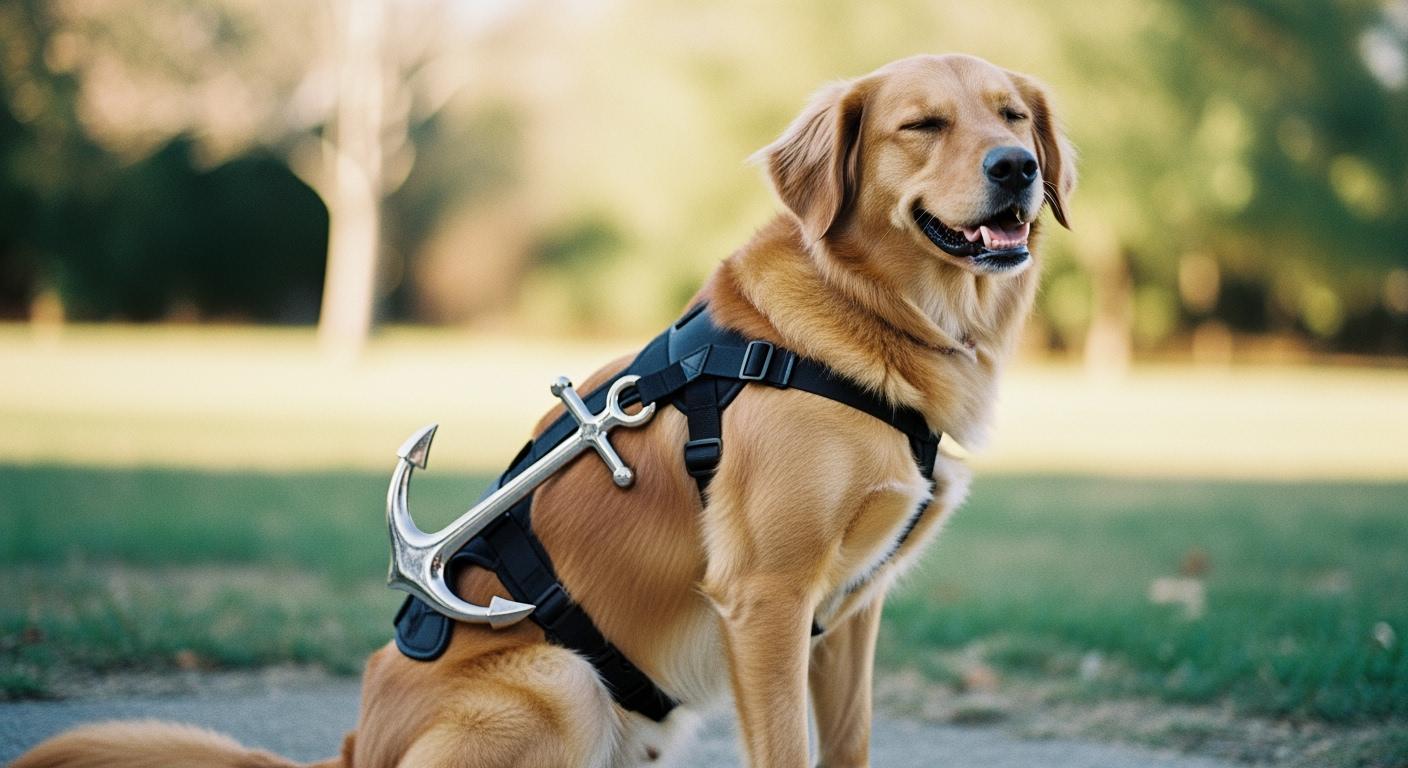
A dog back brace that shifts when the dog sits fails at the anchor, not the size tag. You fit the brace while the dog stands. It looks centered. The straps sit flat. Then the dog sits, the panel creeps forward, and the support zone no longer tracks the spine. This is not user error. It is a geometric mismatch between the brace and the way a dog’s body changes during sitting.
When a dog sits, the abdomen compresses and the pelvis rotates rearward. Two forces hit the brace at once: the rear anchor loses its seat as the thigh-to-abdomen contour changes, and the belly strap faces a shorter, wider torso profile. A brace engineered for a standing silhouette only handles one of those two shapes. The shift you see is the brace defaulting to whichever anchor still has grip—usually the chest strap—while the rear end wanders.
Why a Back Brace Shifts During Sitting

The shift starts at the rear anchor. Most back braces use a flat strap that wraps around the hindquarters and pulls tension forward. When the dog stands, that strap crosses a relatively straight contour where the thigh meets the abdomen. Tension holds. But sitting compresses that same contour—the thigh rotates forward, the belly shortens, and the anchor’s contact surface loses the shape it was cinched against.
Here is the causal chain: a flat rear anchor has no mechanical lock against a rotating hip. As the pelvis tilts, the force vector on the anchor runs parallel to the body surface rather than angled into it. The anchor slides. Once the rear anchor migrates forward, the belly strap is the only thing holding position—and a narrow belly strap is poorly equipped for that job.
A narrow strap under a compressing abdomen behaves like a cord under tension. The center of the band carries most of the load. The edges see less tension and curl inward. What started as a flat band becomes a near-circular cross-section, and the contact patch shrinks to maybe half an inch wide. Every pound of force channels through that narrow line. The dog feels a cord pressing into soft tissue, not a panel cradling the belly. That sensation alone can make a dog refuse to sit.
The back panel amplifies both failures. A stiff panel with no side flex bridges over the spinal curve instead of following it. The panel lifts at the center, the edges dig in, and support alignment is lost. A properly fitted back support brace needs the panel to flex laterally so it tracks the spine through the full sit-to-stand arc—not just the standing position most fitting instructions assume.
In practice: After 20 minutes of wear, slide your hand under the back panel lining. If the skin feels damp or warm to the touch, the liner is trapping heat and the brace will shift more as the dog gets uncomfortable and starts micro-adjusting posture to escape the sensation.
The Sit-Fit Test: Check Where the Brace Actually Fails
You need an observable check that catches shift before it causes skin damage or learned brace refusal. The Sit-Fit Test gives you that—it measures position drift across the movement that triggers the failure.
- Put the brace on while the dog stands calmly. Let the dog settle for two minutes so the initial cinch tension relaxes.
- Mark the rear panel edge against the fur with a small piece of low-tack tape or a washable dot. This is your baseline.
- Ask for five slow sit-to-stand cycles. Do not rush them—fast sits let the dog brace against momentum in ways that hide real drift.
- Walk ten slow steps on a flat surface, then compare the panel position against your mark.
- Measure the shift. More than half an inch of forward migration means the anchor geometry is not holding.
- Remove the brace. Check the skin along every strap path and panel edge. Run your fingers against the fur direction—raised bumps you feel but cannot see are early-stage pressure points.
- Score the result: green (centered, clean skin), yellow (small shift, mild pinkness), or red (major shift, lasting marks, dog hesitates to sit).
Two observations matter more than the raw shift measurement. First: does the dog take an extra half-step or look back at the hindquarters during the sit-to-stand transition? That is a pain-avoidance micro-movement—the dog is adjusting because something pinched. Second: after removal, is the skin dry or damp under the panel? A dry under-layer after 20 minutes means the lining breathes. A damp one means heat and moisture are accumulating, which softens skin and accelerates rubbing damage. Both checks are covered in more detail in the common fit failures that make a back brace unsafe.
Surface-level redness versus deep-tissue marks tell different stories. Redness that fades within ten minutes of removal is usually friction—the liner is moving against the fur. Redness that persists, or purple-toned marks that feel warmer than surrounding skin, suggest sustained pressure above capillary refill. That is a structural fit problem, not a liner issue, and it will not resolve with a thinner sock or more padding.
| Failure sign | Likely cause | Why tightening alone fails | Better design direction |
|---|---|---|---|
| Rear anchor slides forward | Flat anchor, no contour lock | Tightening pulls anchor up, not back—force vector stays parallel to skin | Contoured rear anchor that angles into the thigh-abdomen junction |
| Belly strap rolls | Narrow webbing, no lateral stiffness | Tightening increases edge pressure gradient, accelerates roll | Wider padded belly panel with edge reinforcement |
| Back panel bunches | Full-rigid panel, no side flex zones | Tightening bridges the panel over the spinal curve instead of conforming | Semi-rigid panel with flexible lateral zones |
| Panel edge presses into flank | Panel too short for the dog’s torso length | Tightening concentrates force at the panel edge rather than distributing | Panel length matched to torso, not just girth |
| Dog refuses to sit | Pressure points or restricted hip flexion | Tightening increases discomfort and reinforces avoidance | Flex zones at hip-angle pivot points, breathable lining |
| Skin stays red after removal | Sustained pressure + trapped moisture | Tightening reduces airflow and locks in heat | Moisture-wicking liner, multi-point strap system |
| Result | What you see | What to do next |
|---|---|---|
| Green pass | Panel centered, dog sits and stands without hesitation, skin dry and mark-free | Continue use, run the Sit-Fit Test twice daily for the first two weeks |
| Yellow adjust | Less than half-inch shift, mild pinkness fading within 10 minutes, no pain response | Reposition and retest; check strap tension balance across all anchor points |
| Red stop | Major shift, rolling strap, lasting marks, swelling, warmth, or refusal to move | Stop use immediately; a back support solution with different anchor geometry may be needed |
What Design Holds Better Through Sitting
A contoured rear anchor. A flat strap anchor depends entirely on friction. When the hip rotates and the abdomen compresses, the friction surface changes and the anchor slips. A contoured anchor—one shaped to follow the curve where the thigh meets the abdomen—creates a mechanical lock. The force vector angles into the body contour rather than running parallel to it. This resists forward migration even as the underlying shape changes. Shaped cuffs that close the gap through joint flexion, combined with strap angles that create upward counter-force, distribute compression rather than concentrating it at a single tension line. The lightweight back brace designed for spinal support demonstrates how anchor contour affects positional stability through movement.
A wider padded belly panel. Width is not about comfort—it is about anti-roll geometry. A panel wide enough to span from sternum to flank has lateral resistance to curling. When the abdomen compresses during sitting, the force distributes across the full panel surface rather than concentrating at the centerline. The edges stay flat because the panel has enough bending stiffness across its width to resist the inward curl that turns a narrow strap into a cord. Edge-binding or internal stiffening ribs add further roll resistance without increasing overall strap tension.
A semi-rigid back panel with flexible side zones. A panel that cannot bend laterally will bridge over the curved sitting spine. The center lifts, the edges dig in, and the support loses alignment. Flexible side zones—narrow channels of reduced stiffness running parallel to the spine on each side—let the panel conform to the sitting curve while maintaining longitudinal rigidity. The panel stays in contact with the back through both standing and sitting postures. The dog can transition between positions without the panel popping away from the body.
Lining choice matters here too. A liner that traps moisture softens the skin and lowers the friction threshold at which rubbing starts. A breathable, moisture-wicking liner keeps the skin dry and maintains a stable interface between the brace and the fur. The difference shows up fast in the Sit-Fit Test: a damp under-layer after 20 minutes signals a liner that will cause problems within the first hour of wear. For dogs recovering from spinal conditions, the interaction between brace design and daily mobility is explored in how back braces support IVDD recovery and daily movement.
When a Back Brace Is Not the Right Fix
A brace that shifts during sitting can sometimes be fixed with better design. But not every back problem belongs in a back brace. Know the boundaries.
When the dog refuses to sit or stands with a hunched posture. Refusal to sit with the brace on—especially if the dog sits fine without it—is not stubbornness. It is the dog avoiding a position that causes pain. A brace that restricts hip flexion or presses a rigid edge into the flank during the sit motion will teach avoidance within days. If the dog takes a shortened hind-limb stride, repeatedly shifts weight onto the forelimbs, or shows a more hunched back with the brace than without it, the brace is working against the dog’s biomechanics.
When skin marks do not resolve. Marks that remain red or indented 20 minutes after brace removal signal sustained pressure above what the tissue can tolerate. This is not a break-in issue. It is a structural mismatch between the brace and the dog’s body contour in the sitting position—the position where pressure patterns change most dramatically from the standing fit.
When the problem needs a different support category. A back brace stabilizes the spine. It does not lift the hindquarters, support the hips laterally, or prevent paw drag. If the dog’s primary issue is hind-end weakness, knuckling, or splaying hips, a back brace is targeting the wrong anatomy. The decision between spinal support and full-body lift assistance is explored in the comparison of back braces versus lift harnesses for mobility support.
Disclaimer: The fit checks described here assume a dog with typical body conformation—a defined waist, visible flank, and a coat short enough to see skin marks. Dogs with very deep chests, angular limb deformities, or double coats may show subtler failure signals. On a double-coated breed, rub marks may not be visible; you must hand-check by running fingertips against the fur direction along every strap path. If the dog’s leg or torso conformation falls well outside breed norms, the observations in this article may not catch every pressure point. If the dog shows pain, sudden weakness, loss of coordination, or a gait change that worsens with brace use, discontinue the brace and seek veterinary assessment.
FAQ
Why does my dog’s back brace shift when sitting but look fine standing?
Standing stretches the torso into a long, relatively straight profile. Sitting compresses the abdomen, rotates the pelvis, and curves the spine. A flat rear anchor loses its friction surface during this shape change, and a narrow belly strap rolls under the compressed abdomen. The brace was fitted to one body shape—the standing one—but fails when the shape changes. This is a design geometry problem, not a sizing error.
Can I just tighten the straps to stop the shifting?
Tightening a flat anchor pulls it upward along the body surface rather than locking it backward into the contour. On a narrow belly strap, increased tension accelerates edge curl by widening the center-to-edge pressure gradient. Tightening traps more heat, reduces airflow, and can turn a minor shift into a pressure injury. Better design—contoured anchors, wider panels, flexible side zones—addresses the root cause without relying on tension.
How soon after putting the brace on should I test for shifting?
Run the Sit-Fit Test within the first 30 to 60 minutes of supervised wear. Early shifting nearly always worsens over time as the dog moves, the liner warms, and micro-adjustments accumulate. Catching a half-inch shift at 30 minutes prevents the two-inch drift and skin damage that shows up at the two-hour mark.
What if the brace passes the Sit-Fit Test but the dog still seems uncomfortable?
Look beyond visible marks. Run your hand under the panel after 20 minutes—damp heat means the liner is not breathing. Watch for micro-behaviors: a half-step hesitation during sit-to-stand transitions, a quick glance back at the hindquarters, or a change in tail carriage. These signals often precede visible skin damage. If discomfort persists with a brace that passes the position check, the issue may be joint restriction rather than surface pressure, and reassessment of whether a back brace is the correct support category is warranted.
