
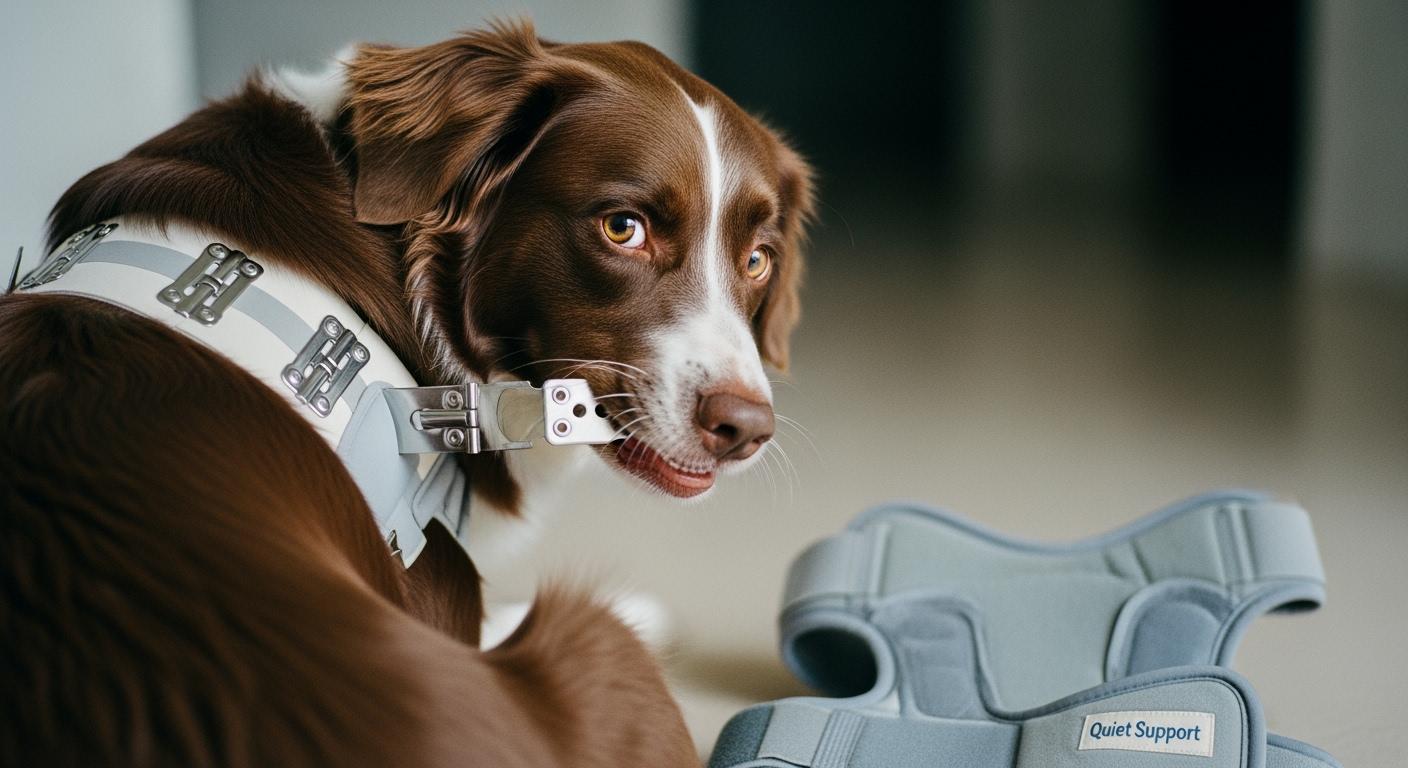
You fit the brace. The dog takes two steps. The hinge clicks. The dog freezes mid-stride. Then turns and bites at the side panel.
That reaction is not stubbornness. A dog back brace metal hinge noise reaction is a mechanical problem before it is a behavioral one. Metal on fabric. Stay shifting in a channel. Edge pressing into a rib. The dog hears the click, feels the shift, and responds the only way it can. Stop. Bite. Refuse.
Most back braces look stable on the table. Straps seem secure. Panels cover the spine. But inside a thin fabric sleeve, a metal stay has room to move. Each step creates a gap between stay wall and channel wall. The stay slides, hits the channel edge, and the impact travels through fabric into the dog’s back. The dog does not know what a hinge is. It knows something just jabbed it from behind.
Where the Clicking and Freezing Actually Starts
A brace that clicks with every step has already failed as a support tool. The dog is not benefiting from stabilization. It is bracing against the brace.
The causal chain runs tight: a narrow stay channel leaves side-to-side clearance around the metal insert. When the dog’s back flexes during walking, the channel gap lets the stay shift laterally. The stay edge strikes the channel wall, creating a sharp mechanical click. The vibration transmits through the panel into the skin directly over the spine. The dog startles. The stride shortens. The dog turns to bite at the source. Support that was supposed to stabilize movement has instead conditioned the dog to fear it.
This is not hypothetical. Flex the brace in your hands before putting it on the dog. Bend it the way a walking back would. If you feel the stay shift inside the panel or hear a click, the dog will feel it magnified through direct skin contact. A hand test takes ten seconds and predicts the entire wear session.
| Failure seen in use | Likely design cause | Why the dog reacts | Better structure or adjustment |
|---|---|---|---|
| Click at each step | Loose hinge or metal stay with channel clearance | Startle, fear, or distraction | Covered, padded, fixed support stay with zero-play channel |
| Rattle when turning | Thin panel, loose frame | Anxiety, freezing | Stable, contoured back panel with internal stay anchoring |
| Squeak when bending | Exposed hinge, hard contact between metal and shell | Avoids movement | Quiet hinge housing, padded rail channels that isolate metal |
| Buckle taps the rib area | Hard buckle positioned over rib contour | Flinching, biting at brace | Low-profile buckle, offset from the rib line |
| Metal stay shifts inside panel | Narrow or thin channel with excess clearance | Pressure, pinching, pain | Wide, padded channel with broad support bridge that fills the gap |
| Dog bites one side of the brace | Uneven strap path, panel twisting under load | Frustration, discomfort | Symmetrical strap path, wide anchor panel that resists rotation |
Each failure point traces back to a single structural decision: how much room the metal stay has inside its channel. Too much clearance and the stay becomes a noise source. Too little padding and the impact travels straight to the skin. The quietest brace is not the one with the most straps. It is the one where the stay cannot move.
Noise phobia in dogs is well documented. A sudden click from an unseen source behind the head triggers a startle response that some dogs do not habituate to over time. A brace that scares the dog provides no support, and that is where a detailed fit evaluation for back braces used during IVDD recovery becomes essential.
Why Tighter Straps Make the Clicking Worse
The instinct when a brace shifts or clicks is to pull every strap one notch tighter. That instinct is wrong.
Tension compresses the panel against the back with more force. If the stay already has clearance inside its channel, increased compression does not eliminate the gap. It changes the angle of contact. The stay that used to slide now presses at a tilt, and the edge digs into the channel wall under higher load. The click becomes a creak. Or a squeak. Or the stay binds briefly, then releases with a sharper snap. The noise gets louder, not quieter.
Narrow straps compound the problem. A half-inch strap under tension concentrates force into a band of high pressure per square inch. After 10 minutes of wear, run your thumb along the skin just behind the strap edge. If you find a red crease that does not fade within 30 seconds of removing the brace, the pressure exceeds what the skin can tolerate for extended wear. That crease is not a fit problem. It is a strap-width problem.
Wide anchor panels distribute strap tension across more square inches of panel contact. The stay channel stays aligned. The load path from strap to stay to spine runs straighter. The same strap tension that creates a pressure line under a narrow panel becomes harmless under a panel twice as wide. Force per square inch drops by half. This is also why a spinal support brace fit guide that checks anchor width and strap path, not just girth measurements, catches problems that a size chart alone misses.
Disclaimer: This pressure check assumes a short-coated dog where skin is visible. Double-coated breeds may show subtler signs. Run your fingers under the panel edge rather than relying on visual inspection alone. If the dog flinches when you press over the stay line, the pressure is too high regardless of what is visible.
What a Quiet Back Brace Design Changes
Quiet is not a feature. It is the result of four structural choices that eliminate the conditions where noise starts.
First, covered metal stays. When the stay is fully enclosed in a padded sleeve that is stitched into the panel rather than slipped into a loose channel, there is no clearance for lateral movement. The stay is fixed. No shift means no impact against the channel wall, and no impact means no click. For a lightweight back brace built for IVDD support, this matters because the dog is already neurologically sensitized. Any sudden stimulus along the spine can trigger a disproportionate reaction.
Second, padded rail channels with enough thickness to absorb the small vibrations that even a fixed stay transmits during flex. Thin foam compresses to nothing under load. A channel with dense padding does what mesh cannot: it decouples stay vibration from skin. Press on the panel with your thumb. If you can trace the outline of the stay through the padding, the padding is too thin.
Third, wide anchor panels that resist the rotational force generated when the dog turns. A narrow brace twists under lateral motion, and twisting misaligns the stay relative to the spine. The stay that was parallel to the vertebrae is now diagonal, and the edge loads one side of the channel harder. Noise. Pressure. Reaction.

Fourth, low-profile buckles offset from the rib contour and secured strap ends that cannot flap against the flank. A buckle that sits proud of the panel by even a quarter inch becomes a percussion instrument with every stride.
| Noisy feature | Quiet design choice | Why the difference matters | Main limitation |
|---|---|---|---|
| Exposed metal stay | Covered, padded stay | Eliminates metal-on-fabric impact noise | Adds bulk that may not suit very small dogs |
| Thin rail channel | Thick, soft padded channel | Decouples stay vibration from skin | Thicker padding traps more heat in warm weather |
| Narrow anchor panel | Wide, stable anchor panel | Resists twisting that creates edge-loading | Wider panels need accurate back-length sizing |
| Large protruding buckle | Low-profile, flat buckle | Stops rhythmic tapping against ribs | Low-profile buckles can be harder to grip |
A dog that associates the brace with unpredictable noise learns to tense up the moment it is put on. Tensed muscles change back contour. The brace that fit a relaxed dog now sits wrong on a tensed one. This is the spiral: noise creates tension, tension changes fit, poor fit creates more noise. The only exit is a design that breaks the cycle at the source.
When a Back Brace Is the Wrong Support Tool
A brace that clicks, shifts, or scares the dog is failing at its only job. But sometimes the problem is not the brace design. Sometimes a back brace is simply not what the dog needs for the stage it is in.
Green reactions: brief head turn, then normal walking resumes within seconds. Continue short, supervised sessions.
Yellow reactions: freezing mid-stride, shortened gait, repeated looking back at the brace. Remove it. Inspect the stay channels, strap paths, and skin underneath. Reduce wear time and reassess fit before the next trial. A yellow reaction left unchecked becomes a red one.
Red reactions mean stop immediately. Biting at the brace, yelping, limping, swelling, a suddenly arched back, or any loss of rear-leg coordination are not adjustment issues. They are neurological warning signs. For dogs with IVDD, the difference between a yellow reaction and a red one can be measured in hours, and the consequence of ignoring it can be permanent.
| Reaction level | What the caregiver sees | What to do next |
|---|---|---|
| Green | Brief head turn, normal walking resumes within seconds | Continue short, supervised trial; monitor fit |
| Yellow | Freezing, shortened stride, repeated looking back, avoids stairs | Stop, inspect brace and skin, reduce wear time, reassess fit before next use |
| Red | Biting at brace, yelping, limping, swelling, arched back, dragging rear legs | Remove brace immediately; contact veterinarian before any further use |
When a back brace cannot be tolerated, the alternatives are not failures. A lift harness may provide the controlled support needed during walks. Strict rest protocols remain the foundation of IVDD recovery. A comparison of back support braces and lift harnesses for IVDD mobility can clarify which tool matches the dog’s current stage. The decision between brace and harness is not about which is better. It is about which the dog can use without adding stress to an already compromised spine.
For dogs that tolerate a brace well, back support solutions focused on stability and comfort provide a pathway to controlled daily movement. The goal is not to immobilize the back. It is to limit the range of motion that triggers pain or nerve compression while preserving enough mobility for the dog to walk, stand, and rest without fear.
Disclaimer: Dogs with angular limb deformities, very deep chests, or back conformation that falls far outside the breed norms this brace was patterned for may not achieve a fit that passes the pressure and noise checks described here. In these cases, the brace should not be used, even if it measures correctly by girth and length. Conformation mismatch can mask pressure points that only become visible as skin damage after extended wear.
FAQ
How do I tell the difference between adjustment curiosity and a noise reaction?
Adjustment curiosity lasts seconds. The dog glances back once or twice, then resumes a normal stride. A noise reaction repeats with every step cycle. The dog freezes each time the stay clicks, shortens its gait, or bites at the same spot on the brace. Time the reaction. One or two glances is adjustment. Three or more freeze-bite cycles in five minutes is a mechanical noise problem.
Can I pad the stay channel myself to stop the clicking?
Adding material inside a channel that was not designed for it changes the channel dimensions and can bind the stay, creating a new pressure point at the edge of the added padding. A channel needs consistent, even padding along its full length. Spot-padding creates a fulcrum that concentrates force. If the stay shifts in the channel, the solution is a brace built with a zero-clearance channel, not a DIY insert.
What if the brace is quiet but the dog still refuses to move?
A silent brace that the dog still rejects is telling you something about pressure, not noise. Check the strap paths for pinch points, inspect the skin for redness or hair flattening along the panel edges, and verify that the wear time and fit conditions for back braces used with IVDD match the dog’s current tolerance. Some dogs need a graduated introduction measured in minutes per day, not hours. A silent brace that hurts is no better than a noisy one.
