
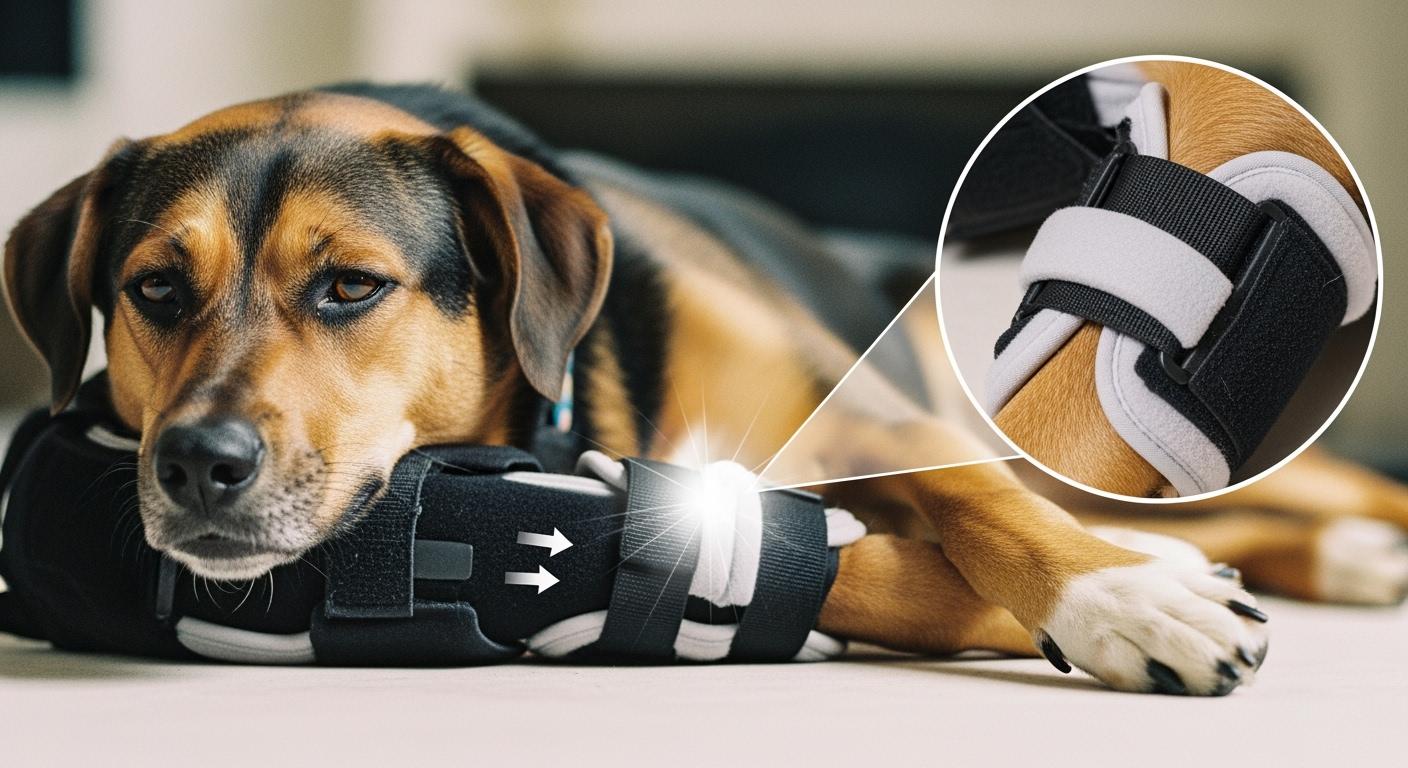
A strap that disappears during a standing walk can become the only thing the dog feels when it lies down. The brace was fitted upright. The padding sat flush. Then the dog drops onto its side and the same strap—unchanged in length, identical in placement—now presses body weight into a narrow line of skin against the floor. This is not a tightening mistake. It is a geometry problem built into the strap design.
When a dog lies down, the chest and belly flatten, the elbow presses into the ground, and the strap that ran across soft tissue moments earlier gets trapped between bone and floor. The force is concentrated at the strap edge. If that edge is narrow, hard, or positioned over a bony prominence, the result is predictable: pressure sores, skin breakdown, and a dog that refuses to rest on the braced side. Understanding how a brace handles both movement and rest positions reveals whether the design supports the full day or only the walking portion of it.
Why Standing Fit Fails When a Dog Lies Down
A brace strap fitted while the dog stands spans a curved, lifted chest or a straight, weight-bearing leg. The strap tension distributes across soft tissue and muscle. The moment the dog lies down, three things change at once. The body weight shifts from the limbs to the torso. The floor becomes a rigid backstop. The strap—still tensioned for the standing shape—now sits between a flattened body and an unyielding surface.
The strap edge turns into a pressure concentrator. This is straightforward mechanics: the same tension force that felt comfortable across a curved standing surface now acts on a compressed, flattened contact zone. The force per square inch jumps. A narrow strap makes this worse because it spreads the same load over a smaller area. A strap that is 0.5 inches wide concentrates roughly twice the pressure of a 1-inch strap under the same body weight. At the elbow—where bone sits close to skin with little fat or muscle padding—the effect is strongest.
The early warning follows a consistent pattern: within twenty minutes of lying down, check the skin under each strap. Pink skin with a defined strap-line that fades within five minutes of brace removal is borderline. A line that stays red longer than ten minutes or shows indentation means the strap is concentrating enough force to restrict capillary refill. Left unchecked, that same strap-line can progress from irritation to an open wound within days of repeated wear. The causal chain is direct: standing fit geometry does not transfer to lying geometry, so a strap calibrated for one position over-pressurizes in the other.
Strap and Closure Design Details That Magnify or Reduce Resting Pressure
Strap Width and Edge Profile
Strap width is the single largest lever for reducing pressure when a dog lies down. A narrow strap—under 0.75 inches for a medium-to-large dog—focuses body weight onto a thin contact line. The floor-side skin bears the full weight of the dog through that strip. A wider strap, 1.25 inches or more, distributes the same load across enough surface area that capillary pressure typically stays below the occlusion threshold.
Edge profile matters independently of width. A strap with a sharp, die-cut edge concentrates force at the perimeter even when the strap body is wide. A bound or rolled edge softens the transition from strap to skin, reducing the shear component that causes digging. This is not cosmetic—a bound edge can cut localized pressure at the strap margin significantly compared to a raw-cut edge of the same width, simply by eliminating the 90-degree corner that acts as a stress riser.
| Design Feature | Why It Fails When Lying Down | Better Design Direction |
|---|---|---|
| Narrow strap (under 0.75 in) | Concentrates body weight onto a thin contact line; exceeds capillary occlusion pressure at the elbow | Wide padded strap, 1.25 in or more for medium-to-large dogs |
| Hard closure edge (metal buckle, exposed plastic) | Presses into floor-side skin; creates a focal pressure point under full body weight | Soft, rounded closure placed away from floor-contact zones |
| Exposed hook-and-loop edge | Abrasive against skin when compressed; catches fur and causes friction burns | Covered or folded edge with hook buried under a fabric overflap |
| Single anchor point | Allows strap rotation and rolling under lateral body movement; rolled strap becomes a narrow ridge | Multi-point anchoring or anti-rotation panel that keeps strap orientation stable |
| Thick buckle positioned under the body | Blocks a relaxed lying position; the dog shifts to avoid it, creating secondary pressure elsewhere | Low-profile closure placed above the elbow line or on the dorsal side |
| Non-breathable liner | Traps heat and moisture; softened skin is more vulnerable to friction damage from strap edges | Breathable liner with moisture-wicking properties; removable for drying between sessions |
| Strap crossing a joint line | Restricts natural joint flexion when lying down; the dog compensates by shifting weight onto the strap | Reroute strap to avoid the joint axis; anchor above and below the joint |
Closure and Anchor Placement
Where a buckle or hook-and-loop patch sits determines whether it becomes a pressure point or stays clear. A closure placed on the lateral or dorsal surface of the brace stays away from the floor when the dog lies on its side. The same closure positioned on the ventral or medial surface gets sandwiched between the dog and the ground. Every pound of the dog’s weight drives it inward.
Anchor panel positioning is equally critical. If the anchor sits too high on the torso, the strap pulls upward at an angle when the dog lies down, creating a diagonal pressure line that loads the lower strap edge disproportionately. If the anchor sits too low, the strap pulls downward and the upper edge digs in. The correct anchor height keeps the strap aligned parallel to the floor in a resting position, so the load distributes evenly across the full strap width rather than concentrating on one edge.
This interaction between anchor placement and strap routing is where many braces fail silently. A strap that runs flat and evenly in standing can shift to a 15- or 20-degree angle purely because the anchor panel does not account for the change in body contour between positions. That angled strap now loads one edge disproportionately—and that edge becomes the pressure point. Fit checks for slipping and rubbing apply the same principle across brace types: if the strap angle changes between standing and lying, one edge is taking more load than the other.
Liner Material and Moisture
A liner that holds moisture softens the outermost skin layer within thirty to sixty minutes of contact. Softened skin has lower resistance to shear and friction. The same strap pressure that would leave a faint pink line on dry skin can break down hydrated skin within a single wear session. Breathable liners allow vapor to escape rather than condensing against the skin surface. The difference is observable: after a twenty-minute wear session, lift the strap and touch the skin beneath. If it feels damp or tacky, the liner is trapping moisture and the skin is more vulnerable to pressure damage than dry skin would be. Elbow support and comfort during daily use depend heavily on whether the materials maintain a dry skin environment during extended contact.
When the Brace Works and When It Does Not
A brace that manages strap pressure well in one dog can fail the same check in another dog of the same breed and weight. The variable is body geometry: the depth of the chest, the prominence of the elbows, the amount of natural padding over bony landmarks, and the dog’s preferred lying position. A dog that lies flat on its side places different demands on strap design than a dog that curls or rests sternally.
Wide padded straps with bound edges and dorsally placed closures tend to perform well across the broadest range of dogs—including thin-coated breeds where the skin has less natural protection, dogs recovering from surgery where skin integrity is already compromised, and dogs that spend long periods resting. The design works because it addresses the mechanics of the problem directly: spread the force, soften the edge, and move hard components away from floor-contact surfaces.
Narrow-strap designs with ventral closures and raw-cut edges tend to cause problems faster in lean dogs, deep-chested breeds, and any dog that lies on the braced side. The failure threshold is lower because the force concentration is higher and the skin tolerance window is shorter. Daily-wear fit and slipping patterns and checks for rubbing, slipping, and limping catch the same progression: a strap that was fine for weeks can suddenly cause a wound because the skin tolerance was gradually exhausted by cumulative micro-damage.
Disclaimer: This check assumes a short-coated dog where strap lines are visible on the skin surface. Double-coated breeds may show subtler rub marks underneath the fur that require hand-checking rather than visual inspection. Run your fingers under each strap after removal—heat, dampness, or a textured ridge in the skin can indicate pressure buildup that the coat conceals. If the dog has angular limb deformities, a very deep or very shallow chest, or any conformation that falls outside the typical range for the breed, the fit checks described here may not catch every pressure point. In those cases, shorter supervised wear sessions and more frequent skin checks are the safest approach.
| Signal Level | What You See | Action |
|---|---|---|
| Green | No strap lines after removal; dog lies down and rises without hesitation; skin is dry and cool under each strap | Continue wear with scheduled skin checks twice daily for the first two weeks |
| Yellow | Faint pink line that fades within five minutes; dog shifts position more than usual; strap edge sits within an inch of a wound or incision | Shorten wear sessions; add padding at the pressure line; recheck fit in lying position |
| Red | Red line lasting more than ten minutes after removal; swelling; heat at the strap site; deep crease or indentation; dog chews the brace, limps, or refuses to lie on the braced side | Stop brace use immediately; contact a veterinarian before resuming wear |
Checking strap lines after every session—not just when something looks wrong—is the difference between catching a pressure problem at the pink-line stage and catching it as an open wound days later. Run a finger under each strap after removal. Feel for heat. Look for a defined crease. If the crease is still visible five minutes after removal, the strap pressure exceeded what the skin can tolerate during that session. The fix is structural: wider strap, softer edge, repositioned closure, or a shorter wear window. Tightening the strap almost always makes the pressure worse because it adds preload to the same concentrated contact zone.
Dog braces built around these design priorities use wider padded contact zones, bound strap edges, and closures placed away from weight-bearing surfaces. The question is not whether the strap is tight enough—it is whether the strap design distributes the dog’s resting body weight across enough surface area that the skin can tolerate session after session.
Frequently Asked Questions
Why does the brace strap feel fine when the dog walks but digs in when it lies down?
Standing posture keeps the strap tensioned across curved, lifted body surfaces where the load distributes through muscle and soft tissue. Lying down flattens those surfaces against the floor, turning the same strap into a pressure concentrator. The strap geometry does not change—the body shape underneath it does. A strap fitted for standing shape over-pressurizes the flattened lying shape.
How soon after a dog lies down should strap pressure be checked?
Check within the first twenty to thirty minutes of a supervised lying session. This is enough time for body weight to settle against the strap and for skin to show an early pressure response. A short-duration check catches the problem before the skin crosses from a temporary pink line into sustained ischemia.
Can padding fix a strap that digs in when the dog lies down?
Padding can reduce peak pressure at the strap edge if it widens the effective contact zone and softens the edge transition. But padding does not fix a fundamentally wrong anchor angle or a closure placed directly under a weight-bearing surface. If the strap routing pulls the padding out of position when the dog lies down—rolling, folding, or shifting—the padding becomes part of the pressure problem rather than the solution.
Should the brace be removed when the dog sleeps or is crated?
Unsupervised rest, crate time, and overnight sleep are periods when the dog cannot communicate discomfort and pressure injuries can develop without intervention. The brace should be removed during these periods unless a veterinarian has given specific instructions to keep it on. Skin needs recovery time from sustained contact pressure to maintain its tolerance for the next wear session.
