
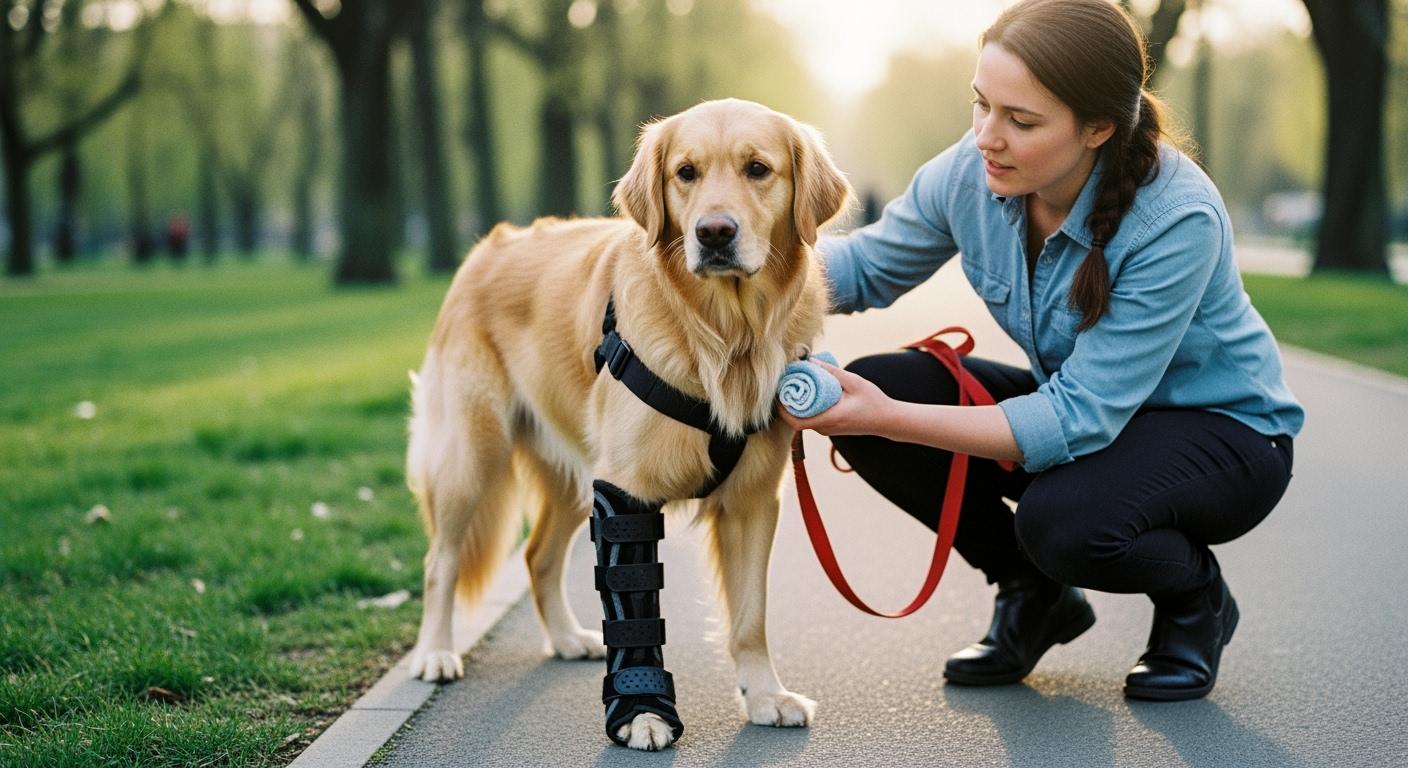
A dog carpal brace with perforated lining can still leave the skin damp after a short walk. You pull the brace off and the inner layer feels sticky. The fur underneath is flattened and wet. That is not a cleaning problem. It is a structure problem — and it sets off a chain of failures that most owners make worse without realizing it.
The issue is not that perforation does nothing. It helps. But fur compression, repeated wrist flexion, and strap tension work together to defeat it. Understanding where the system breaks tells you what to look for — and what not to do in response.
Why Perforated Lining Still Traps Moisture
Perforated neoprene has holes. Air moves through them when the brace is off the dog and sitting on a table. That is the static picture. The dynamic picture is different.
When a dog walks, the carpal joint flexes with every step. The fur under the brace compresses — each strand collapsing against the next — and the perforations that looked open at rest now sit pressed against a dense mat of hair. The air channels close. Moisture from the skin has nowhere to go.
Here is the causal chain in full: carpal flexion compresses fur → fur blocks perforation channels → moisture vapor collects at the skin-facing layer → the lining saturates → surface friction increases → the brace begins to micro-shift with each step → the owner notices the brace sliding and tightens the straps → strap tension compresses the lining harder against the skin → remaining airflow drops to near zero → skin softens from prolonged moisture exposure → friction damage and pressure sores follow.
Each link in that chain is structural, not behavioral. The dog is not doing anything wrong. The owner is responding to what looks like a fit problem. But tightening is the worst response to moisture-driven sliding — it accelerates every failure downstream.
In practice: After 20 minutes of wear, remove the brace and press a dry paper towel against the skin-contact side of the lining. If the towel picks up visible moisture, the perforation-plus-fur-compression system is not moving vapor fast enough for that dog’s coat density and walk conditions.
The lining structure you choose interacts with fur type in predictable ways:
| Lining Structure | Performance Difference | Main Limitation | Where It Works |
|---|---|---|---|
| Solid neoprene | Zero moisture escape; heat builds within 10–15 minutes | Traps vapor and increases friction as soon as the dog moves | Short supervised sessions, cool weather only |
| Perforated neoprene | Allows vapor through open holes at rest; airflow drops under compression | Fur compression closes the channels; dampness still pools at the skin layer | Light walks, mild dry weather, short-coated dogs |
| Open-cell foam | Air and moisture move through interconnected pores | Cell structure collapses under thick fur, losing conductive paths | Short-fur breeds, cool to mild conditions |
| Spacer mesh | Creates a permanent air gap — the mesh structure resists full compression | Requires stable strap placement; gap collapses if straps shift or overtighten | Long walks, thick-coated breeds, humid conditions |
The Tighten-to-Fix Loop That Turns Dampness Into a Fit Failure
Then it slides again.
What is happening, mechanically: damp lining reduces the coefficient of static friction between the brace and the dog’s leg. The brace no longer grips — it micro-rotates. Each carpal flexion pushes it a fraction of an inch. The strap, now tighter, presses the damp lining harder against compressed fur. The fur compresses further. Airflow drops more. More moisture accumulates. Friction drops again. The cycle repeats.
Tightening as a response to moisture-driven sliding is a self-reinforcing loop. The tighter the strap, the less the lining breathes. The less it breathes, the wetter it gets. The wetter it gets, the more it slides. The solution is not more tension. It is removing the moisture and restoring the surface conditions that let the brace grip without compression.
Here is what you can check, directly, after any walk:
| What to Check | Pass Signal | Fail Signal |
|---|---|---|
| Lining surface after 20–30 min wear | Dry to the touch | Damp or sticky against the fingertip |
| Fur texture under the brace | Fluffed, dry, separates easily | Flattened, clumped, feels wet when parted |
| Strap edge imprint on skin | No visible line 5 minutes after brace removal | Red line that persists beyond 5 minutes |
| Brace position change during walk | Has not shifted from original placement | Slid or rotated more than half an inch |
| Dog behavior toward the brace | No attention paid to the brace | Chewing, licking, or pawing at one edge |
| Skin color and temperature | Normal — matches the other leg | Red, warm to the touch, or visibly swollen |
| Brace odor after air drying | No noticeable smell | Persistent musty or sour odor even when dry |
These checks are not subjective. Damp is damp. A red line is a red line. Half an inch is half an inch. Run through the list after each walk during the first week and you will catch the moisture-slide-tighten cycle before it causes skin breakdown.
Disclaimer: This check assumes a short-coated or single-coated dog where the skin is visible after parting the fur. Double-coated breeds — huskies, malamutes, shepherds, retrievers — may show subtler rub marks beneath dense undercoat that require hand-checking rather than visual inspection. Run your fingertips along the skin surface; if you feel warmth, texture change, or the dog flinches at contact, the moisture problem may already be underway even if the skin looks fine.
Structure and Material Choices That Break the Cycle
Perforated outer plus a wicking skin layer. The perforation handles vapor escape; the wicking layer handles liquid transport. A hydrophobic inner face pulls moisture off the skin and moves it toward the outer perforated shell. The two layers do different jobs. A single perforated layer tries to do both and does neither well when fur compresses against it. Removable wicking liners also let you rotate — one on the dog, one drying — which breaks the incomplete-drying link in the chain.
Spacer mesh instead of foam. Open-cell foam collapses under compression. Spacer mesh is a three-dimensional knit — two outer layers connected by spacer filaments that resist crushing. Even with fur pressing against it, the air channel stays partially open. For dogs with thick undercoat, this is the structural difference that keeps vapor moving during a walk. The tradeoff: spacer mesh needs stable strap placement. If the straps shift and the mesh folds, the air gap closes. A stable strap path with fixed anchor points matters as much as the lining material itself.
Rounded strap edges and wider strap profile. A narrow strap with a sharp edge concentrates force along a thin line. When the lining is damp and the skin is softened, that thin line becomes a shear plane — the edge cuts across the skin with each step. A wider strap with rolled or finished edges spreads the same tension over two to three times the surface area. Peak pressure drops. The edge stops acting like a blade. This matters most when fur is compressed and the skin barrier is already compromised by moisture — exactly the conditions where narrow straps cause the most damage.
Here is a second observable check: after positioning the brace, mark the strap edge location with a small piece of tape on the outer shell. Walk the dog for 30 minutes. Measure the distance between the tape and the strap edge. More than half an inch of drift means the strap configuration is not holding — and tightening will not fix it. What fixes it is a brace with a strap layout that resists rotation independent of tension.
For dogs with thick coats that trap moisture regardless of lining choice, the most effective combination tends to be spacer mesh plus a removable wicking liner plus wide rolled-edge straps — three structural changes that each break a different point in the failure chain. Perforated neoprene alone, with narrow straps and no wicking layer, will keep failing the same way in the same conditions. The choices that determine whether a carpal brace stays dry enough to function are structural, not cosmetic.
When a Carpal Brace Is Not the Right Tool
A brace can only manage moisture if the underlying conditions allow it. There are scenarios where no lining structure — perforated, mesh, or wicked — will keep the skin dry enough for safe wear.
If the dog has an open wound, active infection, or dermatitis under the brace zone, moisture control becomes secondary to tissue protection. A damp lining against compromised skin accelerates breakdown regardless of material choices. The brace should come off until the skin barrier is intact.
If the dog’s leg conformation falls significantly outside the breed norms the brace was patterned for — particularly dogs with angular limb deformities, very deep chests that change front-leg angle, or heavy wrinkles that create skin folds under the brace — the fit checks described here may not catch every pressure point. The brace contact surface was designed for a specific leg profile. When the profile differs enough, even a dry lining will press unevenly, and any moisture makes it worse faster.
The distinction between a carpal brace and an upper front-limb brace also matters here. A carpal brace supports the wrist joint specifically. If the dog’s instability is higher — in the elbow or shoulder — a carpal brace will not address it, and the dog will shift weight in ways that create abnormal pressure patterns under the brace. More pressure in the wrong spots means faster moisture buildup and faster skin failure.
Disclaimer: If the dog’s carpal hyperextension is severe enough that the joint collapses even with the brace on, the moisture problem is a secondary concern. The brace is not providing adequate mechanical support for that degree of instability, and continuing to wear it risks joint damage and skin breakdown simultaneously. A different support approach for severe carpal hyperextension may be needed.
Frequently Asked Questions
Why does perforated lining get damp even when the brace looks breathable?
Perforations are open holes when the brace is at rest. When fur compresses against them during walking — which happens with every carpal flexion — the fur fibers block the holes. Vapor has no exit path. The lining saturates from the skin side outward. Perforation improves airflow compared to solid neoprene, but it is not a moisture management system by itself.
How soon should I check the lining during a walk?
Remove the brace at 20 minutes for the first check. If the lining is dry, go to 40 minutes for the next check. If it is dry at 40, the system is working for that dog in those conditions. If it is damp at 20, do not extend wear time — the moisture load will only increase. Dry the brace fully, inspect the skin, and consider whether the lining structure or strap tension needs adjustment before the next session.
Can I use two braces to rotate while one dries?
Yes. Having two complete braces or two removable liners eliminates the incomplete-drying variable. One wears while the other air-dries for a full 24 hours in a well-ventilated area — not in direct sunlight and not with heat, both of which can degrade foam and adhesive layers. For dogs that need daily support, rotation is the single most reliable way to ensure the skin-contact surface is fully dry at the start of each session. A complete carpal brace wear plan should account for drying time as a structural requirement, not an afterthought.
