
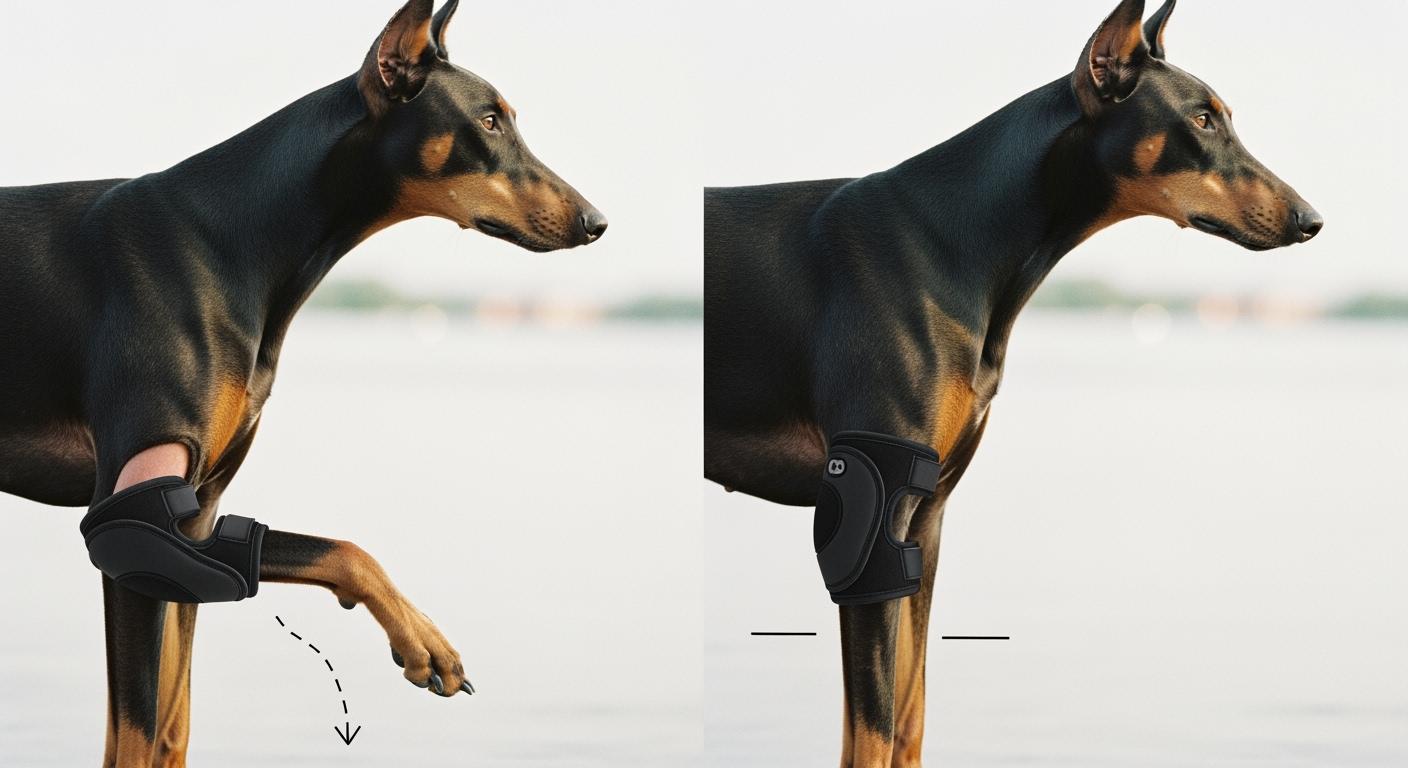
The pad sits centered over the elbow. The dog walks across the room, lies down, gets up. You look again. The pad is below the elbow. Or beside it. You tighten the strap. Same result.
Dog elbow guard slipping on deep chest dog is not a sizing mistake. It is a structural mismatch between the guard’s anchoring strategy and the dog’s body mechanics. Deep-chested dogs have a tall, narrow rib cage that ends at or below the elbow, and a forelimb that tapers quickly beneath the joint. Together, these features create a downward slide path that leg-only designs cannot resist. Understanding why that path exists, which design choices accelerate the drift, and when a different approach makes more sense is what separates a guard that stays put from one that becomes a daily correction loop.
Why a Deep Chest Creates a Downward Slide That Leg Straps Cannot Stop
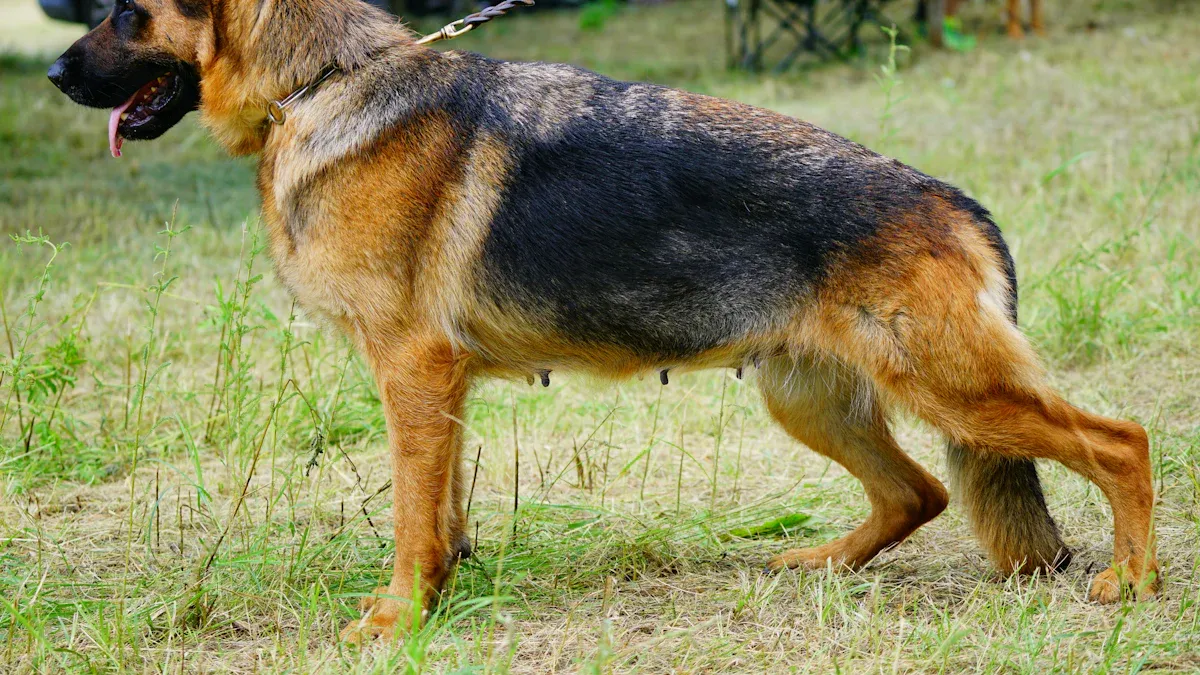
A barrel-chested dog distributes strap tension across a relatively horizontal surface. The chest wall runs more parallel to the ground. A strap cinched around that shape meets resistance in multiple directions.
A deep-chested dog is different. The rib cage is tall and narrow in cross-section. The chest drops to or past the elbow line. Below the elbow, the leg tapers fast. The surface a strap can grip sits on a slope. Each stride sends a pulse of tension through the guard. On a sloped surface, that tension has a downward vector. The strap follows the path of least resistance — down the narrowing leg.
The causal chain runs like this: chest slope creates a downward force vector on the strap. The strap migrates toward the narrower part of the leg. The pad is pulled off the elbow point. No amount of tightening breaks this chain. Tightening increases friction at the strap-skin interface, but the underlying force direction does not change. The pad still drifts. What changes is that now the skin beneath the strap takes more pressure.
A guard that anchors above the elbow — at the chest or shoulder — interrupts this chain at the first link. The anchor sits on a surface whose slope does not feed downward, and the force from leg movement transfers into that stable upper anchor rather than pulling the pad down the taper. This is the mechanical difference between a design that fights gravity and one that surrenders to it. For a closer look at how anchoring interacts with daily wear, elbow support designs that anchor above the joint resist migration in ways that circumferential sleeves cannot replicate.
In practice: After 10 minutes of walking on a flat indoor surface, note the pad’s position relative to the elbow point. Walk another 5 minutes. If the pad has shifted more than half an inch, the guard is migrating — and tightening the strap will not fix the underlying force direction.
Three Design Features That Control Whether a Guard Stays or Drifts
Not all elbow guards fail the same way on a deep chest. Three design decisions determine whether the guard stays centered or migrates: strap width, pad contour, and the presence or absence of an upper anchor.
Narrow straps become pivot axles under lateral force
A half-inch strap concentrates all anchor tension into a thin band. When the dog lies down, body weight presses the elbow laterally into the floor. That lateral force meets the narrow strap at a single line of contact. The strap cannot distribute the rotational load. It becomes a pivot axle.
The elbow pad — attached to that strap — now has a rotation point. As the olecranon pushes sideways, the pad swings off the bony point and onto the surrounding muscle. The wider the strap, the more surface area resists that rotation. A 1.5-inch strap spreads anchor tension across roughly three times the contact area of a half-inch strap. That wider distribution turns what would be a pivot into a stable platform.
The check is straightforward: after the dog lies down and stands back up, look at the pad orientation. If the leading edge has rotated more than a quarter-inch from its starting alignment, the strap width is insufficient for the lateral forces that dog’s chest geometry generates.
| Design feature | What fails on a deep-chested dog | Mechanical reason | What works instead |
|---|---|---|---|
| Leg-only sleeve | Slides down the leg within minutes | No anchor above the elbow; follows the downward taper of the forelimb | Chest or shoulder anchoring that provides a fixed upper boundary |
| Narrow strap (under 1 inch) | Pad rotates off the elbow point | Thin contact band becomes a pivot axle when lateral force hits the olecranon | Wider padded straps that distribute rotational force across more surface area |
| Flat elbow pad | Pad drifts sideways when dog lies down | Flat plane meets curved bone at a single tangent; lateral force slides it off | Cupped or contoured pad that cradles the olecranon with multi-directional contact |
| No upper anchor | Constant downward migration with every step | Nothing interrupts the gravity-driven slide path on the tapered leg surface | Shoulder or chest anchoring that creates a mechanical stop above the elbow |
A flat pad cannot hold the olecranon under lateral load
When a dog lies on a hard surface, the elbow becomes the primary floor contact point. The olecranon — the bony prominence at the back of the elbow — takes the weight. A flat pad meets that bony point as a flat plane meeting a curved surface: contact happens at a single tangent, not across a conforming cradle.
Lateral force from the dog’s body weight pushes sideways at that single contact point. The pad, lacking any concave geometry to capture the bone, slides off. The dog stands up, but the pad stays where lateral force left it — beside the elbow, not over it.
A cupped pad changes the contact geometry. The concave surface wraps around the olecranon, creating resistance in multiple directions. Lateral force now meets a surface that curves with the bone rather than sliding past it. This is not about padding thickness. It is about geometry — whether the pad surface matches the radius of the structure it is meant to protect. The mechanical difference between an unstructured sleeve and a contoured elbow brace becomes most visible during this lateral-load moment: sleeves lack the concave architecture to capture the olecranon at all.
Tip: Run your thumb across the inside of the pad before first use. If the surface is uniformly flat from edge to edge, it will behave as a tangent plane under lateral load. A pad with a discernible cup or contour that echoes the olecranon shape resists lateral displacement through geometry, not just friction.
Without an upper anchor, there is no mechanical stop
A leg-only guard has exactly one retention mechanism: friction. Friction between strap and fur, between pad and skin. But friction is a surface-level force. It scales with contact area and normal force — which is why people reach for the strap and pull tighter.
An upper anchor adds a second, independent mechanism: geometric obstruction. The chest or shoulder harness creates a fixed boundary above the elbow. The pad cannot migrate past that anchor point regardless of what friction does. Each step still produces a downward force vector, but the vector now terminates at a fixed boundary. The pad stays.
This is why designs that combine a contoured elbow brace with upper-body anchoring resist drift in ways that leg-only sleeves cannot. Two retention mechanisms — friction plus geometric obstruction — outperform friction alone, and the difference becomes obvious within the first 15 minutes of wear on a deep-chested dog.
When a Guard Cannot Hold — Fit Tests and Use Boundaries

Even a well-designed elbow guard has limits. Recognizing those limits before committing to longer wear avoids skin damage, behavioral resistance, and a false sense of protection.
The three-part field test
A standing-still fit check tells you almost nothing. The forces that cause slipping — gravity during walking, lateral load during lying down, rotational torque during standing up — are absent when the dog is stationary. Meaningful fit assessment requires dynamic testing.
Walk test. Fit the guard, confirm the pad sits over the elbow point, and walk the dog indoors on a flat surface for 15 minutes. Watch the pad position. If it drifts more than half an inch, the guard lacks either sufficient anchoring or sufficient strap width for that dog’s chest geometry.
Lie-down test. Ask the dog to lie down on a hard floor, wait 30 seconds, then call them up. Check the pad immediately. Lateral load during lying down is the single most common cause of pad rotation, and a pad that has rotated will not re-center itself when the dog stands.
Skin check. Remove the guard and inspect the skin beneath the straps and pad. Flip the inner lining — if the fabric is damp, breathability is insufficient for that dog’s activity level and coat type. Look for defined red lines at strap edges, heat buildup under the pad, and any sign of fur disturbance. Mild strap impressions that fade within 5 minutes are acceptable. Marks that persist, redden, or show swelling are not.
| Signal | What you see | Decision |
|---|---|---|
| Pass | Pad centered after all tests, no skin marks persisting beyond 5 minutes, dog gait unchanged | Continue use with periodic rechecks |
| Borderline | Slight pad drift under half an inch, mild strap impressions that fade quickly, dog notices the guard but does not resist | Adjust strap placement; retest before longer wear |
| Fail | Pad off the elbow point, strap digging in, persistent redness, heat, limping, licking or chewing at the guard | Stop. This design does not match this dog’s chest geometry. |
When chest geometry defeats even a well-anchored guard
Some dogs fall outside the conformational range that most elbow guard designs are patterned for. Dogs with angular limb deformities may have an elbow position that does not align with standard strap paths. Dogs with extremely narrow, slab-sided chests — where the rib cage is not just deep but laterally compressed — may not provide enough surface area for a chest anchor to grip securely, even with wide straps. The distinction between bracing the elbow versus the carpal joint on the front leg becomes relevant here: a dog with multi-joint involvement may need support distributed differently than a single-joint elbow guard can deliver.
These are not design failures. They are use-boundary conditions — situations where the mechanical strategy that works for most deep-chested dogs does not have enough to work with. Recognizing this early saves the dog from prolonged discomfort and the owner from escalating a problem that tightening straps cannot solve.
Disclaimer: The fit checks described here assume a short-coated dog where skin and strap position are visually accessible. Double-coated breeds may show subtler rub marks beneath the fur that require hand-checking rather than visual inspection — run your fingers under the strap edges and along the pad perimeter after each wear session. If the dog’s leg conformation falls outside typical breed norms for which elbow guards are patterned — particularly dogs with angular limb deformities or chests that are both deep and laterally very narrow — these fit tests may not catch every pressure point, and a different support strategy may be needed.
The question is not whether a guard is good or bad in the abstract. It is whether the guard’s mechanical strategy — the combination of anchoring, pad geometry, and strap width — matches the specific chest shape and movement pattern of the dog wearing it. For deep-chested dogs, that match depends on the three features this article has walked through. Miss one, and the guard drifts. Get all three right, and daily elbow support for active dogs becomes reliable rather than a constant adjustment cycle. For dogs whose build sits at the edge of what standard designs can accommodate, evaluating how elbow braces perform under specific conformational conditions before committing to longer wear makes the difference between a tool that helps and one that adds friction to every walk.
FAQ
Why does the guard stay in place when my dog stands but slip within minutes of walking?
Standing produces no cyclic tension on the straps. Walking introduces a repeating pulse — each stride pulls and releases the strap. On a deep-chested dog, that pulse has a downward directional bias because the chest wall slopes toward the narrower leg. The guard migrates incrementally with each step, and the drift becomes visible within a few minutes. A chest or shoulder anchor provides a fixed boundary that absorbs those pulses without translating them into pad movement.
Does tightening the straps fix the slipping?
Tightening increases friction, but it does not change the force direction. On a deep-chested dog, the downward slide vector remains. What tightening adds is concentrated skin pressure — often enough to cause redness, fur loss, or pressure sores under the strap line within a single wear session. If a guard requires overtightening to stay in place, the design lacks either an upper anchor or sufficient strap width for that dog’s chest geometry.
Is a sleeve-style guard ever sufficient for a deep-chested dog?
A sleeve without an upper anchor relies entirely on circumferential friction. For a dog whose chest creates a downward-tapered surface, friction alone is typically not enough to resist migration during normal walking. Sleeves can work for very short-duration, supervised use on dogs with moderate chest depth, but they lack the geometric obstruction that an anchored design provides. The deeper the chest relative to the elbow, the less a sleeve-only approach holds.
What is the single most reliable indicator that the guard design is working?
Pad position after a full movement cycle: 15 minutes of walking plus one lie-down and stand-up. If the pad remains centered over the elbow point with less than half an inch of drift throughout that cycle, the anchoring and pad geometry match the dog’s body. If it does not, no amount of adjustment at rest will compensate for the mismatch that movement reveals.
