
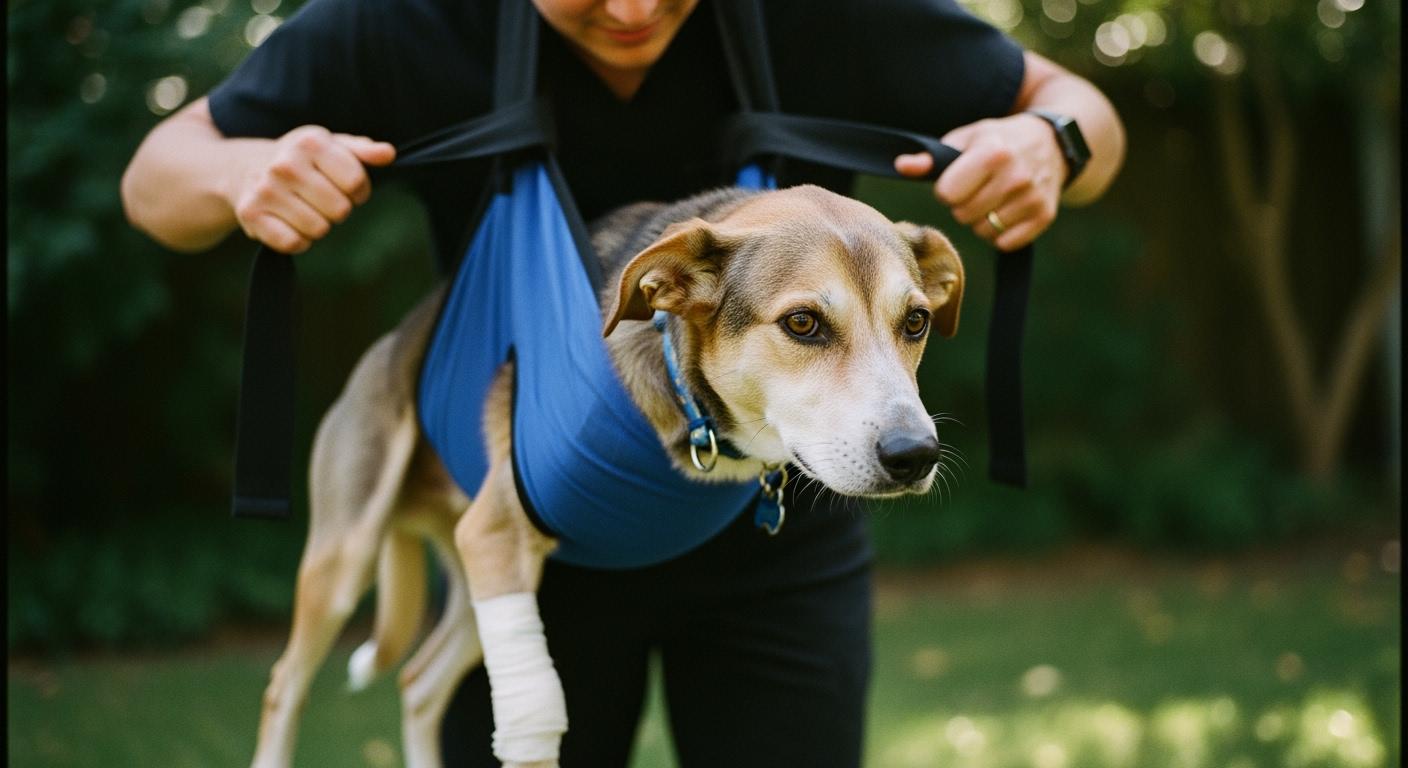
The dog steps onto grass, finds a spot, and begins to squat. The sling slides backward. It is not a handling mistake. The panel under the belly has just lost its grip on a changing contour. When the abdomen rounds and the rear legs flex, a narrow strap has no surface area to resist the shift. It rolls into a cord, migrates toward the groin, and the dog stumbles. That failure is structural. Understanding why it happens changes what you look for in a support sling during TPLO potty breaks.
Why the Sling Slides and Twists During Potty Breaks
Sling slip: what the abdomen does to a narrow strap
A dog’s abdomen is not a static cylinder. During squatting, the ventral contour shortens and rounds. The surface the sling rests against changes shape in under a second. A narrow belly strap — typically an inch or less in width — relies on a single line of contact. When the abdominal curve shifts, that contact line has no anti-rotation surface. Force concentrates at the leading edge of the strap. The edge rolls. Once rolling begins, the entire strap migrates, sliding toward the groin where the contour narrows further. The sling bunches near the hind legs, no longer under the weight-bearing zone it was placed on. Support vanishes at the exact moment the dog needs it most.
You can verify this at home. After a two-minute potty break, look at where the sling’s front edge sits on the belly. If it has shifted more than half an inch from its starting position, the panel width is insufficient for the dog’s abdominal movement during squatting. A wide padded panel — four inches or more across the belly — distributes contact across enough surface area that no single edge bears the full force of the shape change. The panel stays flat because the load is spread, not because the material is grippier.
Here is how common potty-break failures trace back to product structure:
| What happens | Why the structure fails | Design that reduces it | Stop signal |
|---|---|---|---|
| Sling slides toward the groin | Abdomen changes shape during squat; narrow panel has no anti-rotation surface | Wide padded panel with anti-slip lining | Dog stumbles or groin contact increases |
| Dog cannot squat naturally | Sling lifts too high or blocks hip flexion needed for squat posture | Level handle control, open potty clearance | Dog hesitates or refuses to squat |
| Sling blocks urination or defecation | Sling covers the potty area with no clearance cutout | Open potty clearance for both sexes | Dog soils sling or shows potty refusal |
| Dog twists sideways when supported | Uneven handle pull or single-point lift introduces pelvic rotation | Adjustable dual-side straps, level lift | Dog steps sideways or loses balance |
| Belly strap rolls into pressure line | Narrow strap concentrates force at a single edge; edge rolls under load | Wide padded panel distributes load across surface | Red marks or line-shaped rubbing after breaks |
| Dog refuses to move after sling applied | Sling causes discomfort through pressure points or restricts natural gait | Soft breathable material, proper fit with adjustable straps | Dog freezes or shows strong resistance |
Note: Redness under the belly after a potty break is not always a sling problem, but it is always worth checking. If the mark follows a line rather than covering a broad patch, the strap has rolled. Adjust panel width or padding before the next trip.
Pelvic twist: what an uneven handle does to the surgical leg
A second failure starts at the hand, not the strap. When a sling uses a single centered handle, or when one side is pulled higher than the other, the lift force tilts off vertical. A tilted lift vector introduces a rotational moment at the pelvis. One side rises. The other stays lower. For a dog weeks into TPLO recovery, the surgical leg lacks the muscular control to counter that rotation. The pelvis twists, and the dog steps sideways or refuses to bear weight on the operated side.
The problem compounds with each step. Every uneven lift cycle adds a small rotation the dog cannot correct. After a dozen steps, the sling may have drifted far enough off-center that the dog’s gait visibly changes. Walk ten slow steps with the sling, then stop and look at both handle positions relative to the dog’s spine. If one handle sits visibly higher than the other, the lift was uneven and the pelvis has been rotating with each step. Level handle control — dual handles at matched strap lengths or a rigid spreader bar — keeps the lift vector vertical because both hands contribute balanced force through fixed attachment points.
Different support designs handle these stresses differently:
| Design | What it does | Where it fails during TPLO potty breaks | Better structural choice |
|---|---|---|---|
| Towel sling | Emergency-only lift under the belly | No anti-slip surface; rolls into cord; blocks potty area entirely | Not recommended for TPLO potty breaks |
| Narrow belly strap with single handle | Quick lift for short transfers | Concentrates pressure into a line; single handle introduces pelvic tilt | Wide padded panel with dual handles |
| Rear support harness with closed underside | Hind-end lift for dogs with strong front legs | Closed underside blocks urination; may tip forward on uneven ground | Open potty clearance with level lift |
| Full body lift harness | Balanced front and rear support for large or weak dogs | More strapping to adjust; fit takes longer but support is more even | Adjustable multi-point straps, padded panels |
| Lift sling with open potty clearance and wide panel | Targeted belly support without blocking potty function | Least inherent risk; failure comes from incorrect sizing, not design | Anti-slip lining, open potty area, dual level handles |
The TPLO recovery timeline shapes these failures further. During the first two weeks, the surgical leg bears minimal weight, so every ounce of sling support matters. A sling that migrates even slightly leaves the dog compensating with muscles that are not ready. Later weeks bring more weight-bearing but also more movement during potty breaks — the same narrow-strap failure recurs under different conditions. What a dog needs at week one and what it needs at week six are different enough that a single fixed-width strap rarely covers both. The week-by-week progression of weight-bearing milestones after TPLO maps out when sling reliance is highest and when it should taper.
Use this signal guide during every potty break:
| Signal level | What the caregiver sees | Action |
|---|---|---|
| Green | Dog stands, walks slowly, squats with light support; sling stays in place | Continue routine |
| Yellow | Mild slipping, hesitation, uneven lift, line-shaped rub mark | Adjust sling position, reassess panel width and handle balance |
| Red | Collapse, sharp pain response, sudden swelling, incision discharge | Stop, contact your veterinarian |
Alert: Your veterinarian’s discharge instructions override general guidance about sling use, weight-bearing limits, and potty-break duration. Post-operative restrictions vary by surgeon, implant type, and the dog’s individual healing response.
What Better Potty-Break Support Looks Like
Four structural features separate a sling that holds steady during a squat from one that migrates, rolls, or blocks the dog’s natural posture.
Wide padded panel instead of a narrow strap. The difference is not comfort. It is contact area. A panel four or more inches across the belly gives the sling enough surface to resist the abdominal shape change during squatting. A narrow strap has no surface to work with — the edge rolls, and the sling moves. Padding matters for friction stability too: a thin unpadded nylon strap slides more readily than a padded panel with textile grip, especially when the dog’s coat is short and slick. Support sling types and their fit characteristics across different mobility needs show how panel width, strap placement, and handle design each affect whether a sling stays put.
Open potty clearance. If the sling covers the area a dog needs to urinate or defecate, the dog has two choices: hold it or soil the sling. Both are problems. A cutout or open design leaves the potty area unobstructed for male and female dogs alike. This is not about convenience — it is about whether the dog can complete a potty break at all while supported.
Anti-slip lining and level handle control. Anti-slip material on the inside face of the panel grips the dog’s coat or skin without relying on strap tension alone. It adds a second retention mechanism: friction plus surface area, rather than friction from tension only. Combined with dual handles or a rigid spreader bar, the sling stays flat and level through the full squat-and-rise cycle. When hind-leg weakness makes even a short potty trip demanding, lift support designed for dogs with reduced hind-end strength explains how level lift and anti-slip contact work together to keep the pelvis stable.
Adjustable straps matched to body shape. A deep-chested Doberman and a barrel-chested Bulldog need different strap lengths to keep the panel positioned correctly. Fixed straps force a compromise. Adjustable straps let you set the panel where the dog’s anatomy places the weight-bearing zone — not where a one-size template assumes it should be. Getting this right also prevents pressure points. A strap that is too tight in one spot concentrates force exactly where the pressure distribution of a rear lift harness can rub or irritate skin during repeated potty trips. The same principle applies to slings: adjustability matches the load path to the dog’s actual shape so no single point takes more force than the tissue under it can handle.
The range of lift harness designs available today reflects how differently dogs carry weight through their hind end. A sling that works for a lean, short-coated breed may not hold position on a dog with a deeper chest or thicker coat. The structural variables — panel width, lining material, handle configuration, strap adjustability — are what determine whether a potty break ends with a clean squat or a slipped sling.
When a Lift Sling Works and When It Does Not
A rear lift sling works when the dog has enough front-end strength to stand and walk with hind-end assistance only. For many dogs in TPLO recovery, this is the case: the front legs are strong, the surgical hind leg needs light support, and potty breaks are short and on level ground. The sling functions as a balance aid. It does not carry the dog’s full rear weight. It reduces the load on the surgical leg just enough to let the dog squat without collapsing.
A sling is not the right tool when front-end weakness is present. If the dog struggles to hold itself up on the front legs, a rear-only sling shifts more load forward — onto legs that are already struggling. The dog tips, the sling pulls at an angle, and the support becomes counterproductive. The distinction between rear support and full-body support is not about product quality. It is about where the dog’s weakness is and which end needs the assistance. When a support sling is sufficient versus when a lift harness is needed for stairs and transfers comes down to this split: if the front end is stable, rear support can be enough; if both ends are compromised, a full-body harness distributes the load so neither end takes more than it can manage.
Disclaimer: This check assumes a short-coated dog where rub marks and pressure points are visible on the skin surface. Double-coated breeds may show subtler signs that need hand-checking rather than visual inspection — run your fingers under the panel edges after each potty break, feeling for warmth or tenderness that would not be visible through the coat. If the dog’s leg conformation falls outside the breed norms this sling was patterned for — particularly dogs with angular limb deformities or very deep chests — the fit checks described here may not catch every pressure point.
FAQ
How do I know if the sling panel is wide enough for my dog?
After one full potty break, check whether the front edge of the sling has shifted more than half an inch from its starting position. A shift signals that the panel width is not sufficient for the dog’s abdominal movement during squatting. Width, not grip material, is the primary variable.
Can a towel work instead of a lift sling for TPLO potty breaks?
A towel has no structure to resist rolling. It concentrates into a cord under load, blocks the potty area, and provides no anti-slip contact. For a one-time emergency lift it may serve. For daily potty breaks across weeks of recovery, it introduces the same failure modes — sliding, rolling, blocking — that a properly designed sling is built to prevent.
What if my dog refuses to squat with the sling on?
Stop and check two things: whether the sling is blocking the potty area, and whether you are lifting rather than supporting. If the sling covers the area the dog needs for urination, no amount of encouragement will override the physical obstruction. If the rear end is suspended off the ground, the dog cannot achieve the hip-flexion angle needed to squat. Lower the lift until the dog’s paws make full ground contact, and verify the potty clearance is unobstructed.
