
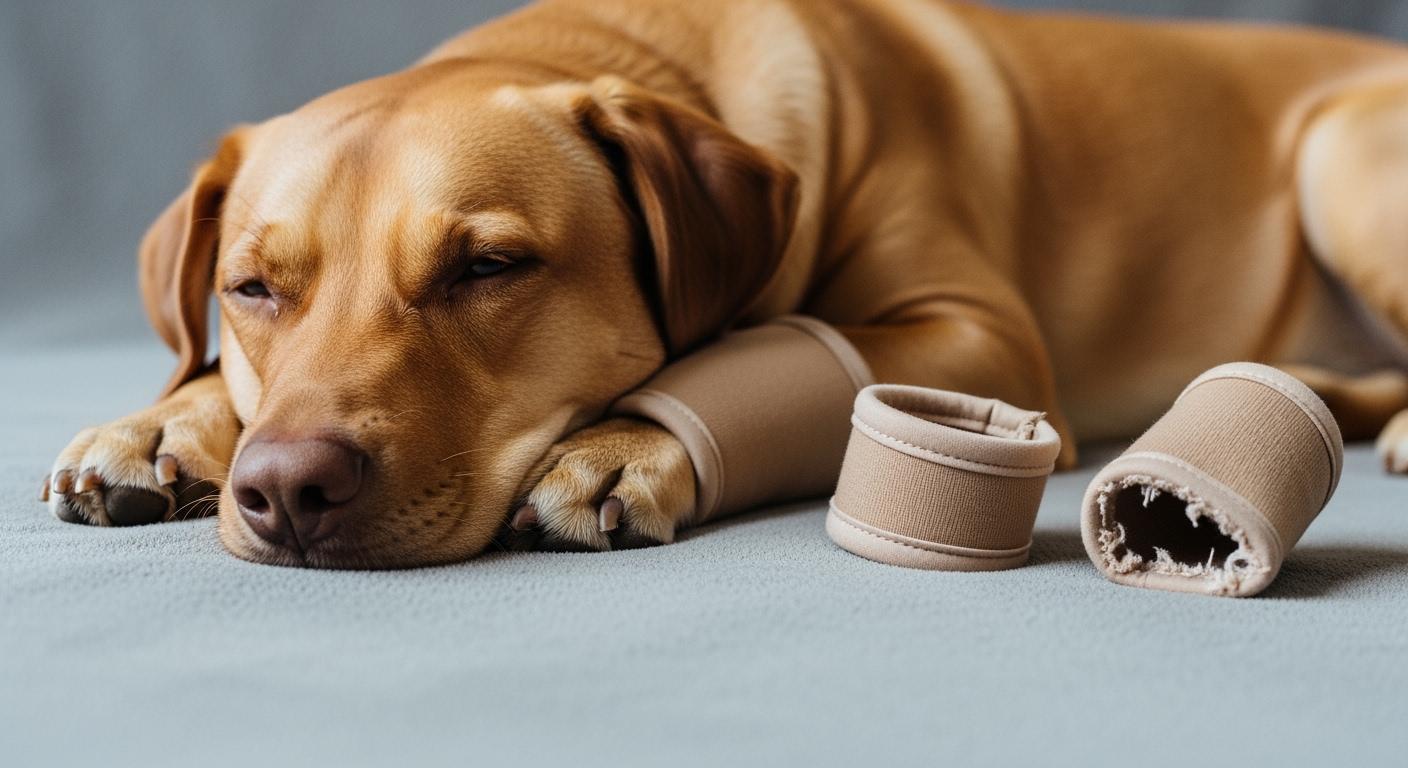
A dog elbow callus cover goes on. It looks right. The dog lies down, stands up, and immediately targets one edge with its teeth. That is not mischief. It is a structural failure signal.
Chewing at the edge means the border is doing something the padded center is not: concentrating pressure into a narrow line. When a dog drops its weight onto a hard floor, the elbow drives into the pad. If the pad shifts, flattens, or the binding is too stiff, the edge becomes the highest-pressure contact point on the entire limb. The dog chews there because that is where it hurts.
Quick Reference: Signs the Edge Is Failing
- Persistent licking or chewing at one specific border location
- Redness, swelling, or hair loss tracing the edge line
- Cover shifts, rolls, or digs in after the dog lies down and stands up
- Dog resists wearing the cover or favors the leg after use
Why Edge Chewing Is a Fit Signal, Not a Behavior Problem
Dogs do not chew randomly. They target the exact spot where the cover border rubs, digs, or traps heat. The top cuff, the lower cuff, the side seam, the closure tab, the pad-to-fabric transition—these are the five failure zones. Each one fails for a specific structural reason.
When a dog lies down, body weight compresses the elbow into the floor. The pad absorbs some of that force. But at the border, where the padding stops and the binding begins, there is an abrupt stiffness change. Soft center. Hard edge. That stiffness differential means the edge carries a disproportionate share of the load. Narrow that edge further—thin binding, sharp seam—and the pressure per square inch spikes. The dog feels it as a hot, pinching line.
Short-coated breeds and dogs with prominent bony elbows feel this faster. There is less hair and soft tissue between the binding and the bone, so the pressure line transmits with less attenuation. The dog chews to remove the irritant. Tightening the cover makes it worse—the pad compresses further, the edge digs deeper, and the chewing intensifies. Bitter spray does nothing. The problem is mechanical, not behavioral.
Edge-Chewing Failure Table
| Chewing Location | Likely Structural Cause | What the Caregiver Sees | Better Design Response |
|---|---|---|---|
| Top cuff edge | Cuff pressure, heat buildup, edge rolls | Chewing top edge, redness | Softer rounded binding, breathable liner |
| Lower cuff edge | Edge digs in when lying down | Chewing lower edge, hair loss | Wider contact zone, stable anchor |
| Side seam | Raised seam over elbow contour | Chewing side, swelling | Recessed seam, seam away from joint |
| Closure tab | Scratchy, exposed hook-and-loop | Chewing closure, limping | Covered closure, smooth inner surface |
| Pad-to-fabric transition | Pad shift, thin edge, pressure line | Chewing at transition, dampness | Wide pad, smooth transition |
Flat Pads and Stiff Borders—The Two Design Failures That Turn the Edge Into a Pressure Point
Two structural problems account for most edge-chewing cases. They often appear together, but each is mechanically distinct.
Flat padding misses the elbow during rotation
A flat pad looks fine when the dog stands still. The failure appears during movement. When a dog shifts weight, rotates the elbow, or transitions from standing to lying, a flat pad cannot track the olecranon—the bony point of the elbow. The pad slides off-center. The elbow lands on the border instead of the cushioned center.
Here is the causal chain: flat pad → no mechanical capture of the elbow point → pad drifts under lateral load → edge becomes primary contact surface → concentrated pressure triggers chewing. A contoured pad with an elbow cup resists this drift because the concave surface mechanically registers against the convex bone. That is not a comfort feature. It is a load-path decision.
In practice: After 10 minutes of the dog lying on a hard floor, lift the cover edge and run a finger along the skin at the border. A sharp red line tracing the binding shape means the edge, not the pad, carried the load. The pad has bottomed out or shifted.
Thin padding bottoms out on hard floors
Padding thickness is not about plushness. It is about compression distance. On carpet, a thin pad may suffice because the flooring itself yields. On tile or concrete, a thin pad compresses fully under the dog’s elbow weight. At full compression, the pad is functionally absent. The elbow rests on the binding and the floor, with a thin layer of flattened fabric in between.
Once the pad bottoms out, pressure at the edge spikes. The binding, which was designed to finish the cover, becomes a load-bearing structure—one it was never engineered to be. Stiff binding compounds the problem: instead of deforming to spread the load, it holds its shape and cuts in.
Stiff binding creates a pressure line
A stiff, narrow binding concentrates force along a line roughly the width of the binding itself—often 3 to 5 millimeters. That line presses into skin, compresses capillaries, and after sustained contact creates the visible red stripe a caregiver can check for. The skin responds with inflammation. The dog responds by chewing.
Wider, softer binding changes the math. It distributes the same force across a broader contact patch, lowering peak pressure. Rounded edge profiles eliminate the sharp transition that triggers the initial chew response. These are not cosmetic differences. They are the difference between a cover the dog tolerates and one the dog removes with its teeth.
Better vs Weaker Design Table
| Design Area | Weaker Design | Better Design |
|---|---|---|
| Edge binding | Stiff, narrow, scratchy | Soft, rounded, wide |
| Pad thickness | Thin, bottoms out | Thick, distributes pressure |
| Pad contour | Flat, no elbow cup | Contoured, fits elbow |
| Inner liner | Non-breathable, rough | Breathable, smooth |
| Closure placement | Exposed, high-tension | Low-profile, covered, wide strap |
| Anti-rotation stability | Loose, slips | Stable, stays centered |
A breathable liner matters here too. Heat and moisture soften the skin, lowering its tolerance for friction. A non-breathable liner traps both. After 20 minutes, the skin under the cover becomes damp and warm—conditions that halve the friction threshold before breakdown starts. Lift the cover after a wear session and feel the skin. Dry and cool means the liner is doing its job. Damp and hot means the cover is creating the conditions for its own failure.
Anti-rotation matters because every degree the cover twists off-axis shifts the elbow away from the padded zone and toward a seam or binding. A dog elbow brace with wide, low-profile straps anchoring above and below the joint resists this rotation better than single-strap designs, which pivot around their single attachment point under side loads.
Fit testing reveals these problems before skin damage occurs. The sequence is straightforward but diagnostic:
Fit Test Steps
- Put the cover on while the dog stands.
- Let the dog lie down naturally for 10 to 15 minutes on a hard surface.
- Call the dog to stand.
- Check whether the pad is still centered over the elbow point.
- Lift the edge and inspect for redness, dampness, hair flattening, or a pressure line tracing the binding.
- Remove the cover if the dog returns to chewing the same edge immediately.
Repeated chewing at the same location after a fit adjustment means the edge design itself is incompatible with that dog’s elbow conformation. The distinction between a dog elbow sleeve and an elbow brace often comes down to this pressure-distribution question: sleeves prioritize coverage and skin protection, while braces add structural support that can change how edge forces transmit through the limb.
When the Cover Cannot Solve the Problem

An elbow callus cover is a pressure-management tool. It is not a wound dressing, and it is not a substitute for veterinary assessment when skin has already broken down. Knowing when to remove the cover is as important as knowing how to fit it.
Remove the cover immediately if the 10-to-15-minute lie-down check reveals a sharp red pressure line tracing the binding shape, skin that feels hot and damp under the liner, or a pad that has shifted more than half an inch off the elbow point. These are mechanical failures that will not self-correct with more wear time. They get worse.
During the first 48 to 72 hours of use, check the skin after every wear session. Early warning signs include hair loss in a ring pattern matching the cover border, skin that stays indented for more than a few seconds after the cover comes off, and any cracking or weeping at the callus surface. Stop use and reassess the elbow support fit and daily use approach if any of these appear.
Red flags that demand immediate removal and a veterinary consult: open or bleeding skin, drainage or pus, rapid swelling, a foul smell from under the cover, or the dog refusing to bear weight on the leg after the cover is removed. These are not fit issues. They are infection or deep tissue problems that a cover can mask but cannot address.
Disclaimer: The skin checks described here assume a short-coated dog where redness and pressure lines are visible on inspection. Double-coated breeds or dogs with heavy elbow feathering may show subtler signs—the pressure line may be felt as a ridge under the coat before it is seen. For these dogs, hand-checking by running a fingertip along the border path is more reliable than visual inspection alone. If the dog’s elbow conformation falls outside typical breed norms—particularly dogs with angular limb deformities or very deep chests that change lying posture—the fit checks described here may not catch every pressure point.
Soft bedding remains relevant even with a well-designed cover. Hard flooring creates a high-pressure baseline that any cover must work against. Adding an orthopedic bed or thick padding under the dog’s resting area reduces the baseline load, giving the cover’s pressure-distribution features less work to do. This is not about comfort. It is about lowering the starting pressure so the pad’s margin for error increases.
Maintaining the cover between uses matters for edge performance. A regular wash and skin-check routine prevents debris buildup along the binding that can create new rough spots. Dried saliva, dirt, and shed hair accumulate at the edge—the same edge the dog targets. Clean edges stay smoother longer.
For dogs whose elbow issues sit at the boundary between elbow and carpal support needs, understanding the difference between elbow and carpal brace targets can clarify whether an elbow cover alone addresses the right joint. A dog shifting weight forward to offload a carpal problem may put unexpected pressure on the elbow cover’s lower edge.
Protection that extends beyond the elbow itself—leg sleeve solutions for broader coverage—can sometimes resolve edge-chewing by eliminating the single-point border that concentrated covers create. When the protective zone extends further up and down the leg, there is no single edge for the dog to fixate on, and pressure gradients are spread across a longer transition.
FAQ
Why does my dog only chew one specific edge of the cover?
Dogs target the edge that carries the highest pressure or the most irritating texture. If it is always the same spot, that specific border location has a structural problem—a seam, a stiff binding segment, or the point where the pad has shifted and left the bone unprotected. Mark the spot, remove the cover, and inspect that exact border for stiffness, roughness, or thinning.
Does tightening the cover stop edge chewing?
No. Tightening increases pressure at the edge. The pad compresses further, the binding digs deeper, and the chewing typically intensifies. The correct response to edge chewing is to remove the cover, check the skin, and identify which structural feature is causing the pressure concentration. Tightening is adding force to a problem that is already about too much force.
How long can a dog wear an elbow callus cover continuously?
There is no single correct duration. The practical limit is set by skin response. Remove the cover after each wear session and check for redness, dampness, or pressure lines. If the skin is dry, cool, and mark-free, the duration was fine. If the skin is red, damp, or lined, the session was too long regardless of the clock time. Overnight use prevents these checks and is not recommended.
What is the difference between a pressure line and normal skin indentation?
A normal indentation from fabric contact fades within a minute or two of removing the cover. A pressure line stays visible for longer, often appears red or purple rather than just depressed, and may feel warmer than the surrounding skin. If the mark is still clearly visible after two minutes, it is a pressure line and the edge needs adjustment or the design needs rethinking.
