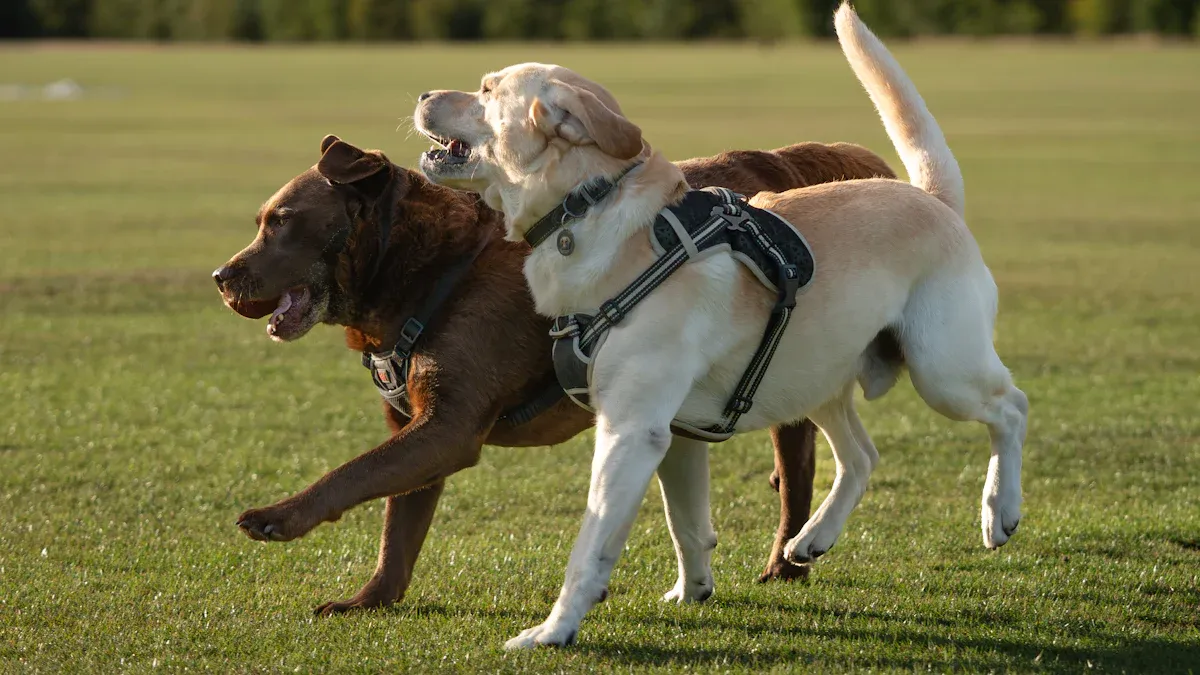
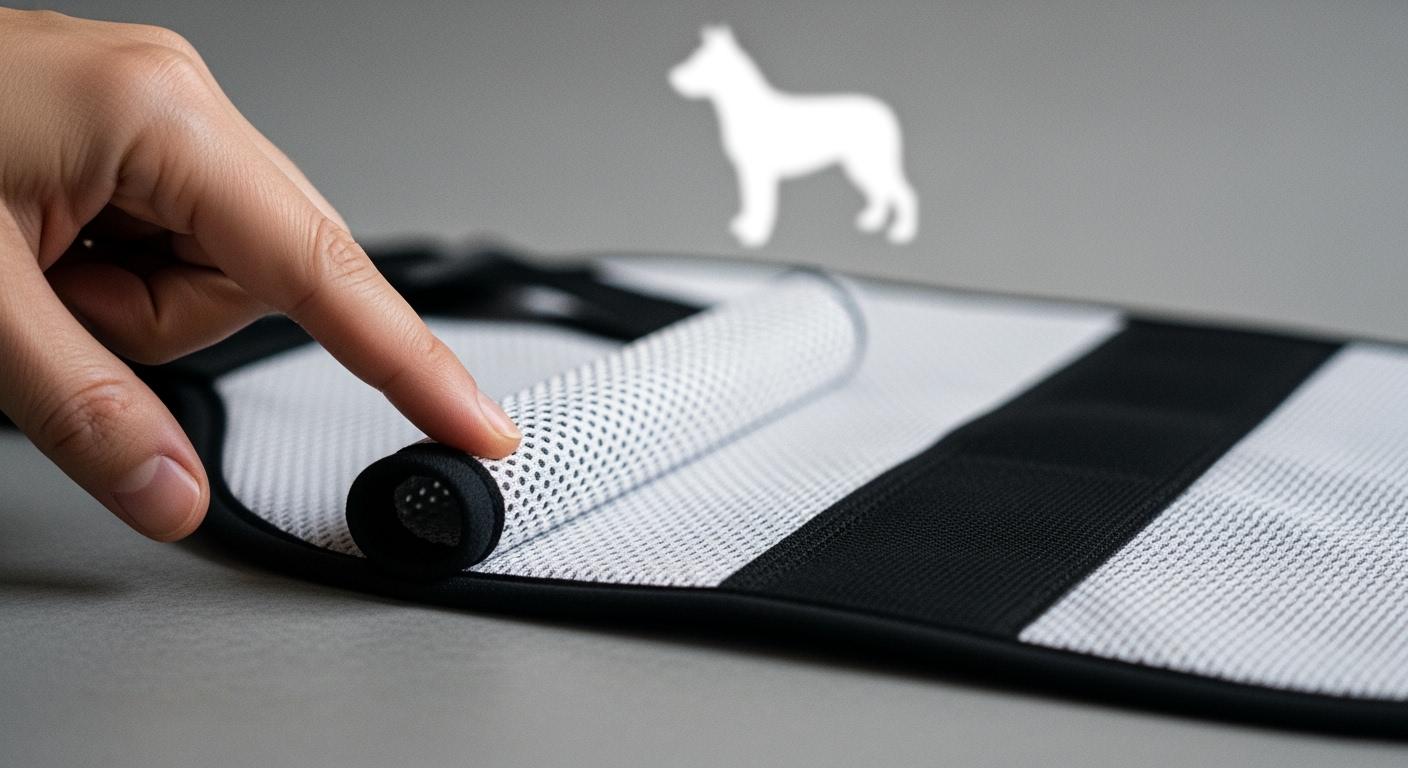
The brace looked right before the wash. After air drying, the mesh edge that sat flat now rolls into a narrow cord. The fabric curls outward or folds inward toward the dog’s skin. Tighten the strap to compensate, and the curled trim drives harder into the body instead of flattening out.
That is not a strap problem. It is an edge recovery failure. The binding and the mesh panel each respond to water and drying on their own timeline — and when they do not come back together, the brace no longer makes full, even contact with the dog’s back. A back brace that cannot recover its edge geometry after washing has lost the one thing that lets it distribute support: a flat contact surface.
Common materials in these panels tell part of the story:
| Material Type | Composition |
|---|---|
| Main Material | 100% Polyester |
| Lining | 100% Polypropylene |
| Spacer Mesh | High quality spacer mesh material |
What Mesh Edge Rolling Looks Like — and Why It Is Not a Strap Problem
Normal strap shifting is predictable. The brace migrates a little when the dog stands, sits, or twists. You reposition it. The edge stays flat. That is a fit adjustment.
Post-wash edge rolling is structurally different. The edge itself warps. Run a finger along the binding and it feels stiff or twisted in one section, soft and flat in another. The mesh panel and the edge binding did not shrink or relax at the same rate during drying, so the shorter material — usually the binding — pulls the longer material into compression. The mesh has nowhere to go but up or down. It curls.
This is the causal chain that turns a clean brace into a pressure problem: binding shrinks more than mesh → the shorter edge pulls the longer panel into compression → the compressed panel buckles into a ridge → the ridge concentrates body contact into a narrow line → strap tension drawn across that ridge drives it deeper instead of spreading it flat. You are not fixing anything by pulling harder. You are feeding force into a fold.
A curled edge reduces flat contact area between the brace and the dog’s body. Instead of distributing load across the full width of the panel, the brace channels it through a thin raised line. If the edge rolls inward, that line presses into skin. If it rolls outward, the edge lifts and the brace loses stability. Either way, support degrades.
Spot it early. After drying, lay the brace flat on a table. If the edge does not sit flush against the surface without finger pressure, recovery has already failed. Here are the signals:
- Edge curls or rolls: The mesh edge folds inward or outward instead of lying flat.
- Stiff or twisted trim: One section feels harder or sits at a different angle than the rest.
- Narrow ridges: The edge forms a thin raised line rather than a wide, soft band.
- Edge lifts away from fur: The trim gaps or sticks up when the dog is still.
- Brace looks flat off the dog, but rolls on: In your hands it seems fine. Under body contour and strap tension, the curl emerges.
- Strap tension makes it worse: Tightening causes more bunching, not less.
Tip: Check the brace only when fully dry. Damp trim masks stiffness and hides partial curling.
| Sign You See | What It Means | What To Do Next |
|---|---|---|
| Edge curls or rolls | Lost shape recovery | Do not use until flat again |
| Stiff or twisted trim | Possible detergent residue | Rinse and air dry again |
| Edge presses into skin | Risk of pressure points | Stop use and check skin |
| Edge lifts away from fur | Poor contact, less support | Adjust fit or replace brace |
Why Mesh Edges Roll After Washing — the Recovery Rate Gap
A washable back brace needs its materials to return to the same dimensions after every cycle. The mesh panel and the edge binding are rarely the same fiber, weave, or density. Polyester mesh stretches and recovers on one curve; polypropylene binding shrinks and relaxes on another. After the first wash — or the tenth — those curves diverge.
Three mechanisms drive the divergence.
Differential Shrinkage Between Trim and Mesh
The binding can lose 2–3% more length through a wash-dry cycle than the mesh panel it borders — a small absolute number that produces a large geometric effect. A shorter edge pulls the longer panel into compression. The panel buckles. The buckle becomes a curl. This is why a brace that looks flat on the table can roll the moment it wraps around a dog’s torso — the body curve adds the last bit of compression that tips the panel into a ridge. A back support brace that uses binding with a stretch-recovery profile matched to its mesh panel avoids this mismatch at the material-selection stage, not through post-wash workarounds.
Heat and Mechanical Distortion
High heat shrinks synthetic binding fast. Wringing or twisting the brace to force water out stretches the trim unevenly — one section elongates, another stays tight. When that uneven trim dries, it sets in the distorted shape. Air drying flat removes both risks. A dryer, unless the care label explicitly permits it, turns edge geometry into a gamble.
Detergent Residue and Stiffening
Soap left in the binding acts like a mild stiffening agent. The edge loses flex. A stiff edge cannot follow body contour under strap tension — it holds its distorted shape and presses in as a ridge instead of conforming. Rinse until the water runs clear. Skip fabric softeners. They coat fibers and reduce the friction that helps binding and mesh move together.
| What you see after washing | Likely cause | Why it affects support | Better design or care response |
|---|---|---|---|
| Edge curls outward after drying | Trim shrank more than mesh | Edge lifts, less contact | Wider, stable binding; air dry only |
| Edge rolls inward on the dog | Binding tension changed | Pressure on skin, discomfort | Balanced mesh and trim recovery |
| Trim becomes stiff | Detergent residue, heat exposure | Hard edge, pressure points | Rinse thoroughly, avoid heat |
| Mesh stretches, binding does not | Uneven material recovery | Edge bunches, poor fit | Matched-stretch materials |
| Strap pulls edge unevenly | Strap tension exposes weak edge | Curling, loss of support | Reinforced trim, strap angle follows body contour |
| Brace stays damp near the trim | Incomplete drying | Risk of odor, skin issues | Full air dry before reuse |
Strap Tension and the Amplification Effect
Here is the part most people miss. A curled edge looks like a tightening problem. It is the opposite. When you pull a strap across a folded edge, the strap does not press the fold flat — it pulls the fold tighter into itself. The ridge sharpens. The contact patch narrows further. More force, less support.
After a 5-minute walk on a flat surface, remove the brace and check: has the edge drifted more than half an inch from where it started? If yes, the edge is buckling under load, and tightening will not fix it. That is a material recovery failure, not a fit failure.
| Design detail | Weak version | Better version | Why it matters after washing |
|---|---|---|---|
| Edge binding | Thin, raw, or loose | Wide, reinforced, smooth | Resists curling, keeps edge flat |
| Mesh layer | Stretches unevenly | Balanced stretch, stable mesh | Prevents bunching and rolling |
| Stitching | Sparse or loose | Dense, secure | Holds shape, resists warping |
| Strap angle | Pulls across curved edge | Follows body contour | Reduces edge distortion |
| Belly anchor width | Narrow, shifts easily | Wide, stable anchor | Keeps brace in place, prevents rolling |
| Inner surface finish | Rough, unfinished | Smooth, soft finish | Reduces pressure points after washing |
Note: A back brace built with matched recovery rates between mesh and binding returns to its as-built geometry after every wash cycle. The edge stays flat. The contact patch stays wide. That is the difference between a brace that survives washing and one that degrades with every cycle.
Post-Wash Checks and When the Brace Is Done
Every wash is a test the brace either passes or fails. The check takes two minutes and catches problems before skin does.
The Dry-Flat Check
Lay the fully dry brace on a hard flat surface. Look at the edge from the side. It should sit flush — no gaps, no waves, no sections that hover above the surface. Run a finger along the entire binding at a steady pace. A smooth, uninterrupted feel means the trim recovered. A bump, hard spot, or tacky section means residue or heat damage is present. Rinse and air dry again before proceeding.
The Movement Test
Put the brace on the dog while standing squarely. Adjust straps to snug — not tight. Walk the dog on a flat surface for five minutes. Then check two things. First, the edge: did any section roll inward, curl outward, or lift? Second, the skin beneath the edge: any pinkness, heat, or an impression line that does not fade within two minutes of removing the brace?
The skin check is the observable verification that matters most. A flat edge leaves either no mark or a diffuse impression that fades quickly. A curled edge leaves a sharp red line — often darker at one end where the fold was deepest — that persists. If the line does not fade within two minutes, the edge is concentrating pressure, and the brace should not be reused in that condition.
Disclaimer: These checks assume a short-coated dog where skin and marks are visible. Double-coated breeds may show subtler rub marks beneath the fur — hand-check the skin by parting the coat along the edge line rather than relying on visual inspection alone. If the dog has pronounced spinal curvature, a deep chest, or conformation that deviates significantly from the breed norms this brace pattern was designed for, the flat-contact checks described here may not catch every pressure point.
| Color | What You See After Fit Check | What You Should Do |
|---|---|---|
| Green | Edge lies flat, trim feels smooth, skin looks normal | Safe to reuse. Continue regular checks. |
| Yellow | Edge shows slight curling, trim feels a bit stiff, mild red marks that fade quickly | Rinse and air dry again. Shorten wear time. Watch skin closely. |
| Red | Edge rolls or bunches, trim is hard or sticky, skin shows deep redness, swelling, blisters, or pain | Stop use immediately. Do not reuse until the problem is fixed or the brace is replaced. |
Stop-Use Signals
Certain signs mean the brace comes off and stays off until the issue is resolved — or the brace is replaced. These are not subtle.
- Redness that deepens after removal: Active inflammation, not transient pressure.
- Blisters at the strap edge or along the brace rim: The skin barrier has broken.
- Swelling that appears during or after wear: Fluid accumulation from sustained pressure.
- Heat under the brace that persists after removal: Inflammatory response, not just trapped body warmth.
- Dampness or odor under the panel: Incomplete drying or moisture trapping — a skin risk.
- Limping, chewing at the edge, or refusing to walk: The dog is telling you the brace hurts.
A small curl is not harmless. A slight ridge still concentrates force into a line. Back braces that fit poorly after washing degrade faster because the same stretched panel now gets loaded across a narrower, distorted contact zone with every movement cycle. If the edge refuses to lie flat after re-rinsing and air drying, the brace has permanently lost its geometry. Replace it.
Edge Design That Survives Washing
Not all edge designs degrade the same way. The difference between an edge that curls after three washes and one that stays flat after thirty comes down to a handful of structural decisions made at the pattern and material-selection stage.
Wider Bound Edges Resist Buckling
A binding that is folded and double-stitched, or backed with a stiffened tape, creates an edge with bending resistance. When the binding tries to shrink, the wider structure distributes the shrinkage force across more material — there is no single weak line to initiate a fold. The edge stays perpendicular to the body. A narrow raw edge has no such resistance. It rolls into the panel body on the first shrinkage cycle, eating into usable contact width from both sides.
Matched Recovery Rates Between Panel and Binding
This is the core material decision. If the mesh panel relaxes to 98% of its original dimension after washing and the binding relaxes to 95%, the 3-percentage-point gap becomes a curl. The two materials must be selected as a system — their wet-to-dry dimensional change curves need to overlap within a narrow tolerance band. A back brace built with matched-recovery materials stays flat because neither component pulls the other out of plane.
Strap Geometry That Does Not Weaponize the Edge
Straps that pull across a curved edge at an angle concentrate tension at one point on the binding. That point becomes the initiation site for a fold. Straps routed to follow the body’s natural contour — pulling along the panel rather than across its edge — distribute tension into the broader panel surface instead of into the binding. Back support solutions that consider strap routing as part of edge durability, not just fit, avoid creating the conditions where a post-wash curl turns into a pressure injury.
Smooth Inner Finishing Without Ridge Lines
Run your fingers along the inside face of the brace. A flat, uninterrupted surface means the stitching and binding transitions are buried or covered. An exposed seam or a binding-to-panel transition that creates a step turns into a pressure line the moment the brace wraps a curved torso. After washing, loose threads or bunching at these transitions amplify the effect. A back support brace worn daily needs an inner surface that stays smooth through every wash cycle — because the skin reads every seam, every time.
In practice: Back braces that survive repeated washing share a common trait — the edge binding and the mesh panel were designed as a system from the start. Matched recovery rates, wide bound edges, strap routing that avoids edge loading, and smooth inner finishing. Any one of these missing, and the brace starts losing geometry within the first five wash cycles.
Mesh edge rolling is not a user error. It is a structural verdict on how the binding and the mesh panel were paired. A brace that curls after washing has revealed a recovery-rate mismatch — the edge shrank more than the panel, and the resulting ridge concentrates pressure instead of distributing it. No amount of strap tightening fixes a fold. Check the edge dry and flat. Walk the dog five minutes, remove the brace, and read the skin. If the edge will not lie flat or the skin tells you something is wrong, the brace is done. A back brace that holds its geometry wash after wash starts with matched materials, wide bound edges, and strap routing that loads the panel, not the binding.
FAQ
How often should the edge be checked after washing?
Every wash cycle, before the brace goes back on the dog. Check dry — damp binding can feel flexible and hide stiffness that sets as it finishes drying on the dog’s body.
What should you do if the mesh edge rolls after drying?
Do not use it. Rinse thoroughly to remove any detergent residue and air dry flat. If the edge still does not sit flush against a flat surface after re-drying, the recovery failure is permanent. Replace the brace.
Can you fix a curled edge by tightening the straps?
No. Tightening a strap across a folded edge pulls the fold tighter into itself, sharpening the ridge and concentrating pressure further. The fix is material recovery, not more tension.
What signs mean the brace should be stopped immediately?
Redness that deepens after removal, blisters, swelling, persistent heat, odor, limping, chewing at the edge, or refusal to walk. Any one of these means the brace comes off and stays off until resolved.
What design features keep an edge flat through repeated washing?
Wide bound edges with double stitching or stiffened tape, mesh and binding with matched wet-to-dry recovery rates, strap routing that loads the panel surface rather than the edge, and smooth inner finishing without exposed seam transitions.