
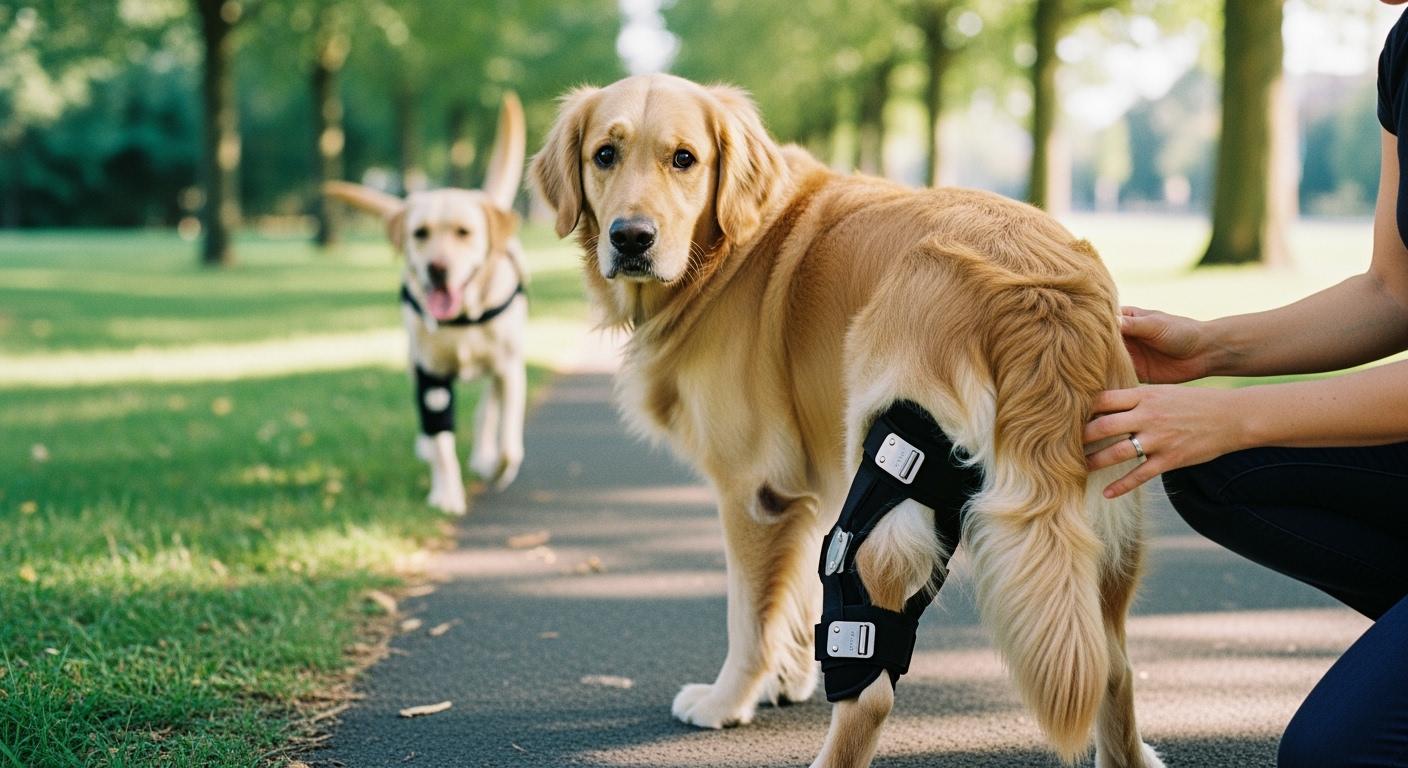
A dog knee brace squeak from hinge during walk starts small. A faint chirp at mid-stride. By the third block it is a steady creak, and the dog has slowed to half pace, head turned back toward the brace. The sound is not just noise. It is a signal that something inside the hinge assembly is rubbing under load in a way the design did not intend.
Most hinge squeaks trace to one of four failure points. None of them fix themselves. All of them get louder.
The Four Failure Points Behind a Squeaking Knee Brace Hinge
A dog knee brace hinge is a simple mechanism: a pin rotating inside a bushing, flanked by side plates. When it stays clean, aligned, and tight, the motion is near-silent. Each failure point introduces friction where there should be none.
Dry pivot friction
The hinge pin rotates inside a polymer or metal bushing. A thin film of factory lubricant separates the two surfaces. Over days of walking, that film breaks down. Heat, moisture, and repeated load cycles accelerate the loss. Once the bushing runs dry, the pin contacts the bushing wall directly. Polymer-on-metal friction under body weight produces a high-frequency squeak — the sound of two surfaces grabbing and releasing at the microscopic level with each stride.
The observable check takes ten seconds. Remove the brace after a walk. Touch the hinge area. If it feels warm compared to the surrounding fabric, the bushing is generating friction heat rather than gliding. A properly lubricated hinge runs cool even after a full walk.
Debris inside the hinge path
An unsealed hinge collects what the walk throws at it. Dried mud, fine grit, shed hair, and mineral residue from puddle water all work into the pivot gap. Each particle becomes an abrasive third body between the pin and bushing. The squeak here tends to be irregular — louder on some steps than others — because the debris shifts inside the joint with each flex cycle. After a wet walk, the sound often worsens as dissolved minerals dry into crystalline grit overnight.
A hinged knee brace with a sealed or covered pivot resists debris ingress better than an exposed hinge, but no design is fully immune. The practical test: wipe the hinge area with a clean, dry cloth after a walk. If the cloth comes away with dark residue or grit, debris is already inside the pivot path and contributing to the noise.
Fabric edge rubbing against hinge hardware
Most knee braces wrap the hinge mechanism in fabric or neoprene. When straps migrate during a walk — and they always migrate a little — the fabric edge can shift into the hinge’s range of motion. The hinge pin then rubs against fabric fibers instead of rotating freely inside its bushing. The sound is lower-pitched than a dry pivot squeak, closer to a rustle or soft scrape, and it typically changes with strap tension rather than step count.
The isolation test is simple. Walk the dog ten steps. Stop. Without removing the brace, run a finger along the fabric edge on both sides of the hinge cover. If the fabric is bunched, folded, or riding up against the hinge housing, smooth it flat and walk another ten steps. A disappearing sound confirms fabric rub. A persistent sound means the problem is deeper.
Hinge axis drift from the stifle joint
This is the failure that matters most. When a hinge drifts even three millimeters away from the stifle joint center, the force vector changes. Instead of rotating cleanly around a single shared axis, the hinge pulls the brace slightly forward or back on each step while the dog’s knee tries to rotate around its natural anatomical axis. The mismatch creates edge loading inside the pivot — one side of the hinge pin presses harder against its bushing wall while the opposite side gaps open.
That uneven load does two things. First, it accelerates bushing wear on the loaded side, widening the pivot clearance and making the squeak progressively louder over days. Second, the off-axis force transmits through the brace frame into the straps and padding. The brace begins to migrate. The dog feels the shift and compensates with a shortened stride or a hip drop. That altered gait feeds back into more axis drift. A self-reinforcing loop.
When a knee brace cannot hold its hinge axis against the stifle through a full walk, stability support becomes unreliable regardless of how tightly the straps are cinched. The failure is geometric, not tension-based.
A 20-Step Walk Separates Normal Sound from Structural Trouble
Fit the brace while the dog stands square on a non-slip surface. Center the hinge visually over the stifle joint — the bony landmark where the femur meets the tibia. If the hinge sits above or below that point before the dog takes a single step, axis drift has already begun. Proper stifle alignment starts at rest and must hold through movement.
Walk twenty slow steps in a straight line. Listen for three distinct sound signatures:
| What you hear | Likely failure | Pass signal | Fail signal |
|---|---|---|---|
| Single soft click at full flexion | Normal end-of-travel contact | Sound does not repeat mid-stride | Click recurs at the same point in every step cycle |
| Repeated high-frequency squeak | Dry pivot or debris friction | Squeak stops after hinge cleaning | Squeak returns within the same walk after cleaning |
| Low rustle or scrape near hinge cover | Fabric rubbing hinge hardware | Sound stops after smoothing fabric edge | Sound persists after fabric adjustment |
| Sharp click or metal knock | Loose rivet, screw, or cracked side plate | N/A — always requires inspection | Stop use immediately, inspect all hardware |
| Grinding sensation through the brace frame | Worn bushing or pin deformation | Hinge moves smoothly when flexed by hand | Gritty or uneven resistance during manual flex |
| Noise plus dog freezing or biting the brace | Pain, pressure point, or skin irritation | Dog gait stays even and relaxed | Remove brace, check skin for heat or rub marks |
After the straight walk, add one sit-stand cycle and one slow turn. These movements load the hinge differently — sitting compresses the joint surfaces through a larger angle, and turning introduces a rotational force that a straight walk does not. A hinge that stays quiet during straight steps but squeaks during the sit or turn is revealing early bushing wear or axis drift that only appears under off-axis load.
Rotation during movement amplifies every small fit error. A brace that stays centered during a straight-line walk can still twist during a turn if the strap paths lack sufficient anti-rotation surface area. Narrow straps transfer side loads poorly — the force concentrates at the strap edge, the edge rolls, and the brace rotates around the leg. Once rotated, the hinge axis no longer points at the stifle. The squeak that follows is the sound of that misalignment.
Remove the brace. Check the skin along the full strap path. Red marks directly under the hinge point suggest edge loading translated into pressure against the leg. Marks that follow a diagonal line suggest the brace rotated during the walk. Neither pattern is acceptable.
Disclaimer: This walk test assumes a dog with standard stifle conformation and a short-coated leg. Dogs with angular limb deformities, very deep or narrow chests, or double-coated breeds may show subtler rub marks that require hand-checking the full leg circumference above and below the brace rather than relying on visual inspection alone. If the dog’s leg shape falls outside the breed norms this brace was patterned for, the fit checks described here may not catch every pressure point.
When to Clean, Adjust, Replace, or Stop Using the Brace
When cleaning solves it
A dry or debris-loaded hinge quiets down after cleaning when the bushing and pin are still dimensionally sound. Use a damp cloth on the hinge exterior after every walk. For hinges with accessible pivot points, a dry brush removes loose grit before it works deeper. Avoid spray lubricants unless the brace documentation explicitly approves one — many contain solvents that swell polymer bushings, making the fit tighter and the friction worse within days.
Knee pads with integrated hinge covers reduce the exposed pivot area that collects debris. Less exposure means less ingress, which means fewer cleaning cycles over the brace’s service life.
When strap adjustment solves it
Fabric-edge squeaks stop when the strap path is corrected. The straps should follow the natural contour of the leg without bunching the underlying fabric. Tighten only enough that the brace does not slip when the dog transitions from stand to sit. Over-tightening collapses the padding, reduces vibration absorption, and transfers more hinge noise directly to the leg.
On small breeds, shorter femurs leave less surface area for strap anchoring, which means every strap carries more anti-rotation duty per inch of contact. If strap migration recurs on every walk despite adjustment, the brace may not have enough anchor surface for the dog’s proportions — a geometric limitation, not a user error.
When replacement is the only path
Some failures cannot be adjusted out. A hinge pin that rattles inside an ovalized bushing will keep squeaking because the clearance is now structural, not a lubrication gap. A cracked side plate flexes under load and clicks at the fracture line with every step. Rivets that have loosened cannot be re-tightened at home — they require factory tooling.
Signals that point to replacement rather than repair:
- The hinge has visible side-to-side play when the brace is held and rocked gently
- Manual flexing of the hinge produces a gritty or stepped resistance instead of smooth rotation
- Squeak intensity increases week over week despite consistent cleaning
- The brace migrates more than half an inch during a twenty-step walk even with straps at correct tension
- Skin under the hinge point shows persistent redness or hair loss after walks, indicating pressure concentration from axis drift
Stop use entirely if the dog shows swelling, heat, open skin, or a sudden worsening of gait. These are not hinge problems. They are fit problems that have crossed into tissue stress.
Disclaimer: A quiet hinge at rest does not confirm proper fit. Always verify that the brace can hold its position through a full sit-stand-turn cycle before assuming the noise is cosmetic. A brace that is silent but misaligned transfers load to the wrong structures and can cause joint irritation without producing audible warning signs.
A dog knee brace squeak from hinge during walk is never random. It has a mechanical cause. Dry friction. Debris. Fabric interference. Or — most critically — axis drift that changes how force travels through the joint. Each has a different fix. Each gets worse when ignored. The walk test, the post-walk skin check, and the isolation sequence described here separate the sounds that are harmless from the sounds that mean the brace is no longer doing its job.
