
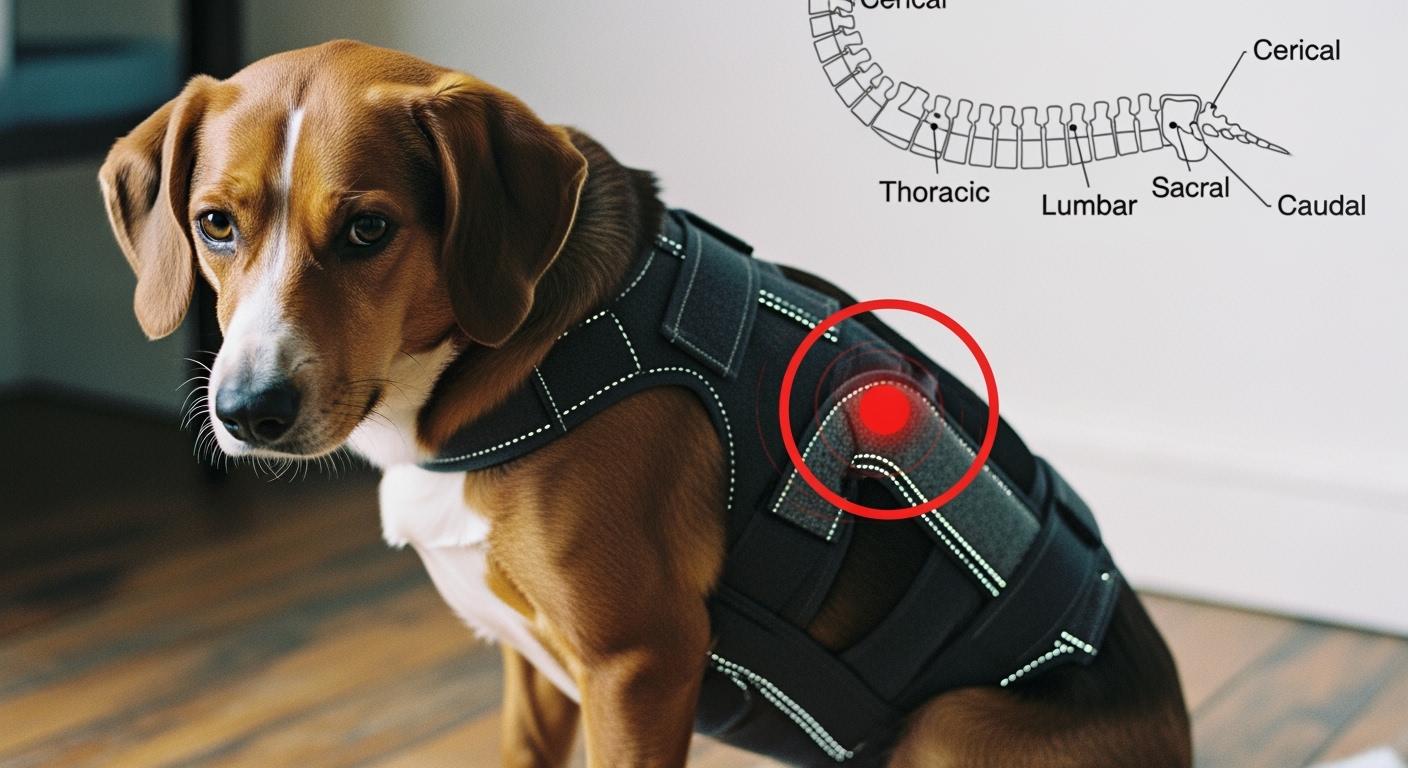
The brace goes on. The dog stands. Then it turns — and you see it. A single sharp crease folding across the back panel at one point, right where the spine needs steady contact the most. The rest of the brace sits fine, but that one fold line is doing something no back brace should do: concentrating force instead of spreading it.
That is a pressure hinge. And a pressure hinge is not a minor fit issue. It takes the very device meant to protect a vulnerable disc and turns it into a focused load point. The brace is no longer supporting the spine — it is pressing into one segment of it.
This failure has a specific cause. It is not about the dog being the wrong shape. It is not about tightening a strap harder. It comes down to how the brace panel transitions from stiff to flexible, how the rear anchor holds position, and whether the support zones are segmented or built as a single continuous piece. When those three decisions are wrong, the brace folds at the wrong spine point every time the dog moves.
When Support Turns Into a Pressure Hinge
Support, in a back brace, means the panel follows the contour of the spine and distributes contact pressure across a broad surface. When a dog with IVDD shifts weight, turns, or sits, the brace should move with the back — not against it. The force from each motion spreads across the panel area. No single point carries the load alone.
A pressure hinge is the opposite. The brace panel folds along a single line — usually at the boundary between two stiffness zones, behind the shoulders, or where the rear anchor ends. That fold line becomes a fulcrum. Instead of distributing force across the panel, the hinge channels body weight and motion stress onto the vertebral segment directly beneath the crease.
The mechanics are straightforward. When stiffness changes abruptly across a panel — rigid here, flexible there, with no transitional zone between them — lateral force during a turn hits the stiffness boundary and has nowhere to go. The panel cannot bend gradually, so it buckles. That buckle point is now a hinge. And that hinge sits directly over a disc that is already compromised.
One way to confirm this is happening: run your thumb along the inside of the brace after a 20-minute wear session. Feel for a warm, flattened, or compressed spot in the padding that aligns with a fold line on the outside. Even pressure leaves padding consistent. Concentrated pressure compresses it. If you find a dense, heated patch under the crease, the brace is transferring force onto that single zone — a fit failure that makes IVDD symptoms worse rather than stabilizing the spine.
What owners notice first tends to follow a pattern. The dog freezes mid-turn. Or hesitates before sitting. Or the panel buckles visibly behind the shoulders and stays that way. Sometimes the rear of the brace slides forward after a short walk, bunching fabric toward the mid-back. These are not random. Each one points to a structural decision that went wrong in the brace design.
Three Design Decisions That Cause the Fold
Three choices in how a back brace is built determine whether it distributes force or concentrates it. Get any one wrong, and the brace bends at the wrong spine point under load.
Stiffness Gradient: Why a Sudden Jump Creates a Hinge
Panel stiffness cannot change all at once. When the brace goes from fully rigid over the thoracic spine to fully flexible over the lumbar zone with no graduated transition, the boundary between those two zones becomes a mechanical weak point. Force entering the rigid section cannot dissipate gradually into the flexible section — it hits the boundary and reflects. The panel buckles along that line.
Think of it like folding a piece of cardboard. A flat sheet bends wherever you press. But a sheet with a pre-scored line bends at the score every time. An abrupt stiffness change in a brace panel is that score line. Every turn, every sit, every weight shift — the panel folds there. Not where the dog’s anatomy needs it to bend. Where the manufacturing choice told it to.
A graduated panel — one that transitions stiffness across a zone rather than at a line — spreads bending across a broader area. No single crease forms. The force dissipates along the transition zone instead of concentrating at its edge. This is not about making the brace softer. It is about controlling where the stiffness changes, and how sharply.
Anchor Stability: When the Rear Panel Walks Forward
A back brace that cannot hold its rear position will migrate forward during movement. As the rear anchor slides, the panel bunches behind the shoulders. That bunch becomes a fold. The fold becomes a pressure hinge.
The mechanism is lateral force under motion. A narrow rear strap or a single-point anchor has no rotational resistance. When the dog turns, lateral force hits the panel edge. With nothing resisting rotation, the edge lifts and the panel shifts. Within minutes, the brace has moved half an inch forward. The fabric that was spread across the lumbar spine is now stacked up behind the ribcage. The support zone has collapsed into a crease.
A back brace with a wide, multi-point rear anchor resists this. The distance between anchor edges creates a lever arm against rotation — lateral force hits the panel and the anchor holds position because the force cannot overcome that spread. The panel stays where it was placed. No bunching, no forward creep, no fold line forming behind the shoulders.
Segmentation: One Continuous Panel Cannot Follow a Curved Spine
A single unsegmented panel treats the dog’s back as a flat surface. It is not. The spine curves. The shoulders move. The lumbar region flexes during sitting. A continuous panel cannot follow three different contours simultaneously — so it bridges across them, leaving gaps where support should be and creating pressure points where the panel resists the curve.
Segmented panels — independent sections that articulate at the junctions between spinal regions — let each zone follow its portion of the back independently. The thoracic section stays flat against the ribcage. The lumbar section follows the lower back curve. The junction between them bends along the dog’s natural flexion point, not along an arbitrary stiffness boundary in the brace.
Here is what the failure-to-structure comparison looks like across these three dimensions:
| Failure Sign | Why It Happens | Better Structure or Fit Result |
|---|---|---|
| Panel folds behind shoulder | Panel too long or stiff at front | Segmented panel, fits shoulder curve |
| Rear panel slides forward | Rear anchor not stable | Wider anchor, anti-slip design |
| Belly strap rolls | Strap too narrow or loose | Wide, padded strap, stays flat |
| Brace bends over painful area | Wrong flex zone, poor segmentation | Graduated stiffness, no sharp fold |
| Dog freezes during turning | Brace pinches or folds at wrong spot | Smooth, even support, no pressure hinge |
| New pressure mark after removal | Fold or buckle creates hot spot | Even pressure, soft edges, no skin mark |
None of these failures are random. Each traces back to a specific structural choice. Understanding what a back brace is supposed to do starts with recognizing that the support is only as good as the panel’s ability to stay flat, stay placed, and bend where the dog bends — not where the manufacturing process drew a line.
Where a Back Brace Works and Where It Does Not
A back brace with segmented panels, graduated stiffness, and stable anchoring performs one job well: it limits spinal flexion and distributes external support across the back during controlled movement — short leash walks, sit-to-stand transitions, crate-rest periods where the dog is allowed limited mobility.
It does not immobilize the spine. A fabric-and-splint brace cannot achieve rigid fixation. If the clinical need is zero spinal motion — post-surgical stabilization, acute disc extrusion with neurological deficits — a back brace is the wrong tool. This is not a design flaw. It is a use-boundary. IVDD support solutions cover a spectrum, and a back brace occupies the middle: more support than unrestricted movement, less fixation than surgical stabilization.
The brace also assumes a specific set of conformational norms. It patterns off the typical back length-to-chest depth ratio of common breeds. Dogs with extreme proportions — very deep-chested breeds where the sternum sits far below the spine line, or dogs with angular limb deformities that alter weight distribution through the back — may push the brace outside its designed fit envelope. The panel length and anchor placement that work on a dog with standard proportions may not hold position on a body shape the pattern was never built for.
Disclaimer: Double-coated or very thick-furred breeds may show subtler pressure marks that need hand-checking rather than visual inspection. Run fingertips along the vertebral processes after brace removal to feel for warmth or tissue density changes that hair obscures. If the dog’s leg conformation falls outside typical breed norms — particularly dogs with angular limb deformities or unusually deep chests — the fit checks described here may not catch every pressure point, and a brace patterned for standard proportions may not distribute force as intended.
Use this safety table to assess what you see during and after wear:
| Status | What You See |
|---|---|
| Green | Panel stays centered, no sharp fold, dog walks calmly, no skin mark |
| Yellow | Mild shifting, small edge lift, needs readjustment after short movement |
| Red | Sharp fold over spine, pain response, limping, pressure mark, swelling, chewing, or worse neurologic signs |
Back braces play a specific role in IVDD recovery, but that role has boundaries. The brace that controls flexion during a short leash walk is not the same device that belongs on a dog during unrestricted activity. Knowing where the boundary sits — and checking for the fold that says the brace crossed it — is the difference between support and a pressure hinge.
Fit Checks That Catch a Wrong Bend Before It Hurts the Dog
Standing Alignment Check
Place the brace on a standing dog. Look down the spine line from above. The center panel should track the vertebral column without a visible crease, buckle, or gap. Run a finger along each edge — both sides should sit at the same height relative to the floor. One edge riding higher means the panel has already started to rotate.
Mark the rear anchor position with a piece of tape on the fur. This is your reference point for the next check.
Short Walk Check
Walk the dog on a short leash for ten minutes at a slow, steady pace. No turns sharper than a wide arc. No stairs. After ten minutes, stop and check the tape mark. If the rear anchor has moved forward more than half an inch, the brace is migrating under motion. Migration is not a tightening problem — it is an anchor design problem. A brace that cannot hold position during a straight walk will fold during a turn.
Self-check: if you see the dog shorten its stride on one side mid-walk, the brace may be restricting hip motion on that side. Stop, check the rear edge position, and look for bunching.
Post-Wear Skin and Padding Check
Remove the brace after the walk. Check the inside padding first — run your thumb across the full length. The padding should feel consistent in thickness and temperature. A compressed, warm, or dense patch signals concentrated pressure during wear. Match that spot to the outside panel. If it aligns with a fold line, the brace is hinging there.
Then check the skin. Look for redness, warmth, or indentations that remain more than two minutes after brace removal. Press gently on any mark — if the skin blanches white and stays white, the pressure was high enough to affect capillary refill. That mark is where the hinge loaded onto the body. A proper brace fit for IVDD leaves no mark that outlasts the time it takes to run these checks.
Note: If any red-zone sign appears — sharp fold, limping, swelling, pain response — remove the brace and consult a veterinarian before using it again. A brace that bends at the wrong point under load increases pressure where it should be reducing it.
FAQ
How do I know the fold is a pressure hinge and not just a wrinkle in the fabric?
A wrinkle disappears when you smooth the panel with your hand and does not return until the dog moves. A pressure hinge is structural — it forms at the same spine point every time the dog turns or sits, and it reforms immediately after you smooth it because the stiffness boundary underneath is forcing the fold. Check after a sit-to-stand: if the crease appears in the same location three times in a row, it is a hinge, not a wrinkle.
Can a belly strap that is too tight cause the panel to fold at the wrong point?
Yes — but the mechanism is not what most people assume. A belly strap that pulls too hard does not directly fold the panel. It pulls the entire brace downward, which shifts the panel’s contact zone lower on the ribcage. The panel then bridges across a contour it was not shaped for, and the resulting gap creates a buckling point. The fix is not loosening the strap — it is checking whether the strap width is sufficient to spread tension so the panel stays aligned with the spine.
What does a correct stiffness transition look like compared to a wrong one?
A correct transition feels like a gradient — you can press along the panel and feel stiffness change gradually over a two-to-three-inch zone. A wrong transition feels like a step — stiff, stiff, stiff, then suddenly flexible at a distinct line. That line is the hinge waiting to form. Run your thumb along the panel before putting it on the dog. If you can point to exactly where the stiffness changes, the panel has a score line.
