
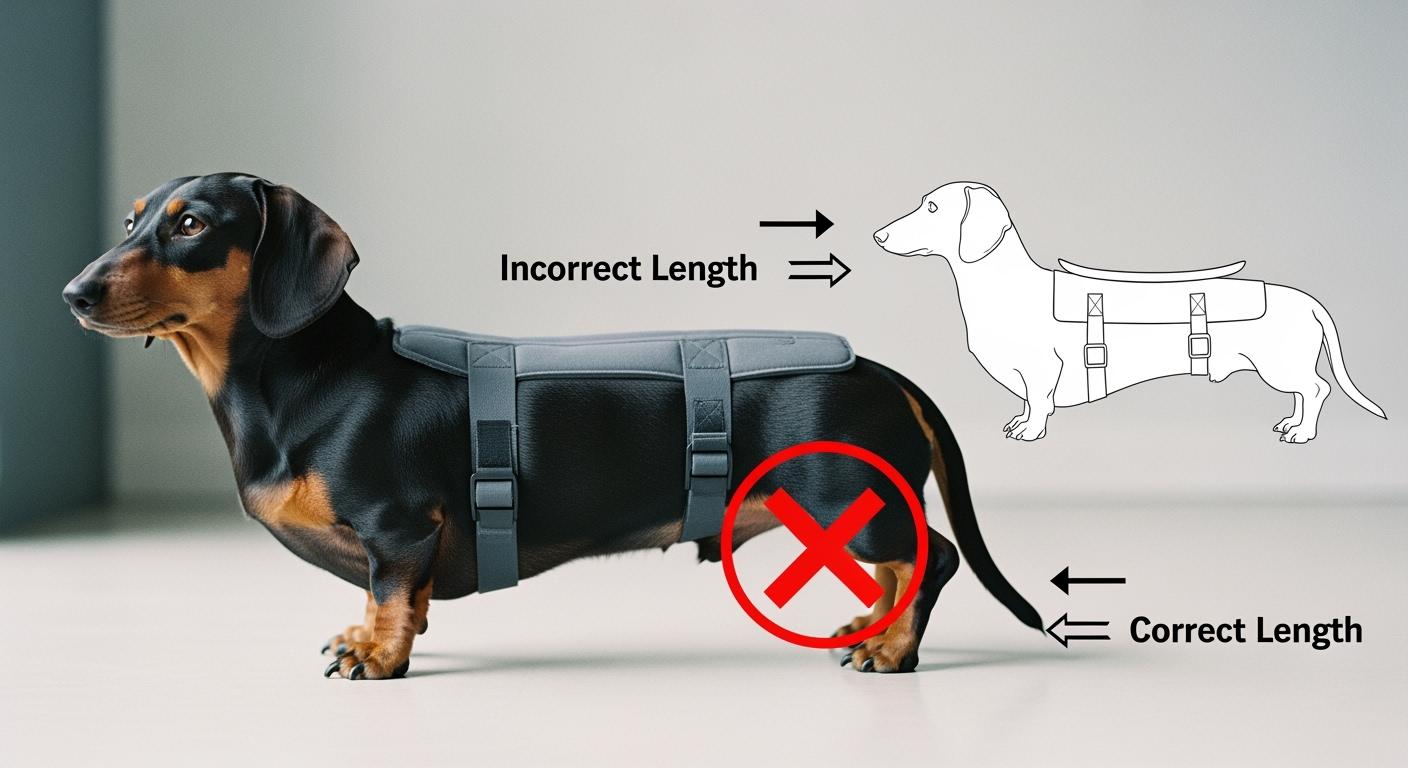
A dog back brace can match the chest measurement on a sizing chart and still run too long across the back. The panel reaches past the hips. It crowds the neck. The belly strap drops off the rib cage and lands on the narrow waist. On a short-torso dog — a Dachshund, French Bulldog, or Corgi — there is simply less distance between the shoulder base and the hip movement zone. When that distance is shorter than the brace panel, no amount of strap adjustment fixes the mismatch.
The problem is not the chest fit. It is the panel length. And tightening the straps to compensate sends the failure cascading.
When Chest Size Matches but the Back Brace Still Runs Too Long
Most sizing charts use chest girth as the primary dimension. That number tells you whether the brace wraps around the rib cage without cutting off breath. It says nothing about how far the back panel extends from shoulders to hips.
On a short-torso dog, the usable length between the base of the neck and the front of the pelvis can be two to three inches shorter than what a standard back brace panel was patterned for. The panel does not know the dog is compact. It was cut for an average torso length within that chest-girth band. When the panel overshoots, three things happen in sequence.
First, the rear edge lands in the hip movement zone. The panel covers the point where the hip flexes during sitting and turning. The dog cannot bend normally. It freezes, arches, or shortens stride.
Second, the belly strap — which should sit flat against the stable, cylindrical rib cage — slides rearward onto the tapered waist. On the rib cage, the strap has a wide, bony platform to anchor against. On the waist, it has none. The strap rolls. It bunches. It rotates the entire brace with every step.
Third, the owner tightens the straps to stop the shift. This is the cascade point. Tightening pulls the panel harder against the back, but the panel is still too long — so the rear edge now digs deeper into the hip zone while the front edge creeps toward the neck. Pressure concentrates at two points: the hip contact line and the neck base. The dog moves less. Skin reddens underneath. The brace becomes a net negative.
This sequence is predictable once you see the panel-length-to-torso ratio as the controlling variable. A back brace that fits well depends on the panel stopping before the hip zone, not on how tight the straps go.
Here is how the common fit failures present:
| Fit sign | What the owner sees | Why it happens | Better design direction |
|---|---|---|---|
| Rear edge touches the hip area | Panel covers the hip joint | Panel length exceeds torso distance | Shorter graded panel, low-profile rear edge |
| Dog cannot sit normally | Dog freezes or arches when sitting | Rear panel blocks hip flexion | Panel stops before hip movement zone |
| Brace shifts forward | Brace slides toward the neck | Rear edge pushes forward during movement | Flexible edge, correct panel length |
| Belly strap rolls or slides | Strap bunches at the waist | Strap lands on narrow waist, not rib cage | Separate belly adjustment, shorter panel grading |
| Tightening increases rubbing | More marks, same slipping | Straps compensate for poor panel fit | Correct panel length, soft rolled edge |
| Dog walks shorter or freezes | Short stride, hesitation | Brace blocks normal back or hip motion | Panel fits between skeletal landmarks |
All six failure patterns trace back to one root condition: the panel is longer than the dog’s torso. The chest measurement was right. The panel was not.
Where the Panel Hits — and What Goes Wrong Next
Short-torso dogs leave less room for error. The distance from the shoulder base to the front of the pelvis is compressed. Every extra half-inch of panel length lands somewhere it should not. Three contact zones fail in predictable order.
Rear edge meets the hip movement zone
When the rear edge of the panel extends past the front of the pelvis, it intrudes into the space the hip joint needs to flex. In a standing position the overlap can look minor — a quarter-inch of panel past the bony landmark. But when the dog sits, the hip rotates and the back curves. That quarter-inch becomes a hard stop. The panel edge acts like a wedge driven into the hip crease.
The dog compensates by not sitting fully. It hovers. It arches. It shifts weight forward. Over repeated wear sessions, the rear edge wears a friction track into the skin directly over the hip point. You can verify this: remove the brace after a 10-minute wear session and run your fingers along the skin just forward of the hip. A warm, pink stripe at the exact width of the panel edge is the tell. That stripe means the panel ends in the wrong place.
For dogs with IVDD and back support needs, this hip interference is especially damaging. A dog that cannot sit comfortably cannot rest. A dog that cannot rest loads the spine continuously.
Belly strap drops off the rib cage
A belly strap works by anchoring against the rib cage — a semi-rigid cylinder that resists rotation. When the panel is too long, the strap lands behind the ribs, on the tapered waist where the abdomen narrows toward the hind legs. This surface is soft, angled, and narrow. The strap has nothing to grip.
It rolls into a cord. It slides forward and back with each step. The owner feels the shift and tightens the strap. Tightening a strap on a soft, angled surface does not create stability — it creates a constriction ring around the abdomen. The dog’s diaphragm works against it on every breath.
The observable check: mark the strap position with a small piece of tape on the fur before a 10-minute walk. If the strap has moved more than half an inch from the tape mark when you remove the brace, the landing zone is wrong. The fix is not a tighter strap. It is a panel short enough to place the strap over the rib cage.
Front edge crowds the neck or shoulder
When the whole panel shifts forward — whether from rear-edge push during movement or from belly-strap rotation — the front edge creeps toward the base of the neck. The dog’s shoulder blades need clearance to swing forward during walking. A panel edge that sits at or above the shoulder base restricts scapular motion.
You may see the dog shorten its front reach. The stride looks choppy. Breathing may sound heavier because the front chest strap, now pulled upward, compresses the thoracic inlet. A brace that fits correctly sits behind the shoulder blades, not on top of them.
Sitting and turning expose what standing hides
A standing fit check is incomplete. The brace looks straight. The edges appear to land at the right landmarks. But standing is a static position. The failure only declares itself during movement.
Ask the dog to sit slowly. Watch the rear edge. If it digs, lifts, or the dog freezes partway down, the panel is too long for the torso curve that sitting demands. Ask for a slow turn. If the brace rotates around the body, the panel lacks enough torso length to stay indexed to the spine during lateral motion.
Check the skin after 10–15 minutes of indoor movement. Run your hand along the rear edge zone, the belly strap track, and the front neck line. Warmth is the first signal. Pinkness is the second. A defined edge-mark is the third. Any of these means the brace fit failed during movement — even if it looked correct standing still.
Disclaimer: This fit-check sequence assumes a short-coated dog where skin changes are visible to the naked eye. Double-coated breeds may show subtler rub marks beneath the fur that require hand-checking rather than visual inspection — run your fingertips along the skin surface, not over the coat, to detect heat or texture change.
Design Differences That Change Fit on a Short Torso
Shorter graded panel length — not just a smaller chest size
Some braces scale down by shrinking the chest circumference while keeping the panel length nearly constant across sizes. That approach fails on a short torso because the panel-to-torso ratio gets worse, not better, as the chest band shrinks. A smaller chest size on the same panel length means the brace wraps tighter around a shorter back — exactly the condition that drives the failure cascade described earlier.
A graded panel shortens proportionally with the chest band. Each size step reduces both the girth and the back length. On a Dachshund with a 19-inch chest and a 6-inch usable back length, a graded panel lands between the landmarks. An ungraded panel may measure 8 or 9 inches — two to three inches of excess that must go somewhere. That somewhere is the hip zone.
This is why back support solutions for compact breeds need panel length to be part of the sizing logic, not an afterthought. The chest measurement opens the door. The panel length decides whether the dog walks through it.
Low-profile rear edge
A rear edge that stops at the front of the pelvis — without a thick rolled hem, a stiff binding, or a rigid plastic stay at the terminal edge — reduces the consequence of small fit errors. On a short torso, the difference between “clears the hip” and “digs into the hip” can be half an inch. A low-profile edge turns that half-inch from a hard stop into a soft transition. The panel tapers. It flexes. It does not concentrate force into a single line.
Low-bulk materials matter more when the contact area is small. Every edge millimeter that contacts skin on a short-torso dog represents a larger percentage of the total panel perimeter than it would on a long-backed breed. The edge-to-surface ratio is higher. That makes edge construction disproportionately important.
Soft rolled edges and breathable lining
Wide, soft-edged straps spread pressure across more surface area. That reduces the pounds-per-square-inch at any single point under the strap. Narrow straps — especially those with a hard binding stitch along the edge — act like a dull blade when tensioned. They cut a linear pressure track into the skin.
Breathable linings matter here too. A short torso has less surface area for heat dissipation. The brace covers a higher percentage of the dog’s total back area. Moisture builds faster. If the lining does not wick, the skin macerates under a warm, damp panel. Macerated skin tears at lower friction thresholds. What starts as a minor rub becomes a open sore faster on a compact dog than on a large one.
You can test lining performance directly: after a 15-minute wear session, flip the brace over and press the back of your hand against the inner lining. It should feel no warmer than the dog’s exposed fur. If the lining holds heat, the skin underneath has been stewing.
Separate chest, belly, and rear adjustment
A single-strap or two-strap system forces one tension setting to control fit across three zones with different shapes and different movement demands. The chest needs clearance for the shoulders. The belly needs anchorage on the rib cage. The rear needs to stop before the hip without tension pulling the whole panel backward.
When one strap drives all three, tightening the belly to stop a shift pulls the rear edge into the hip zone and the front edge into the neck. Three problems created by solving one. A lightweight back brace with independent adjustment zones lets each landmark be set independently. The rear edge stays indexed to the pelvis regardless of belly-strap tension. The chest band stays behind the shoulders regardless of how the rear is set.
Here is what independent zones control:
| Adjustment Zone | What It Controls | Why It Matters on a Short Torso |
|---|---|---|
| Chest | Neck and shoulder clearance | Prevents the front edge from riding up onto the shoulder blades |
| Belly | Strap placement and tension | Keeps the strap anchored on the rib cage, not the waist |
| Rear | Edge position and hip clearance | Stops the panel before it enters the hip flexion zone |
When the Brace Is the Wrong Tool
Not every back support problem on a short-torso dog is a fit problem. Some are a mismatch between what the dog needs and what a back brace can provide. Knowing where that line sits prevents you from chasing fit adjustments that cannot work.
Movement red flags that go beyond fit
- The dog cannot stand or walk without assistance — a brace does not replace structural limb support.
- The dog drags its back legs or shows knuckling — this signals a neurologic deficit, not a panel-length issue.
- Visible changes in spine shape or new asymmetry when standing — a brace masks symptoms; it does not address structural progression.
- The dog vocalizes when the brace is applied or removed — pain at rest is not a fit variable.
If any of these appear, a lift harness or assisted-mobility plan may be the safer path. A back brace supports the spine during supervised, voluntary movement. It is not a stabilization device for a dog that cannot weight-bear.
Skin and pressure signs that mean stop
- Redness that does not fade within 10 minutes of brace removal
- Heat concentrated at one edge or strap line that persists after the brace is off
- Indentations still visible 5 minutes after removal — the skin should rebound, not hold a cast of the brace edge
- Any broken skin, weeping, or scabbing under a contact point
These are not warnings to adjust. They are stop signals. The pressure exceeded what the skin can tolerate, and continuing will deepen the injury. Short-torso dogs have less subcutaneous fat over their spine and hip points. The bony landmarks sit closer to the surface. Pressure transfers faster from the brace edge to the bone.
Disclaimer: If the dog’s leg conformation falls outside the breed norms this brace was patterned for — particularly dogs with angular limb deformities, very deep chests relative to back length, or fused vertebrae that change the spinal curve — the fit checks described here may not catch every pressure point. In these cases, a custom-molded orthotic assessed by a veterinary rehabilitation specialist offers a margin of safety that an off-the-shelf panel cannot match.
When a different support plan makes more sense
A back brace is one tool in a larger set. It works when the dog can stand, walk, and sit voluntarily and the brace stays indexed to the right landmarks during those movements. When those conditions are not met — when the dog cannot move independently, when the torso shape falls outside standard grading, when skin tolerance is already compromised — recovery support for IVDD and back injuries may need to shift toward a lift harness, a structured rest protocol, or a veterinary reassessment.
The goal is not to make the brace work. It is to support the dog. When those two goals diverge, the brace loses.
| Signal level | What you see | What to do |
|---|---|---|
| Green | Brace stays flat, dog stands, sits, and turns normally, no red marks after removal | Continue supervised use, check fit regularly |
| Yellow | Mild shifting, light edge pressure, dog hesitates, strap needs repeated adjustment | Recheck panel length, adjust or try shorter panel |
| Red | Rear edge digs, sitting is blocked, gait worsens, skin is red or swollen, dog refuses movement | Stop use immediately, reassess support plan |
