
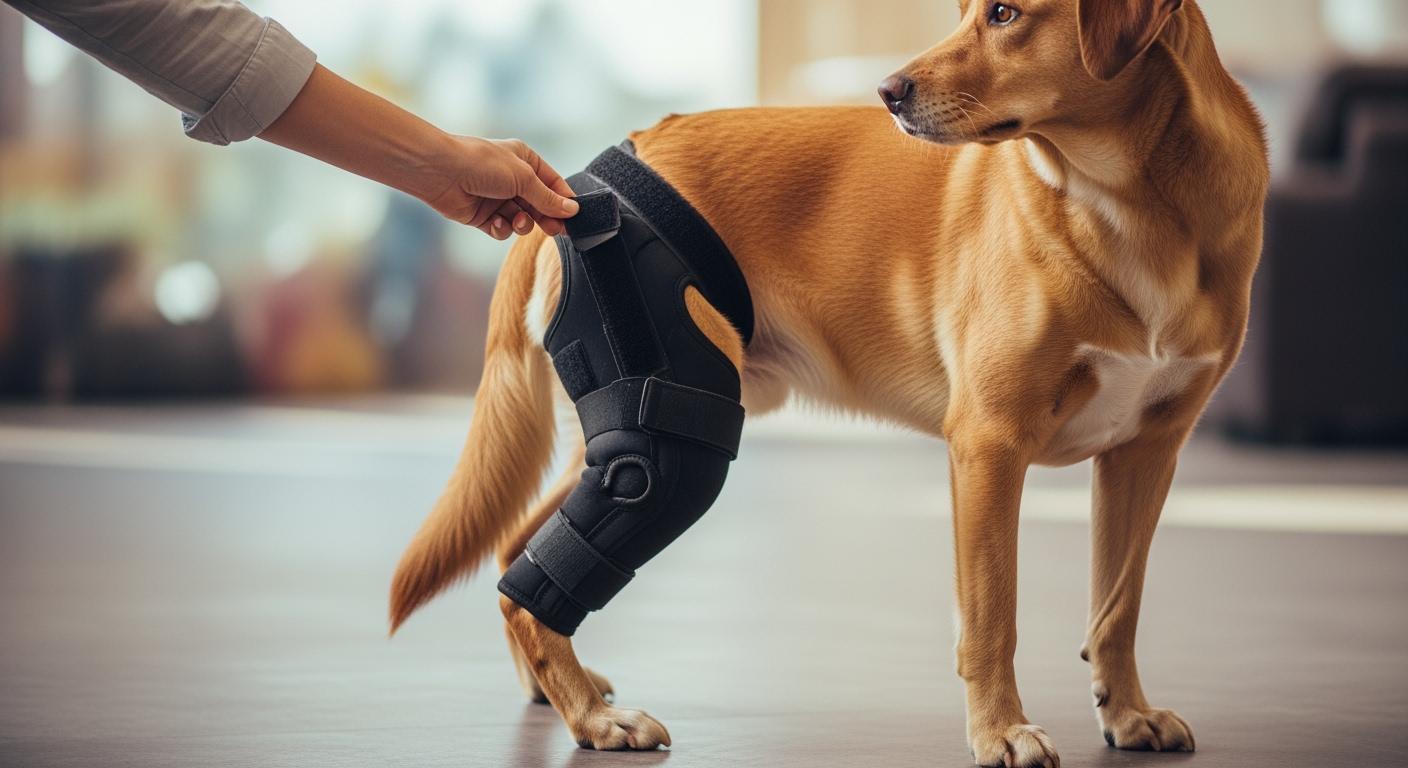
The brace sits snugly above the knee at first. Then the dog walks. A turn. A sit-to-stand. And the brace creeps downward — half an inch, sometimes more. The dog hind leg brace slips toward paw, and the support that was centered over the stifle joint is now riding the narrow part of the calf. It still feels tight. That is the problem.
Tightness is not the same as position. A brace that has migrated below the knee joint can feel secure against the skin while doing nothing for the knee. This is not a strap-tension issue. It is an anchoring failure — and the leg’s own shape works against the brace every time the dog moves.
Why the Brace Slides Down: Gravity, Taper, and What Fails at the Anchor Point
A canine hind leg narrows below the knee. The thigh is wider, the calf tapers. When a knee brace relies on lower-leg grip alone, that taper becomes a ramp. Every stride generates a downward force vector. The wider thigh pushes the brace downward with each muscle contraction. The narrower calf offers nothing to stop it — no shelf, no ridge, no anatomical feature that resists downward migration.
Here is the chain: the brace cuff contacts the leg above and below the knee. During walking, thigh muscles expand and contract. That expansion pushes against the upper edge of the brace, driving it downward. If the only counter-force comes from a strap cinched around the calf, the brace rides the taper like a wedge. The strap digs in tighter as the brace descends — creating an illusion of security. But the support pad has already drifted away from the joint it is supposed to stabilize.
When the brace sits correctly, the hinge aligns with the knee’s axis of rotation. The support surfaces distribute load across the joint. But once it slips even half an inch toward the paw, the hinge axis no longer matches the joint axis. Now every step applies twisting loads the knee was never designed to handle. The brace becomes a lever arm pushing at the wrong angle. That is how a knee brace that fits well at rest can fail completely in motion — not because it is too loose, but because the anchoring strategy only works when the leg is static.
| Brace setup | What fails in real use | Why it slips toward the paw | Better design direction |
|---|---|---|---|
| Soft knee wrap with only lower-leg tension | Slides after walking | Lower-leg grip cannot resist gravity and taper | Add upper-thigh suspension, diagonal straps |
| Single ACL/CCL brace with weak upper-thigh anchoring | Moves during turns and sits | No counter-force above the knee to resist downward push | Strengthen upper-thigh anchor, wider strap beds |
| Hinged knee brace with poor joint alignment | Support pad drifts below knee within minutes | Misaligned hinge axis creates rotational slip, not just downward slide | Knee-centered alignment, anti-rotation contact surfaces |
| Double rear-leg brace made from two separate single braces | Both braces slip and rotate independently | No shared anchoring; each brace fights leg taper alone | Use purpose-built double knee brace with shared rear anchor |
| Purpose-built double knee brace with shared rear anchoring | Stays centered, resists slip | Anchoring and tension are balanced across both legs | Maintain shared anchor, independent tension per leg |
How to check if the brace is slipping — two observable tests
Mark the top edge of the brace with a piece of tape placed on the fur just above it. Walk the dog on a leash for 10 minutes at a normal pace. Include one or two turns and a sit-to-stand transition. Recheck: if the brace edge has moved more than half an inch below the tape mark, the anchoring is failing — regardless of how tight the straps feel.
Second check: after removing the brace, look at the strap marks on the skin. A well-distributed strap bed leaves shallow marks that fade within 10 to 15 minutes. If the marks are still deep and red after 20 minutes, the pressure was too concentrated in a narrow band. That narrow pressure band is often the byproduct of a strap that was overtightened to compensate for missing upper-thigh anchoring.
Disclaimer: These checks assume a short-coated dog where strap marks are visible against the skin. Double-coated breeds may show far subtler marks — hand-feeling for residual heat or indentation is more reliable than visual inspection. If the dog’s leg conformation falls outside the proportions these brace designs are patterned for, particularly dogs with heavily muscled thighs relative to slender lower legs, the fit checks described here may not catch every pressure point.
Why Tightening the Lower Strap Makes the Problem Worse
Tightening the strap around the calf feels like the obvious fix. The brace feels loose when it slides, so it must need more tension. But the lower strap sits on a part of the leg that tapers. When you cinch it harder, you increase friction at the calf — not at the knee. The brace still has no anchor above the joint. So it slides anyway. Now it slides with more force pressing into the skin.
| Consequence of overtightening | What happens in real use | Why it misleads |
|---|---|---|
| Increased friction without anchoring | Brace still migrates downward but with more skin drag | Friction at the calf cannot substitute for suspension above the knee |
| Pressure concentration at bony points | Red marks, heat, swelling at the fibular head or tibial crest | Tight straps over bone create point loads — skin breaks down before the brace stops moving |
| Deep strap marks that do not fade | Indentations visible 20+ minutes after brace removal | The mark is read as “secure fit” when it is actually tissue compression beyond what capillaries tolerate |
Deep strap marks are sometimes mistaken for proof that the brace is working. They are not. A mark that stays visible for 20 minutes after removal means the tissue under that strap was compressed hard enough to displace fluid from the interstitial space. That is a pressure injury in slow motion. It does not mean the brace was stable — it means the strap was narrow and tight enough to damage skin while the brace kept sliding.
This is a common pattern with knee braces that rely on horizontal strap cinching around the lower leg. The strap pulls straight across the calf. That gives grip in one plane only — circumferential. But downward slip is a vertical force. A horizontal strap cannot resist a vertical load effectively unless it sits on a surface that does not taper. The canine lower leg tapers. So the strap becomes a compression band, not an anchor.
A narrow strap under high tension also concentrates force along a thin line. The skin under that line gets less blood flow. After 30 to 60 minutes of wear, the dog may start licking, chewing, or refusing to walk — not because the knee hurts, but because the strap is burning a ring into the leg. The caregiver tightens it further. The cycle accelerates.
What Holds: Structural Features That Resist Downward Slip
Upper-thigh suspension anchors above the taper point
When a brace includes a cuff or strap that wraps the upper thigh above the stifle, it creates a mechanical stop. The thigh is wider than the calf. A strap placed above the widest point of the thigh cannot slide down because it would have to move over a larger circumference. That is a geometric lock — no amount of walking force can pull a properly sized upper-thigh cuff past the muscle belly it sits above.
This is why knee braces designed with separate upper and lower anchor points resist migration better than single-cuff wraps. The upper anchor handles vertical suspension. The lower straps handle rotational stability. Separating those functions means neither strap has to do both jobs poorly.
Diagonal strap paths resist rotation and slip simultaneously
A strap that runs at 30 to 45 degrees across the leg resists forces in two directions at once — vertical slip and rotational twist. A horizontal strap only resists circumferential loosening. When a dog’s leg moves through a stride, the forces on the brace are not purely vertical. The leg rotates slightly with each step. A purely horizontal strap lets the brace rotate around the leg’s long axis. A diagonal strap converts some of that rotational force into tension along the strap’s length, which pulls the brace back toward center rather than letting it walk around the leg.
Two diagonal straps crossing in opposite directions create a force couple — each resists the direction the other cannot. That is the difference between a brace that needs readjustment every few minutes and one that stays put through a 20-minute walk.
Wider strap beds distribute load so pressure does not become pain
A strap that is one inch wide concentrates all its holding force into a narrow band. Double the width to two inches and the same tension produces half the pressure per square inch of skin. That matters because skin tolerance has a threshold. Below it, the dog tolerates the brace. Above it, the dog licks, chews, or refuses to move.
Anti-slip lining materials help — but only when the structural anchoring is already correct. A grippy liner on a brace that lacks upper-thigh suspension will simply drag skin downward with it instead of sliding over the fur. The liner improves friction at the interface; it does not create an anchor where none exists.
For dogs with bilateral hind leg issues, a purpose-built double knee brace with shared rear anchoring keeps both braces centered better than two independent single braces. Two separate braces each fight leg taper alone. A shared anchor bridges the force across both legs, so neither brace can migrate without pulling the other — and the other resists.
Fit verification after structural changes
| Signal level | What the caregiver sees | What to do |
|---|---|---|
| Green | Brace stays centered through 10-minute walk, skin marks fade within 15 minutes, dog moves naturally | Continue regular checks, note wear duration |
| Yellow | Minor drift under half an inch, light rubbing marks that fade slowly, repeated strap adjustment needed | Reassess strap path angle, check upper-thigh anchor tension, monitor closely |
| Red | More than half an inch downward slip, cold paw, swelling, deep marks lasting 20+ minutes, chewing, refusal to walk | Stop use, consult a veterinarian, consider a different brace structure |
When the Brace Is the Wrong Tool
Pain, swelling, or a worsening limp signal more than a fit issue
If the dog was limping before the brace and limps worse with it — even when the brace stays perfectly centered — the problem is not the brace position. It is that external support cannot address what is happening inside the joint. Swelling that increases during brace use, warmth over the joint that persists after removal, or sensitivity when the knee is touched all point to an inflammatory process that a brace cannot resolve.
A knee brace supports by limiting range of motion and offloading some load from the joint. It does not reduce intra-articular swelling. It does not heal a torn ligament. When the underlying instability is severe — particularly a full cruciate tear with significant drawer motion — even a well-anchored brace may not provide enough stabilization to prevent the joint surfaces from grinding with each step. The brace stays in place. The damage continues underneath it.
Severe ACL/CCL instability exceeds what external bracing can manage
Certain mechanical signs suggest the joint instability is beyond the capability of external support. A pronounced drawer sign — where the tibia slides forward relative to the femur when the joint is manipulated — means the primary passive stabilizer of the knee is gone. No external brace can fully replicate the function of an intact cranial cruciate ligament. A brace can reduce the mechanical load, but it cannot eliminate the abnormal translation between bone surfaces. When a clicking or popping sound accompanies each step, that is often bone contacting bone or a meniscal tear flipping in and out of the joint space — mechanical problems that bracing does not fix.
This is where understanding the difference between a fit problem and a structural mismatch matters. A brace that slips because the anchoring is wrong can be replaced with a better design. A brace that fails because the joint itself cannot be stabilized externally requires a different intervention path entirely.
Disclaimer: If the dog shows a sudden worsening of lameness, cannot bear weight on the leg at all, has a visibly deformed joint angle, or shows signs of systemic illness such as fever or lethargy alongside joint symptoms, discontinue brace use immediately and seek veterinary evaluation. These are not fit-adjustment problems.
When to stop adjusting and seek veterinary guidance
Stop adjusting and consult a veterinarian when any of these are present: more than half an inch of downward slip that persists across multiple fit attempts with different strap tensions, deep strap marks that do not fade within 20 minutes, a paw that feels cold compared to the other legs, swelling that worsens during or after brace wear, the dog chewing at the brace or refusing to stand, or a limp that was mild but becomes pronounced with the brace on.
Adjusting the same failing brace repeatedly and hoping for a different result is not persistence. It is pressure injury waiting to happen. Recognizing when a knee brace solution fits the specific leg and condition — and when it does not — is the difference between supporting a joint and damaging the skin, the trust, and the recovery timeline.
FAQ
Why does the brace keep sliding down even when the straps feel tight?
Tightness at the calf does not anchor the brace at the knee. The canine hind leg tapers below the stifle. A tight lower strap grips a sloping surface. Without a counter-force above the knee — an upper-thigh cuff or diagonal strap path that pulls upward — gravity and muscle motion drive the brace down regardless of how firmly it presses into the skin. The sensation of tightness is skin compression. It is not joint stabilization.
How much downward movement is too much?
Mark the brace’s top edge before a 10-minute walk. If the brace has moved more than half an inch below that mark afterward, the anchoring is insufficient. A small shift under a quarter inch during the first few minutes of wear can be normal as the materials settle against the fur, but any continued migration during movement indicates the suspension strategy is not holding.
Will anti-slip liners stop the brace from sliding?
Anti-slip liners increase surface friction between the brace and the skin or coat. They help when the brace shape and strap path are already correct and the slip is minor. They do not fix an anchoring failure. A brace without upper-thigh suspension will still slide — the liner just takes the skin with it, which can cause friction injuries that are harder to spot than simple strap marks.
