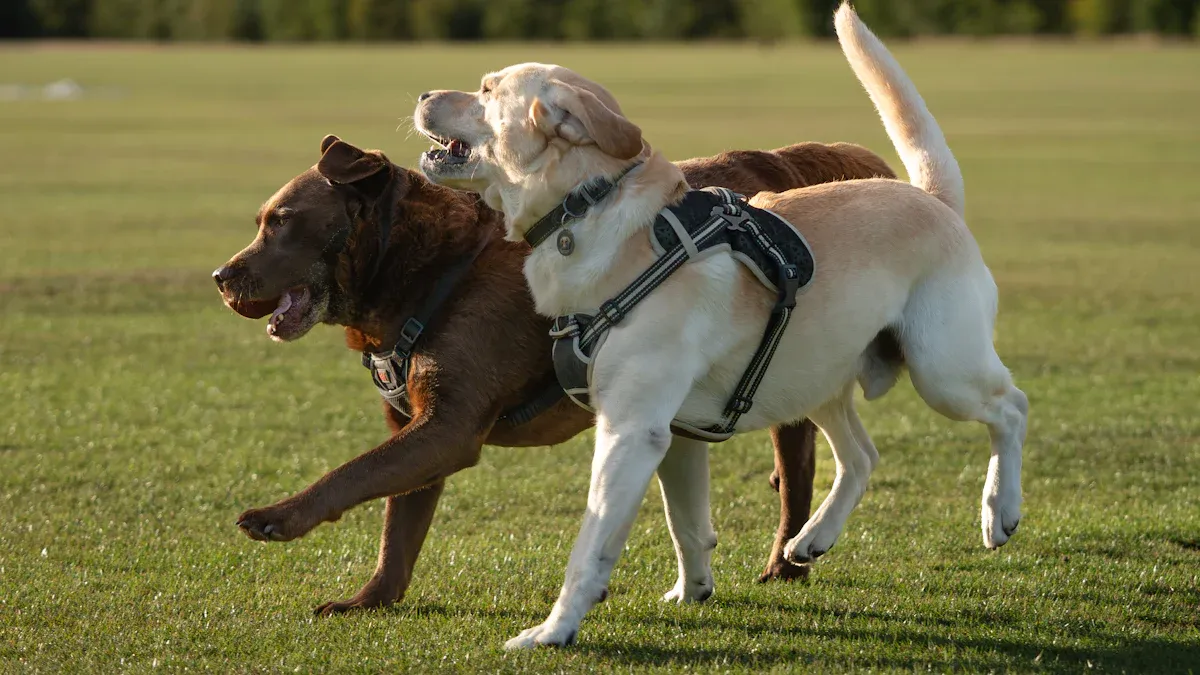
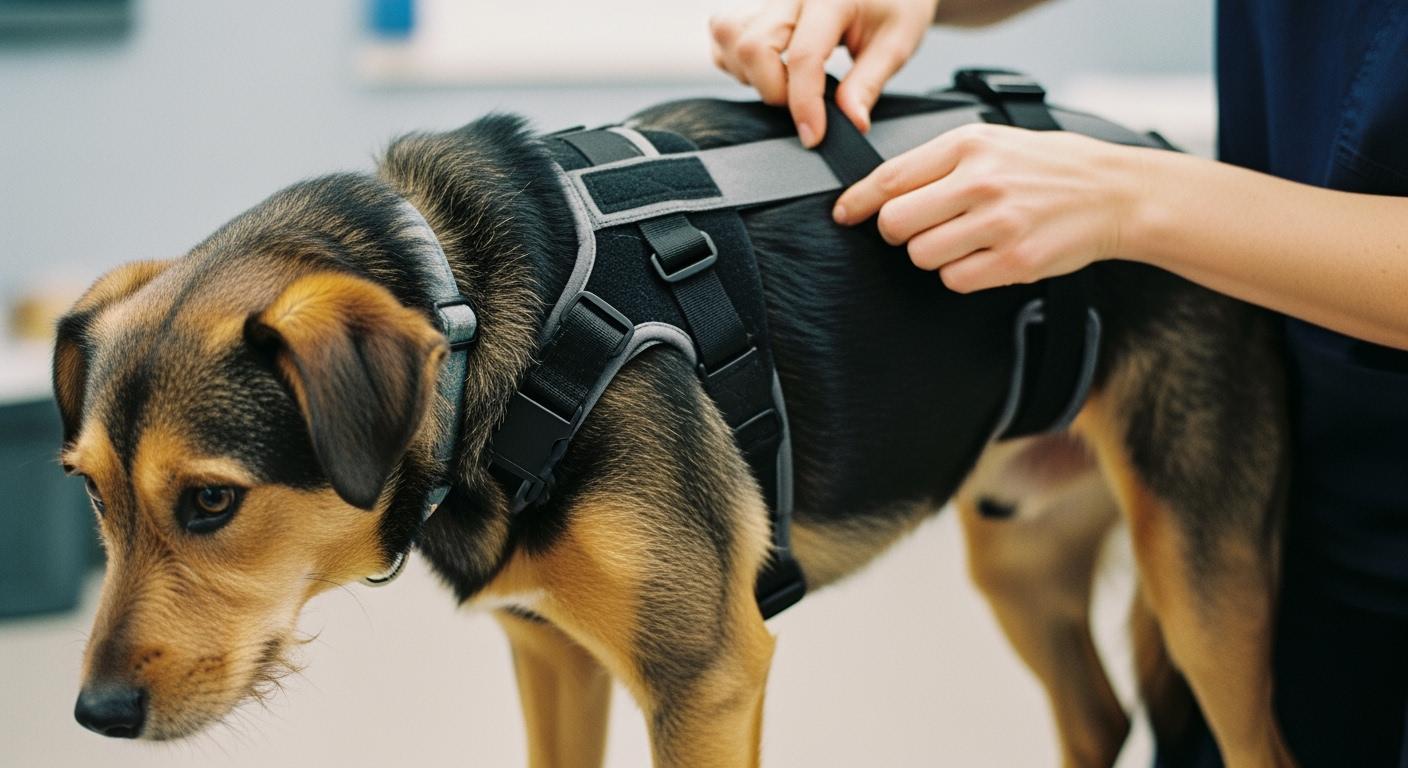
A dog walks forward in a back brace without trouble. The steps look steady. Then the dog lowers its head to sniff the ground. The movement stops. Freezing. Head lifting. An awkward sidestep. This is not stubbornness. It is structure. When a back brace blocks natural sniffing posture, the failure is almost always mechanical, not behavioral, and straight-walking alone will not catch it.
| Brace Area | Failure During Sniffing | What the Dog May Show | Better Design Cue |
|---|---|---|---|
| Front edge | Catches at shoulder line | Freezing or head lift | Rounded, low front edge |
| Chest strap | Pulls front body upward | Short stride or pausing | Stable, non-pulling chest |
| Belly strap | Acts as pressure hinge | Shifting or discomfort | Wider, softer contact |
| Back panel | Too long, blocks flexion | Awkward curve or twist | Matched to spine profile |
| Rear anchor | Restricts back end movement | Uneven gait | Flexible, secure fit |
| Material | Too stiff, blocks motion | Rubbing or resistance | Breathable, flexible base |
When Straight Walking Looks Fine but Sniffing Reveals the Real Problem
Straight walking is a low-demand test. The spine stays mostly aligned. The shoulders do not need to glide forward. The neck stays neutral. A back brace that passes a straight-walk check with flying colors may still fail the moment the dog lowers its head to sniff.
What changes? Everything that matters.
When a dog drops its nose toward the ground, the cervical spine flexes, the thoracic spine rounds slightly, and both scapulae shift forward and down over the ribcage. These are not independent movements. They form a kinetic chain: head lowering pulls the neck forward, the neck pulls the shoulders, the shoulders pull the chest strap forward, and the chest strap pulls against whatever it is anchored to. A brace built around a static standing posture can resist every link in that chain.
If the front edge sits above the manubrium, the ascending scapula catches it mid-glide. The dog cannot push through. It freezes or lifts its head. If the chest strap runs across the point of the shoulder, the forward translation of the humerus pulls the strap taut upward, lifting the brace’s front panel into the throat. The dog shortens its stride to reduce the pull. If the back panel extends too far toward the lumbar region, the panel bridges across the thoracolumbar junction and resists the flexion needed for a full sniff.
These failures are invisible during a hallway walk. They only surface when posture changes. When evaluating back support solutions designed for stability during daily activity, the sniffing test reveals more about fit quality than any static measurement.
Tip: Watch the dog’s scapulae, not just the head. If the shoulder blades stop gliding forward as the head drops, a contact point on the brace is blocking them.
The Four Contact Zones That Make or Break Sniffing Posture
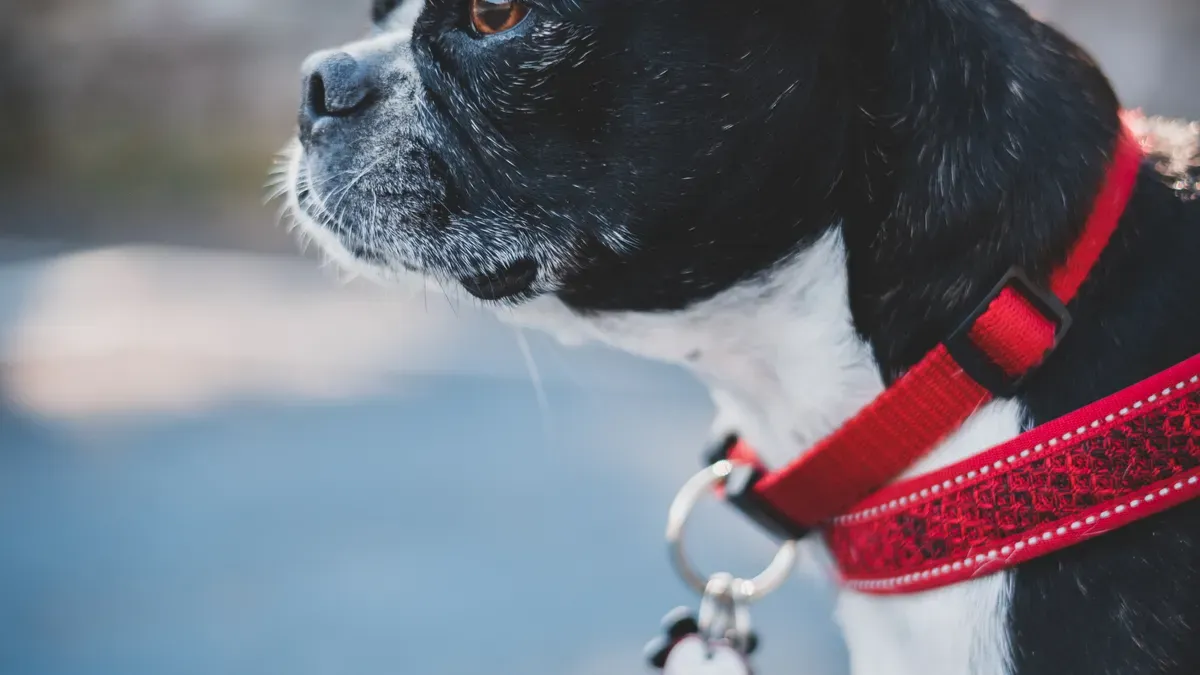
Four contact zones on a back brace determine whether a dog can lower its head to sniff or will freeze mid-motion. Each zone has a distinct failure mode, and each failure produces an observable signal that a short supervised session can catch.
Front edge and shoulder clearance
The front edge of a back brace panel sits near the shoulder line. When the dog lowers its head, the scapulae glide forward along the ribcage. They travel upward and outward in an arc. A front edge cut square and high across the withers intersects that arc. The scapula hits the edge, and forward motion stops. The dog lifts its head because lifting is the only available option.
A rounded, low-profile front edge stays below the scapular glide path through the full range of neck flexion. The difference is geometric, not cosmetic. The edge profile either clears the shoulder or it does not. There is no partial clearance at the point of contact.
To verify: after 10 minutes of walking with sniffing, slide two fingers under the front edge on each side. If the skin beneath feels warmer than the surrounding fur, the edge is catching and generating friction heat during scapular movement. A passed check means cool, dry skin under the edge on both sides.
Chest strap and upward pull
The chest strap stabilizes the brace against the front of the torso. During sniffing, the shoulders translate forward, which shifts the chest profile. If the strap is positioned high on the sternum or cut too narrow, the forward motion of the shoulders converts into upward tension: the strap pulls the brace upward toward the throat, and the dog responds by shortening its stride to reduce the tug.
A proper spinal support brace fit keeps the chest strap seated low and flat across the sternum so that shoulder translation does not redirect into vertical pull. The strap should be wide enough to resist rolling under side-to-side tension. A narrow strap under lateral load rolls at its edge, concentrating force into a thin line. That line digs. The dog compensates.
Observable check: walk the dog on a loose leash for 5 minutes, encouraging sniffing. Stop and check the chest strap position. If it has ridden up more than half an inch from its starting position, upward pull during head-lowering is the cause.
Back panel length and spinal flexion
The back panel provides spinal support, but its length dictates how much of the spine it immobilizes. A panel that extends too far into the lumbar region bridges multiple vertebral segments. When the dog attempts to round its back for a deep sniff at ground level, the panel resists the curvature. The dog either cannot reach the ground or twists laterally to work around the panel, creating an asymmetrical load on the spine.
The panel should cover the thoracic spine where support is needed but stop before the thoracolumbar junction, where flexion must occur for natural sniffing posture. This junction is the transition point between the rib-bearing thoracic vertebrae and the more mobile lumbar spine. A well-fitted panel matches the dog’s thoracic spine profile without extending into lumbar territory.
Verification: have the dog sniff a treat held at ground level. Watch the spine from above. If the back panel bows away from the spine at the lower end during the deep-sniff position, the panel is too long for that dog’s torso. If it stays flush through the full range, the length is correct.
Belly strap as a pressure hinge
The belly strap is easy to overlook. It wraps under the torso and anchors the lower edge of the brace. But a narrow belly strap under tension behaves like a hinge, not like a support. When the dog flexes or twists, the narrow strap concentrates force into a thin contact band. That band rolls. As it rolls, it pulls the brace panel downward into the spine and twists it off the centerline.
A lightweight back brace designed for extended daily wear distributes belly-strap pressure across a wider contact patch. Wider straps resist rotation because the force from any edge-rolling moment has farther to travel before the opposite edge lifts. The strap stays flat. The brace stays centered. The dog does not feel a narrow band digging into the underside with every breath or step.
After the brace comes off, check the belly for a defined strap-line crease. A faint indentation that fades within 10 minutes is normal. A sharp red line that stays visible after 20 minutes means the strap is too narrow or too tight for the load it carries.
Tip: Run a finger under the belly strap after the dog has worn the brace for 15 minutes of mixed walking and sniffing. If the skin feels tacky or damp while the rest of the belly is dry, the strap is creating a microclimate that can lead to skin breakdown over repeated sessions.
When a Back Brace Is Not the Right Support Tool
A back brace is a mechanical support tool, not a replacement for veterinary assessment. If a dog has not been evaluated for the underlying condition that led to bracing, sniffing restriction may mask something more serious. Signs that warrant stopping brace use and seeking veterinary guidance include hind-leg weakness, knuckling of the paws, loss of balance, or sudden pain responses when the brace is applied or removed. These are not fit problems. They are neurologic or structural red flags that a brace cannot and should not address.
Dogs with severe spinal deformities, advanced neurologic deficits, or an inability to stand independently are outside the intended use profile of a back brace. A dog that cannot bear weight on its hind limbs needs a different intervention pathway entirely. A lift harness offers controlled mobility support for dogs that cannot stabilize themselves during movement, which is a fundamentally different use case from spinal bracing during ambulation.
Four observable conditions where a back brace is not the correct tool:
- The dog cannot stand or walk even briefly without assistance.
- Removing the brace reveals sharp strap lines, open sores, or areas of heat that do not fade within 30 minutes.
- The dog vocalizes, flinches, or panics when the brace is applied, regardless of how gradually it is introduced.
- The underlying condition has not been diagnosed by a veterinarian.
Disclaimer: The fit checks described in this article assume a dog with a typical thoracic and shoulder conformation patterned for standard brace sizing. Dogs with angular limb deformities, a very deep or very shallow chest, or breeds with extreme body proportions may show altered contact patterns where the front edge and chest strap interact with anatomy differently. In these cases, visual inspection alone may miss pressure points, and hand-checking under the brace edges after every session becomes essential rather than optional.
The same sniffing restriction that signals a structural mismatch can also signal that a back brace fit failure is creating unsafe wear conditions. If adjustments to the four contact zones do not resolve freezing or head-lifting within two supervised sessions, discontinue use and seek a veterinary reassessment. A brace that cannot permit natural sniffing posture through fit correction is the wrong tool for that dog.
Spinal support during IVDD recovery depends on a brace that stabilizes without restricting. When the brace itself becomes the restriction, the support equation inverts.
FAQ
How quickly should a dog be able to sniff normally in a well-fitted back brace?
A dog that has worn the brace for two or three short acclimation sessions, with no structural interference from the front edge or chest strap, typically lowers its head to sniff within seconds of encountering an interesting scent. If sniffing remains hesitant after multiple sessions and the four contact zones have been checked and adjusted, the brace design itself is the likely constraint. Dogs do not need to learn to ignore a mechanical block.
Can a back brace that blocks sniffing still provide adequate spinal support?
Not without tradeoffs that compound over time. A brace that resists head-lowering creates compensatory movement patterns: the dog may squat from the hind end to reach the ground instead of flexing through the spine, or twist laterally to work around the blocked forward plane. These compensations load the spine asymmetrically. A back brace exists to stabilize, not to redistribute stress to a new axis. If the dog cannot sniff, the support is not neutral.
What is the most reliable single test for sniffing-posture interference?
The treat-at-ground-level test. Hold a high-value treat flat on the floor. The dog should drop its nose to the treat in one fluid motion, without hesitating, lifting mid-motion, or sidestepping. Run this test three times. If the dog freezes or lifts on any repetition, check the front edge and chest strap. If it passes all three, the brace is not blocking cervical or thoracic mobility during the sniffing movement arc.