
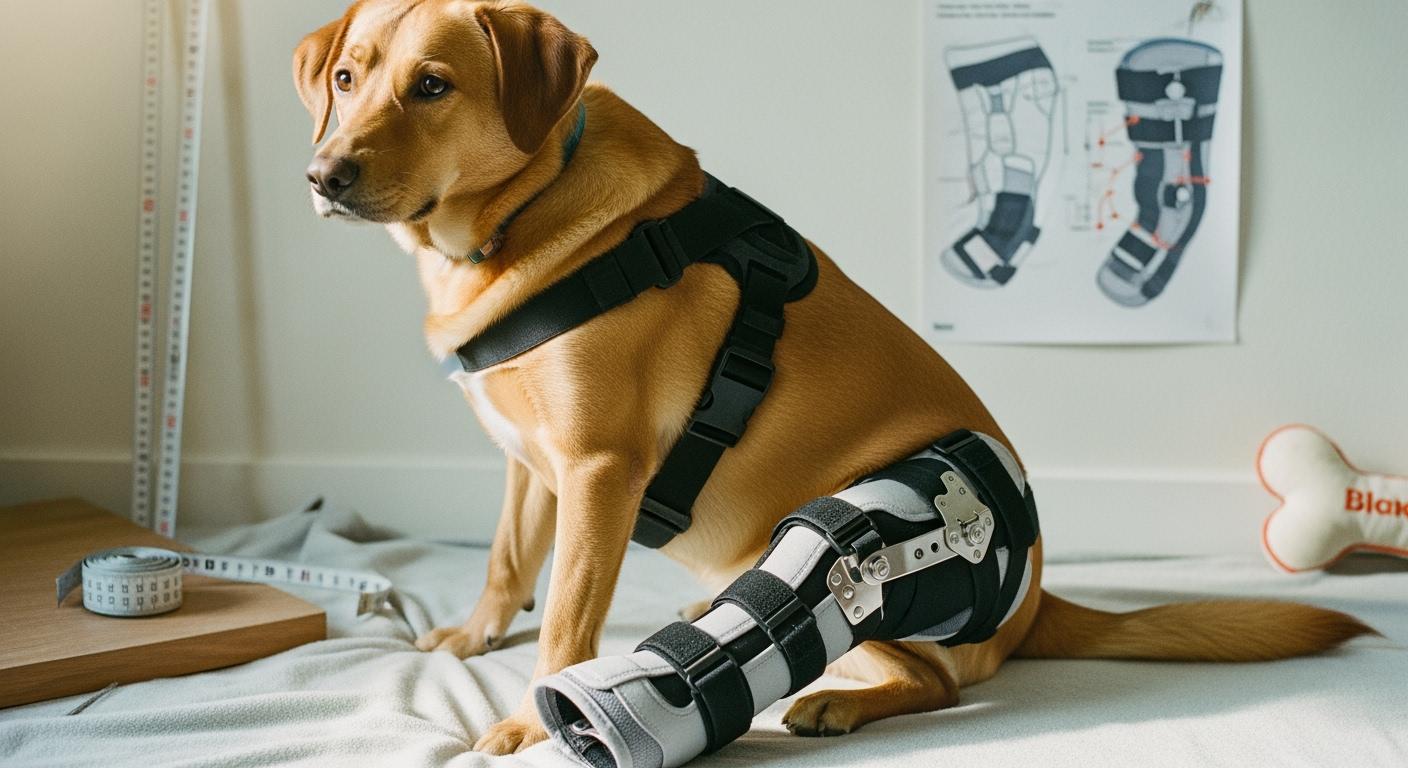
A brand adding post-surgical dog leg braces to its product line faces decisions that a simple product listing does not resolve. A stifle brace built for TPLO recovery and a carpal splint for arthrodesis stabilization share almost nothing in terms of structure, hinge requirement, or size logic. Treating them as variants of the same SKU creates fit problems that show up in returns, channel complaints, and veterinary pushback.
This article walks through the structural, sizing, and supplier decisions a buyer or product manager needs to make before committing to a post-surgical brace range. It covers how surgery type defines product structure, what makes a size system commercially viable, and which supplier capabilities matter for this category.
Post-operative bracing is not automatically appropriate after every procedure. The treating veterinarian or rehabilitation professional determines whether external support is needed, when it can be introduced, and what motion, incision-clearance, or loading limits apply. The sourcing discussion below therefore addresses product-development requirements only after a clinical use case has been defined.
How Surgery Type Defines Brace Structure Requirements
When a post-operative protocol includes external limb support, the required product structure depends on the joint involved, the procedure, the incision location, the intended motion restriction, and the treating professional’s instructions. Stifle, carpal, hock, fracture-protection, and soft-tissue applications should not be treated as minor variants of one product. Buyers first need a clinically defined use case and then need to determine whether the proposed structure can meet it without interfering with the incision, approved movement, or monitoring requirements.
The table below shows possible support formats only when external support is part of the treating professional’s post-operative plan. It is a product-development reference, not a prescribing guide.
| Procedure or Joint | Possible Support Format When Clinically Directed | Product-Development Consideration | Main Sourcing Risk |
|---|---|---|---|
| Stifle procedures such as TPLO, TTA, or extracapsular repair | Hinged or stability support only when included in the post-operative plan | Joint alignment, permitted motion, incision clearance, and supervised fit | Applying one hinge or size logic across different procedures and body proportions |
| Carpal arthrodesis | Rigid or semi-rigid splint where specified by the treating professional | Immobilization requirement, incision access, padding, and pressure distribution | Edge pressure, moisture retention, or loss of fit as swelling changes |
| Hock or tendon repair | Fixed-angle or controlled-motion support where clinically specified | Required angle, anchor geometry, and monitoring access | Using one fixed angle across different limb conformations |
| Fracture fixation | Protective support only when compatible with the fixation and post-operative protocol | Implant protection, imaging access, swelling, and inspection requirements | Applying external pressure or restricting movement without case-specific approval |
| Minor soft-tissue surgery | Protective sleeve or limited support where appropriate | Incision protection, contact pressure, removal, and inspection access | Presenting light protection as structural stabilization |
Each row represents a distinct product development path. A hinged stifle brace requires hinge validation across every size in the range because the relationship between joint center and hinge placement does not scale linearly from small to large breeds. A sample that tracks correctly in a medium may misalign in an extra-small or extra-large, creating rotational torque instead of controlled support.
Brands can verify this during sampling: measure the distance from the hinge axis to the tibial crest landmark on each size. If that offset shifts disproportionately across the size run, the grading logic needs revision before production.
Brace Types and Their Development Implications

Not every brace type belongs in every product line. The choice between a soft sleeve, hinged brace, rigid splint, and custom-molded orthosis affects tooling, material sourcing, size grading, and the supplier profile required to produce each one consistently.
| Brace Type | Support Level | Development Complexity | Best Fit for Product Line |
|---|---|---|---|
| Soft compression sleeve | Light | Low — fabric cut-and-sew, limited structural components | Entry SKU, minor post-op protection, recovery accessory |
| Hinged brace | Moderate to high | High — hinge sourcing, ROM stop calibration, multi-size joint alignment | Core stifle post-op SKU, requires size-specific hinge validation |
| Rigid or semi-rigid splint | High | Moderate — shell forming, padding bond, strap anchor placement | Carpal or hock stabilization, post-arthrodesis support |
| Custom-molded orthosis | Highest | Very high — case-by-case fabrication, clinical collaboration required | Veterinary-channel specialty, complex or non-standard anatomy |
For a brand new to this category, a narrower initial range is usually easier to validate than launching several structural types at once. The starting SKUs should follow the target channel, clinically defined use cases, and the supplier’s demonstrated production capability rather than a fixed sequence that applies to every product line. Each additional structure introduces new sizing, material, fitting, and validation variables.
Soft sleeves share more production DNA with textile recovery products than with orthopedic braces. A supplier that performs well on hinged braces may not have the same competency in compression-garment construction, and vice versa. Brands should ask whether a single supplier can demonstrate sample-level competence across each structural type before consolidating orders.
Building a Commercial Size System for Post-Surgical Braces
A size chart that lists only circumference measurements creates a predictable problem: two dogs with the same thigh girth can have meaningfully different limb lengths, joint positions, and muscle distribution. When circumference is the only grading variable, the brace aligns correctly on some dogs within a size and sits off-axis on others. The brand absorbs the resulting fit complaints.
A commercially viable size system for post-surgical leg braces should include at minimum:
- Limb circumference at the joint and at one reference point above and below the joint
- Segment length from joint center to the proximal and distal anchor points
- Left and right designation where strap routing or hinge placement is asymmetric
- Small-breed and large-breed grading that accounts for proportion differences, not just linear scaling
The grading logic itself is a supplier evaluation signal. A supplier who can explain why a particular measurement matters for a given brace structure — and where the grading breaks down at the extremes — understands the product beyond assembly instructions. A supplier who offers the same size increments for a hinged stifle brace and a soft sleeve has not differentiated the structural demands of each product.
Sample check: Request size-set samples at the smallest, median, and largest grade for one brace model. Measure strap-anchor-to-joint-center distance on each. If that distance shifts as a proportion of total segment length across the size run, the grading multipliers need adjustment.
Evaluating Supplier Capability for Post-Surgical Brace Lines

A supplier who can produce a generic knee sleeve is not automatically qualified to manufacture a hinged post-operative stifle brace. The gap between those two products includes hinge sourcing or fabrication, range-of-motion stop calibration, multi-material bonding, and size grading that respects joint biomechanics.
Buyers evaluating suppliers for a post-surgical brace line should consider several capability areas that go beyond unit price and MOQ structure.
| Capability Area | What to Verify | Signal of Strength | Signal of Risk |
|---|---|---|---|
| Structural design rationale | Can the supplier explain why a hinge is placed at a specific position for a given brace size? | Supplier references joint landmarks and grading logic in the explanation | Supplier says placement follows a standard template across all sizes |
| Material specification control | Are liner, shell, strap, and hinge materials documented with batch traceability? | Supplier provides material spec sheets and can confirm batch-level consistency records | Supplier describes materials in generic terms without documentation |
| Size grading methodology | Does the grading logic account for proportion changes between small and large breeds? | Supplier identifies where linear scaling breaks down and proposes alternative grading at those points | Supplier applies the same multiplier across all size steps |
| Sample revision process | How are structural revisions documented and confirmed between rounds? | Supplier tracks revision history with dated spec changes and re-confirms affected sizes | Supplier sends revised samples without documenting what changed |
| Batch consistency | Are production batches verified against the approved pre-production sample? | Supplier retains a sealed reference sample and checks production against it per batch | No formal batch-to-reference comparison process exists |
| OEM vs. ODM flexibility | Can the supplier work from a brand’s spec or adapt existing designs to brand requirements? | Supplier distinguishes between cosmetic customization and structural modification, and can explain the development impact of each | Supplier treats all custom requests as equivalent in complexity and lead time |
OEM development — where the brand provides the structural specification — requires the supplier to execute against external design intent. ODM development — where the supplier adapts an existing platform design — shifts more structural decision-making to the supplier. The right model depends on whether the brand has in-house product development capability or needs manufacturing-level design input. Either way, the signals above help separate suppliers who understand post-surgical brace construction from those who assemble to a pattern without understanding the clinical purpose.
Strap routing is a practical sampling variable. Rather than approving anchor positions based on visual symmetry alone, buyers should compare brace migration, edge contact, strap displacement, and joint tracking against the approved fit reference during controlled, supervised movement. Marking the starting position before the trial can reveal slide-down or rotation, but the acceptance criteria should be defined for the intended product structure and use case rather than treated as a universal anatomical rule.
Structuring Your RFQ for Post-Surgical Leg Braces
An RFQ for post-surgical braces needs more detail than a standard product inquiry because the structural, sizing, and documentation requirements vary by brace type. A well-structured RFQ reduces the back-and-forth that delays sampling and makes it easier to compare supplier responses on equivalent terms.
For each brace type in the planned range, the RFQ should specify:
- The target surgical or post-operative application and the structural features required for that application
- The size matrix with measurement points, grading increments, and any left/right requirements
- Material preferences for liner, shell, hinge, strap, and padding components, with acceptable alternatives noted
- Packaging requirements including fitting instructions, size labels, and any branding placement
- Sample expectations: how many sizes, whether functional and packaging samples are reviewed separately, and the revision process
- Documentation required: material specifications, batch QC records, and any applicable compliance declarations
Suppliers who respond with a price and MOQ alone, without addressing the structural and sizing requirements in the RFQ, are unlikely to engage at the level of detail this product category demands. A capable supplier will ask clarifying questions — about joint-angle range, breed coverage targets, or material trade-offs — before quoting.
In practice: Brands entering this category for the first time can reduce validation complexity by limiting the initial range to the structures that match their target channel and clinically defined use cases. A full sampling and size-validation cycle should be completed for each structure before additional brace types are added.
A post-surgical dog leg brace line is easier to evaluate when the intended clinical use case, product structure, size logic, and supplier responsibilities are defined before sampling. Veterinary direction establishes whether external support belongs in the post-operative plan; the buyer’s role is then to verify whether the selected structure can be sized, documented, sampled, and reproduced consistently across the planned range.
For brands evaluating this category, further reading on B2B buyer questions for veterinary rehab braces, post-operative cruciate brace selection, and post-surgical ACL brace support decisions can help refine product specifications. See also GaitGuard’s dog leg brace solutions overview for structural and customization options across the category.
