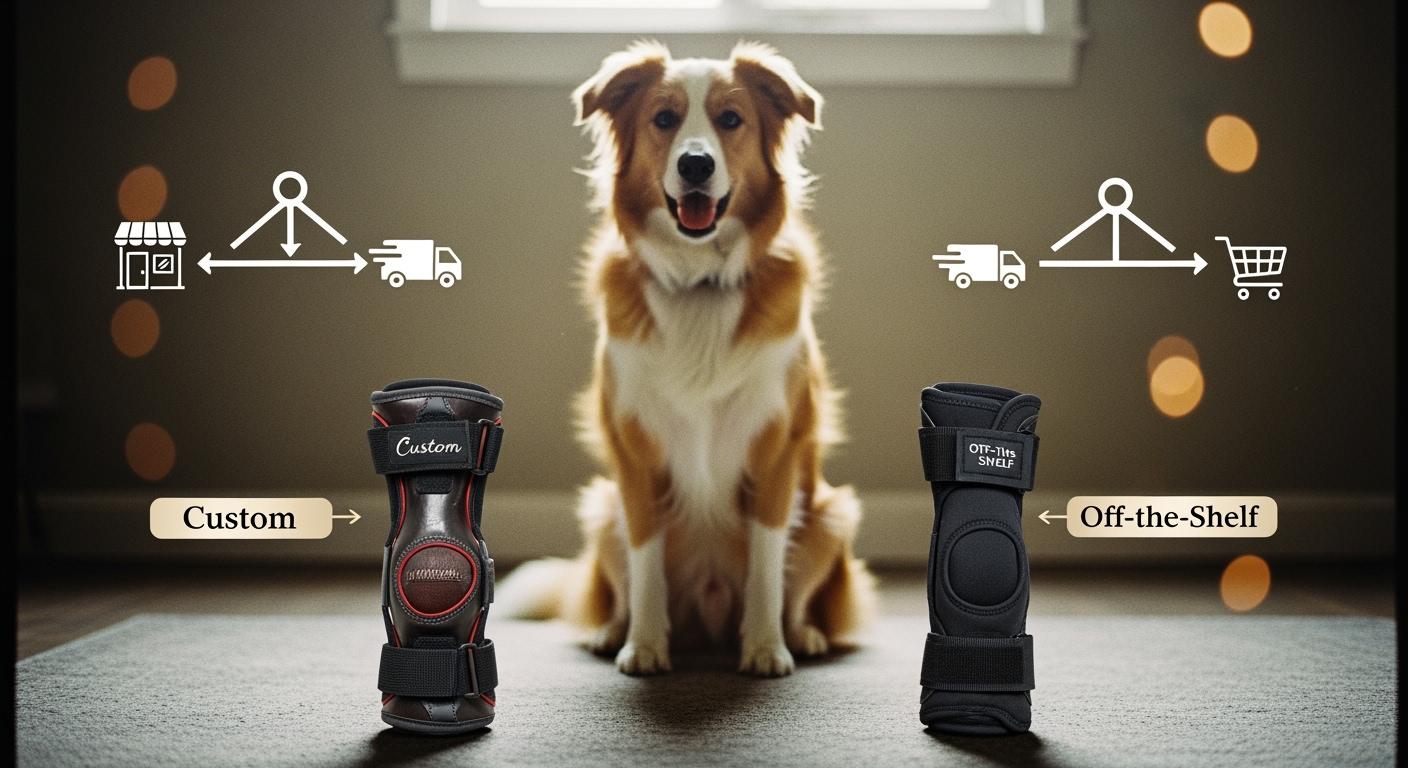
A brand or private-label buyer evaluating whether to offer custom dog knee braces, off-the-shelf braces, or both faces a set of product-development and supply-chain trade-offs that go well beyond unit cost. The choice affects the size system, sample workflow, inventory model, channel positioning, and the type of supplier relationship the brand needs — and each route carries different risks at different stages of the product lifecycle.
Custom knee brace programs rely on individual measurements, casting, or scanning to produce a brace matched to a single dog’s anatomy. Each order generates a unique pattern. This route supports premium private-label positioning and veterinary-channel credibility but introduces a made-to-order fulfillment model with longer coordination cycles and heavier technical-support demands. Off-the-shelf braces use standardized size grading and published measurement charts, letting brands stock SKUs, forecast size mixes, and replenish through wholesale channels. The trade-off is fit coverage: graded sizes work for dogs within the published measurement range but may not cover dogs whose limb proportions fall outside that range. A hybrid route — standard SKUs for routine sales plus a custom inquiry path for out-of-range measurements — lets a brand test demand with manageable inventory while retaining an individual fit-development route.
| Decision Area | Custom Brace | Off-the-Shelf Brace | Hybrid Route | Key Supplier Evidence |
|---|---|---|---|---|
| Size System | Individual pattern per dog | Graded sizes for broad coverage | Standard SKUs + custom inquiry | Size grading logic, sample consistency across sizes |
| Development Complexity | High — custom pattern, revision cycles | Moderate — size grading, tooling | Moderate to high | Revision workflow, design rationale per size |
| Inventory Model | Made-to-order, lower finished-goods stock | Stocked SKUs, demand forecasting | Mixed — stocked standards, made-to-order customs | Batch repeatability, delivery reliability |
| Customization Depth | Individualized — structure, materials, fit | Limited — standard options | Custom path for out-of-range fit | Material traceability, hinge and strap QC records |
| Channel Fit | Veterinary, premium private-label | Retail, wholesale, marketplace | Veterinary + retail | Channel documentation, support-claim evidence |
How the Custom-vs-Standard Decision Shapes a Knee Brace Product Line
The route a brand selects determines more than whether each brace is made to a custom pattern or pulled from a finished-goods shelf. It sets the size-system logic the supplier must support, the sample-approval workflow the brand must manage, the inventory and fulfillment model the operations team inherits, and the claims the brand can safely make in each channel.
For a custom program, every order starts with a measurement set or cast. The supplier builds a brace to that individual anatomy, positioning hinge axes, strap anchors, and shell contours to match one dog’s stifle joint. This model suits premium private-label lines and veterinary rehabilitation distribution, where the end buyer expects documentation of fit and joint alignment. But it also means the brand carries the fitting-coordination burden: inaccurate measurements, unclear revision feedback, or a supplier that cannot translate a cast into consistent brace geometry all create downstream problems that are difficult to isolate after the fact.
For a standard program, the brand stocks graded SKUs and the buyer selects from a published size chart. This model scales across retail and marketplace channels with faster replenishment and lower per-unit handling. The brand’s main exposure is fit coverage. A size chart using a single circumference measurement groups dogs with different leg lengths and joint positions into the same SKU. If the supplier’s grading logic does not account for how proportions shift at the extremes of the range, the brand inherits sizing-related returns or customer-support load that a custom program would route through revision rather than replacement.
The hybrid route addresses this tension by keeping standard SKUs for dogs that fall within the published grade range and maintaining a custom inquiry path for measurements or limb proportions outside that range. This structure lets a brand launch with manageable inventory and add custom capability as channel feedback identifies where standard sizing underperforms. Brands should define the split using their own fit records, size-distribution data, and channel feedback rather than assuming a fixed market-coverage percentage. The trade-off is operational: the brand must maintain two fulfillment workflows and two sets of supplier quality expectations.
Size Systems, Joint Alignment, and Structural Differences That Affect Development
Standard braces face a different version of this problem. The hinge position is fixed per size grade. Within any given SKU, dogs with the same thigh circumference may have stifle joints at different heights relative to the brace shell. The causal chain is straightforward: single-measurement size chart → variable hinge-to-joint relationship within one SKU → less consistent brace tracking across dogs assigned to the same size → difficulty separating measurement error from a limitation in the grade. This can increase fit-related support issues even when the customer followed the published chart.
Strap routing compounds this. Custom braces allow strap anchor positions to follow the individual dog’s leg contour, helping the design avoid concentrated contact near prominent areas while maintaining suspension without excessive tightening. Off-the-shelf braces use fixed anchor points. A brand evaluating a standard program should inspect samples at multiple points in the size range — not only the medium — to confirm that strap placement remains workable as limb length and circumference change. A strap that sits correctly on the fit-model dog may move toward a joint crease on a dog with the same circumference but a shorter femur.
Pressure distribution and skin-contact zones matter for both routes but are managed differently. A custom program lets the brand specify padding thickness, edge finishing, and shell contour per dog. A standard program relies on the supplier’s default padding pattern. In either case, the brand should verify during sample review that seams do not align with bony landmarks, strap edges do not dig in under tension, and the inner liner holds its position rather than bunching during repeated flexion.
Supplier Evaluation Criteria for Custom Knee Brace Programs
Structural design rationale. Ask the supplier to walk through hinge placement for two sizes at opposite ends of the range — say, a small-breed stifle and a large-breed stifle. A capable supplier references joint landmarks and explains where the grading logic adjusts, not just where it scales. A supplier that describes the same template applied to all sizes with a uniform multiplier is signaling that their process may not account for how limb geometry changes across breeds and weights.
Material specification and traceability. The supplier should provide material spec sheets with batch identifiers. Generic descriptions — “neoprene panel,” “elastic strap” — without grade, thickness, or supplier origin make it difficult to trace a comfort or durability issue back to a specific material lot. If a brand later needs to substitute a material, batch traceability is the difference between a controlled change and a blind one.
Sample revision workflow. A custom program depends on a defined sample-approval loop. The brand provides measurements or casts; the supplier produces a sample; the brand checks fit, joint alignment, strap placement, and edge finishing; the supplier revises. A supplier that cannot describe how many revision rounds are standard, what triggers a new cast request, or what documentation accompanies each revision is unprepared for a program where every order is effectively a new product.
Hinge and assembly QC. Inspect hinge movement for smooth articulation without lateral play. Check that stitching around hinge mounts and strap anchors is reinforced and consistent. Ask whether custom orders are produced by a dedicated team or distributed across the same lines as standard production — distributed custom work introduces variability that is harder to audit than in standardized runs.
| Capability Area | What to Verify | Signal of Strength | Signal of Risk |
|---|---|---|---|
| Structural design rationale | Can the supplier explain hinge placement per size? | References joint landmarks and grading adjustments | Uses the same template for all sizes |
| Material specification | Are materials documented with batch traceability? | Provides spec sheets with batch records | Describes materials in generic terms only |
| Size grading methodology | Does grading logic hold across breed types? | Identifies where linear scaling breaks down | Applies uniform multiplier to all size steps |
| Sample revision process | How are revisions structured and documented? | Defined workflow with fit records per revision | No structured revision process |
These checks apply whether the brand is evaluating a new supplier for its first custom program or auditing an existing partner before expanding SKUs. A supplier that can explain these controls clearly is easier to evaluate during sampling and production planning. For a closer look at how custom and off-the-shelf routes compare across specific injury applications, see our breakdown of custom and standard CCL brace fit considerations and the ACL brace selection for individual injury applications. Buyers moving from product-route analysis to supplier screening can also review GaitGuard’s custom dog brace manufacturing support for pet brands.
Evidence Boundaries and Support Claims by Product Route
Published evidence on canine stifle orthoses remains limited. A 2016 retrospective study of 10 dogs evaluated weight bearing at baseline and at 90 days or more after custom stifle orthosis placement. A 2025 study followed only two dogs for 32 days and reported changes in weight distribution and owner-assessed function; one dog also received additional conservative therapies, making it difficult to isolate the orthosis effect. These findings are directional, not proof that custom braces outperform all size-graded braces or produce the same result across patients. Direct head-to-head comparisons between custom and off-the-shelf routes remain limited, so product claims should not be built from these studies alone.
Reported issues across orthosis use can include skin irritation, mechanical problems, limited tolerance, or refusal of the device. These risks can occur in either route, but the product-development questions differ. In a custom program, the brand should examine measurement accuracy, contouring, padding specification, and revision records. In a standard program, the brand should examine size-chart coverage, fixed strap positions, and whether the grade remains aligned across different limb proportions.
Support claims should match the product route and stay within verifiable boundaries. A custom brace program can reference an individual measurement process, documented fit adjustments, and a defined revision path when those steps are actually part of the service. A standard brace program can reference published size coverage, repeatable SKU availability, and the support structure confirmed during sample review. Neither route should claim to cure, heal, replace veterinary diagnosis, or guarantee an outcome. Customer-facing claims should reflect what the product specification and sample-validation process confirmed, not what the wider product category is assumed to deliver.
Disclaimer: Standard size grading may not accommodate dogs with angular limb deformities or body proportions outside the pattern range. Brands should define these limits in customer-facing sizing materials and train support staff to identify cases that may require a custom route before purchase.
| Product Route | Appropriate Support Claims | Required Validation |
|---|---|---|
| Custom Brace | Individualized fit process and documented adjustment route | Measurement protocol, sample approval records, fit documentation, revision records |
| Off-the-Shelf Brace | Published size coverage and repeatable standard-SKU availability | Size grading documentation, multi-size sample review, batch consistency records |
| Hybrid Route | Standard grade coverage with a defined custom referral path | Standard-SKU validation plus documented criteria for routing out-of-range cases |
From Product-Route Decision to RFQ Requirements
Before sending an RFQ to a custom knee brace supplier, a brand should resolve three internal decisions that shape every specification that follows.
Target channel and brace structure. A veterinary rehabilitation channel requires different documentation, support materials, and product-boundary definitions than a marketplace or DTC channel. The channel affects structure selection: a hinged product positioned for clinician-led fitting requires different hinge specifications, measurement documentation, and support materials than a semi-rigid standard SKU intended for general retail distribution. Define the primary channel and the corresponding structure requirements before the supplier conversation begins — retrofitting structure to channel after samples are produced adds cost and time.
Development route commitment. Lock in custom-only, standard-only, or hybrid before the RFQ. The route determines the size-system requirements, sample workflow, and the supplier capabilities the brand needs to verify. A brand that sends an RFQ without committing to a route gets back responses built on the supplier’s default assumptions — which may not match the brand’s actual program needs.
Specification documentation. A complete RFQ for a knee brace program covers: size range and grading logic (or measurement protocol for custom), material preferences and acceptable substitutes, hinge type and placement tolerances, strap layout and anchor positions, padding specification and edge finishing, branding and packaging requirements, and target order volume. The more precisely these are defined before supplier conversations, the more directly the supplier’s response reveals whether they understand the product category rather than returning a generic quotation. For product-level context before the RFQ, review the knee brace stability and recovery support solution overview.
The RFQ should also state which dimensions require sample confirmation before production approval. Joint alignment, strap tension under load, padding contact zones, and edge finishing are typically non-negotiable checkpoints regardless of route. A supplier’s willingness to document these checkpoints — and their ability to describe what acceptable variance looks like for each — is itself a useful evaluation signal before any purchase commitment is made.
Brands that invest the time to define these parameters before seeking quotes reduce the likelihood of discovering structural mismatches after samples arrive. The goal is not to eliminate all variables — custom manufacturing always involves iteration — but to ensure that the variables the brand and supplier are iterating on are the right ones: fit, alignment, and material performance, not fundamental disagreements about what the product is supposed to be.