
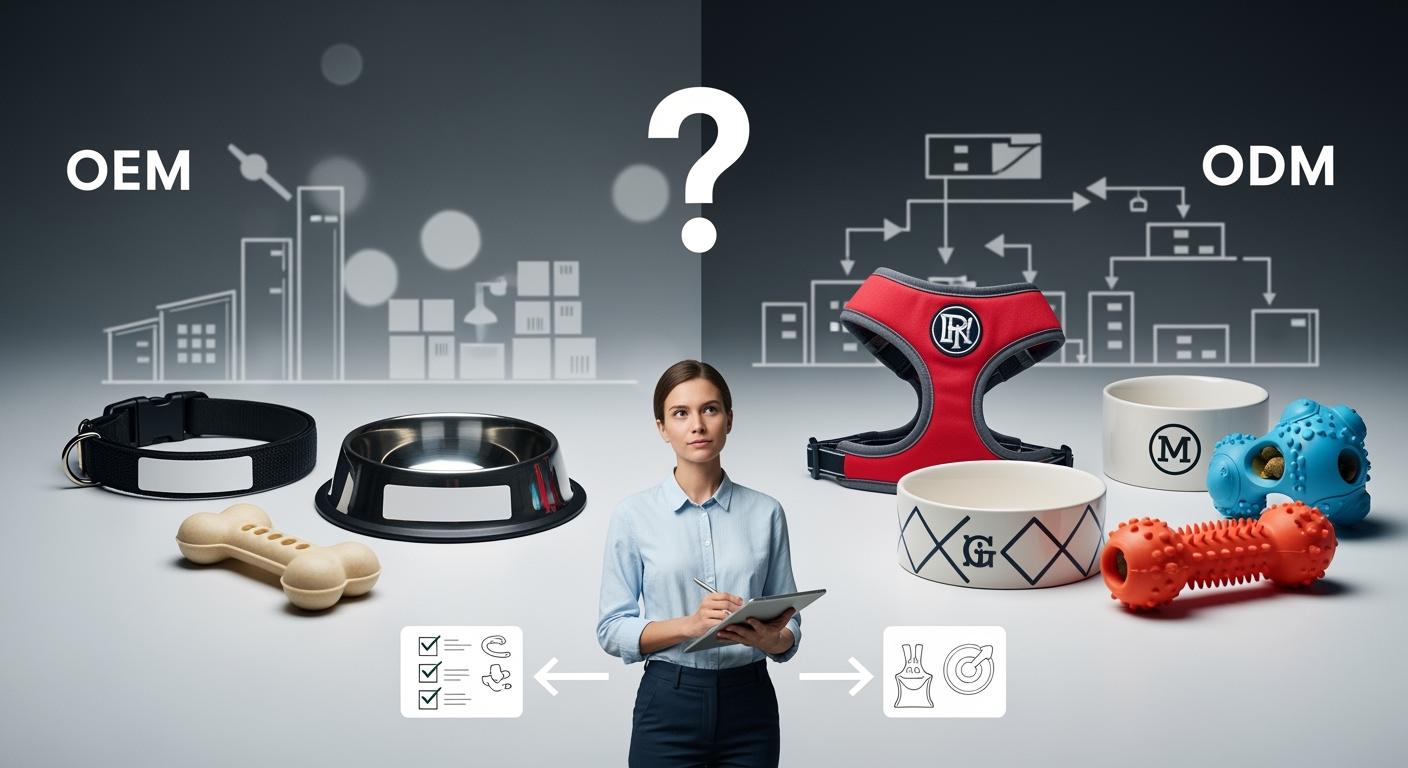
When a brand decides to add a dog knee brace, lift harness, or recovery sleeve to its product line, the first operational question is not which supplier to call. It is which manufacturing model fits the product as it exists today. A brand that already owns a finished brace design, complete with material specs and a size chart, needs something different from a brand that has identified a market gap but has no technical drawings. Choosing between OEM, ODM, and private label for OEM pet products is less about terminology than about product maturity, required customization, and who will control the decisions that follow.
Product Maturity Sets the Direction
Sourcing decisions become clearer when measured against a single variable: how finished the product definition is before the supplier gets involved.
If a brand holds a complete product package — engineering drawings, material callouts, a validated size chart, reference samples, and defined acceptance criteria — the OEM model is the natural fit. The manufacturer’s role is to adapt that package for production, source the specified materials, build tooling, and reproduce the design at scale. The brand retains control over what the product is. The supplier controls how it gets made. This model works for dog braces where the brand has already proven a structure through earlier sampling or a previous production run and now needs a partner that can execute faithfully, batch after batch.
When the brand has a clear commercial target but no finished product definition — a specific condition to address, a channel to serve, a price position to hit — the ODM model shifts more of the development workload to the supplier. The brand defines the intended use, the target user, and the product’s acceptable-use boundary. The supplier proposes the structure, materials, and size system. The brand reviews and approves. This model suits a company entering a new category — an IVDD support product, for instance — where internal development resources are unavailable but the commercial opportunity is clear.
Private label occupies the far end of the spectrum: the product already exists. The brand selects a catalog item, adds its logo and packaging, and moves to market. This is not a development model. It is a branding and speed play. For wholesale buyers testing a new channel or filling a seasonal gap, private label reduces buyer-side development work and upfront investment, but it also limits control over product structure, sizing logic, and differentiation.
The table below maps product maturity to the most practical starting point:
| What the Brand Has | What the Supplier Must Do | Usually a Better Fit |
|---|---|---|
| Finished drawings, material specs, validated size chart, reference sample | Adapt for mass production, source materials, build tooling, reproduce at scale | OEM |
| Market brief, target user, price position, channel plan | Develop structure, propose materials, build size system, produce samples | ODM |
| Channel need, target price, branding requirements | Supply existing product with logo and custom packaging | Private Label |
| Partial drawings, reference samples, specific material or sizing requirements not met by either standard OEM or ODM | Co-develop structure, refine size logic, adapt materials against existing platform | Hybrid |
A common mistake is to start with the model label and try to make the product fit it. Suppliers do not always use OEM and ODM consistently — some call any logo-on-product arrangement OEM, regardless of who designed it. The more reliable approach is to audit what the brand already owns, identify what must still be developed, and let that gap determine the sourcing structure. That audit — covering drawings, samples, material specifications, size charts, packaging artwork, and test criteria — also surfaces what a sourcing manager needs to protect before handing anything to a factory.
Customization Depth: Logo Changes vs. Structural Decisions
Not all customization carries the same development weight. Understanding the difference between surface-level changes and structural changes determines how long sampling takes, how many revision rounds are realistic, and whether the brand is truly differentiating its product or just decorating an existing one.
Low-depth customization covers branding and presentation: logo application method, packaging design, hangtags, insert cards, label copy. These changes do not alter how the product functions or fits. They add workload to artwork approval and packaging sampling, but they do not trigger structural re-validation. Most private-label programs operate entirely within this layer.
Mid-depth customization introduces material substitutions, color changes, strap layout adjustments, or modified lining choices. These changes can affect how a dog brace holds position on the leg, how a lift harness distributes pressure, or whether a recovery sleeve retains its shape after washing. Each substitution should trigger a new sample round — not just to confirm appearance, but to verify that the change did not shift the product’s functional behavior. A neoprene swap that looks equivalent on a spec sheet may stretch differently under load or stiffen differently when wet.
Deep customization covers structural decisions: altering the hinge angle on a knee brace, redesigning the strap layout to reduce rotation, developing a new size chart for a different breed profile, or changing the support level from light stabilization to active joint constraint. These changes redefine what the product is. They require new patterns, new size validation, and often new tooling. This is the layer where OEM and ODM diverge most clearly: in OEM, the brand specifies the structure; in ODM, the supplier proposes or adapts it. Structural changes are usually outside a standard private-label program and may move the project into ODM or co-development.
For a sourcing manager evaluating a potential supplier, one quick signal is whether the supplier can distinguish between these layers in conversation. A supplier that treats a strap-angle change the same way it treats a logo color change — “no problem, we’ll handle it” — may not understand what that change does to the product’s performance on a dog in motion. The right supplier asks which revision rounds are structural and which are cosmetic, and builds the sampling timeline accordingly.
Ownership, Samples, and Change Control
Three areas create most of the tension in contract manufacturing relationships: who owns what, what happens during sampling, and what changes without written approval.
Design files and intellectual property. In OEM, the brand typically owns the product design because the brand supplied it. Newly created production files — pattern adaptations, mold designs, tooling modifications — may or may not transfer to the brand depending on what the contract states. In ODM, the supplier usually owns the product design and the development files; the brand owns the commercial relationship and its trademark. Private label gives the brand no IP in the product itself. Before the first sample is cut, the ownership of background IP (what each party brought in) and foreground IP (what gets created during development) should be committed to writing. This is especially relevant when a brand wants to move a product from ODM to OEM later, or take a design to a second factory.
Sampling sequence. A reliable sampling process for a dog brace or harness moves through at least three stages: a construction sample that proves the basic pattern and material combination works, one or more revised samples that incorporate feedback on fit and function, and a golden sample that freezes the specification for production. The golden sample is not just a reference for appearance. For a knee brace, it should confirm that the hinge aligns with the intended joint position across the size range. For a lift harness, it should confirm that load-bearing points sit where the design intended. Bypassing these checks because a single size looked acceptable is a recurring source of batch-to-batch drift.
Change control. After the golden sample is approved, any change to material, structure, stitching, component source, or packaging should require written approval from the brand. This sounds procedural, but in practice it is what prevents a factory from substituting a lining fabric because the original was out of stock — a substitution that may go unnoticed until a distributor reports that the product no longer fits the same way. The table below summarizes how ownership and control responsibilities shift across models:
| Decision Area | OEM | ODM | Private Label |
|---|---|---|---|
| Product design ownership | Brand owns | Supplier typically owns | Supplier owns |
| Production file ownership | Negotiable; defined in contract | Supplier typically owns | Supplier owns |
| Sampling workload | Brand drives; high involvement | Supplier leads; brand reviews | Minimal; branding only |
| Change control authority | Brand holds final approval | Shared; brand approves structural changes | Supplier controls product; brand controls packaging |
| Batch-to-batch verification | Brand-defined specs and tolerances | Supplier-defined; brand monitors | Supplier-defined and monitored |
In practice: Before signing a sampling agreement, ask the supplier to walk through what happens when a material is backordered mid-production. The answer reveals more about their change-control discipline than any quality manual.
Brand Stage and Sales Channel Considerations

The right model also depends on where the brand sits and where it sells.
A brand still validating whether a canine rehab product line has channel traction may be better served by private label or ODM: lower upfront investment, shorter time to first order, and the ability to test market response before committing to structural development. A brand that already sells into veterinary or rehab channels and needs to defend shelf position typically benefits from OEM: the control over structure, materials, and size logic becomes a competitive barrier rather than a cost.
The sales channel also shapes the decision. An Amazon or DTC brand competing on visible product features needs differentiation that customers can see and compare — strap layout, material feel, hinge design, size-range coverage. Meaningful control over those features usually requires OEM or deeper ODM development; a standard private-label catalog product offers less structural differentiation. A distributor selling into veterinary clinics needs product consistency, clear product-type boundaries, and supply stability more than it needs visual novelty. For that channel, a well-chosen ODM product with reliable batch consistency may deliver more commercial value than a fully custom OEM design that adds SKU complexity without improving clinic adoption.
There is also a practical sequencing pattern. Brands often start with private label on one or two SKUs to establish channel presence, shift to ODM as they identify which product categories justify deeper investment, and move selected products to OEM once they own enough market data and customer feedback to specify a differentiated design with confidence. Each transition changes the supplier relationship — and each transition requires revisiting the ownership, sampling, and change-control terms described above.
What to Prepare Before Approaching a Supplier
Regardless of which model a brand selects, approaching a supplier without a structured brief increases the likelihood of miscommunication during sampling. An OEM-ready project normally requires a sufficiently mature specification package, reference sample, or tech pack before production execution. An ODM or co-development project may begin with a structured brief and turn that brief into approved product specifications through sampling.
At minimum, a sourcing brief for canine orthopedic or mobility products should cover:
- The condition or use scenario the product is meant to address, and what the product should not claim to do;
- The target size range, including whether small-breed and large-breed versions need separate patterns;
- Which materials or material properties are non-negotiable and which are open to supplier suggestion;
- The intended support level — light stabilization, active joint constraint, or post-operative protection — and the structural features that define it;
- Branding and packaging requirements, separated into cosmetic (logo, color, box design) and functional (size-chart inserts, wear instructions, warning labels);
- Whether the brand or the supplier is responsible for compliance documentation in the target market.
One of the most valuable things a brand can bring to the first supplier conversation is a clear statement of what the product is not. Defining the product’s boundary — this brace is not intended for dogs above a certain weight, this harness is not designed for unsupervised use, this sleeve is not a substitute for a rigid cone in surgical wound protection — protects both the brand and the manufacturer from downstream complaints rooted in off-label use. It also signals to the supplier that the brand understands the difference between a product feature and a medical claim, which matters when evaluating rehab products for professional channels.
Sourcing note: A supplier that never asks about product boundaries or acceptable-use limits — that only wants to talk about MOQ, price, and lead time — may not be equipped to support a brand that sells into channels where product failure has clinical or reputational consequences.
Brands that arrive at the first conversation having already separated what they own from what they need built are the ones that get accurate timelines, realistic MOQ guidance, and sampling schedules that reflect the actual development work involved — rather than generic promises that collapse under the weight of unresolved decisions later.
Brands that need supplier input on product adaptation, material direction, sizing logic, strap layout, or sample development can review the OEM/ODM pet orthotics project scope before preparing an RFQ.
FAQ
How do I know whether my product is ready for OEM or still needs ODM-level development?
If you can hand a supplier a complete size chart with measurement points defined, material specifications with tolerance expectations, and a reference sample whose structure you want reproduced — the product is OEM-ready. If you are still defining which measurements matter or what support level the structure should deliver, the product needs ODM-level development first. The gap is not about how many drawings you have; it is about whether the product’s functional requirements are stable enough to freeze before tooling begins.
What is the most common sourcing mistake brands make when moving from private label to OEM?
Underestimating the sample workload. In private label, the brand usually approves branding and packaging around a supplier-defined product. The product may already be in production, but the buyer still needs to verify its fit logic, quality consistency, channel suitability, and claim boundaries.
In OEM, the brand must approve structure, materials, fit across every size in the range, and final packaging. Brands that budget the same timeline and revision tolerance for OEM as they did for private label often rush the golden-sample stage, locking in specifications that have not been validated across the full size range — a decision that surfaces later as batch inconsistency or fit complaints.
The manufacturing model is not a supplier feature. It is a structure for dividing development, ownership, and production responsibility between a brand and a factory. The right model is the one that matches how much of the product already exists, how deeply the brand needs to control what gets built, and how the finished product will be sold.
