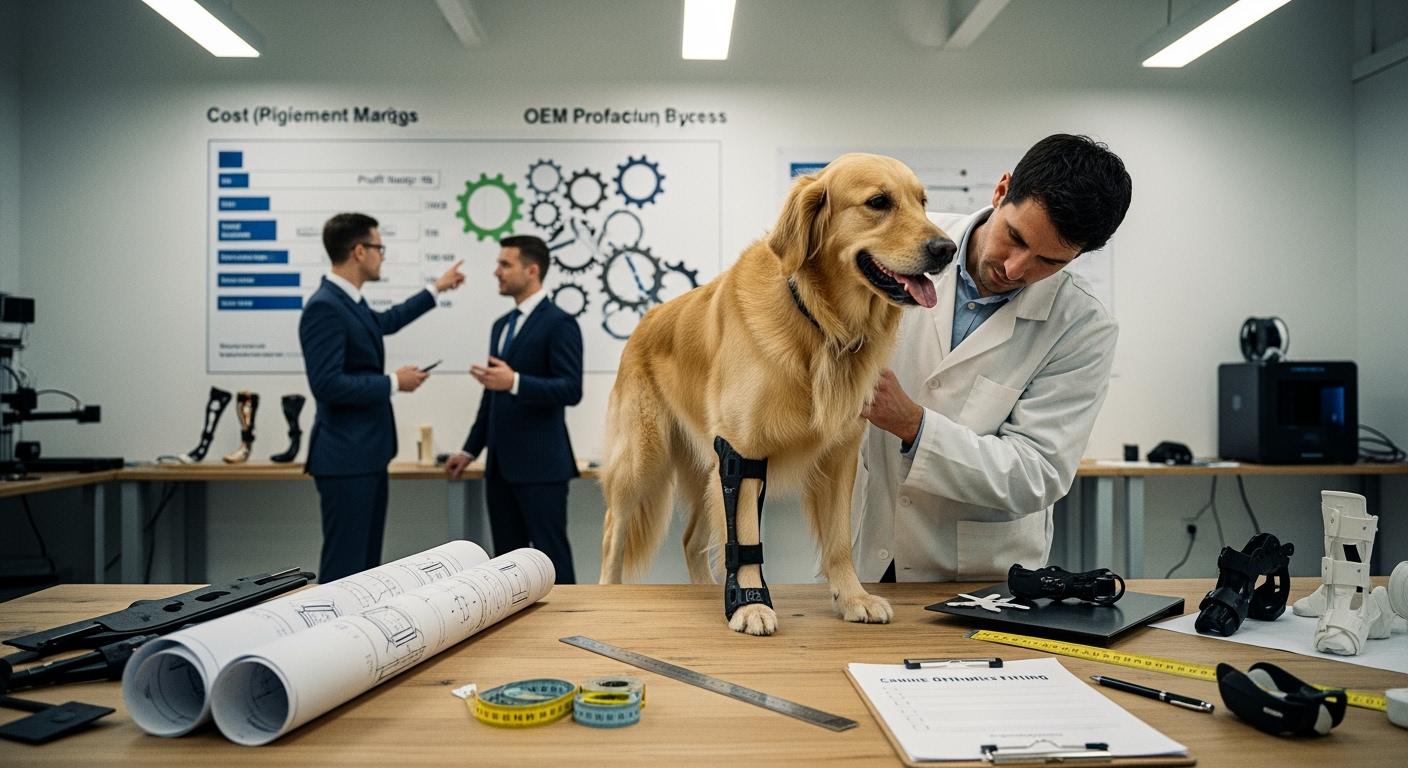
When a brand decides to add custom dog braces to its product line, the first question is rarely “how much does one brace cost.” The real question is: what drives the total project cost, which costs are one-time, and which recur with every order. Answering that requires defining the product before requesting a quote. Without a structured specification, suppliers return numbers that cannot be compared — and brands absorb the risk of hidden charges, scope mismatches, and rework later in development.
This article maps the eight cost drivers that shape every custom dog brace project and explains how to build an RFQ that returns comparable, decision-ready supplier quotes.
The Eight Cost Drivers That Shape a Custom Brace Quote
Suppliers cannot quote accurately from a product name or a photo. A “dog knee brace” can mean a soft wrap, a hinged support, or a rigid orthotic — each with different materials, hardware, and manufacturing steps. The cost difference between these structures is significant, and it compounds when factoring in size range, branding, packaging, and quality control requirements.
Eight factors drive the total project cost. Each one represents a decision the brand must make before comparing suppliers:
| Cost Driver | What the Brand Decides | How It Affects Cost | What to Request from the Supplier |
|---|---|---|---|
| Product structure and support level | Soft, hinged, rigid, or hybrid brace | More structure or features add material and labor | Drawings, BOM, sample references |
| Material and component specification | Type and grade of foam, textile, hardware | Premium or custom materials raise unit cost | Material list, supplier declarations |
| Standard sizing vs. custom fitting | Number of sizes, custom patterns or molds | More sizes or custom fit increase pattern work and inventory complexity | Size chart, grading files, sample set |
| Pattern, mold, and tooling development | New patterns, molds, dies, digital models | New tooling or revisions add one-time charges | CAD files, tooling list, revision log |
| MOQ, order quantity, and size mix | Total units, size breakdown, colorways | Small runs or fragmented size/color splits raise per-unit cost | Order plan, color chart, size matrix |
| Logo, labels, instructions, packaging | Custom branding, inserts, retail packaging | Custom packaging and inserts add setup and per-unit cost | Packaging mockup, dielines, print proof |
| Sampling, testing, inspection, documentation | Number of samples, QC scope, compliance docs | More samples, tests, or documentation requirements add cost | Sample log, inspection plan, doc checklist |
| Delivery terms, freight, duties, replenishment | EXW, FOB, DDP, urgent orders, warehousing | Freight, duties, and rush orders add landed cost | Freight quote, duty estimate, lead time |
These drivers interact. A decision about product structure affects the size grading approach, which affects tooling requirements, which in turn affects MOQ feasibility. Brands that define all eight before sending an RFQ gain two things: quotes that can be compared line by line, and a clear view of where cost can be controlled without sacrificing product integrity.
In practice: One of the most common causes of quote variance across suppliers is that each factory fills in undefined specifications differently. Two suppliers may quote the same product name but assume different materials, support levels, or size counts. Submitting an identical, detailed specification to every supplier is the single most effective step toward comparable pricing.
Product Structure and How Support Level Changes Unit Cost
The support level a brand selects for its brace line is the single largest cost lever. A soft support wrap uses flexible materials, requires less tooling, and can often adapt to an existing supplier pattern with limited development work. A hinged brace introduces hardware — hinges, stays, reinforced anchor points — each adding component sourcing, validation, and assembly steps. A rigid or custom-molded orthotic requires molds, digital models, and more involved fitting geometry, which increases both one-time development cost and recurring unit cost.
Brands planning a dog brace product line should match the support level to the channel and the claims the product will carry. A soft brace positioned for mild support and daily wear can launch with a smaller SKU set and simpler material spec. A hinged or rigid brace intended for post-surgical or chronic-condition support demands more precise sizing, more sample iterations, and more documentation.
Hybrid structures — combining soft, hinged, and rigid elements — and replaceable components such as swappable liners or hinges introduce additional engineering and inventory complexity. Each replaceable part requires its own pattern, fit check, and spare-part planning. The unit cost rises, but so does the product’s differentiation in channels where end users expect longer product life and adjustable support.
Sample check: Before approving a pre-production sample for a hinged or rigid brace, confirm that the hinge axis aligns with the intended joint position across every size in the range. A hinge that aligns on a medium but shifts on a small or large is a grading issue, not a material issue — and it will surface in customer feedback as slipping or rubbing.
Materials, Tooling, and Development Costs
Material choices — foam density, textile grade, lining type, lamination — set both the unit cost baseline and the supply consistency risk. Standard-grade materials sourced from established supplier chains keep unit cost predictable and simplify reorders. Premium or custom-spec materials — a specific foam density, an antimicrobial lining, a proprietary textile — may improve product positioning but also narrow the supplier base and increase the impact of a material batch change.
Hardware adds a separate layer of cost and validation. Hinges, stays, buckles, and strap closures each require sourcing, compatibility testing with the brace body, and in many cases dedicated tooling. A brand that specifies a custom hinge design should expect a one-time tooling charge, a longer sample timeline, and additional inspection steps during production.
Tooling costs — patterns, molds, fixtures, cutting dies — are almost always one-time charges, but they are among the least understood items in a brace quote. A new mold for a rigid shell component is a fixed cost whether the brand orders 500 or 5,000 units. The per-unit impact, however, changes dramatically with order volume. Brands should also confirm tooling ownership in writing. Without a clear clause, the supplier may retain the right to reuse or modify the mold, which limits the brand’s ability to move production or enforce exclusivity.
Development costs accumulate through the revision cycle. Each pattern adjustment, material substitution, or size addition that occurs after the initial construction sample may trigger a new sample round and additional charges. Brands that limit the number of included revisions in the development agreement — and group changes into fewer, more deliberate revision rounds — keep this portion of the budget under control.
Sourcing note: Request a material declaration sheet and batch retention sample for every key material in the BOM. If a supplier cannot provide material traceability or pushes back on retaining approval samples, treat that as a signal that batch consistency may be difficult to enforce later.
MOQ, Size Mix, and Sample Workflow
Small production runs carry higher per-unit cost because setup, material preparation, and line changeover are largely fixed regardless of order size. When a brand orders 200 units, those fixed costs are spread across far fewer braces than a 2,000-unit run. This is why MOQ and unit price often move in opposite directions. Buyers should review the supplier’s dog brace MOQ and manufacturing cost framework before comparing unit prices, because an unusually low MOQ may be offset by a higher unit cost, narrower customization options, or a more limited production scope.
Size mix amplifies this effect. Every additional size in the range requires a separate pattern, separate grading, and separate inventory tracking. A four-size brace line has roughly twice the pattern and inventory complexity of a two-size line, even if total unit volume stays the same. Colorways add another multiplier: each new color may require separate production batches, separate quality checks, and separate packaging inventory. Brands launching a new brace line should consider starting with two to three sizes and one or two colorways, then expanding once channel demand data confirms which sizes and colors move.
The sample workflow is where cost control and quality assurance intersect. A typical custom brace project moves through three stages: a construction sample that proves the basic structure and material combination; a fitting or function sample that verifies the brace performs as intended across sizes; and a pre-production golden sample that becomes the reference standard for all bulk orders. Skipping or compressing these stages to save time often shifts cost downstream — into rework, inconsistent production, or product that does not match the approved reference.
For brands evaluating whether to proceed from pilot to full production, the golden sample serves a second purpose: it is the objective standard against which future batches can be measured. Without it, quality disputes become subjective. The sample workflow should therefore be priced and approved as a defined project stage rather than treated as an informal step before bulk production.
In production: A golden sample that looks correct on inspection but was never tested on dogs across the full size range can pass internal QC and still generate channel returns. Fit validation across sizes — not just on a single medium — should be part of the sample approval criteria.
Building an RFQ That Returns Comparable Quotes
A comparable quote starts with a consistent specification. Before contacting suppliers, the brand should define:
- The target joint, support level, and product structure.
- A preliminary bill of materials covering all foams, textiles, hardware, and closures.
- The size range, size mix, and colorways for the initial order.
- Logo placement, packaging type, and any insert or label requirements.
- Which components use existing supplier tooling and which require new development.
- The sample stages required, the inspection scope, and the documentation deliverables.
Suppliers should then return a quote that separates charges into four categories: one-time costs (patterns, molds, tooling, sample revisions), recurring unit costs (materials, labor, assembly, standard packaging), order-level costs (inspection, special packing, testing), and landed costs (freight, duties, brokerage). A quote that lumps these together makes it impossible to understand what drives the total or to compare suppliers on equal terms.
The table below is a framework for comparing supplier responses once the specification has been submitted:
| Quote Item | Supplier A | Supplier B | Supplier C | Included or Excluded | Buyer Follow-Up |
|---|---|---|---|---|---|
| Sample charge | |||||
| Pattern or development | |||||
| Tooling charge | |||||
| Unit price by size | |||||
| Packaging charge | |||||
| Inspection and testing | |||||
| Freight term | |||||
| Payment term | |||||
| Lead time | |||||
| Replacement responsibility |
Before making a supplier decision, brands should also confirm tooling ownership terms, whether the quoted MOQ applies per size or per total order, what the revision policy covers, and how material changes are communicated and approved. These dog brace manufacturer evaluation checks help buyers review whether a supplier can document specifications, samples, material controls, production review, and change management before price becomes the deciding factor.
For brands deciding between a fully custom brace and an adapted platform design, the choice should be weighed against channel requirements, target price point, expected size complexity, and the degree of product differentiation required. That product-route decision should be settled before the RFQ because it changes the scope of development, sampling, tooling, and recurring unit cost.
A clear specification, a consistent RFQ format, and a disciplined separation of one-time and recurring costs give brands control over the custom dog brace sourcing process. The eight cost drivers are not independent — each decision about structure shapes the material spec, which shapes the tooling requirement, which in turn affects the viable MOQ. Working through these interdependencies before contacting suppliers turns the quote process from a price comparison into a supplier evaluation.
FAQ
What should a brand include in an RFQ for custom dog braces?
At minimum: the target joint, support level, product structure, a preliminary bill of materials, the size range and size mix, colorways, logo and packaging requirements, sample stage expectations, inspection scope, and delivery terms. Submitting the same specification to every supplier is what makes quotes comparable.
How does adding features affect the quote?
Each addition — a new hinge design, an extra size, an additional colorway, a molded component, or another sample revision — may trigger new tooling, additional pattern work, updated documentation, or a separate production setup. The cost impact depends on whether the change uses existing supplier resources or requires new development.
Why separate one-time and recurring costs?
One-time costs (patterns, molds, tooling, sample revisions) are paid once and amortized over the product’s lifetime. Recurring costs (materials, labor, packaging) repeat with every order. Separating them allows brands to model total project cost at different order volumes and compare suppliers on a like-for-like basis. A quote that appears cheaper on unit price may carry higher one-time charges that change the total cost equation.