
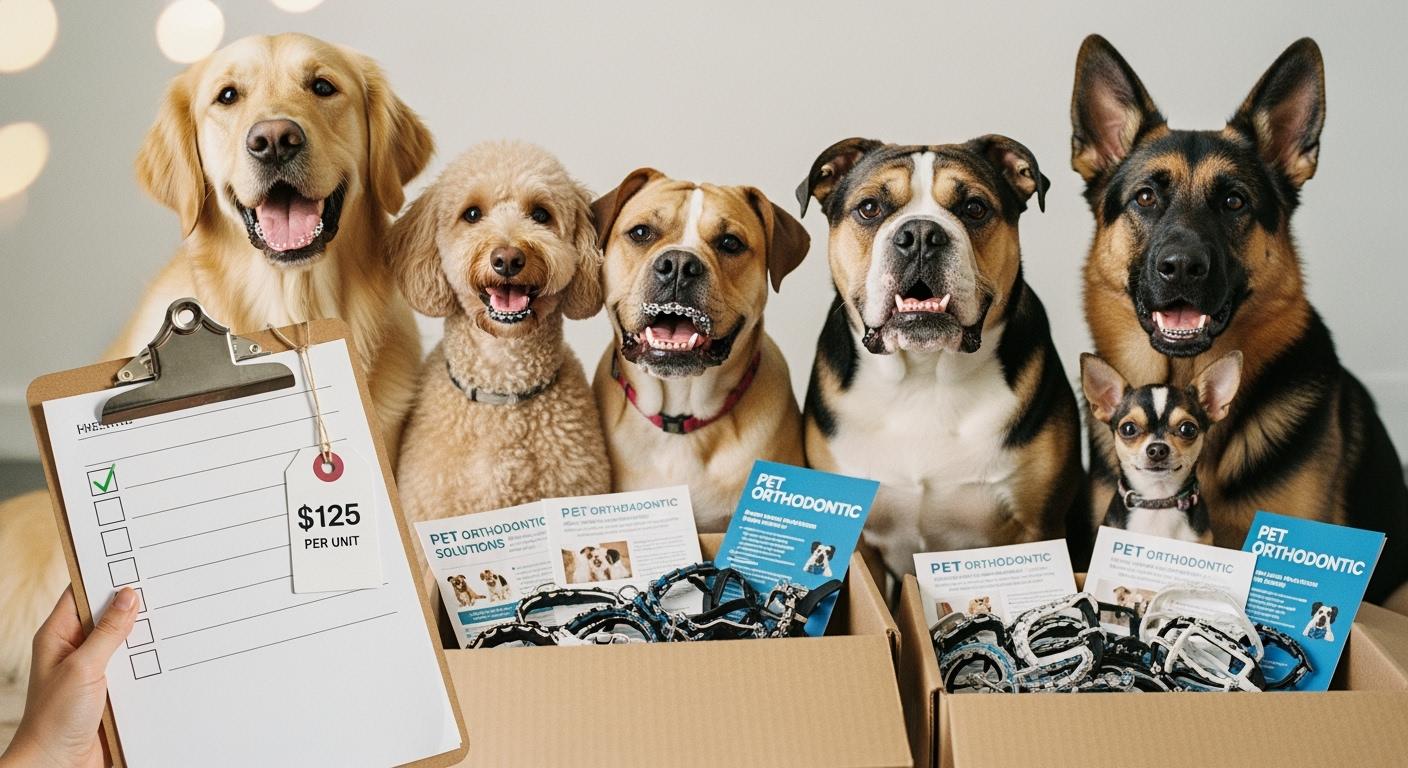
When sourcing dog braces wholesale, buyers often begin by comparing unit prices — then discover that MOQ, size mix constraints, and landed cost reshape the entire order. A quote that appears competitive on a per-piece basis can become less favorable once production minimums, freight, and duties are factored in. Understanding what drives each cost layer, and what should be confirmed before comparing supplier responses, helps buyers avoid orders that look viable on paper but create inventory, margin, or supply problems after placement.
What Drives MOQ — and What to Verify Before Comparing Quotes
Minimum order quantity is not a sales condition designed to push volume. It reflects the production economics of the category. For dog braces, MOQ is shaped by several interdependent factors that buyers benefit from understanding before they request quotes.
Material purchasing minimums set the first constraint. Brace production draws on fabric rolls, foam sheets, hinge hardware, hook-and-loop strapping, and edge binding — each sourced from suppliers with their own minimum order thresholds. If a single brace style combines three fabric types with two densities of neoprene or EVA foam, the total order must consume enough of each material to satisfy those upstream minimums. An order that meets the total-piece MOQ but spreads across too many SKUs may fall short on individual material draws.
Production setup adds a second layer. Cutting dies, pattern layouts, sewing station configuration, and assembly-line balancing are prepared per order. Short runs concentrate these fixed costs across fewer units, increasing the per-piece burden — or making the order uneconomical for the factory to accept regardless of the unit price offered.
Size and color combinations multiply complexity. An order of 500 pieces across five sizes averages 100 pieces per size. Adding two colors creates ten combinations at 50 pieces each. Each combination may require separate cutting runs, thread changes, and packing configurations. The effective MOQ applies at the production-combination level, not just the total order level. Buyers who understand this dynamic can plan assortments that balance channel coverage with production feasibility.
Custom components introduce their own thresholds. Branded labels, custom-printed packaging, proprietary buckle colors, or modified hinge geometries often require separate production runs with higher per-SKU minimums. These charges are not always visible in the initial unit price and should be confirmed as separate line items.
Inspection and order administration carry fixed costs that do not scale down with smaller orders. Quality sampling, batch documentation, and export paperwork represent a baseline workload regardless of order size.
| MOQ Driver | What It Affects | What Buyers Should Verify |
|---|---|---|
| Material purchasing minimums | Raw fabric, foam, and hardware availability per SKU | Whether the order volume covers all material types in the specification |
| Production setup and line preparation | Cutting, sewing, and assembly configuration | How setup cost is amortized across the order quantity |
| Size and color combinations | Number of production variants per order | Whether MOQ applies per combination, per SKU, or to the total order |
| Custom components and tooling | Labels, packaging, proprietary hardware | Separate minimums for branded or custom elements |
| Inspection and order administration | QC sampling, documentation, export processing | Which inspection and documentation costs are included in the unit price |
Sourcing note: Before comparing supplier quotes, confirm whether the MOQ applies to the total order, per SKU, or per size-color combination. Suppliers calculate this differently, and a lower per-unit price tied to a higher-combination MOQ may not represent better total value.
Why Size Mix Determines More Than Inventory Levels
How pieces are allocated across sizes affects MOQ feasibility, production cost, and sell-through risk. An equal split — the same quantity for every size — is straightforward to calculate, but it may not reflect the demand profile of a specific product or sales channel.
Demand-based allocation should be built from the buyer’s own channel data, comparable product history, or a documented market forecast. A universal size distribution should not be assumed across veterinary channels, online retail, regional distribution, and private-label programs because breed mix, product type, measurement logic, and customer profile can all change demand by size.
Buyers without reliable sell-through data can separate the range into provisional core and extended sizes, but that classification should remain a planning hypothesis until the first order produces actual SKU-level results. The initial assortment should therefore be reviewed against channel coverage, supplier minimums, and the cost of carrying slower-moving sizes rather than copied from a generic market ratio.
| Size-Planning Input | What Buyers Should Review | Ordering Decision |
|---|---|---|
| Existing sell-through | Units sold by size, product type, and channel | Allocate more volume only where actual demand supports it |
| Comparable product data | Size distribution from a similar brace or support product | Use as a starting point, not as confirmed demand |
| Channel coverage | Breed profile, body-size range, and customer segment | Confirm which sizes are necessary at launch |
| Supplier minimums | Minimum quantity per size, SKU, or production combination | Balance range coverage against production feasibility |
| Extended sizes | Expected demand for very small, giant, or atypical body types | Use conservative quantities until demand is validated |
Size mix also interacts directly with MOQ. A supplier may accept a total order quantity while still requiring a minimum production quantity for each size or SKU. When the forecast quantity for one size falls below that threshold, the buyer may need to adjust the allocation, reduce the initial size range, or confirm whether the supplier can combine material and production preparation across the order.
Replenishment planning depends on accurate size-level sell-through data. Tracking sales by SKU, size, and color across the first order cycle reveals which combinations reorder at different rates. This data informs reorder points, safety stock, and whether certain sizes justify larger batch quantities to reduce per-unit freight cost. Buyers should also examine how the supplier developed its measurement points and grade rules; the process for building a dog brace sizing system is more informative than a size chart that lists only weight or breed ranges.
In practice: Do not define core sizes from a generic market assumption. Use available channel data to build the first allocation, record sell-through by SKU, and revise the size mix after the initial order cycle.
Product Price, Landed Cost, and Why Trade Terms Matter
A factory unit price is not the cost of getting braces to a warehouse. The gap between product price and landed cost includes freight, insurance, duties, brokerage, and domestic delivery — each of which varies by order volume, destination, and the trade term under which the order is placed.
Trade terms define where specific costs, responsibilities, and risks transfer between supplier and buyer. EXW (Ex Works) places most transport responsibility on the buyer from the seller’s premises. FOB (Free on Board) applies to sea or inland-waterway transport and transfers risk once the goods are on board the vessel at the named port of shipment. FCA (Free Carrier) can be used when goods are delivered to a named carrier or terminal and is often more appropriate for containerized or multimodal shipments. Delivered terms vary by rule, so buyers should compare quotations only when the same Incoterms® 2020 rule and the same named place are used.
The cost layers of a wholesale brace order typically fall into four categories:
| Cost Layer | Included Items | Buyer Input Needed | Supplier Evidence | Common Exclusion |
|---|---|---|---|---|
| Product cost | Materials, components, labor, assembly | Product specification, size matrix | Material spec sheet, batch record | Freight, duties |
| Customization | Logo, labels, packaging, proprietary colors | Artwork files, packaging design | Pre-production sample, packaging proof | Domestic delivery |
| Order-level | Samples, inspection, documentation, packing | Inspection plan and criteria | QC report, sample record | Warehousing |
| Landed cost | Freight, insurance, duties, brokerage, delivery | Shipping address, preferred mode | Freight quote, HS code classification | Product warranty |
Duty rates deserve particular attention. They depend on product classification under the Harmonized System, country of origin, and applicable trade agreements. Using an outdated or estimated rate creates a meaningful gap between planned and actual landed cost. A licensed customs broker or freight forwarder provides the correct rate for each HS code — supplier estimates should not be relied on for this line item.
Buyers comparing supplier responses should request all quotations under the same trade term and separate each cost layer in their comparison. A quote that appears lower on unit price may be higher on landed cost once freight terms, documentation fees, and inspection charges are itemized. A structured dog brace manufacturer evaluation checklist can then be used to compare sizing evidence, material specifications, sample controls, MOQ allocation, quality checks, and quotation exclusions before price becomes the deciding factor.
Sourcing note: Request every quotation under the same Incoterms® 2020 rule and the same named place. FCA may be more suitable for containerized or multimodal shipments, while FOB applies only to sea or inland-waterway transport. Ask suppliers to itemize product cost, customization, inspection, packaging, and freight-related charges so that the comparison uses equivalent cost boundaries.
Lead Time Components: What Happens Before Production Starts
Production lead time does not begin when the purchase order is issued. It starts after sample approval, specification confirmation, and — depending on payment terms — deposit receipt. Buyers who plan inventory around the quoted production window without accounting for pre-production steps risk stock gaps that are difficult to close quickly.
The pre-production phase includes specification finalization, sample review, and material preparation. Samples should be requested in every size and material combination that will appear in the production order. A single sample in one size confirms workmanship for that size only — it does not validate that pattern grading, strap angles, and hinge positioning remain consistent across the full size range. Sample evaluation typically covers fit across sizes, material texture and thickness, stitching density and consistency, and closure hardware function.
Material and component preparation follows sample approval. Suppliers source fabric, foam, hardware, and packaging materials against the confirmed specification. Lead time during this phase depends on material availability, total order volume, and the number of custom components. Orders with proprietary colors, custom-printed labels, or non-stock hinge hardware require longer preparation than orders using standard materials.
Production, inspection, and packing follow material readiness. Buyers should confirm whether inspection occurs in-line during production, pre-shipment after completion, or both. Inspection scope should cover size grading accuracy, stitching consistency, hardware attachment security, and packaging conformity — not just visual appearance. A pre-shipment inspection report that documents findings against the approved specification gives the buyer an objective basis for acceptance before freight costs are committed.
| Phase | Typical Activities | Buyer Confirmation Needed |
|---|---|---|
| Specification and sample approval | Define SKU range, review materials, approve samples across sizes | Fit, material, stitching, and hardware verified for each size |
| Material and component preparation | Source fabric, foam, hardware, packaging to confirmed spec | Material specs match approved samples; custom components confirmed |
| Production and in-line inspection | Cut, sew, assemble, inspect during production | Inspection scope and sampling rate confirmed |
| Pre-shipment inspection and packing | Final QC check, pack, prepare export documentation | Inspection report received and reviewed before shipment release |
| Freight and delivery | Transit, customs clearance, domestic delivery | Freight timeline tracked separately from production timeline |
Freight time should be tracked independently from production lead time. Air freight may add days; ocean freight can add weeks depending on origin and destination ports. Customs clearance and domestic delivery add further time. When production and freight delays compound, the total gap between order placement and warehouse receipt can exceed the production window by a wide margin. Building both timelines separately into replenishment models prevents this compounding effect from causing stockouts.
Sample check: A sample that fits well in size medium does not confirm that the pattern grading works at size XS or XL. Before approving production, verify that strap placement, hinge alignment, and overall proportions remain consistent at both ends of the size range — not just at the center.
A wholesale dog brace order involves decisions that extend well beyond the unit price on a quotation. Buyers who understand MOQ drivers can plan size mixes that meet production minimums without building excess inventory in slow-moving sizes. Separating product price from landed cost prevents margin erosion from unaccounted freight, duties, and fees. Confirming what happens between sample approval and shipment — and treating freight time as independent from production lead time — supports accurate replenishment planning. Before requesting quotes, define the specification, size matrix, customization requirements, and preferred trade term so that every supplier response can be evaluated on the same basis. Buyers preparing a supplier-specific RFQ can use GaitGuard’s dog brace MOQ and manufacturing cost framework to confirm the current order threshold, quotation inputs, payment structure, and lead-time assumptions.
