
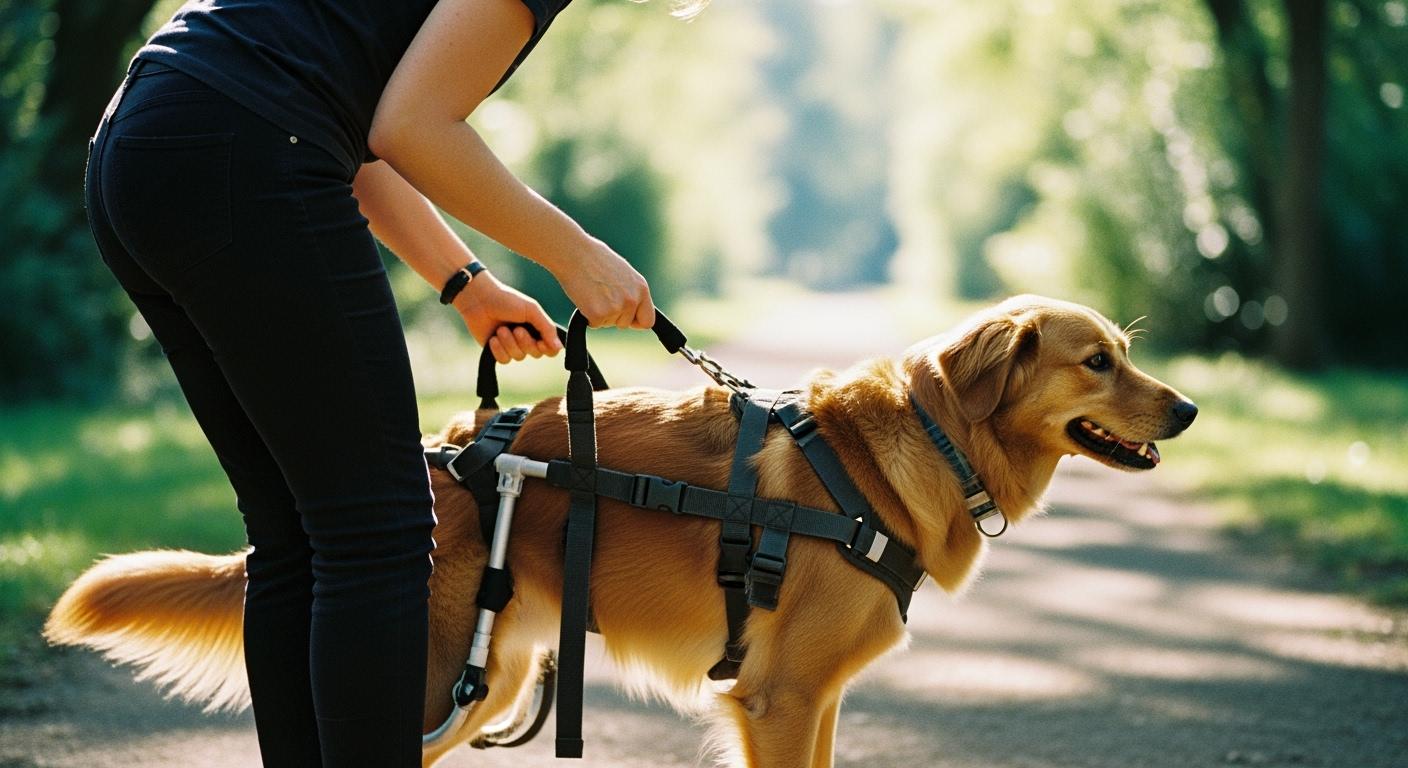
Brands and distributors adding a dog support harness line face a structural decision before any sample is made: which product routes belong in the range, and how each route’s design determines what the product can and cannot do. A rear-support harness built for rising from rest is not interchangeable with a full-body harness made for stair transfers. Getting this wrong at the product-definition stage creates SKUs that overlap in function, miss key use cases, or require constant customer explanation.
This article compares the four main dog support harness product routes—rear-support, front-support, full-body, and sling—across structural requirements, size-grading logic, and sample validation. It also covers what to request from a supplier to confirm that they understand the category beyond surface-level assembly.
Product Route Decision: Rear, Front, Full-Body, and Sling
Dog support harnesses are not a single product with cosmetic variations. Each route serves a different support zone and task profile. A brand planning a mobility support line needs to define which routes to include, what each route must structurally deliver, and where the boundaries sit before investing in samples.
The table below maps assistance tasks to the appropriate product route, the structural requirement that makes each route functional, and the main limitation a brand should document in customer-facing materials.
| Assistance Task | Support Area | Product Route | Required Structure | Main Limitation |
|---|---|---|---|---|
| Rising from rest | Rear | Rear-support | Padded pelvic contact zone | Limited front-limb lift |
| Short assisted walking | Rear or front | Rear- or front-support | Adjustable handles | May not suit full transfer |
| Toileting posture | Rear | Rear-support | Male-dog clearance | Not for long walks |
| Stairs or ramps | Full body | Full-body | Balanced lift points | Bulkier and requires handler training |
| Vehicle access | Full body | Full-body | Reinforced handles | May require two handlers |
| Full transfer or repositioning | Whole body | Full-body | Broad load distribution | Not for continuous walking |
Rear-support harnesses
Rear-support harnesses target hind-limb weakness, partial paralysis, or post-surgical recovery where the front limbs remain functional. The structural priority is load distribution across the pelvis and abdomen, supported by an adjustable handle position that lets the handler assist without twisting the dog’s spine.
In production, the main variables are the pelvic contact-zone shape, the handle attachment angle, and the clearance cut for male dogs. A rear-support harness that fits a deep-chested breed may pull forward on a narrower build, shifting pressure to the abdomen instead of distributing it. Brands evaluating samples should check whether the harness maintains its rear contact position across multiple body shapes within the same size grade—not just on one fit model.
For a deeper look at rear-lift versus full-body trade-offs, see the rear-lift and full-body support comparison.
Front-support harnesses
Front-support harnesses address forelimb weakness, shoulder instability, or post-operative front-limb protection. The handle must sit behind the shoulder to avoid restricting the shoulder joint during movement. Unlike rear harnesses, the chest fit and strap routing directly affect whether the dog can take a natural stride.
From a product-development standpoint, front-support harnesses present a narrower use window than rear or full-body routes. They are often purchased alongside another product in the range. Brands should evaluate whether a front-support SKU earns its place in the line or whether the same need is better covered by a well-designed full-body harness with front-accessible handles.
Full-body harnesses
Full-body harnesses provide multi-point weight distribution across the chest and pelvis for dogs with generalized weakness, multi-limb instability, or conditions requiring balanced handler control during stairs, ramps, and vehicle transfers. The structural complexity is higher: both chest and pelvic strap systems must work together without one set pulling the other out of position.
Full-body harnesses are the most demanding route to size correctly. Each additional strap adds an adjustment point, but also adds a potential failure point if the sizing logic does not account for the relationship between chest girth and pelvic girth. A brand moving into full-body harnesses should expect longer sample rounds and more detailed size charts than for single-zone products. The full-body lift harness fit guide covers the key adjustment points and sizing variables in more detail.
Slings and their limits in a product range
A simple sling—a padded band placed under the abdomen or chest—is the most basic entry in a mobility support range. It can handle short-duration tasks such as rising, brief repositioning, and toileting support. It packs flat, stores easily, and carries a lower unit cost.
However, a sling does not anchor to the dog’s body, provides no rotational stability, and relies entirely on the handler’s grip for control. In a product line, a sling works as an entry-level or complementary SKU, not as a replacement for structured rear or full-body harnesses. Brands adding a sling should define which tasks it covers and which it explicitly does not, then communicate those boundaries in product documentation and channel training.
For a comparison of sling versus harness use cases, see the support sling versus lift harness comparison.
In production: A sling’s simplicity does not eliminate quality risk. The load-bearing seam between the padded panel and the handle is a single point of failure. Sample validation should include repeated lift cycles, not just a static fit check.
Structure Requirements by Support Task
Contact zones and load distribution
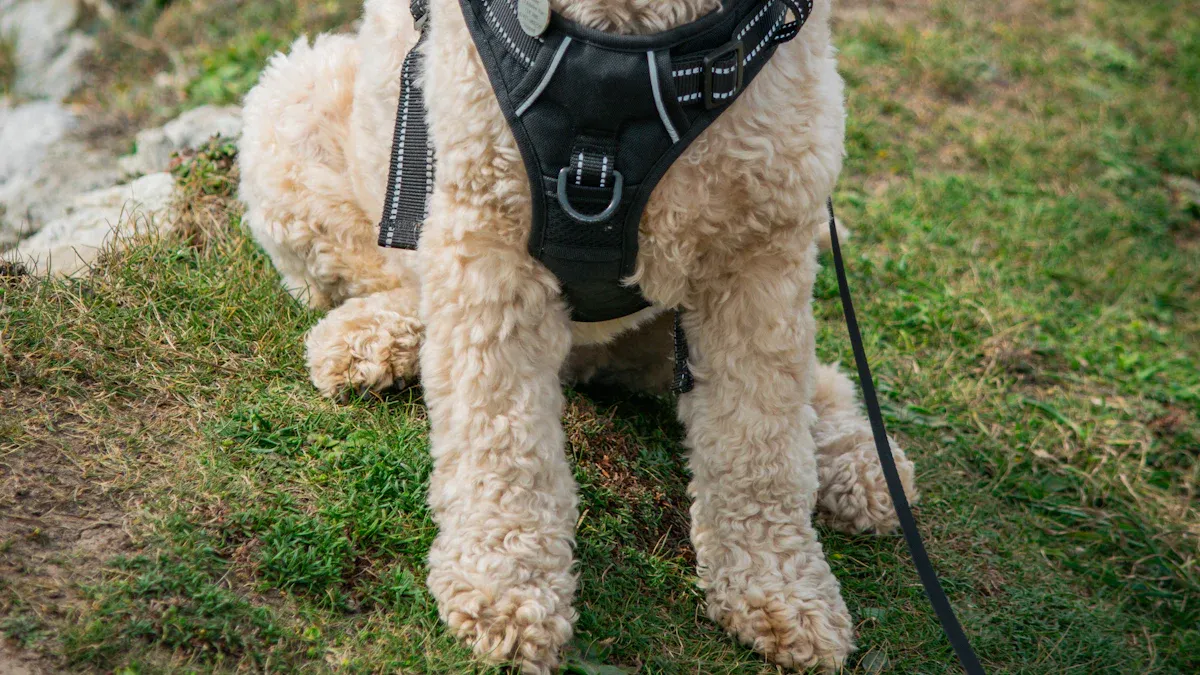
How a harness distributes force determines whether it assists safely or creates pressure points. The contact zone—the area where the harness bears against the dog’s body—must be broad enough to spread load across muscle and bone rather than concentrate it on a narrow band.
Multiple contact points across the chest and back reduce peak force on any single zone, which becomes especially relevant for dogs with muscle wasting or bony prominence.
Brands should request sample photos showing the harness under load, not just on a standing dog. Observing how the contact zone shifts during walking, rising, and turning reveals whether the pattern and padding actually maintain distributed contact under dynamic conditions.
Handle position and lifting leverage
Handle position directly affects handler control and lifting safety. A back-mounted handle gives the handler leverage for quick stabilization and guided walking. For rear-support harnesses, the handle should sit above the pelvic zone so the lift vector aligns with the dog’s center of mass rather than pulling upward and forward. For full-body harnesses, dual handles—one over the shoulders and one over the hips—let handlers adjust lift balance for different tasks.
The handle must connect to reinforced webbing that runs through the harness body, not simply be stitched onto the outer fabric. During sample evaluation, brands should check whether the handle attachment shows stitch elongation or fabric distortion after repeated use.
Anti-migration anchoring
A harness that shifts during movement undermines both safety and handler confidence. Anti-migration features—adjustable straps, secure buckle placement, and non-slip inner surfaces—keep the support zone where it was designed to sit. Migration tends to be worst during stair climbing and vehicle transfers, when the dog’s body angle changes relative to the handler’s lift direction.
Sample validation should record harness position before and after each core task. A harness that consistently drifts forward or rotates on one side may indicate a pattern issue, not a fit-adjustment problem—especially if the same migration appears across multiple dogs within the same size grade.
Sample check: Mark the harness-edge position with removable tape at the start of each validation task. Record displacement after the task is complete and repeat the check across multiple dogs within the target size range. Consistent drift in the same direction signals a likely pattern issue rather than a single handler error.
Limb, abdomen, and toileting clearance
Clearance design affects more than comfort—it determines whether a dog can move naturally while wearing the harness. A rear-support harness that restricts hind-limb extension will cause the dog to shorten its stride. A full-body harness with insufficient abdominal clearance makes toileting difficult and creates hygiene problems for long-term wear.
The decision table above includes clearance as part of the required structure for each route. Brands should verify clearance during sample validation by observing the dog through the full range of each target task, not from a single static position.
Size System and Sample Validation
Chest, waist, torso, and weight data
A harness size system built on a single girth measurement produces SKUs that fit inconsistently. Chest girth determines the main contact-zone fit, but waist circumference affects anti-migration performance, and torso length controls handle placement relative to the dog’s center of mass. Weight data provides a secondary reference for load-dependent products.
Brands defining a size chart should collect all four measurements and understand how they vary within the target breed set. Two dogs with the same chest girth can have meaningfully different torso lengths—a short-backed Bulldog and a long-backed Dachshund will not share the same handle-position experience. For a detailed measurement methodology, see how to measure a dog for harness size and fit.
| Measurement | Why It Matters | Main Trade-Off |
|---|---|---|
| Chest girth | Primary contact-zone fit | Too narrow: pressure points. Too wide: migration. |
| Waist | Helps prevent forward migration | A tighter waist improves anchoring but may complicate toileting access. |
| Torso length | Handle-to-center-of-mass alignment | One torso length per size grade assumes proportional breeds. |
| Weight | Secondary load and durability reference | Weight alone does not predict girth or length. |
Separate front and rear sizing
Dogs do not have uniform proportions between front and rear body segments. A dog may fit a medium chest plate but require a large pelvic zone, or vice versa. Unified sizing—one size label for the whole dog—simplifies inventory and SKU counts but sacrifices fit precision. Separate front and rear sizing improves match rates, particularly for breeds with pronounced chest-to-waist ratios or for senior dogs with regional muscle loss.
Separate sizing increases SKU count and inventory complexity. Brands weighing this decision should consider whether their target channel—DTC, veterinary, or rehabilitation wholesale—can absorb the additional customer education required to explain independent front and rear measurements.
The five sample-validation tasks
Sample validation should confirm that a harness functions under dynamic conditions, not just that it looks correct on a standing dog. Five tasks cover the core assistance scenarios a mobility support harness must handle:
- Standing and weight shifting. Confirm that the harness stays in position as the dog shifts weight between limbs. Check for pressure points and contact-zone migration.
- Controlled walking and turning. Observe whether the harness maintains its support zone during straight-line walking and gentle turns. Record any rotation or sliding.
- Toileting posture. Verify that the harness does not obstruct elimination. Check handler access to buckles and straps in a crouched position.
- Step, ramp, or vehicle transfer. Test handle integrity and load distribution when the dog’s body angle changes relative to gravity. Evaluate handler posture and control.
- Short lift and repositioning. Confirm secure grip, balanced lift, and controlled handler leverage during brief full or partial lifts.
Record migration, pressure distribution, handle control, movement clearance, and handler comfort for each task. Document results with photos or short video clips taken during the test, not after repositioning the harness.
In practice: A sample that passes all five tasks on one dog does not validate the size grade. Repeat the tasks across multiple dogs positioned at different points within the target size range before approving the golden sample.
Supplier Evaluation for Mobility Harness Programs
A supplier that produces one basic sling is not the same as a supplier that develops rear-support, front-support, and full-body harnesses across graded sizes. The evaluation areas below help brands distinguish between a manufacturer that understands load-bearing soft goods for canine mobility and one that is pattern-cutting from a single template.
| Evaluation Area | Evidence to Request | Strong Signal | Red Flag |
|---|---|---|---|
| Mobility harness development | Product portfolio and relevant case records | Multiple harness routes with graded sizes | Only one basic sling |
| Front and rear pattern capability | Sample range and adjustment options | Separate front and rear sizing logic | No size-grading logic |
| Size grading and fitting documentation | Size chart and fitting guide | Clear measurement methodology | No fitting instructions |
| Handles, webbing, buckles, and seams | Component specifications and available test records | Reinforced components with documented checks | Weak seams or no verification records |
| Sample revisions and functional validation | Revision history and validation method | Documented sample-validation process | No sample records |
| Material and workmanship | Material specifications and QC records | Consistent batch-quality documentation | Frequent defects or no records |
| Packaging and instructions | Packaging samples and instruction drafts | Complete kit with task-specific guidance | Missing or generic instructions |
| Supply reliability | Order terms and production records | Transparent production planning | Unpredictable delivery and no planning visibility |
OEM, ODM, and private-label capability
Not every dog support harness project starts from a blank pattern. Some brands need private-label versions of existing designs with logo, packaging, and color customization. Others need ODM development—a new harness structure built to a target support profile and channel price point. Brands should confirm which level a supplier can deliver before committing to a sample round.
Lower-complexity customization includes logo placement, packaging design, color variations, and label content. These changes typically do not affect structural performance. Higher-complexity customization—material substitutions, strap-layout changes, and size-grade adjustments—may require new samples and revised fitting documentation. A supplier should be able to explain which customizations trigger revalidation rather than treating all changes as equivalent.
The dog mobility support solutions overview covers product categories available for brand customization.
Samples, revisions, and quality control
A clear sample workflow separates suppliers that control their production process from those that simply ship the first assembled version. Brands should request a documented revision history showing what changed between sample rounds and why. Strong suppliers track pattern versions, material-lot references, and inspection results by round.
QC records should cover in-process checks—seam integrity, buckle attachment, and handle reinforcement—not just final visual inspection. Batch traceability matters for harnesses because a material substitution in one production run can change fit, durability, or wash performance without being visible in a photo.
Packaging, instructions, and ongoing supply
Packaging and instructions are part of the product, not an afterthought. For mobility harnesses, instructions should define which tasks the product is designed for, which it is not, how to measure for the size system, and how to check fit before assisted use. A supplier that provides only generic diagrams or no task-specific guidance may not fully understand how the product is used downstream.
Supply stability depends on whether the supplier maintains traceable material sources, plans production capacity around recurring orders, and communicates lead-time variables rather than offering one fixed number without context. Brands evaluating long-term supply can review the dog lift harness product category for available structures and customization entry points.
