
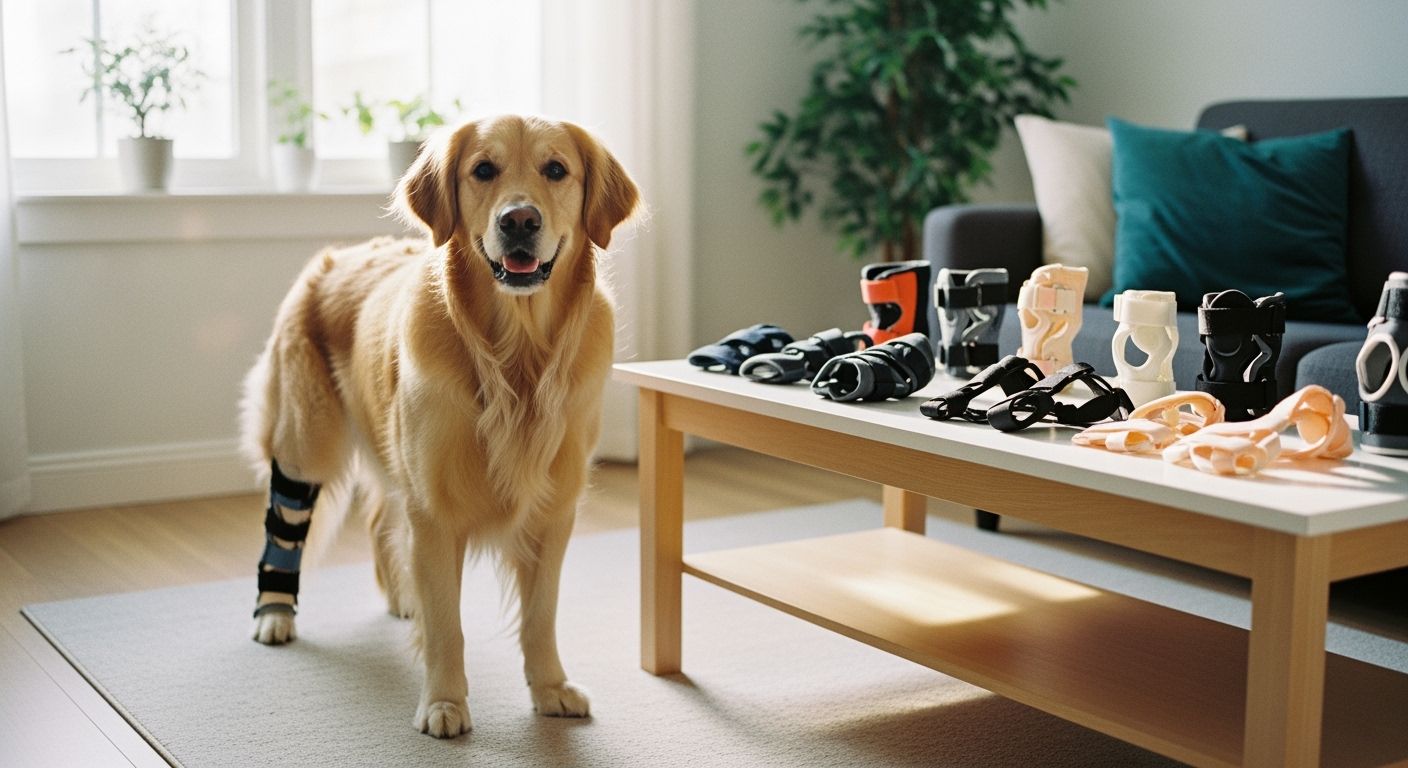
A brand planning to enter the canine orthopedic brace category faces more than a product selection decision. The real work is defining which structural tiers to carry, how to organize sizing across different anatomical regions, and what to validate before moving a product concept into production. Getting these three calls right determines whether the line holds its position in the market or accumulates returns and customer confusion.
An orthopedic dog brace line is not a single product. It is a structured catalog organized across two axes: structural tier and target joint. Each intersection carries its own sizing logic, material requirements, and production complexity. Brands that treat this as a category-building exercise rather than a one-off SKU addition avoid the most common cost drivers: size charts that fail across breeds, support levels that do not match the labeled condition, and samples that look acceptable but cannot be reproduced at scale.
Structural Tiers That Define a Product Line
The orthopedic dog brace category breaks into three structural tiers. Each tier is designed for different support requirements and carries a different production profile.
Flexible textile wraps use neoprene, jersey, or breathable knit fabrics to deliver compression and light proprioceptive feedback. These products are generally positioned for lighter support applications where flexibility and ease of use are priorities. From a sourcing standpoint, soft wraps are the lowest-complexity tier. Tooling is minimal, size grading is forgiving, and lead times are shorter. The trade-off is limited differentiation: most soft sleeves look similar at retail, so brands compete on fit consistency, material hand feel, and packaging rather than structural innovation.
Stay-reinforced devices embed aluminum or thermoplastic stays into textile bodies to add vertical stiffness without full rigid immobilization. These mid-tier products are designed for applications where additional structural support is needed compared with flexible sleeves. Production complexity increases because stay placement, length, and flex profile must match the target joint’s range of motion. A carpal stay that works for a front wrist will not transfer to a rear hock without geometry changes. Brands expanding into this tier should expect longer sampling cycles and more back-and-forth on stay positioning relative to strap anchor points.
Hinged and rigid devices use mechanical hinges or thermoformed shells to control joint motion paths. Hinged models are designed around joint movement alignment, while rigid structures provide a higher level of movement restriction depending on the product design. These are the highest-complexity tier. Hinge alignment tolerances are tight. Poor pivot alignment can create uneven contact pressure and affect brace positioning during movement. Rigid shells require either precise off-the-shelf size grading or custom casting workflows. This tier typically commands the highest margin but demands the most rigorous supplier qualification.
Many product lines may benefit from carrying more than one structural tier. A soft-wrap entry tier builds volume and channel presence. A reinforced or hinged tier signals category competence and captures clinical and professional-channel demand.
Joint-Specific Design Requirements
Orthopedic dog braces cover six anatomical regions: stifle (knee), hock (tarsus), carpus (wrist), elbow, hip, and spine. Each region imposes distinct mechanical demands that a universal sleeve design cannot satisfy.
Stifle braces must control cranial tibial translation — the forward sliding of the lower leg relative to the femur. This requires hinge axis alignment that tracks the natural stifle pivot during flexion and extension. A misaligned hinge creates a lever effect: instead of stabilizing the joint, it forces the brace to pivot against the leg. Hinged stifle braces also need robust proximal and distal anchoring because the femur and tibia act as long muscular levers that generate high internal forces against external shells.
Hock braces manage hyperextension control and Achilles tendon unloading. The hock bends backward at a steep angle during push-off, so brace geometry must resist collapse in that direction while allowing forward flexion. Strap angles and dorsal stiffness are design variables that directly affect whether the brace supports the tendon without restricting gait.
Carpal braces resist downward palmar collapse under weight-bearing. Because front limbs experience significant weight-bearing demands, carpal devices require appropriate structural support and secure distal anchoring above the paw. Rear hock devices need diagonal anchoring to counter angular propulsion forces. Front and rear leg sizing charts cannot be shared: the limb taper, muscle distribution, and joint angle are fundamentally different.
Elbow braces must distinguish between active joint stabilization and passive pressure relief. A therapeutic elbow brace restricts range of motion through structured materials; a protective sleeve or pad cushions the olecranon against hard surfaces. Confusing these two product types in a catalog creates fit and expectation mismatches.
Hip braces depend on pelvic anchoring that resists displacement during gait. Dual-anchor systems that connect chest harness points to rear hip panels maintain tension across the torso and prevent the brace from sliding backward or rotating along the ribcage-to-waist taper. Breeds with deep chests and narrow waists are particularly challenging for single-anchor designs.
Back braces stabilize the trunk and spine through circumferential compression and stay reinforcement. These devices often pair with neck supports or hip harnesses for conditions requiring multi-segment stabilization, such as support applications related to back and spinal mobility needs.
For deeper joint-by-joint coverage of brace types, fit variables, and daily-use boundaries, buyers can review GaitGuard’s dog brace and mobility support guides. Brands organizing products around defined use cases can also compare the site’s dog brace solutions by condition before deciding which joint categories belong in the initial line.
Sizing Logic and SKU Planning
Body weight is not a sizing metric for structural braces. Two dogs of identical weight can have completely different limb geometry. A Bulldog and a Greyhound at the same kilogram weight will require different stifle brace dimensions, strap lengths, and hinge positions.
Joint-specific anatomical measurements replace weight-based sizing. For each brace type, brands should define the measurement inputs that matter: joint circumference at the target location, limb segment length above and below the joint, and joint-center position relative to anatomical landmarks. These measurements become the basis for the size chart and directly influence which body types each SKU can accommodate.
Size mix planning should be based on target market data, customer demand, and the intended product channel. Different regions and channels may require different size distributions because larger breeds carry higher orthopedic loads. Initial production allocations should be determined using available sales data, target breeds, and expected channel demand rather than fixed assumptions. This allocation logic reduces tied-up inventory in slow-moving sizes while ensuring core size coverage.
Standard size grading works for soft wraps and most stay-reinforced devices. Mass-produced size matrices streamline tooling and lower per-unit cost. Complex anatomical deformities, angular limb deviations, or body proportions outside the standard pattern range may require custom fitting workflows — either through individual casting or 3D scan-based shell fabrication. Brands should define which conditions fall within standard grading and which require custom pathways before finalizing SKU counts.
Each new size column multiplies across structural tiers and anatomical regions. A brand carrying three structural tiers across four joint regions with five sizes per product faces sixty SKUs before adding color or packaging variants. SKU count decisions should account for inventory carrying cost, warehouse space, and the replenishment complexity that comes with size-level forecasting.
Sample Workflow and Production Validation
Three sample stages separate a product concept from a production-ready line. Skipping any stage transfers risk to the bulk order.
Construction sample. The supplier builds a first physical prototype from available stock materials. The purpose is to verify pattern accuracy, strap placement logic, and rough dimensional proportions. This stage catches fundamental design issues before custom tooling or material procurement begins. Brands should check whether strap anchor points align with the intended joint geometry and whether the overall proportion matches the size grade target.
Revised sample. After the construction sample is evaluated on anatomical models or test subjects, specific feedback goes back to the supplier: hinge axis adjustment, seam bulk reduction, strap tension redistribution, material substitution. The revised sample uses specified production-grade fabrics and hardware. This is the stage where dynamic fit issues surface — a brace that looks correct on a static form may shift, rotate, or create pressure points during gait. Brands should observe whether hinge pivot positions remain aligned through a full flexion-extension cycle and whether strap tension stays consistent after repeated movement.
Golden sample. The supplier produces the final reference unit on the actual bulk production line. This sample becomes the quality benchmark for the full commercial order. The golden sample locks the bill of materials, stitch specifications, component sources, and assembly sequence. Every subsequent bulk shipment is compared against this reference. Material substitutions after golden sample sign-off require a new approval cycle.
A common failure point is validating only one size during sampling. A Medium sample that passes all checks does not guarantee that the Small or Extra-Large versions will perform identically. Pattern grading sometimes introduces proportional drift: strap angles that work at one scale may pull at different vectors on a larger or smaller frame. Brands should sample at least two sizes — typically the expected highest-volume size and one boundary size — before signing off on the full size run.
In production: A construction sample that fits well in a single size does not confirm that the size grading logic holds across the full range. Validate at least two sizes, including a boundary size, before locking the pattern.
Supplier Capabilities and Category Operations
A supplier that can produce a sample is not the same as a supplier that can reproduce it consistently across sizes, materials, and production batches. Brands evaluating manufacturing partners for an orthopedic dog brace line should assess several dimensions beyond unit price.
Structural understanding. Can the supplier explain why a stifle brace hinge is positioned at a specific point relative to the joint line? Can they describe how material substitutions — changing neoprene density, switching hook-and-loop supplier, adjusting stay thickness — affect device performance? A supplier that cannot articulate these relationships is unlikely to flag design risks before they reach production.
Material control. Skin-contact materials and breathable fabrics require consistent sourcing and clear material specifications. Hook-and-loop fastener cycling life, neoprene density tolerance, and stitch thread durability all affect product lifespan. The bill of materials should be contractually locked after golden sample approval. Unauthorized material substitutions — switching to a lower-density foam, changing adhesive type, sourcing fasteners from a different sub-supplier — can alter fit, support level, and durability without visible changes to the sample appearance.
Customization depth. Logo application, packaging design, and color selection are surface-level customizations that typically do not affect structural performance. Material changes, strap layout modifications, stay repositioning, and size grade adjustments are structural customizations that require re-sampling. Brands should distinguish between these two categories in their product brief to avoid conflating a packaging update with a development cycle. Buyers that need structure changes, material review, size-system development, or sample confirmation can use the OEM/ODM pet orthotics development page as the next B2B route.
Production parameters. Minimum order quantities, lead times, and replenishment cycles vary by structural tier. Flexible wraps, with simpler construction and fewer components, typically carry lower MOQs and shorter production windows. Hinged and rigid devices, with more assembly steps, tighter tolerances, and specialized hardware sourcing, require longer lead times and higher minimums. Brands should align their inventory planning with tier-specific production realities rather than applying a single set of assumptions across all products.
Quality and change control. Batch-to-batch consistency depends on whether the supplier maintains documented process controls for stitch density, strap tension during assembly, hinge installation torque, and final inspection criteria. A supplier that cannot clearly explain incoming material inspection or in-process QC checkpoints may have difficulty maintaining consistent production controls — which produces variable output as production volumes scale.
Building a complete orthopedic dog brace line is a category development exercise, not a single-product sourcing event. The brands that get it right treat structural tier selection, joint-specific sizing, sample-stage validation, and supplier qualification as connected decisions rather than sequential tasks.
