
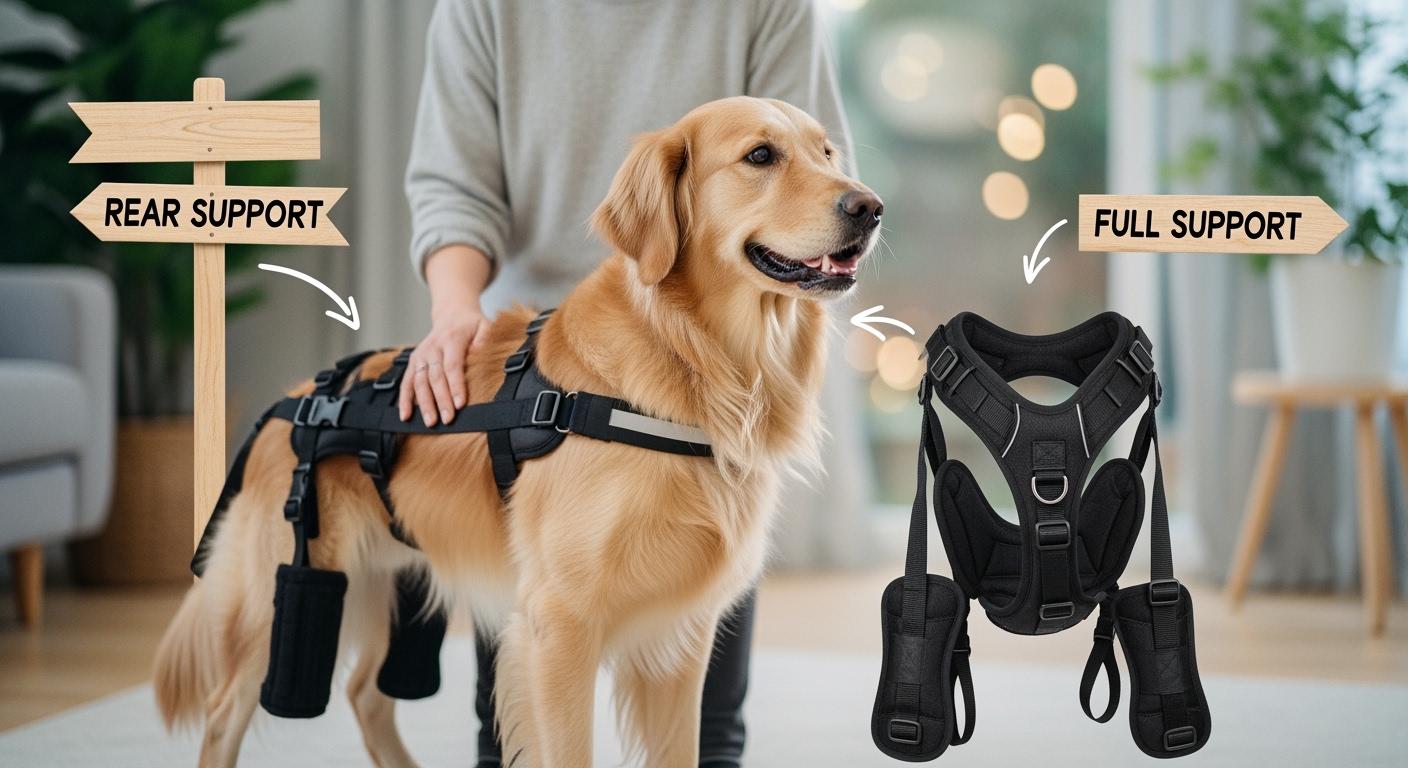
When comparing the best dog lift harness rear lift vs full body options, the main decision is not which harness sounds more supportive, but which support layout matches your dog’s mobility pattern and the amount of assistance needed during daily care. This article is for owners, clinics, and rehab-minded buyers who need to compare when a rear lift design is enough, when full body support is more appropriate, and what fit and handling factors should guide the choice. Read it to decide which harness category better fits walking, stairs, bathroom trips, post-surgical care, and daily mobility support before reviewing condition-based support pathways.
Key Takeaways
Choose a rear lift harness when support is mainly needed for the hind end.
Choose a full body harness when the dog needs more balanced whole-body assistance.
Fit, tolerance, and owner handling requirements should guide the choice.
Daily use case matters more than marketing labels such as “best” or “premium.”
Best Dog Lift Harness Rear Lift vs Full Body: Quick Comparison
Key Differences and Use Cases
The most useful way to compare rear lift vs full body is to ask where the support is actually needed: mainly under the back half of the body, or across the dog’s overall balance and lifting needs. The table below should be used as a decision shortcut, not as a product-ranking chart.
Harness category | Primary support area | Best-fit use case |
|---|---|---|
Rear lift harness | Hind end and rear-leg assistance | Dogs that mainly need help with back-leg weakness, stairs, bathroom trips, or short assisted walks |
Full body harness | Front and rear support with more balanced lifting | Dogs that need broader mobility assistance, post-surgical support, or help across multiple body regions |
A rear lift harness is usually the better choice when the dog still manages most forward movement but needs meaningful help from the rear end. A full body harness is usually the better choice when support needs extend beyond the hind legs or when balance and lifting need to be distributed more evenly. If you need broader background before comparing products, continue through our GaitGuard Guides.
Pros and Cons for Daily Support
For daily support, the most important variables are the dog’s mobility pattern, the amount of owner assistance required, and whether the harness can be used consistently without creating new handling problems.
Rear lift harness:
usually easier for short daily tasks, quicker to deploy, and more practical when the support need is mainly behind the dog.
Rear lift harness limitation:
less useful when the dog also needs meaningful front-end or full-body assistance.
Full body harness:
more useful when lifting needs are broader, more balanced, or linked to post-surgical or advanced mobility situations.
Full body harness limitation:
more setup time, more bulk, and more owner handling complexity during daily use.
Decision rule: choose rear lift when the support problem is mainly behind the dog; choose full body when the support problem is broader than the hind end alone.
If the mobility pattern is still unclear, compare it first against the broader use cases in our Solutions overview. The better harness category is the one that matches daily function and handling reality, not the one with the longest feature list.
Rear Lift Harness: Best Uses and Support
What Is a Rear Lift Harness?
A rear lift harness is a handler-assisted support device designed to help with hind-end weakness, rear-leg instability, and short daily mobility tasks. It is typically more relevant when the dog still moves forward reasonably well but needs targeted assistance from the back half of the body.
Here is a table showing what makes a rear lift harness different from other types:
Feature | Description |
|---|---|
Rear support focus | Designed mainly for hind-end assistance rather than full-body lifting |
Handle-based assistance | Lets the handler assist during stairs, walking, or bathroom trips |
Adjustment range | Important for keeping the harness stable during repeated daily use |
Typical routine | Short repeated tasks rather than full-day wear |
Fit requirement | Must stay aligned without twisting or pinching during assisted movement |
Best Rear Lift Harness for Hind-Leg Weakness
For hind-leg weakness, the best rear lift harness is usually the one that combines stable rear support, easy handling, and enough adjustment to stay aligned during daily tasks. Selection should focus on support layout, strap stability, and handling efficiency rather than brand familiarity alone.
Daily Activities: Walking, Stairs, Bathroom Breaks
Rear lift harnesses are most practical for routine tasks such as short walks, stairs, bathroom breaks, and quick transfers. If you are already comparing actual harness options, this is the right point to review product options by handle design, adjustment range, and day-to-day handling practicality.
Tip: Always check that the harness fits well before you lift your dog. A good fit keeps your dog comfortable and safe.
Limitations and When to Avoid
A rear lift harness becomes less suitable when the dog also needs major front-end support, balanced lifting across the body, or more structured post-surgical assistance. It is best viewed as a targeted rear-support tool, not as a universal mobility answer.
Full Body Harness: Support for Total Mobility
What Is a Full Body Harness?
A full body harness is a more balanced mobility support device that helps distribute assistance across both the front and rear sections of the body. It is generally the better option when the dog needs broader lifting support, more balance control, or help across more than one problem area.
When Full Body Support Is Needed
Full body support is more relevant when mobility loss is not isolated to the hind end, when post-surgical handling needs are greater, or when the dog’s balance and standing ability require more evenly distributed assistance.
Here are some common reasons to use a full body harness:
Post-surgical recovery with higher handling needs
Generalized weakness affecting more than the hind legs
Balance loss that makes rear-only assistance insufficient
Daily mobility tasks that require broader lift distribution
Best Dog Harnesses for Post-Surgery and Weakness
For post-surgical weakness or broader mobility loss, the better full body harness is usually the one that provides stable lift distribution, repeatable fit, and practical daily handling for the caregiver. Product evaluation should focus on support coverage, adjustment range, and whether the harness matches the dog’s current mobility stage.
Pros, Cons, and Comfort Factors
Use the table below to evaluate whether full body support is justified by the case, not simply whether it looks more comprehensive:
Benefit | Description |
|---|---|
Balanced support | Helps distribute assistance across more of the body during lifting and mobility tasks |
Post-surgical use | More suitable when recovery support extends beyond the hind end alone |
Higher handling complexity | Requires more setup time and more owner involvement during routine use |
Fit sensitivity | Needs careful adjustment to avoid twisting, rubbing, or uneven loading |
When you pick a harness, always check the fit. The harness should spread weight evenly and not press on sore spots. Look for straps you can adjust and padding on the chest and belly. These things stop rubbing and keep your dog comfy. A strong harness that is easy to put on makes care easier. The best harness for big dogs should let your dog move in a normal way. Make sure you measure your dog for the right fit. Straps should sit above the shoulder joint so your dog can move well. You want a harness that is easy to use, especially if you help your dog a lot. A vet-recommended harness can really help your dog every day.
How to Choose the Right Harness for Your Dog
Assessing Mobility and Support Needs
Start by defining the actual mobility problem. If the issue is mainly hind-end weakness, a rear lift design is often sufficient. If the issue includes broader instability, post-surgical handling, or whole-body weakness, full body support is usually more appropriate.
Ask yourself these questions:
Does your dog have trouble with only the hind legs or with both front and back legs?
Is your dog recovering from surgery or dealing with age-related mobility issues?
Does your dog need help with stairs, bathroom breaks, or longer walks?
For broader educational context after this section, continue through our Guides before comparing specific harness setups.
Fit, Comfort, and Safety Tips
Fit quality determines whether either harness category will remain usable. A harness that shifts, twists, bunches, or creates pressure points will underperform even if the support category is correct. Early fit review is part of safe use, not an optional step.
Here are some tips for fit, comfort, and safety:
Measure your dog’s chest, belly, and hips for accurate sizing.
Look for harnesses with adjustable straps and padding.
Make sure the harness does not rub or pinch your dog’s skin.
Check that the harness stays in place during movement.
Choose materials that are easy to clean and gentle on your dog.
Fit check rule: if the harness changes stride, rubs the skin, or keeps shifting during assisted movement, treat that as a setup problem to correct before routine use continues.
When you move from evaluation to product review, compare Products by fit adjustability, support layout, and ease of assisted handling.
Matching Harness to Daily Routine
Daily routine should decide the harness category. Rear lift designs are usually more efficient for repeated short tasks. Full body designs are usually more relevant when support needs are broader, more frequent, or more demanding physically.
Use this table to match harness types to daily activities:
Daily Activity | Rear Lift Harness | Full Body Harness |
|---|---|---|
Short walks | Usually suitable | Suitable when broader support is needed |
Bathroom breaks | Usually suitable | Suitable |
Stairs | Suitable for rear-support cases | Suitable for broader mobility cases |
Standing up | Suitable for rear-support cases | Usually more suitable |
Post-surgical support | Sometimes sufficient | Usually more suitable |
Balance support | Limited | Usually stronger |
Choose the harness category that matches the daily task pattern first, then refine by fit and handling needs.
Common Mistakes to Avoid
Many dog owners make mistakes when choosing a harness. You can avoid these by following simple steps.
Do not pick a harness without checking sizing and fit.
Avoid harnesses that lack padding or adjustable straps.
Do not use a rear lift harness for dogs with overall weakness or balance problems.
Do not ignore signs of discomfort or rubbing.
Avoid harnesses that are hard to clean or adjust.
Common mistake: choosing a full body harness just because it sounds more supportive, or choosing rear lift support when the case actually needs broader assistance.
The better harness is the one that matches the dog’s mobility problem and the caregiver’s actual handling routine, not the one with the broadest feature list.
Tips for Using and Maintaining Dog Lift Harnesses
Record for 5 days before changing harness type: stair difficulty, ability to stand up, amount of rear support needed, amount of full-body support needed, skin response after use, and whether the harness stayed aligned during assisted movement.
Proper Fitting and Adjustment
You want your dog to feel safe and comfortable every time you use a lift harness. Start with the right adjustment. Measure your dog’s neck and chest with a soft tape. Adjust the neck and chest straps to their largest setting before you place the harness on your dog. Secure all straps and tighten them so you can fit two fingers between the strap and your dog’s body. Make sure the harness sits flat against the chest and back. Avoid twisting or bunching.
After securing any harness type, do a final mobility check: your dog should be able to sit, turn their head, and move their front legs freely. The harness should feel snug around the chest but never restrict breathing or movement.
A harness that is too loose can slip off. A harness that is too tight can cause chafing or restrict movement. Regularly recheck the adjustment, especially if your dog is growing or their weight changes. Always check the secure fit before each use. Adjustment is key for safety.
Cleaning and Care
Keep your dog’s harness clean to protect their skin and maintain safety. Most harnesses use nylon, neoprene, or mesh. These materials balance durability and comfort. Wash the harness regularly, following the care label. Use mild soap and cool water. Let the harness air dry. Check for worn spots or broken buckles. Replace the harness if you see damage. A clean, well-maintained harness helps with secure adjustment and safety.
Helping Your Dog Adapt
Some dogs need time to get used to a new harness. Lay the harness on the floor and scatter treats around it. Let your dog sniff and explore. Next, feed treats through the neck loop while you hold it. Encourage your dog to put their nose through the loop for a treat. Practice putting the harness on and taking it off, rewarding your dog each time. This positive approach builds trust and makes daily adjustment easier. Always check the secure fit and comfort after each adjustment. Safety comes first every time you use the harness.
Rear lift vs full body is ultimately a mobility-pattern decision. Rear lift harnesses are usually the better fit when the dog mainly needs hind-end assistance for daily tasks. Full body harnesses are usually the better fit when the dog needs more balanced support, broader lifting help, or more structured assistance after surgery or with advanced weakness.
For follow-up after this comparison, continue only to the most relevant internal paths: use Guides for educational background, Solutions for condition-based support direction, and Products when the case is ready for harness evaluation.
Data authenticity note: This article is for educational purposes only. It is designed to help readers compare when rear lift support is more appropriate than full body support, and when full body support is more appropriate than rear-only assistance. It does not replace veterinary diagnosis, individualized fitting, or a full mobility support plan.
FAQ
What is the main difference between a rear lift and a full body dog harness?
A rear lift harness mainly assists the hind end. A full body harness distributes support more broadly across the body. The better choice depends on whether the mobility problem is rear-focused or more generalized.
When should you use a rear lift harness?
Use a rear lift harness when the dog mainly needs hind-end assistance for short daily tasks such as stairs, bathroom trips, and supported walking.
When does your dog need a full body harness?
Choose a full body harness when support needs extend beyond the hind legs alone, especially in post-surgical, generalized weakness, or balance-related situations.
How do you know which harness fits your dog best?
A correct fit stays aligned during movement, does not bunch or twist, and avoids pressure points that change gait or cause rubbing.
Can you leave a lift harness on your dog all day?
Usually no. Lift harnesses are generally best used for active support periods, not as all-day wear devices. Skin checks and fit checks should be part of every repeated-use routine.
