
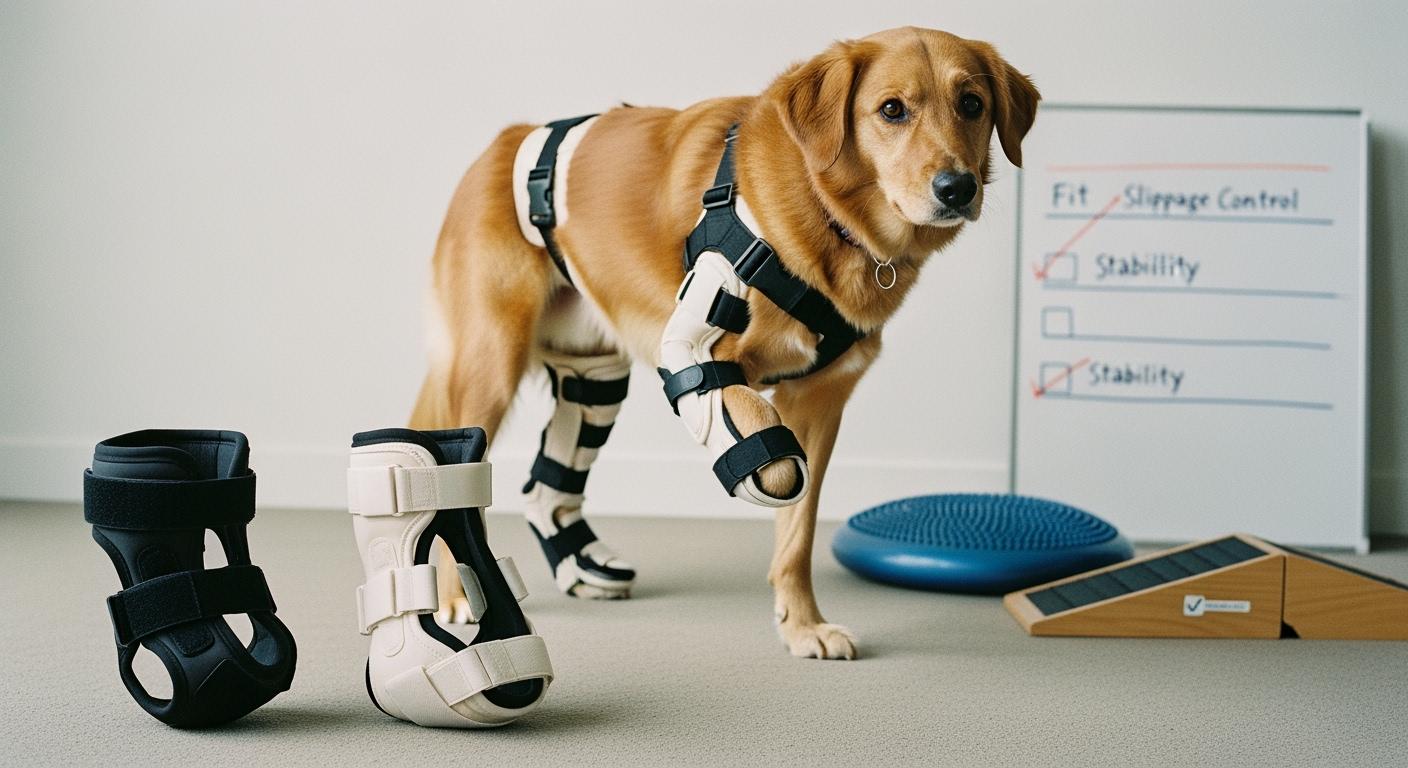
Dog ACL brace alternatives do not fail only because of support level. Many fail because the fit is inconsistent, the brace rotates, or the support shifts during real movement. This guide compares ACL brace alternatives by fit precision, slippage control, and daily rehab stability so you can judge whether a brace is likely to stay aligned, remain comfortable, and support safer movement during recovery. A brace that fits well should stay positioned through walking, standing, and short rehab sessions without twisting, rubbing, or losing knee alignment.
Key Takeaways
The best ACL brace alternative is the one that stays aligned with the knee during real movement, not just while the dog is standing still.
Slippage usually starts with poor measurement, weak strap control, or a brace shape that does not match the dog’s leg.
Daily fit checks should focus on rotation, strap migration, skin marks, and whether the brace still supports natural walking.
Dog ACL Brace Alternatives Fit and Slippage: What Matters Most
Why Fit Is Critical for Dogs
Fit matters because knee support only works when the brace stays aligned with the joint it is supposed to support. A brace can look well made and still fail if it does not match the dog’s limb shape, muscle contour, or movement pattern. In ACL recovery, the practical question is not just whether the brace feels snug at first, but whether it keeps the knee supported through standing, turning, and short controlled walking.
Most fit problems come from three sources:
The brace does not match the dog’s stifle location and leg proportions.
The support level is chosen without considering injury severity or walking ability.
Measurements are taken too quickly or without the dog standing correctly.
You should always measure your dog’s leg before you pick a brace. Braces made just for your dog’s size fit the best. Braces that are one-size-fits-all do not work well for most dogs. A brace that fits just right helps your dog feel better and move easier while healing.
Tip: Take your time to measure your dog’s knee and stifle. Use a soft tape measure and follow trusted steps. This helps you avoid mistakes with fit.
How Slippage Affects Recovery
Slippage is one of the fastest ways for an ACL brace alternative to lose value. Once the brace starts sliding or rotating, support no longer stays centered on the knee and the dog may compensate with shorter steps, toe-out posture, or uneven weight use.
Slippage also increases the chance of rubbing and pressure marks. That means it is not only a comfort issue. It is also a performance issue, because the brace can no longer control movement the way it was intended to.
When you test a brace at home, do not judge it only while the dog is standing still. Watch what happens during walking, turning, sitting, and getting up. If the brace drifts, twists, or loses joint alignment, the fit or the brace design is not yet working well enough.
Note: Slippage control is not just about comfort. It also helps the brace support the knee and helps your dog heal from ACL injuries.
You can read more about brace choices and knee support in other ACL brace articles and support pages. Use these to learn about different brace shapes, strap spots, and inside materials. Focus on good fit and slippage control to help your dog get better.
Key Factors Affecting Fit and Slippage in Dogs
Strap Placement and Adjustment
Strap placement controls whether the brace stays stable as the dog moves. If the straps sit too high, too low, or tighten unevenly, the brace is more likely to rotate, slide down, or create pressure in the wrong area. A good strap layout should hold the brace in place without bunching, digging in, or shifting as the dog walks.
Place support straps so they help anchor the brace above and below the knee without crowding the joint.
Check that the straps lie flat and do not roll, twist, or pinch the skin.
Recheck tension after short movement instead of assuming the first adjustment will hold.
Brace Structure and Hinge Design
Brace structure matters because the frame, hinge path, and body coverage all affect how the support behaves under load. A brace that follows the dog’s limb shape more closely will usually distribute pressure better and stay aligned longer. Hinges and structured side support can improve control, but only if the brace still fits the dog’s leg accurately.
Anatomical Factor | Description | Impact on Fit and Slippage |
|---|---|---|
Custom Cast or 3D Scan | Ensures even pressure and limb alignment | Reduces slippage and improves fit |
Custom-fit and more adjustable brace options are often worth comparing when off-the-shelf sizing repeatedly leads to drift, gapping, or uneven pressure.
Lining and Skin Contact
The lining inside the brace touches your dog’s skin all day. You want materials that feel soft and let air flow. Breathable neoprene or mesh, soft inner linings, and moisture-wicking fabrics help prevent rubbing and skin irritation. These materials also help the brace stay in place by reducing sweat and friction. Look for reinforced stitching and padding in areas that touch the skin most. A good dog brace should support the knee without feeling stiff or causing chafing. When you choose a brace, check the lining to make sure it will be comfortable for daily wear.
Tip: Check your dog’s skin often for redness or signs of rubbing. Change or adjust the brace if you see any problems.
Measuring Fit for Non-Surgical Dog ACL Brace Options
How to Measure Your Dog’s Leg
Measurement should be treated as part of fit control, not as a quick setup step. If the numbers are wrong, every later judgment about comfort, slippage, and support will also be less reliable. Measure with the dog standing squarely on a non-slip surface and record the numbers before comparing sizes.
Here is a simple checklist for measuring:
Find the center of the knee joint.
Measure the thigh’s widest part above the joint.
Measure around the knee joint itself.
Measure the lower leg just below the joint.
Check the length from the hip to the ankle.
Tip: Measure twice, record both numbers, and note any swelling or coat thickness that may change the final fit.
Accurate measurements make it easier to compare alternatives fairly. They also make it easier to tell whether a fit problem comes from sizing, brace shape, or strap setup.
Signs of Poor Fit in Dogs
You must watch for signs that a non-surgical dog acl brace does not fit well. Poor fit can stop the brace from giving the right support. It can also cause problems for your dog’s knee and joint.
Common signs of poor fit include:
The brace slips down or rotates around the leg.
You see gaps between the brace and your dog’s knee.
The straps leave marks or cause swelling.
Your dog licks or chews at the brace.
The brace does not stay over the joint during movement.
If you see these signs, try adjusting the straps or check your measurements. Some non-surgical options and dog ccl injury brace options may need a different size or design. Always make sure the brace supports the knee and joint without causing pain. A good fit helps your dog move better and supports recovery.
Note: If you cannot get a good fit, ask your vet about other dog ccl injury brace options or non-surgical options for support.
Braces that fit well give steady support to the knee and joint. They help your dog stay active and safe during recovery.
Preventing and Managing Brace Slippage
Features That Usually Help
Braces that manage slippage better usually combine three things: stable strap placement, enough structure to hold alignment, and inner materials that do not create excessive rubbing or drift. Wide adjustable straps, breathable linings, and a shape that follows the leg more closely are usually more useful than adding compression alone.
Look for straps that can be adjusted in small increments.
Check whether the brace stays centered above and below the knee.
Choose linings that reduce rubbing without making the brace overly bulky.
How to Test Slippage at Home
Home testing should be simple and repeatable. Put the brace on, align it carefully, and then watch what happens during a short walk, a turn, a sit, and a stand. The brace should stay centered, keep the joint covered, and avoid visible twisting.
Check whether the brace slides down after a short walk.
Look for rotation around the leg when the dog turns.
Watch for gaps forming around the knee after movement.
Inspect the skin after removal for rubbing or pressure marks.
If the brace keeps drifting after careful adjustment, the issue is usually sizing, brace shape, or support design—not just strap tension.
Daily Stability and Movement Control
Stability During Walking and Activity
You want your dog to feel steady and safe every day. A non-surgical dog acl brace helps support your dog’s knee and joint. The brace keeps the joint in line and stops bad movement. Semi-rigid and hinged braces give more help for serious injuries than soft ones. Hinged braces lower stress on the hurt ligament and spread weight on the leg. Full-leg support systems keep the joint steady, control swelling, and lower pain as your dog heals.
A non-surgical dog acl brace can help your dog walk and play sooner. It lowers the chance of new injuries and helps muscles stay strong. This makes rehab safer and easier for your dog. You may see less limping and better movement as your dog uses the brace. Many owners notice less swelling and more activity during rehab.
Evidence Type | Findings |
|---|---|
Biomechanical Studies | Braces stop the knee from sliding forward too much. |
Long-term Observational Studies | Bracing works well for small or older dogs and those with partial CCL tears. |
Clinical Observations | Less swelling, less limping, better weight use, and more activity. |
Tip: Watch your dog during walks and rehab. Adjust the non-surgical dog acl brace if you see slipping or discomfort.
Balancing Support and Mobility
You want your dog to move easily and stay safe. The right non-surgical dog acl brace gives support but lets your dog move. Braces stop painful knee movement and keep the joint steady. They help your dog put weight on the hurt leg and stop muscle loss. Braces also help your dog move normally and avoid new injuries.
A non-surgical dog acl brace lowers pain and keeps the knee steady. It helps your dog know where the leg is and supports weight. Braces do not replace surgery, but they help a lot with rehab. You should check the fit often and make sure your dog can still move well. Good movement means your dog can walk, stand, and play with less pain and more confidence.
Note: Always use the non-surgical dog acl brace as part of a full rehab plan. Work with your vet or rehab expert to adjust support and movement for your dog.
You help your dog move better and keep joints healthy by focusing on stability, support, and daily movement during recovery.
Comfort and Wear-Tolerance for Dogs
Materials and Padding
You want your dog to feel comfortable while wearing braces every day. The right materials and padding make a big difference in how well the brace works and how long your dog can wear it. Good materials help the brace stay in place and protect the knee and joint from rubbing or pressure. Many braces use soft padding and flexible fabrics to give steady support without causing pain.
Here is a table showing common materials and their benefits:
Material | Benefits |
|---|---|
Breathable mesh | Protects skin and prevents overheating |
Neoprene | Provides flexibility and comfort |
Washable fabrics | Easy to clean and maintain hygiene |
Wide straps | Adds comfort and support |
Extra padding | Enhances comfort for the dog |
You should look for braces with these features:
Adjustable straps for a snug fit
Even pressure to prevent sore spots
A brace with these qualities will help your dog move better and keep the knee and joint safe during recovery. Always check that the brace fits well and does not pinch or bunch up.
Monitoring for Irritation
You need to check your dog’s skin often when using braces. Even the best brace can cause irritation if it does not fit right or if your dog wears it for too long. Watch for redness, swelling, or hair loss around the knee and joint. If you see your dog licking or chewing at the brace, this may mean the brace is causing discomfort.
Tip: Remove the brace daily to inspect the skin and fur. Clean the area and the brace to keep everything fresh.
Follow these steps to keep your dog comfortable:
Ensure the brace fits snugly but does not pinch.
Check for even pressure to avoid sore spots.
Adjust straps for optimal comfort.
If you notice any irritation, adjust the brace or ask your vet for advice. Keeping your dog’s knee and joint healthy will help with long-term support and recovery.
Common Mistakes in Choosing Dog ACL Brace Alternatives
Overlooking Fit and Slippage
One of the most common mistakes is comparing ACL brace alternatives by brand, material, or price before checking whether the brace can actually stay aligned on the dog’s leg. A brace that looks supportive on paper may still fail if it slips, rotates, or creates uneven pressure during normal movement.
You should always check how the brace fits before using it daily. Make sure the straps hold the brace in place above and below the knee. If you notice gaps or the brace sliding down, adjust it or try a different size. Braces that fit well give steady support and help your dog move with confidence. Poor fit and slippage can slow recovery and make the joint less stable.
Tip: Watch your dog walk and play with the brace on. If you see the brace shift or your dog seems uncomfortable, take action right away.
Ignoring Professional Guidance
Another common mistake is using a brace decision as a substitute for diagnosis. If the dog’s knee instability, pain pattern, or gait problem is not clear, it becomes much harder to judge whether a brace is failing because of fit, because of support level, or because the support category was wrong from the start.
Ignoring expert input can cause:
Progressive joint damage and arthritis. Unstable knees wear down cartilage faster, leading to pain and stiffness.
Higher chance of injuring the other leg. Dogs often put extra weight on the healthy leg, which can cause a new injury.
More complicated, more expensive fixes later. Delayed or poor treatment can lead to meniscal tears or severe arthritis.
Reduced quality of life. Chronic pain and limited movement can affect your dog’s mood and appetite.
You should always talk to your vet or a rehab specialist before choosing braces. They can help you find the best brace for your dog’s knee and joint needs. Professional advice ensures the brace gives the right support and helps your dog heal safely.
Practical Comparison Checklist: Fit, Slippage, and Stability
When you compare ACL brace alternatives, use the checklist below to decide whether a brace is likely to work in daily rehab rather than only in a product photo or size chart.
Fit Precision
Measure the thigh, knee, and lower leg with the dog standing evenly.
Check whether the brace sits centered on the knee without gaps.
Look for even pressure instead of one tight spot doing all the work.
Tip: A good fit means the brace does not pinch or leave marks on your dog’s skin.
Slippage Control
Test the brace during walking, turning, sitting, and standing.
Watch for sliding, rotation, or loss of knee alignment.
Reassess the fit if the brace drifts after a short session.
Slippage Sign | What to Look For |
|---|---|
Brace slides down | Adjust or try new size |
Brace rotates | Check strap placement |
Gaps at the joint | Re-measure for accuracy |
Daily Stability
Look for steadier weight use and less visible hesitation.
Confirm that the brace supports movement without forcing an awkward gait.
Inspect comfort and skin condition after each session.
Note: Daily stability helps your dog recover and stay active during rehab.
This checklist gives you a simple way to compare braces and find the best support for your dog’s knee and joint health.
Next Steps and Internal Resources
Where to Learn More About Dog ACL Braces
Once you have compared fit, slippage control, and daily stability, the next step should depend on what you still need to answer. If you still need sizing help, go to a measurement and fit-check guide. If you need to compare support levels, move to a brace selection page. If you are ready to review brace options, go to the most relevant knee-brace category or product page.
Here is a table that shows where you can get more facts:
Next Step | Use It For |
|---|---|
Fit and safety guide | When you still need help with comfort, rubbing, and correct daily setup. |
Sizing and fit-check guide | When you need to re-measure or confirm whether drift comes from sizing. |
Knee-brace category or product page | When you are ready to compare actual brace options after the fit logic is clear. |
You can read the dog ACL brace alternatives article, the main dog knee brace category, and the ACL/CCL condition-based support page for more info. Many people say their dogs walk better and move more with the right brace and support. Braces are important for rehab, especially for dogs with medial patellar luxation or dogs who cannot have surgery for medial patellar luxation.
When to Consult a Vet
Consult your veterinarian when the brace repeatedly slips, the dog shows ongoing pain, the knee remains unstable, or skin irritation appears after careful adjustment. A brace can support recovery, but it cannot replace diagnosis, rehab planning, or treatment decisions when the joint problem is still changing.
Ask your vet if a dog brace is a good idea when your dog hurts his ACL.
Talk with your vet about the good and bad parts of each choice.
Your vet will help you choose if braces, surgery for medial patellar luxation, or other treatments are right for your dog. They can also check your dog’s rehab after surgery and change the recovery plan if needed. If you see your dog is less steady, has less joint support, or looks uncomfortable, call your vet for help. This makes sure your dog gets the best care while getting better.
The best dog ACL brace alternative is the one that fits the leg accurately, stays aligned during movement, and supports daily rehab without creating new problems. Use this quick review template after each trial session:
Fit check: centered on the knee, no gapping, no twisting, no new skin marks.
Movement check: steadier walking, less hesitation, no visible drift during turns or sit-to-stand.
Decision check: keep, adjust, re-measure, or move to another brace option.
Review the notes every few days before changing support levels. Data authenticity note: This article is for educational purposes only. It is designed to help readers compare fit and slippage control across ACL brace alternatives, not to replace a veterinary diagnosis or an individualized treatment plan.
FAQ
How do I know if a dog ACL brace fits correctly?
You should check that the brace sits snugly on your dog’s leg without gaps or pinching. The brace should not slide down or twist when your dog walks. Always measure your dog’s leg before choosing a brace.
What causes a dog ACL brace to slip during daily use?
Loose straps, poor sizing, or the wrong brace design can cause slippage. You should adjust the straps and check the fit often. If the brace keeps slipping, try a different size or ask your vet for advice.
Can dogs wear an ACL brace all day?
Most dogs can wear a brace for several hours each day. You should remove the brace at night and check your dog’s skin for irritation. Give your dog breaks to keep the skin healthy and comfortable.
How do I help my dog get used to an ACL brace?
Start with short wear times and give treats or praise. Let your dog walk around the house first. Increase the time slowly as your dog gets comfortable. Watch for signs of discomfort or irritation.
Does a brace replace surgery for dogs with ACL injuries?
A brace does not replace surgery for every dog. Some dogs may need surgery for full recovery. You should talk to your vet to decide the best treatment for your dog’s injury.
