

Dog arthritis mobility support is not one product or one routine. A dog that slips on smooth flooring needs a different solution from a dog that cannot rise without help, becomes unstable on stairs, or needs support at both the front and rear of the body. The safest starting point is to identify the exact task that is difficult, then match the ramp, traction aid, sling, harness, or joint support to that task.
This guide combines home setup, equipment selection, fit checks, and daily transfer steps. Mobility aids can make handling safer and help a dog participate in movement, but they do not diagnose arthritis or replace veterinary assessment, pain management, or rehabilitation advice.
Key takeaways
- Start with the problem you can see: slipping, difficulty rising, unstable stairs, short-transfer weakness, or fatigue during assisted walking.
- Use ramps and traction changes to reduce avoidable jumping and slipping before adding more complicated equipment.
- A rear sling is usually suited to brief hind-end assistance, while a lift harness provides more stable control for repeated walking, stairs, or transfers.
- Choose full-body support when weakness is not limited to the back legs or when the dog twists under rear-only assistance.
- Check strap position, skin condition, balance, and gait every time a new aid is introduced.
- Stop and contact a veterinarian if mobility changes suddenly, the dog repeatedly falls, cannot rise, drags a limb, or shows marked pain.
Quick decision table for dog arthritis mobility support
| Problem observed | First support to consider | Best use | Main fit or safety check |
|---|---|---|---|
| Slipping on hardwood or tile | Non-slip runners, secured mats, paw traction aid | Indoor walking routes | Edges stay flat; socks or boots do not rotate or restrict the paw |
| Hesitation at beds, sofas, or cars | Stable ramp with a grippy surface | Reducing jumping during entry and exit | Ramp does not flex, slide, or create an incline the dog cannot control |
| Weak back legs during a short rise or potty break | Rear support sling | Brief, supervised assistance | Pressure is spread across a wide support panel rather than a narrow strap |
| Repeated help with walking, stairs, or transfers | Lift harness with stable handles | Controlled daily assistance | Harness stays centered and does not pull into the armpits, throat, or abdomen |
| Weakness at both ends or poor whole-body balance | Full-body lift harness | Broader front-and-rear support | Front and rear lifting points work together without twisting the torso |
| One joint needs targeted stability | Joint-specific brace considered with veterinary guidance | Knee, hip, hock, carpal, or elbow support | The brace matches the affected joint and does not alter gait or create pressure points |
Start with the movement problem, not the product
Arthritis may show up as stiffness after rest, slower transitions, shorter steps, hesitation before stairs, reduced confidence on smooth floors, or fatigue during ordinary routines. These signs do not all require the same equipment. Before choosing an aid, note when the problem appears and which part of the task becomes difficult.
- During rising: Does the rear end collapse, or does the dog also struggle to lift the chest?
- During walking: Is the dog slipping, drifting sideways, tiring, or dragging a paw?
- During elevation changes: Is the difficulty caused by jumping, the incline, poor traction, or loss of balance?
- During handling: Can the dog bear some weight, or does the caregiver have to lift most of the body?
A short written log can help separate an occasional difficult day from a consistent pattern. Record the surface, activity, support used, and any change in gait or behavior. This information is also useful when discussing mobility changes with a veterinary team.
Build a safer route through the home

Equipment works better when the route around it is stable. Create a continuous non-slip path between the dog’s bed, water, feeding area, outdoor exit, and the rooms used most often. Rubber-backed runners, secured mats, and low-profile traction surfaces are generally easier to navigate than loose rugs with curled edges.
Keep pathways wide enough for the dog to turn without stepping off the traction surface. Remove clutter, block unsafe stair access when supervision is not available, and place beds where the dog does not need to cross a long section of slick floor. A broader overview of indoor setup is available in the guide to home mobility aids for senior and disabled dogs.
Ramps for beds, stairs, and vehicles
A ramp may be useful when jumping is the main obstacle, but a ramp is not automatically safe because it is available. Check its width, surface grip, incline, side stability, and the space available for entering and exiting. The dog should be able to approach the ramp straight, pause without sliding, and move at a controlled pace.
- Place the ramp on a flat, stable surface and prevent movement at both ends.
- Use a grippy surface that remains secure when wet or dusty.
- Introduce the ramp at a low height before using it for a vehicle or furniture.
- Guide rather than pull; a harness can provide balance without forcing the dog up the incline.
- Stop if the dog freezes, scrambles, repeatedly slips, or tries to jump off the side.
Choosing between a sling, lift harness, and full-body harness
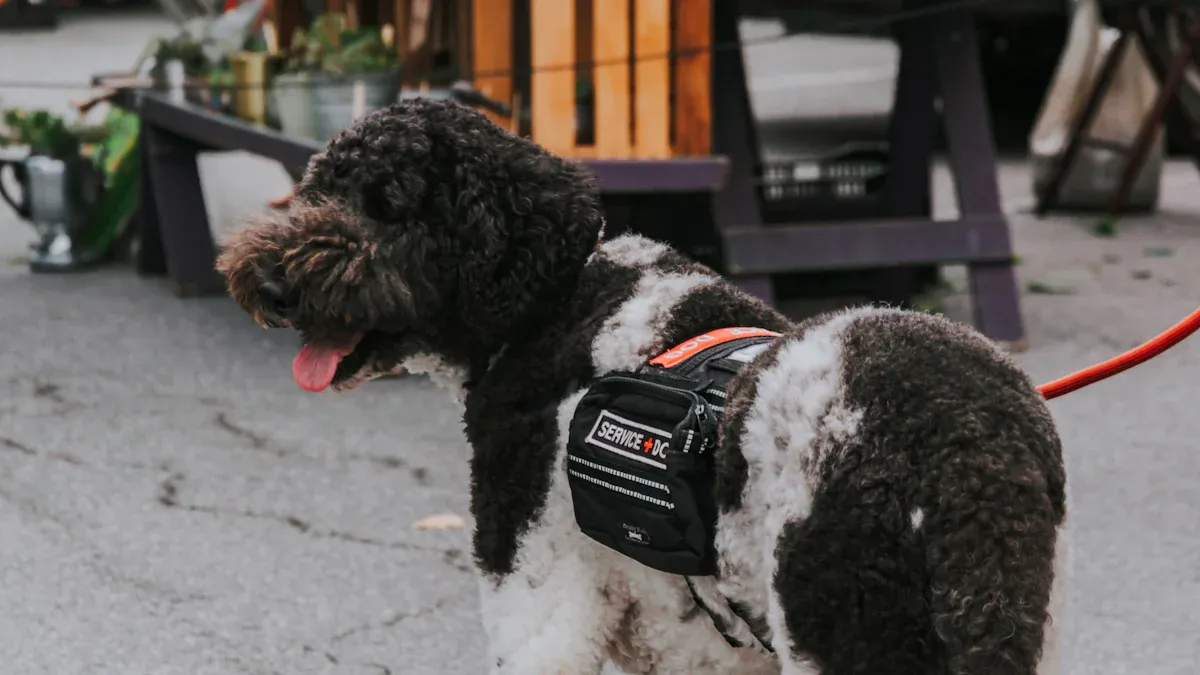
Rear support sling
A rear sling supports the hindquarters during a short rise, brief potty trip, or controlled transition. It is most appropriate when the front legs remain stable and the dog can still participate in movement. A wide, shaped support panel is preferable to a narrow strap or improvised towel because pressure should be distributed rather than concentrated on the abdomen.
A sling is not ideal when the dog needs prolonged walking support, rotates under the sling, has front-leg weakness, or requires precise control on stairs. For differences between sling designs and fit zones, use the dog support sling guide.
Lift harness with one or more handles
A lift harness is designed for repeated assistance during standing, short walks, stairs, car entry, or daily transfers. It should spread handling force across a stable body panel and remain centered as the caregiver applies support. Handle position matters: an awkward lifting angle can tilt the dog, pull the harness forward, or cause the straps to shift.
Compare support-zone coverage, handle height, strap path, padding, and adjustment rather than choosing by handle size alone. The best dog lift harness guide explains how rear-only and broader support designs differ. Current dog lift harness options can also be reviewed by support area and daily handling scenario.
Full-body lift harness
Full-body support is more appropriate when both the front and rear need assistance, the dog twists under rear-only lifting, or the caregiver needs better control during a whole-body transfer. The front and rear sections should work together so the torso remains level. More coverage is not automatically better: the design still needs clearance around the throat, armpits, abdomen, genitals, and sensitive skin areas.
Joint-specific braces
A harness or sling assists handling; it does not stabilize a particular joint in the same way as a joint-specific brace. When arthritis-related difficulty is concentrated at the knee, hip, hock, carpal joint, or elbow, a veterinarian may help determine whether targeted support is appropriate. Review dog arthritis brace solutions by joint before comparing brace structures, but do not use a generic brace to guess which joint is responsible for a gait change.
Fit and skin checks for mobility aids
A mobility aid should remain stable without restricting normal breathing, toileting, limb movement, or circulation. Fit must be checked while the dog is standing and again while the dog takes several controlled steps. A device that looks centered at rest may rotate, migrate, or tighten when support is applied.
| Check | What to look for | Stop or adjust when |
|---|---|---|
| Strap position | Straps lie flat and avoid the throat, armpits, and bony joint points | A strap rolls, twists, or cuts into a moving area |
| Balance | The dog remains level when light assistance is applied | The body tilts, the rear swings, or the front feet lose contact |
| Gait | Steps remain controlled without obvious shortening or crossing | The device changes limb placement or causes stumbling |
| Skin | No persistent redness, heat, hair disruption, swelling, or moisture buildup | Redness remains after removal or the dog licks, chews, or avoids the device |
| Breathing and toileting | The dog can breathe, urinate, and defecate without obstruction | Panels or straps press into the chest, abdomen, or toileting area |
Introduce new equipment in short sessions. Let the dog inspect it, fit it without lifting, then practice on a flat non-slip surface. Increase assistance only after the dog can stand and take several controlled steps without distress or device movement.
Safer walks and transfer steps
The merged daily-routine content belongs here because equipment choice and handling technique must work together. Keep walks and transfers predictable, use the same clear route, and avoid sudden lifting.
Standing from a bed or floor
- Clear the area and place the dog’s feet on a non-slip surface.
- Position the sling or harness before asking the dog to rise.
- Apply only enough upward support to prevent collapse; allow the dog to bear the weight it can manage safely.
- Pause after standing so the dog can regain balance before moving.
- Stop if the dog cannot place a foot normally, repeatedly buckles, or shows sudden pain.
Short assisted walks
Use a flat, predictable surface and keep the support steady rather than lifting with each step. The goal is balance assistance, not carrying the dog while the legs swing. Watch for slower steps, scuffing, leaning, panting unrelated to temperature, or a change in willingness to continue. End the session before form deteriorates.
Stairs and car transfers
Whenever possible, use a stable ramp instead of asking an arthritic dog to jump. If stairs cannot be avoided, keep the dog aligned with the steps, support the weak area, and move one controlled step at a time. Do not pull upward from a collar or lift from a single narrow strap. During car entry, secure the ramp first and leave enough space for a straight approach.
When home mobility support is not enough
Arthritis may explain a gradual mobility change, but sudden or rapidly worsening signs can indicate a different problem. Stop using the aid and contact a veterinary professional when the device cannot keep the dog stable or when the movement pattern changes unexpectedly.
| Sign | Recommended response |
|---|---|
| Sudden inability to stand or bear weight | Seek prompt veterinary guidance |
| Repeated falls, collapse, or severe loss of balance | Stop assisted walking and arrange urgent assessment |
| New knuckling, dragging, or inability to place a paw | Contact a veterinarian; do not assume the change is only arthritis |
| Marked pain, vocalization, or major behavior change | Stop the activity and seek professional advice |
| New bladder or bowel-control problem | Arrange urgent veterinary evaluation |
| Persistent redness, swelling, sores, or hair loss under equipment | Remove the device and review fit before further use |
How the support options fit together
A practical dog arthritis mobility support plan often uses layers: traction for the route, a ramp for elevation changes, and a sling or harness for tasks where balance assistance is needed. A brace may be considered separately when a specific joint requires targeted support. The broader dog mobility support solutions page organizes these options by daily movement problem.
For pet brands, distributors, and sourcing teams evaluating bulk canine mobility-support product development, GaitGuard’s custom dog brace manufacturer page explains the B2B manufacturing scope. This procurement information is separate from individual veterinary and product-use decisions.
FAQ
Should I choose a ramp or a lift harness for a dog with arthritis?
Choose based on the task. A ramp addresses jumping and elevation changes. A lift harness addresses balance or partial-weight support during standing, walking, stairs, or transfers. Some dogs use both because the tools solve different problems.
When is a rear sling enough?
A rear sling may be enough for brief hind-end support when the front legs remain stable and the dog can still participate in movement. It is less suitable for prolonged walking, front-leg weakness, whole-body instability, or a dog that twists under rear-only support.
How tight should a lift harness fit?
It should stay centered without restricting breathing or movement. Straps should lie flat, remain clear of the armpits and throat, and allow controlled steps without rubbing or pinching. Recheck fit while assistance is being applied, not only while the dog is standing still.
Can a mobility aid replace veterinary treatment for arthritis?
No. Ramps, traction aids, slings, harnesses, and braces are handling or support tools. They do not diagnose the cause of mobility loss and do not replace veterinary assessment, pain management, rehabilitation, or treatment planning.
What should I do if my dog refuses a new device?
Stop forcing the session. Check whether the device shifts, pinches, blocks movement, or changes balance. Reintroduce it for a shorter period on a non-slip surface. If resistance continues or the dog shows pain, ask a veterinarian or rehabilitation professional to review the device and the fitting method.
Dog arthritis mobility support works best when each aid has a defined job. Match the equipment to the difficult movement, introduce it gradually, and keep checking fit, skin, gait, and comfort as the dog’s needs change.
