When comparing a dog brace for ACL injury custom vs off the shelf, the main decision is not whether both options can provide support, but which fit pathway matches your dog’s instability level, anatomy, and rehabilitation plan. This article is for owners, clinics, and rehab-minded buyers who need to compare when custom bracing usually makes more sense, when an off-the-shelf brace may be enough, and what fit, wear, and monitoring factors should guide the final choice. Read it to understand how support goals change with brace type and when to review condition-based support pathways before moving into product selection.
Key Takeaways
Choose custom bracing when fit precision, stronger support, or unusual limb shape make standard sizing less reliable.
Choose off-the-shelf bracing when support is needed quickly and the case still fits standardized sizing and simpler support demands.
Fit quality, wear tolerance, and activity control affect outcomes more than brace category labels alone.
Veterinary guidance should confirm that the brace path matches the ACL case and recovery objective.
Dog Brace for ACL Injury Custom vs Off-the-Shelf
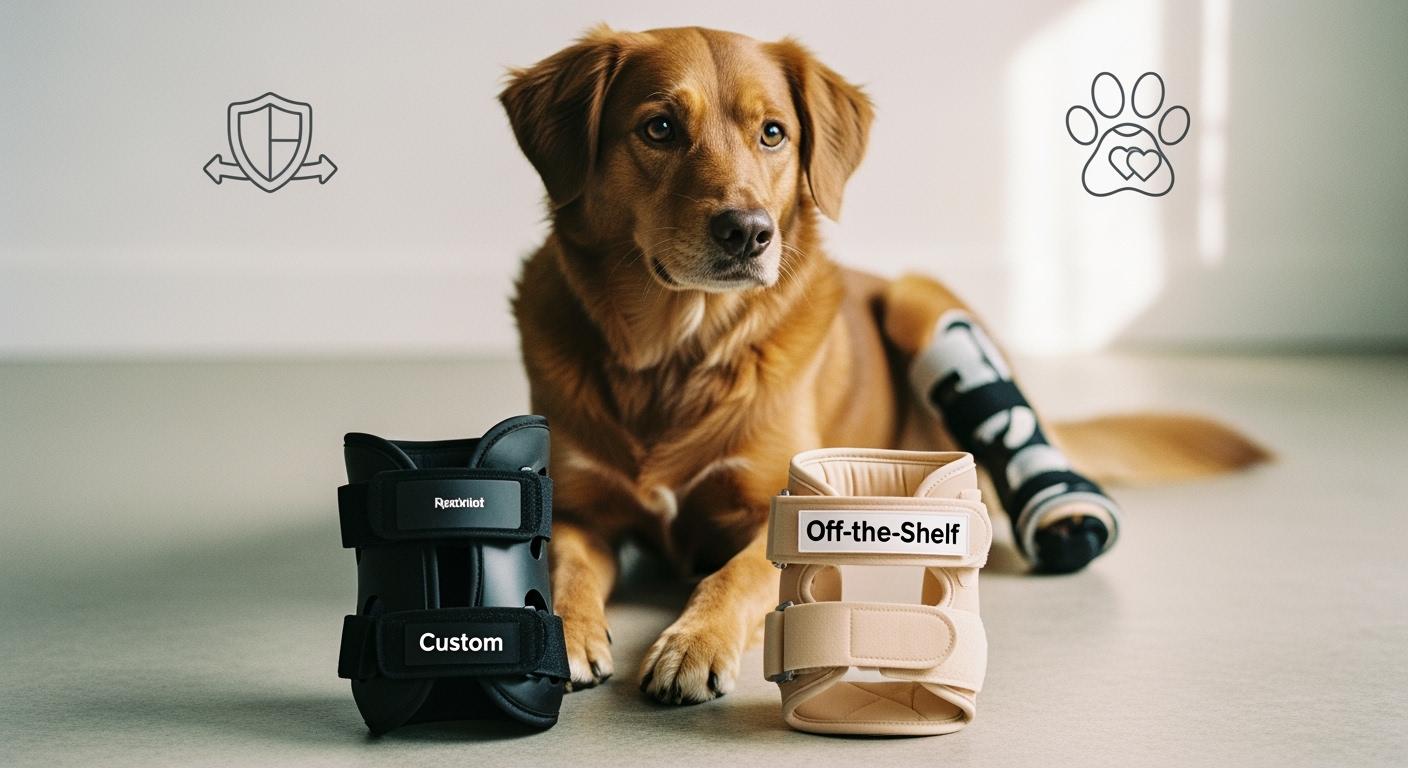
The practical difference is simple: custom braces prioritize fit precision and higher control, while off-the-shelf braces prioritize faster access and simpler setup. The better option depends on what the case actually needs, not on which category sounds more advanced.
What Is a Dog Knee Brace for ACL Injury
A dog knee brace for ACL injury is an external support device used to improve stability around the stifle during conservative management or rehabilitation. In practical use, the brace helps reduce uncontrolled motion, support safer movement, and lower strain on the injured knee when the case is still appropriate for bracing.
A custom brace follows the dog’s individual measurements or mold, which makes it more relevant when alignment precision and higher support demands matter. An off-the-shelf brace follows standardized sizing, which makes it more relevant when the case needs support quickly and the dog’s anatomy still matches a repeatable standard fit.
Dog knee braces help in several ways:
Reduce uncontrolled knee motion during daily movement
Support safer weight-bearing and activity control
Help the dog move with more predictable stability
Work as part of a larger rehab or management plan
If you want broader educational background before comparing brace products, continue through our GaitGuard Guides.
Custom vs Off-the-Shelf: Key Differences
The most useful way to compare these brace paths is by fit precision, support demand, access speed, and how demanding the recovery routine will be. That framework is more practical than comparing products by price or availability alone.
Here is a side-by-side table to help you see the main differences:
Decision factor | Custom Brace | Off-the-Shelf Brace |
|---|---|---|
Fit precision | Higher when measurements are handled correctly | Depends on how well standard sizing matches the dog |
Support demand | Usually better for more demanding or longer-term support cases | Usually better for simpler or early-stage support needs |
Access speed | Slower due to fitting and production steps | Usually faster to obtain and begin using |
Routine complexity | Higher setup involvement | Lower setup involvement |
Main risk | Longer lead time if support is needed immediately | Fit mismatch, slipping, or reduced control |
Custom braces are usually more relevant when the case needs stronger alignment, unusual anatomy makes standard sizing less reliable, or the support routine is expected to be longer and more demanding. Off-the-shelf braces are usually more relevant when the case needs support quickly and the dog still fits a standardized sizing pathway without major alignment problems.
Veterinarians often suggest you:
Confirm diagnosis and support objective first.
Assess whether the case needs higher fit precision or faster access.
Review anatomy, activity level, and daily routine demands.
Choose the brace pathway that can stay aligned and wearable over time.
Decision rule: choose the fit pathway first, then compare products within that pathway.
If you want more information about dog knee braces, visit the dog knee brace product page. For support with ACL or CCL tears, check the ACL/CCL condition-based support page.
Fit and Comfort
Measuring for the Right Dog Knee Brace
Measurement quality matters because both brace paths can fail when the numbers are wrong. A custom brace depends on accurate anatomy capture, while an off-the-shelf brace depends on whether the dog’s measurements still fit standardized sizing without losing alignment.
Measure from the groin to the top of the knee.
Measure from the top of the knee to the apex of the hock.
Wrap the tape around the widest part of the chest, just behind the front legs.
Measure the height from the base of the rear paw to the top of the hip.
Measure the thigh halfway between the knee bend and the groin.
A helper or treats can keep your dog calm. Write down each measurement for the best fit.
Record before choosing brace type: thigh circumference, circumference above and below the knee, brace-zone length, current weight-bearing quality, skin sensitivity history, and whether the case needs immediate support or can wait for a custom fitting process.
Adjustability and Materials
Material and adjustability matter because fit must stay stable over repeated wear. The useful question is not which material sounds premium, but whether the brace can stay aligned, remain tolerable, and avoid skin problems during the intended routine.
Material | Characteristics |
|---|---|
Neoprene | Breathable, durable, lightweight for all-day wear |
Stretchable | Provides a secure fit |
Soft and flexible | Enhances comfort during use |
Custom braces often use more advanced materials for a tailored fit. Off-the-shelf braces use stretchable designs for quick comfort.
Signs of Proper and Improper Fit
A useful fit stays aligned, does not rotate or slip, avoids new pressure points, and supports movement without worsening gait. If the brace rubs, slips, changes stride negatively, or the dog resists wear repeatedly, the fit pathway should be reassessed.
Tip: Always check the fit daily to keep your dog safe and comfortable during knee recovery.
Stability and Rehab Needs
How Braces Support ACL Recovery
A dog knee brace helps your dog heal after an ACL or CCL injury. The brace gives extra support to the knee joint. It acts like the torn ligament and stops bad movements. When the brace fits well, your dog can walk, run, and play with more confidence. The brace helps your dog do rehab exercises and keeps muscles strong. Your dog may feel less pain and swelling because the brace keeps the knee straight.
Gives support to the knee joint
Stops twisting and stretching too far
Lowers swelling and stress on ligaments
Helps your dog move better during rehab
Matching Brace Type to Activity Level
You need to pick a dog knee brace that matches your dog’s activity and rehab stage. Active dogs or dogs with bad injuries often need a custom brace for more support. Off-the-shelf braces are good for mild injuries or quick help. Make sure the brace fits tight but does not hurt your dog. Use the brace for walks, play, or rehab, and slowly let your dog wear it longer as they get stronger.
Pick a brace with enough support for your dog
Change the fit as your dog’s knee gets better
Follow your vet’s advice for activity
Role in Rehabilitation
A brace works best when it supports a broader rehab system that includes activity control, weight management, and repeated reassessment. The brace should make the recovery plan easier to execute, not be presented as the whole recovery plan by itself.
Rehab rule: choose the brace path that the dog and caregiver can actually maintain within the planned recovery routine.
Cost and Accessibility
Custom Brace Price and Lead-Time
Cost and timing should be evaluated together with fit precision and expected support demand. A lower-cost brace that fails in fit or alignment is not automatically the lower-cost decision in practice.
Custom paths usually require more setup time and more professional involvement.
Off-the-shelf paths usually start faster when support is needed immediately.
The correct choice depends on whether speed or fit precision matters more in the case.
Off-the-Shelf Brace Cost and Speed
If you need a dog knee brace quickly, an off-the-shelf brace is a good choice. You can buy this type of brace in standard sizes and start using it right away. The price depends on the style and features. Some braces cost less, while others with hinges cost more. You can see the differences in the table below:
Decision factor | Custom path | Off-the-shelf path |
|---|---|---|
Speed | Usually slower | Usually faster |
Fit precision | Usually higher | More variable |
Setup complexity | Higher | Lower |
Best-fit use case | Demanding or longer-term support needs | Faster-start or simpler support needs |
You can find an off-the-shelf brace at many pet stores or online. This makes it easy to get support for your dog’s knee without waiting.
Budget and Insurance Factors
Budget matters, but the more important operational question is whether the brace path is realistic for the case, the timing, and the level of follow-up the routine will require.
Timing rule: use the faster path only when it still fits the case well enough to remain clinically useful.
Mistakes to Avoid
Skipping Veterinary Diagnosis
The most common mistake is choosing a brace path before the case direction is clear. Veterinary diagnosis should define whether the dog needs higher fit precision, faster early support, or a different treatment path altogether.
Overlooking Fit and Comfort
Fit and comfort matter because a brace that slips, rubs, or changes gait negatively cannot stay clinically useful, even if the support concept was correct.
Common error: a brace that is still wearable is not automatically a brace that is still helping.
A good knee brace stops bad movement, keeps the joint steady, and helps with rehab. Your dog can heal faster if you check the fit every day and make changes when needed.
Misunderstanding Brace Limitations
A brace supports function and rehabilitation, but it does not replace diagnosis, case management, or surgical planning when the injury severity exceeds what bracing can realistically control.
Aspect | Dog Knee Brace | Surgical Intervention |
|---|---|---|
Main role | Support, symptom management, rehab assistance | Structural intervention and stabilization |
Typical fit | Cases where external support remains realistic | Cases where the knee problem exceeds what bracing alone can manage |
Main limitation | Does not repair the ligament by itself | Requires surgical planning and controlled recovery |
Experts say that dog knee braces do not cure torn ligaments or take the place of surgery every time. Braces give outside support and help with simple treatment, but you should not believe claims that they can fix everything.
Quick Comparison Table: Custom vs Off-the-Shelf Dog Knee Braces
Use this shorter summary table to compare how the two brace paths differ operationally:
Brace path | Best-fit use case | Main tradeoff |
|---|---|---|
Custom brace | Higher support demand, harder fit cases, longer-term rehab use | Slower access and higher setup complexity |
Off-the-shelf brace | Faster-start support, simpler cases, early evaluation-stage use | Higher risk of fit mismatch or reduced control |
Fit-path rule: choose the support pathway first, then compare products inside that pathway.
You should always check the fit and comfort of any brace you choose. Watch your dog for signs of rubbing or slipping. Talk to your vet if you have questions about which brace is best for your dog.
Next Steps and Resources
After you decide between custom and off-the-shelf, keep the next step simple. Use Guides for educational background, Solutions for condition-based support direction, and Products when you are ready to compare actual brace options.
Workflow tip: choose the fit pathway first, then compare products within that pathway.
You want your dog to have good knee support after an acl injury. Custom braces fit your dog well and give strong support. Off-the-shelf braces are easy to get and help fast. Look at this table to see the choices:
Feature | Standard Brace | Hinged Brace | Custom-Fit Brace |
|---|---|---|---|
Support Level | Basic | Moderate to High | Very High |
Price Range | Low | Medium | High |
Fit Type | Adjustable | Adjustable with hinges | Tailored to dog’s anatomy |
Ideal Use | Mild issues | CCL tears, post-op | Complex or chronic issues |
Mobility Control | Minimal | Controlled | Customizable |
Here are steps to help your dog get better: 1. Watch how your dog gets used to the brace. 2. Check if the knee brace fits right often. 3. Help your dog by keeping them at a healthy weight, doing gentle exercise, and using therapy.
Pick a brace that fits your dog’s knee and recovery plan. Your vet can help you choose what is best.
The key difference between custom and off-the-shelf ACL bracing is fit pathway, not just product category. Custom braces are usually the better fit when precision, stronger support, and longer-term alignment matter more. Off-the-shelf braces are usually the better fit when support is needed quickly and the case still matches standardized sizing.
Data authenticity note: This article is for educational purposes only. It is designed to help readers compare when a custom ACL brace is more appropriate than an off-the-shelf brace, and when an off-the-shelf brace is a more practical first step. It does not replace veterinary diagnosis, imaging, individualized brace fitting, or a full rehabilitation plan.
FAQ
How do you know if your dog needs a custom or off-the-shelf ACL brace?
Start with fit demand, support demand, and timing. If the case needs more precision or longer-term support, custom is often more relevant. If support is needed quickly and standard sizing still fits well, off-the-shelf may be enough.
Can a dog wear an ACL brace during rehab exercises?
Sometimes, yes. A brace can support movement and reduce overload risk, but it works best when paired with activity control and a broader rehab plan rather than used alone.
How quickly can you get a dog ACL brace?
Off-the-shelf braces are usually faster to obtain, while custom braces usually take longer because they depend on measurement, fitting, and production steps.