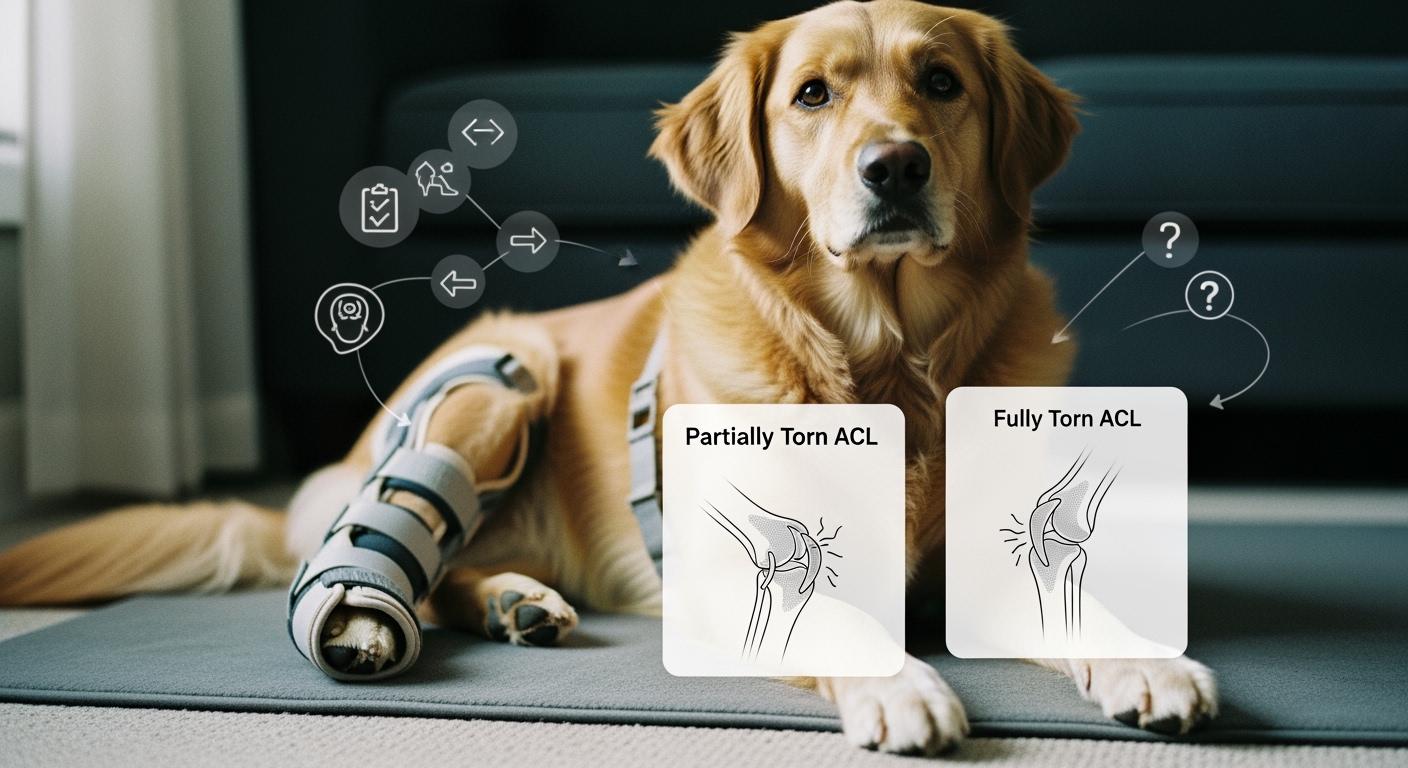
When comparing a dog leg brace ACL tear partial tear vs full tear, the main question is whether the brace is being used to support conservative management in a partial tear or to provide limited support within a larger treatment plan for a full tear. This article is for owners, clinics, and rehab-minded buyers who need to compare how support goals, brace expectations, and decision paths change between these two injury types. Read it to understand when bracing is more realistic for partial tears, why full tears often require a different level of intervention, and when to review condition-based support pathways before moving into product selection.
Key Takeaways
Partial tears usually make bracing more realistic as part of conservative management.
Full tears usually require stronger intervention and different expectations from brace use.
Fit, activity control, and monitoring matter in both cases.
A brace should follow diagnosis and treatment goals, not replace them.
Dog Leg Brace ACL Tear Partial Tear vs Full Tear: What It Means
Understanding Dog ACL Tears
Partial and full tears refer to different levels of injury in the cranial cruciate ligament, often called the CCL or ACL in owner-facing searches. That difference matters because a brace is not being asked to do the same job in both cases. The support path changes with the severity of instability, treatment objective, and expected recovery plan.
Partial tears mean the ligament has some damage. Your dog may still walk, but the knee feels unstable. Full tears mean the ligament is completely torn. This causes much more joint instability. Both types of torn ccl can make your dog limp or avoid putting weight on the leg.
Key Differences: Partial vs Full Tear
Use the comparison below to decide what the brace is realistically expected to do in each case:
Tear Type | What It Usually Means | Brace Role |
|---|---|---|
Partial Tear | Ligament damage with some remaining function and variable instability | Often used to support conservative management and activity control |
Full Tear | Complete rupture with stronger instability and reduced joint control | Usually supportive only within a broader plan that may include surgery or structured rehab |
Partial tears often develop with enough remaining stability that a brace may still play a meaningful role in support, comfort, and conservative management.
Full tears usually move the case into a different decision path. A brace may still help with support or recovery structure, but it is rarely the whole answer in a severe instability case.
The key distinction is not whether a brace exists for both situations, but whether the case still matches what bracing can realistically accomplish.
Support Goals for Partial ACL Tears in Dogs
Stability and Activity Control
In partial-tear cases, the brace is mainly a conservative-management tool. The goal is to reduce instability, support safer daily movement, and make activity control more practical while the case is being monitored and managed.
Bracing usually works best here when it is paired with activity limits, rehabilitation work, weight management, and repeated reassessment rather than being treated as a stand-alone fix.
Partial-tear rule: if the goal is to stabilize daily function while avoiding overload, bracing can be relevant; if instability keeps worsening despite support, the case should be reassessed quickly.
A brace does not repair the ligament directly. Its value in a partial tear comes from supporting function and reducing uncontrolled motion while the dog is being managed conservatively.
You should always control your dog’s activity during recovery. Avoid running, jumping, or rough play. Gradually increase exercise as your dog gets stronger. Canine rehab professionals can guide you on safe activities and progress.
Fit, Comfort, and Monitoring
Fit quality determines whether the brace can stay aligned and remain clinically useful. The brace should add control without creating pressure problems, slipping, or a gait pattern that becomes worse under wear.
Veterinarians check for these key points when fitting a brace:
Does the brace stay aligned during normal movement?
Does the support level match the instability level?
Can the dog tolerate repeated wear calmly?
Are skin and pressure points staying stable?
Can the caregiver manage the routine consistently?
You need to monitor your dog closely while using a brace. Watch for signs that may mean trouble, such as limping, stiffness, swelling, or changes in how your dog moves. The table below shows what to look for and when to call your vet:
Monitoring signal | What it suggests |
|---|---|
Limping that worsens | Sudden change in pain or weight-bearing |
Swelling around the knee | Fit or case response needs reassessment |
Clicking or popping with discomfort | Joint instability may still be significant |
Muscle loss or lower use of the limb | The current plan may not be maintaining function well enough |
Sudden change in pain or weight-bearing | Immediate reassessment is needed |
These signals matter more than whether the brace still appears intact. Brace use should be judged by functional response, not by continued wear alone.
Let your dog rest without the brace as your vet recommends. Regular check-ins with your vet help track healing. Canine rehab experts may adjust your dog’s plan as recovery continues.
Bracing can help your dog heal from a partial ACL tear, especially when combined with canine rehab, weight management, and careful monitoring. Not every dog needs surgery for a partial tear. Early intervention and a tailored plan give your dog the best chance for a strong recovery.
Support Needs for Full Tears or Severe Instability
Realistic Expectations for Dog Braces
In full-tear cases, expectations for bracing should be more limited and more strategic. The question is no longer whether the brace can “handle the whole problem,” but whether it can provide useful support within a broader treatment or recovery plan.
A brace may still help reduce some instability, improve comfort, and support safer movement, but it should not be presented as equivalent to restoring the ligament’s function in a full tear. In severe cases, brace value is usually supportive rather than definitive.
Here is a table that lists the main ways dog braces help with full tears:
Benefit | Description |
|---|---|
Support role | Can add external stability during movement or recovery routines |
Comfort role | May reduce symptom burden in some cases |
Rehab role | Can support structured rehabilitation when used correctly |
Main limitation | Does not resolve the structural problem by itself |
A brace does not fix the ligament. It lets your dog move safely and feel better. For some dogs, like older ones or those with health problems, a brace may be the best choice. For young, active, or big dogs, a brace is just one part of the plan.
When Surgery May Be Needed
When the case is a full tear or severe instability pattern, surgery may become the more realistic path depending on size, activity level, health status, and the degree of instability the dog is showing.
The decision should be guided by veterinary assessment of function, progression, and whether conservative management remains realistic.
Criteria | Description |
|---|---|
Body size | Larger dogs often place higher demands on the unstable knee |
Activity level | More active dogs may need a stronger long-term solution |
Overall health | Health status influences whether surgery is realistic or limited |
Instability severity | Higher instability reduces what bracing alone can realistically do |
If your dog is old, sick, or cannot have surgery, a brace can still help. It can lower pain and help your dog stay active. You should talk to your vet to pick the best plan.
Here is a table that compares braces and surgery for full ACL tears:
Decision factor | Brace pathway | Brace pathway |
|---|---|---|
Typical fit | More realistic in partial-tear or support-focused cases | More realistic in full-tear or higher-instability cases |
Main goal | Support, symptom management, conservative care | Structural intervention and longer-term stabilization |
Role of rehab | Central to success | Still central after surgery |
Main limitation | May not be enough for severe instability | Requires surgical planning and controlled recovery |
Bracing with Veterinary Guidance
Always use a brace as part of a plan made with your vet. Treating a full tear usually needs more than just a brace. Your vet may tell you to use rest, gentle walks, rehab, and keep your dog at a good weight. Physical therapy, water therapy, and joint supplements can also help your dog heal.
Here are some important steps to help your dog with a full tear:
Build up knee muscles with slow walks and rehab.
Keep your dog at a healthy weight to help the knee.
Do not let your dog jump or play rough.
Use joint supplements and anti-inflammatory support if your vet says so.
Make your home safer with rugs that do not slip and ramps.
Go to regular checkups and therapy sessions.
Your vet will check if the brace fits right and look for problems like skin sores or swelling. Follow all the instructions for using and cleaning the brace. This helps your dog get the most help from the brace and avoid problems.
Dog braces are important for treating full ACL tears, but they work best with other treatments. Always work with your vet team to make the best plan for your dog. This gives your dog the best chance to feel good, move well, and enjoy life.
Choosing the Right Dog Brace and Support Path
Assessing Your Dog’s Condition
Start by defining the injury pattern as clearly as possible: partial tear with some remaining function, or full tear with stronger instability and lower confidence in the limb. That distinction should come before product choice, because the support path depends on it.
Record for 7 days before changing brace strategy: weight-bearing quality, walk tolerance, swelling after activity, stair difficulty, skin response under the brace, and whether instability seems unchanged, improved, or worse.
For broader educational background after this section, continue through our Guides before comparing specific brace setups.
Selecting the Best Brace Fit
Brace selection should follow support objective, instability level, and routine practicality. The best brace is not the most complex one by default. It is the one that stays aligned, matches the case, and can be used consistently within the treatment plan.
Match the brace category to partial-tear or full-tear support needs.
Choose the support level that fits the instability level.
Confirm that fit and hinge alignment stay stable during movement.
Check whether the dog tolerates repeated wear calmly.
Make sure the caregiver can manage the routine consistently.
Factor | Why It Matters |
|---|---|
Support objective | Determines whether the brace is being used for conservative management or support within a broader plan |
Fit quality | Keeps the brace aligned and clinically useful |
Wear tolerance | Controls whether the routine is realistic day to day |
Handling practicality | Affects whether the plan can actually be maintained |
Veterinary oversight | Confirms whether the current support path still fits the case |
When you move from planning to product review, compare Products by support level, fit structure, and routine usability rather than by marketing claims alone.
Common Mistakes to Avoid
The most common mistake is treating partial tears and full tears as if they should follow the same brace logic. They should not.
Expecting a brace to solve a full tear by itself
Choosing based on price or speed instead of case fit
Ignoring fit drift, skin response, or worsening instability
Mistake | How to Avoid |
|---|---|
Using one logic for both tear types | Separate support expectations for partial and full tears |
Buying by convenience alone | Match the brace to diagnosis and rehab objective |
Skipping follow-up | Monitor fit, function, and progression regularly |
Common error: a brace that is still wearable is not automatically a brace that is still helping.
If the case direction is still unclear, compare it first against the broader scenarios in our Solutions overview.
Activity Level and Instability: Impact on Support Choices
How Activity Affects Brace Selection
Activity level changes brace demands. A highly active dog usually exposes instability faster, while a low-activity dog may tolerate a simpler support routine. Activity should refine the brace choice, not override diagnosis.
Higher activity usually increases support demands.
Lower activity does not remove the need for correct support matching.
The better brace is the one that matches instability and daily loading realistically, not the one that simply sounds more flexible or more rigid.
Instability and Severity Considerations
Instability severity remains the stronger decision factor. Partial tears may justify a support-first path. Full tears more often require a broader intervention path with different brace expectations.
Decision rule: activity level refines the choice, but tear severity defines the support path.
Choose the brace by what the knee still can do and what it can no longer do safely. Partial tears and full tears should not be managed with the same assumptions.
For follow-up after this comparison, continue only to the most relevant internal paths: use Guides for educational background, Solutions for condition-based direction, and Products when the case is ready for brace evaluation.
Data authenticity note: This article is for educational purposes only. It is designed to help readers compare how brace expectations differ between partial ACL/CCL tears and full tears in dogs. It does not replace veterinary diagnosis, imaging, individualized brace fitting, surgery planning, or a full rehabilitation program.
Match the right brace and support plan to your dog’s ACL tear for the best results.
Partial and full tears need different care and expectations.
Always talk with your veterinarian and follow their advice.
Use trusted resources to help your dog recover and stay active.
FAQ
What does a dog leg brace do for an ACL tear?
A brace supports function and helps manage instability, but it does not repair the ligament by itself.
Can a brace help with both partial and full ACL tears?
Yes, but not with the same expectation. In partial tears, bracing may support conservative management. In full tears, bracing is usually more limited and often part of a broader treatment or recovery plan.
How do you choose the right brace for your dog?
Choose by diagnosis first, then by instability level, fit quality, activity demands, and whether the support routine is realistic to maintain.
Can a partial tear become a full tear if support fails?
It can progress if instability and loading are not controlled well enough, which is why monitoring matters as much as initial brace choice.
When should a brace plan be reassessed?
Reassess when limping worsens, swelling increases, weight-bearing drops, or the brace no longer changes daily function in a meaningful way.