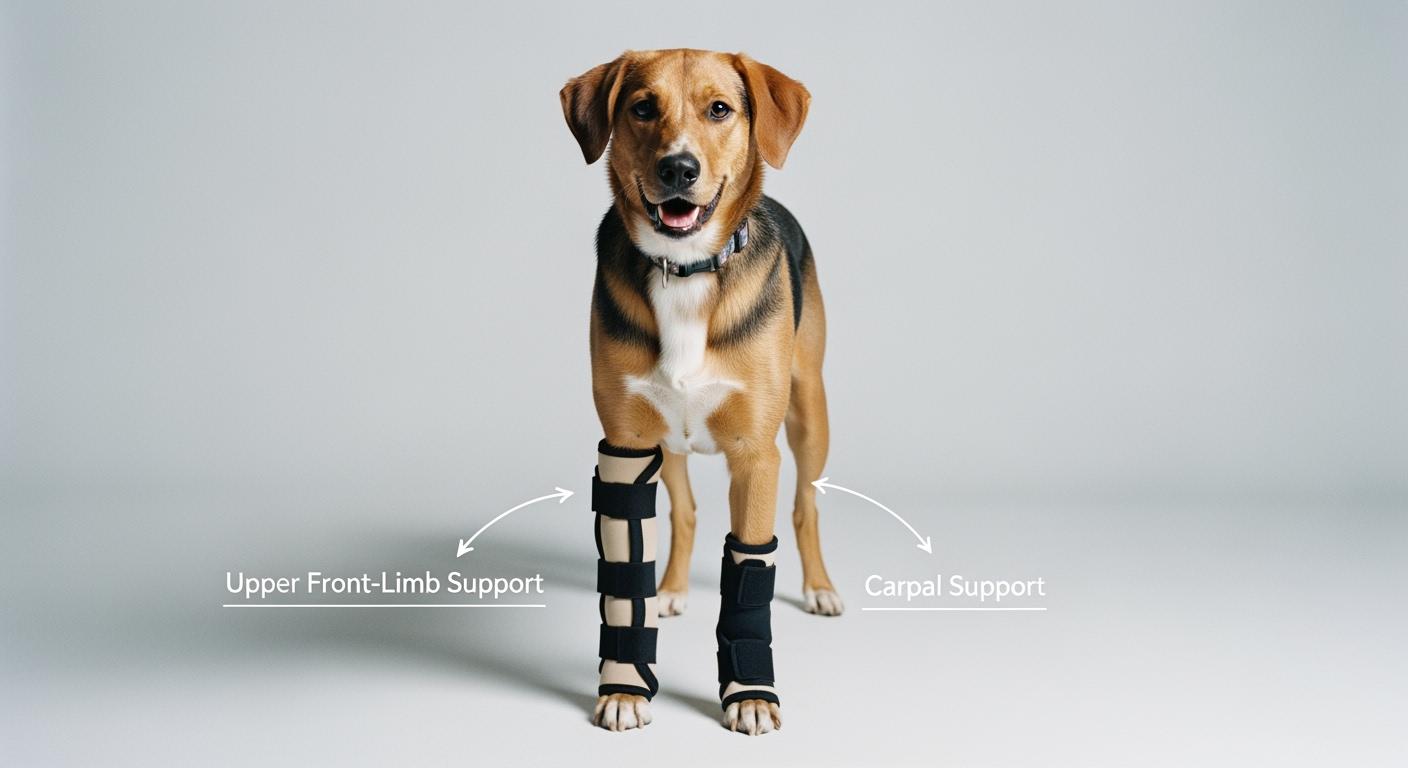
You may wonder whether your dog needs carpal support or upper front-limb support. Carpal support targets the wrist joint, helping with issues like hyperextension, sprains, or arthritis pain in the lower front leg. Upper front-limb support helps stabilize injuries higher up, such as the shoulder or elbow. Signs like swelling at the wrist, limping, or stiffness often point to carpal issues. If your dog shows pain or instability higher on the leg, upper limb support may help. Always talk to your veterinarian before choosing a dog leg brace front. This article will help you focus on fit, comfort, and daily use.
Key Takeaways
Find out where your dog is hurt. Use carpal support if the wrist is hurt. Use upper limb support for elbow or shoulder problems.
Talk to your veterinarian before picking a brace. The veterinarian can find the problem and tell you which support is best.
Make sure the brace fits well. Measure your dog’s leg when they are standing. Check if the brace feels good so it does not bother your dog.
Let your dog wear the brace for a short time at first. Slowly let your dog wear it longer so they get used to it.
Look at your dog’s skin often for any signs of irritation. Fix any problems right away to keep your dog safe and comfortable.
Dog Leg Brace Front: Support Areas Explained
When you search for dog leg brace front, you usually want to know which part of your dog’s front leg needs support. This term often refers to braces that help stabilize either the lower front leg (wrist or carpal area) or the upper front limb (elbow or shoulder). Understanding the difference helps you choose the right brace for your dog’s specific injury or condition.
You can see the main types of braces and their support areas in the table below:
Type of Brace | Support Areas |
|---|---|
Front Splint | Supports the carpal joint, wrist, and paw, stabilizing the entire lower leg. |
Carpal Splint | Supports only the carpal joint and lower leg, allowing the paw to move freely. |
If your dog has trouble with the wrist or paw, a carpal splint or front splint may help. These braces focus on the lower part of the leg. For injuries higher up, such as the elbow or shoulder, you may need a brace that covers the upper front limb. Each type of brace targets a different area, so knowing where your dog feels pain or weakness is important.
You can find more details about general front-leg support in our front-leg support guide and learn about wrist-specific solutions in our dog carpal brace guide. These resources help you understand which brace matches your dog’s needs.
Carpal (Wrist) Support
Carpal support braces help dogs with wrist injuries, arthritis, or instability in the lower front leg. These braces wrap around the carpal joint and sometimes extend to the paw. They keep the wrist steady and limit movement that could cause pain. Carpal braces work well for dogs who limp, show swelling at the wrist, or have trouble placing weight on the paw. You can read more about carpal support in our educational dog carpal brace guide.
Upper Front-Limb Support
Upper front-limb support braces help dogs with injuries or weakness in the elbow or shoulder. These braces cover a larger area and provide stability higher up the leg. If your dog struggles with movement near the elbow or shows pain when lifting the leg, upper limb support may help. For a deeper look at upper limb support, visit our dog leg brace educational page.
Dog Leg Braces: Anatomy and Common Injuries
Front Leg Anatomy Overview
To pick the right brace, you should know your dog’s front leg parts. The front leg has a few main sections:
The humeral region is at the top of the leg. It connects to the shoulder.
The radial region is under the humerus. It leads down to the carpal area.
The carpal region is the wrist joint. This joint lets your dog move its leg easily.
The distal extremities are the paw and toes.
When your dog walks, the front leg touches the ground. This is called the stance phase. When the paw moves forward, it is the swing phase. Each part helps hold your dog’s weight and take in shock. If one part gets hurt, your dog might need a brace or splint. This can help keep the leg steady and lower pain.
Typical Injuries Requiring Bracing
Dogs can hurt different parts of their front legs. Some injuries happen more often than others. You can look at the table below to see common injuries and how often they happen:
Injury Type | Prevalence Description |
|---|---|
Cranial Cruciate Ligament | This injury is common in dogs. It happens a lot in big breeds like Labrador Retrievers and Rottweilers. Fixing the CCL is a surgery vets do often. |
Carpal injuries can happen from sudden hits, sprains, or twisting the joint. Sometimes, carpal injuries come from too much bending or turning. Side-to-side forces can also hurt the carpal joint. Some breeds have weaker ligaments, so they get hurt more easily. Diseases like rheumatoid arthritis can also cause problems in the carpal joint.
Upper front-limb injuries can be broken bones, torn ligaments, or hurt tendons. Other problems are dislocated joints, brachial plexus avulsion, elbow dysplasia, bone infection, and muscle injuries. Vets use exams, X-rays, and sometimes MRI to find out what is wrong. If your dog has pain, swelling, or trouble moving the leg, a brace can help. It can support healing and make your dog feel better.
Tip: Always ask your vet to check your dog’s injury before picking a brace. Finding the problem early helps your dog get better faster.
Carpal vs Upper Limb Braces: Choosing the Right Support
Picking the right support for your dog’s front leg injury is important. The right brace can help your dog heal and feel better. You need to match the brace to where your dog is hurt. Think about what your dog does every day. This section will show you how carpal and upper limb braces are different. You will learn when to use each one. You will also see what is good and not so good about them.
When to Use Carpal Support
Carpal support is best if your dog has problems with the wrist or lower front leg. These problems can happen after an accident, too much running, or as your dog gets older. Watch for these signs:
The lower front leg feels loose or wobbly.
The area near the wrist is swollen.
Your dog uses one leg more than the other.
The wrist looks bent in a strange way.
The lower leg looks flat on the ground.
Your dog walks or runs in a weird way.
Your dog does not want to move much, especially if it hurts a lot.
Carpal support braces help most with wrist joint injuries. Look at the table to see which injuries need this kind of brace:
Injury Type | Description |
|---|---|
Sprains | Ligament injury. It can be mild, medium, or bad. |
Luxations | The joint is out of place. Many ligaments and the joint capsule are hurt. This happens a lot in the carpus and tarsus. |
Fractures | The bone breaks where it connects or from bending too far. This makes the joint weak. |
If your dog cannot stand or walk because of wrist pain, a carpal brace or dog splint can help. The brace keeps the joint steady. It can make pain less and help your dog feel safe moving around.
When to Use Upper Limb Support
Upper front-limb support braces are for dogs with injuries or weakness higher up the leg. Look for these signs and times:
Your dog is getting better after surgery on the leg or hip.
Your dog has hip, elbow, or shoulder dysplasia.
The upper limb bends too much.
The kneecap is out of place or the cruciate ligament is torn.
Your dog cannot feel where the leg is.
There is a slipped disc in the back.
The upper limb ligaments are hurt but not too bad.
Your dog has arthritis in the elbow or shoulder.
Your dog is healing after surgery.
These braces keep the upper leg steady. They stop the joint from moving too much. They help muscles get stronger again. Your dog can move with less pain. The brace also stops more injuries while your dog heals. If your dog has trouble balancing or hurts near the elbow or shoulder, upper limb support may be best.
Benefits and Limitations
Carpal and upper limb braces both help, but each has good and bad points. The table shows what is good about carpal support braces:
Benefit | Description |
|---|---|
Gentle support | Gives gentle help to the carpus. It keeps the joint safe and stops more injury. |
Pain reduction | Stops painful moves. Your dog can walk with less pain. |
Joint stability | Keeps the joint still. This helps it heal and hurts less when moving. |
Full support during therapy | Gives full help when your dog is getting better after injury or surgery. |
Waterproof | Good for water therapy. The brace will not get ruined. |
Freedom of movement | The carpus gets help but the paws can still move. This lets your dog walk naturally. |
Confidence in movement | Your dog can stand and walk better. Steps are less shaky. |
Upper limb braces also help with pain and keep the leg steady. They are good after surgery or for long-term problems. They stop the joint from moving too much, help balance, and let muscles heal. But both types of braces can make it harder for your dog to move. Some daily things may be tough. Your dog might need time to get used to the brace, especially if it covers a big part of the leg or is stiffer than a front leg splint.
Tip: Always check if the brace fits well and feels good for your dog. If the dog leg brace is too tight or loose, it can rub, stop your dog from moving, or slow down healing. Ask your vet to help you pick the right brace for your dog’s injury and how active your dog is.
Decision Guide: Which Brace Does Your Dog Need?
Use this checklist to help you pick between carpal and upper limb support:
Where does your dog hurt or swell?
At the wrist or lower leg: Try carpal support.
Higher up, near the elbow or shoulder: Try upper limb support.
Does your dog have trouble standing or walking?
Yes, with a bent or flat wrist: Carpal support may help.
Yes, with weak or sore upper leg: Upper limb support may help.
Did your dog have surgery or a joint problem?
Yes, in the lower leg: Use a carpal brace or dog leg brace front.
Yes, in the upper limb: Use an upper limb brace or front leg splint.
How active is your dog?
Active dogs may need braces that let them move more.
Less active dogs may do better with a stiffer brace.
The right support helps your dog heal faster and walk with confidence. For more help picking and fitting dog leg braces, check our page about dog leg brace front and our big guide to dog leg braces.
Fit, Comfort, and Common Mistakes
Proper Fitting Tips
Getting the right fit for dog leg braces makes a big difference in your dog’s recovery. You should always measure your dog’s leg and joint sizes carefully. Use a soft tape measure and keep it snug but not tight. Measure while your dog stands to get the most accurate numbers. Take each measurement twice to avoid mistakes. The materials in the brace matter, too. Look for padding, hinges, and fastening systems that match your dog’s needs. Carpal braces often have more flexible padding, while upper limb braces may use extra support. A good fit feels snug but does not squeeze. Your dog should move freely without rubbing or chafing. If you see the brace slipping or twisting, it may not fit right.
Comfort and Daily Use
You want your dog to feel comfortable in their brace every day. Start by letting your dog wear the brace for short periods. Use treats and praise to help them adjust. Slowly increase the time as your dog gets used to it. Most dogs should wear their brace for 8 to 12 hours during active times. Take the brace off at night or when your dog rests for a long time. Always check your dog’s skin for redness, swelling, or irritation. Clean the brace often with a lint roller to remove fur. Handwash it in lukewarm water with gentle soap and let it air dry. Watch for signs like licking, chewing, or limping. These may mean the brace does not fit well. If you notice any problems, talk to your veterinarian. Regular checkups help keep your dog safe and comfortable.
A brace only works if it fits well. Too loose, and it will not support your dog. Too tight, and it can hurt or cut off blood flow. Always check for rubbing, slipping, or discomfort.
Mistakes to Avoid
Many dog owners make simple mistakes when using dog leg braces. You can avoid these problems by following a few tips:
Common Mistakes | Description |
|---|---|
Wearing the brace too tight | Can cause discomfort and restrict circulation. |
Leaving it on overnight | May lead to skin irritation or injury. |
Skipping rest days | Essential for proper healing and recovery. |
Using a brace instead of activity restriction | A brace supports but does not replace rest. |
Ignoring skin checks | Regular checks prevent skin issues. |
Measure your dog’s leg while standing, not sitting.
Make sure the tape is snug, not loose.
Double-check every measurement.
Watch for signs like licking, chewing, or new sores.
Never use a dog splint or brace as a replacement for veterinary care.
Veterinarians recommend checking the fit often and scheduling regular visits as your dog heals. They can help you choose the right brace and make sure it gives enough support without causing harm. For more tips, visit our dog leg brace educational page or ask your vet for advice.
Carpal braces help the wrist joint. They are good for sprains and arthritis. Upper front-limb braces keep the forelimb steady. They work well for elbow injuries and after surgery. Use the checklist to find what your dog needs. Always ask your veterinarian for advice. For more tips, look at our educational pages about dog leg braces and front-leg support.
FAQ
How do I know if my dog needs carpal or upper limb support?
You should check where your dog shows pain or swelling. Carpal support helps the wrist or lower leg. Upper limb support helps the elbow or shoulder. Ask your veterinarian for a diagnosis.
Can my dog wear a brace all day?
You should let your dog wear the brace during active hours. Remove it at night or during long rest. Always check your dog’s skin for redness or irritation.
What signs show a brace does not fit well?
Watch for these signs:
Licking or chewing at the brace
Limping or walking oddly
Redness or sores under the brace
If you see these, adjust the fit or talk to your vet.
How do I clean my dog’s leg brace?
Handwash the brace in lukewarm water with mild soap. Let it air dry. Clean it often to remove fur and dirt. This keeps your dog comfortable and the brace working well.