
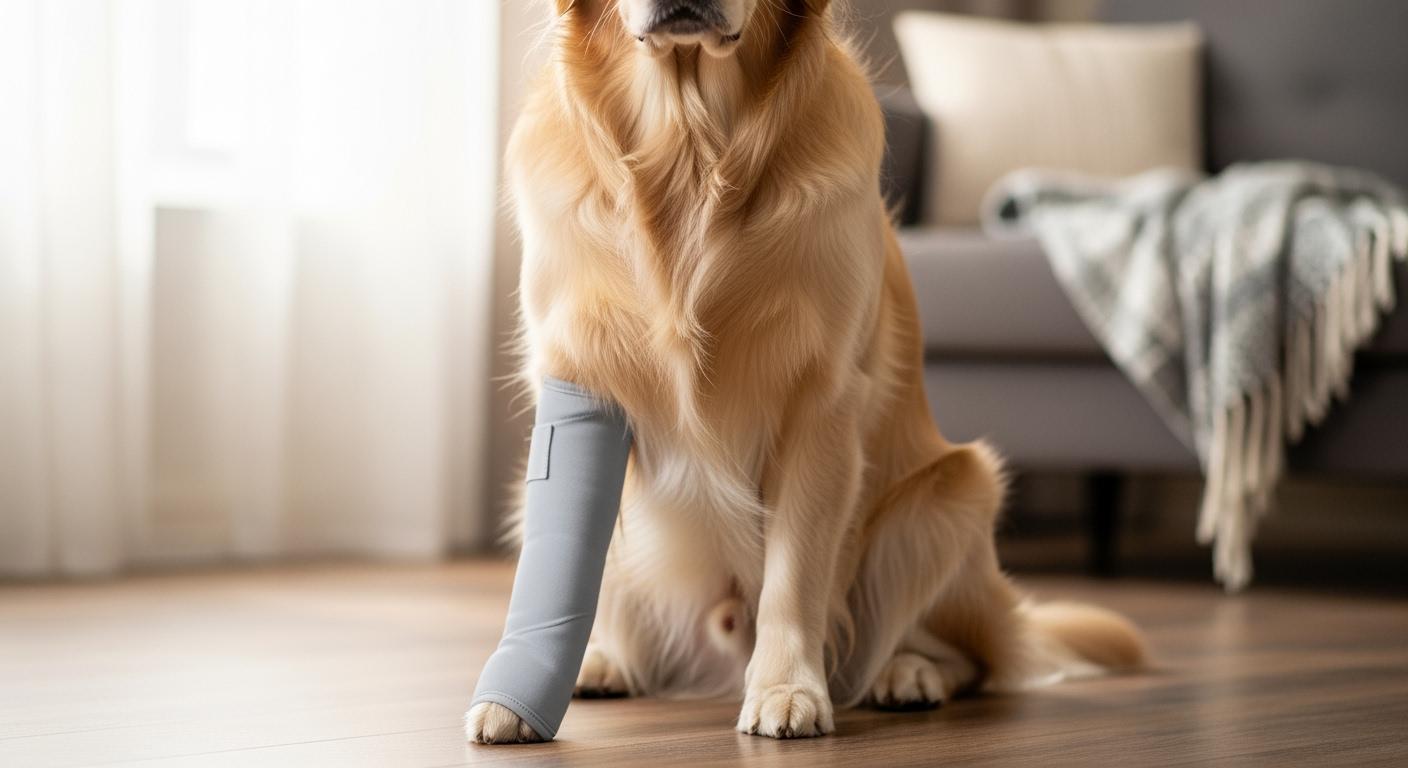
A dog sleeve to prevent licking front leg covers a wound or irritated area and blocks the dog from reaching it. That is the idea. What actually happens, though, is that within minutes of putting the sleeve on, the dog locates a loose strap tail or an exposed buckle and starts chewing. The sleeve is not torn because the fabric is weak. It fails because the closure sits inside the dog’s bite path. Strap ends hang free. Moisture builds up underneath. The licking stops for a moment — then restarts worse than before.
Most sleeve failures trace back to three points: where the closure is positioned, whether strap tails are secured, and how well the fabric manages moisture against the skin. Each point is a design decision, not a random accident. And each can be checked.
Why a Front-Leg Sleeve Fails When the Dog Reaches the Closure
A sleeve wraps around the leg and fastens somewhere along its length. That fastening point — a buckle, a hook-and-loop tab, a strap anchor — creates a hard edge or a loose end. If the closure sits on the lateral or anterior surface of the front leg, the dog can reach it by curling its neck downward and to the side. The geometry is unforgiving. A dog of average flexibility can touch nearly any point from the mid-humerus down to the carpus on the front leg. Place a buckle in that zone and the dog will find it.
The bite path dictates which closures survive
The causal chain is mechanical, not behavioral. A buckle positioned on the lateral aspect of the front leg sits inside a reachable arc when the dog lowers its head. The dog does not need to be determined or anxious — the hard edge is simply there, accessible. Once the dog’s teeth engage the buckle edge, the force applied is concentrated on a small surface area. A typical medium-to-large dog can apply bite pressure sufficient to deform a plastic side-release buckle within seconds. The buckle cracks or opens. The sleeve loses tension. It slides. The wound is exposed.
This is not about the dog misbehaving. It is about why licking persists even when a barrier is in place — the barrier itself becomes the target when the closure geometry works against the dog’s anatomy.
Strap tails turn into pull toys
A strap tail that hangs loose past the buckle or fastener is a lever. The dog grabs it and pulls. Even a short tug shifts the strap through the buckle or loosens the hook-and-loop engagement. Once the strap loosens, the sleeve circumference increases, and the whole assembly can rotate or slide down the leg. A sleeve that was covering the wound five minutes ago now sits bunched above or below it.
The fix is not trimming the strap shorter — it is a design where strap ends are captured inside a fabric tunnel, folded back under a keeper, or secured flat against the sleeve body so no free edge protrudes.
A shifted buckle relocates the entire coverage zone
When a buckle does not sit flat — either because of its profile or because the underlying fabric bunches — every step the dog takes produces a small micro-shift. Over dozens of steps, the buckle migrates. The sleeve twists. The protected zone moves with it. What started as full coverage of a wound on the anterior foreleg becomes partial coverage with the wound edge exposed. The dog notices the exposed edge and licks it. The sleeve is still on, but functionally it has already failed.
| Failure Point | Why It Happens | Better Design or Action |
|---|---|---|
| Loose strap tail | Strap end not captured or tucked | Cover strap ends inside a fabric tunnel or keeper |
| Exposed buckle edge | Closure sits inside the dog’s bite path | Low-profile buckle, positioned dorsally or recessed |
| Sleeve twists after walking | Closure shifts under load or sleeve circumference too loose | Adjust fit, verify buckle position after movement |
| Damp fabric under the sleeve | Low breathability traps moisture against skin | Multi-directional stretch fabric with open knit structure |
| Dog chews same spot repeatedly | Closure or seam edge irritates skin | Reposition closure, check for rub marks |
| Status | What You See | Was ist zu tun? |
|---|---|---|
| Green | Closure stays flat, skin is dry, dog ignores the sleeve | Continue use, routine checks |
| Yellow | Dog noses strap, fabric shifts, mild rub marks appear | Adjust fit, retuck straps, monitor |
| Red | Dog chews buckle, wound exposed, skin wet or red, swelling | Remove sleeve, contact your veterinarian |
Closure Design Details That Keep the Sleeve Working
A sleeve keeps a dog from licking a front-leg wound only as long as every closure point stays out of reach. Three design details determine whether that lasts ten minutes or ten hours.
Low-profile buckles remove the hard point dogs target
A buckle that protrudes from the sleeve surface creates a purchase point. The dog’s teeth catch the edge and apply force. A low-profile buckle — one that sits nearly flush with the fabric, with rounded edges and no protruding lip — denies the dog that purchase. The teeth slide off rather than catching. This is not about making the buckle “stronger.” It is about reducing the mechanical advantage a dog’s bite has over the closure. Sleeves designed with recessed, flat-profile closures change the bite equation entirely — the dog cannot get a grip, so it stops trying.
Covered strap ends eliminate the pull-and-chew cycle
Every exposed strap tail is a handle the dog can use. Once pulling starts, it cascades: the strap loosens, the sleeve shifts, the wound appears, licking resumes. Strap ends sewn inside a fabric channel or secured under a dedicated flap remove the handle. The dog’s mouth finds nothing to grip. The sleeve stays where it was fitted.
When fitting any front-leg sleeve, run your finger along every strap from anchor point to tip. If you can lift a free end, the dog can too. Tuck it. If there is no channel or flap to tuck it into, that sleeve will fail at the strap — not on day ten, but on day one.
Smooth edge binding at the armpit and lower cuff prevents rub irritation
The axillary area and the distal cuff are high-motion zones. Every step flexes the skin at these boundaries. A raw-cut or stiff fabric edge at either point rubs with each stride. Over an hour, the friction produces redness. The dog licks to soothe it — licking the very area the sleeve was meant to protect. Smooth, folded-edge binding or a seamless knit construction at both openings reduces friction by distributing contact across a wider, softer surface instead of a narrow edge.
Breathable fabric breaks the moisture-licking loop
Moisture trapped under a sleeve creates a cycle: skin gets damp, dampness causes irritation, irritation triggers licking, licking introduces more moisture. A fabric with an open knit structure and multi-directional stretch interrupts that cycle. Air moves through the material, carrying moisture away from the skin. The skin stays dry. Without the dampness trigger, the dog has one less reason to focus on the leg.
The fabric also needs to dry quickly. A sleeve that stays wet after washing or after a walk in wet grass becomes a bacteria trap. Rotating between two clean, dry sleeves and washing in cold water with air drying keeps the material from degrading and the skin from reacting.
| Performance Difference | Warum das wichtig ist | Signal weiterleiten |
|---|---|---|
| Open-knit breathable fabric vs. dense woven | Trapped moisture triggers skin irritation and licking | Paper towel pressed against skin under the sleeve after 20 minutes of wear comes away dry |
| Multi-directional stretch vs. single-axis stretch | Single-axis stretch bunches or restricts during compound leg movements | Sleeve does not ride up or twist during a 10-step walk; fabric moves with the leg without bunching |
| Seamless or flat-seam construction vs. overlock stitching | Raised inner seams concentrate pressure along narrow lines, creating rub points | No linear red marks on skin after 60 minutes of wear |
| Machine-washable quick-dry vs. slow-drying liner | A sleeve that stays damp between uses harbors bacteria | Sleeve air-dries fully within 2-3 hours after hand washing |
Running a Chew Test Before Extended Wear
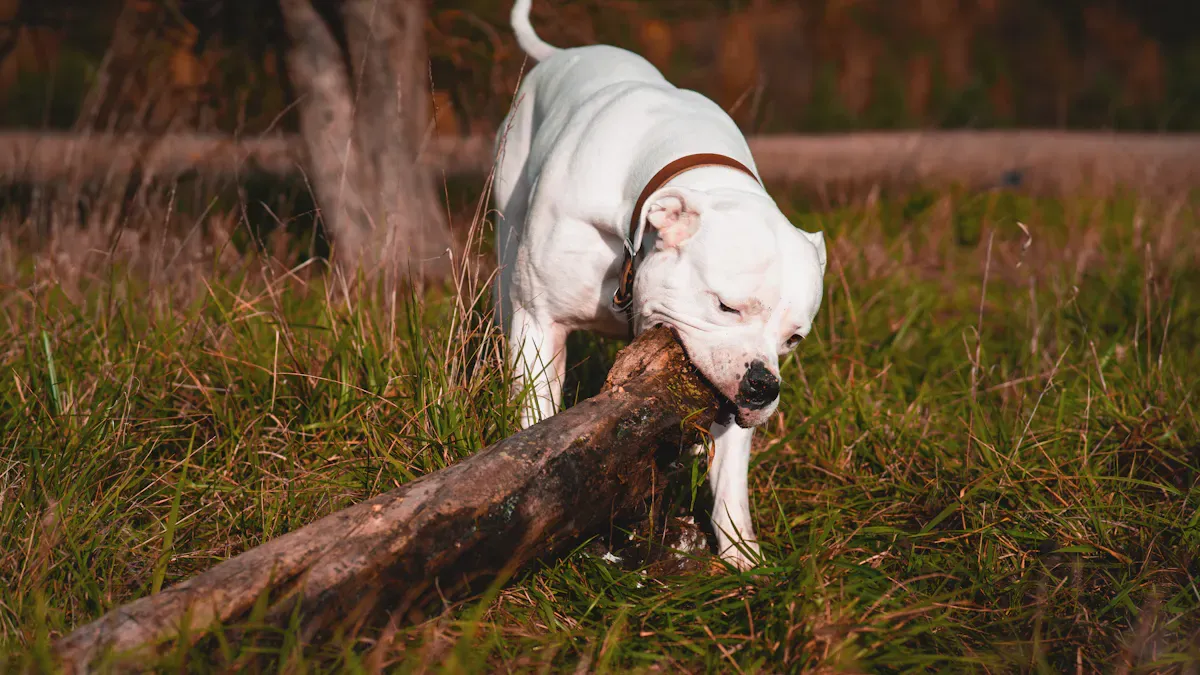
A sleeve that passes a 60-minute supervised chew test will usually survive a full day. One that fails in the first ten minutes will never work, no matter how many times it is re-adjusted. Fit and coverage checks after the first wear session reveal problems before they compound.
Fit the sleeve while the dog is standing
Fit the sleeve on a standing dog, not a lying one. A leg loaded with weight has a different circumference and muscle shape than a relaxed leg. If the sleeve fits correctly under load, it is less likely to shift when the dog moves. Cover the entire wound or irritated area with at least half an inch of fabric margin above and below. Tuck every strap end. If a strap end cannot be fully tucked, that sleeve’s closure design is incompatible with this dog’s leg shape.
Walk 10 to 20 steps, then check for movement and moisture
Walk the dog indoors on a flat surface for 10 to 20 slow steps. Watch the sleeve. Does the buckle stay flat? Does the fabric twist? After 20 minutes of indoor activity, remove the sleeve. Press a dry paper towel against the skin. If the towel comes away damp, the fabric is not moving enough air. If the towel is dry and the skin temperature under the sleeve matches the uncovered leg, airflow is adequate. Check whether any strap end has crept out from its tucked position — movement loosens straps that felt secure during static fitting.
Watch where the dog noses, bites, or paws
Some dogs ignore the sleeve completely. Others fixate within seconds. Dogs with high baseline excitability or strong reactions to handling tend to target closures faster. If the dog noses the buckle, mouths a strap, or paws at the sleeve edge, those are the points that will fail. Mark them. If those points correspond to closures or seam lines, the sleeve design is wrong for this dog — not because the dog is difficult, but because the closure geometry puts hard points inside the dog’s investigatory field.
In practice: A dog that ignores the sleeve for 30 minutes of supervised wear will usually tolerate it for a full wear session. A dog that targets a closure within the first five minutes will not adapt — the closure must be repositioned or the sleeve replaced with a different design.
Recheck closures after 30 to 60 minutes
Remove the sleeve after the first 30 to 60 minutes and inspect. Run your hand along the inside surface — any damp patches? Check the skin for linear red marks along seam lines or cuff edges. Check whether buckle position has migrated from where it started. If any strap has loosened by even a quarter-inch, the closure is slipping under load. Re-tuck and re-test. If it loosens again, that closure type cannot hold against this dog’s movement pattern.
When a Front-Leg Sleeve Is Not the Right Tool
A sleeve is a physical barrier. It works when the barrier stays between the dog’s mouth and the wound. It stops working when the dog defeats the barrier or when the barrier itself creates a new problem. Recognizing the difference between an adjustment issue and a fundamental mismatch saves days of frustration — and protects the wound.
Repeated chewing means the barrier has already failed
If the dog chews through a strap, cracks a buckle, or tears the fabric more than once, the sleeve is not a viable barrier for this dog. Re-adjusting the same sleeve will not change the outcome. The closure geometry that failed the first time will fail again. At that point, broader anti-lick strategies beyond a single-leg sleeve become relevant — a recovery suit, a combination of sleeve plus soft collar, or a different barrier configuration that removes the closure from the bite path entirely.
Wet fabric and skin redness signal the sleeve is working against recovery
A sleeve should keep the wound environment stable. When the fabric under the sleeve feels damp at a routine check, or the surrounding skin appears red or swollen, the sleeve is contributing to the problem it was meant to solve. Moisture trapped against skin macerates the tissue. Bacteria proliferate in the warm, wet environment. The dog licks more, not less. Daily-use sleeve fit and protection protocols emphasize switching to a dry sleeve the moment dampness is detected — not at the next scheduled check.
| Warning Sign | What It Indicates | Action |
|---|---|---|
| Damp fabric at routine check | Moisture trapped, breathability insufficient | Switch to dry sleeve; evaluate fabric breathability |
| Red or swollen skin under or near the sleeve | Irritation or early infection | Remove sleeve, contact your veterinarian |
| Dog chews through closure more than once | Closure inside bite path, barrier compromised | Switch to alternative recovery tool |
| Foul odor from fabric or skin | Bacterial buildup, possible wound complication | Remove sleeve, contact your veterinarian |
Switching to a cone, recovery collar, or combination approach
Some front-leg wounds sit at a position — very distal, near the carpus, or very proximal, near the elbow — where any sleeve closure will inevitably land inside the dog’s bite arc. In these cases, a sleeve alone will keep failing regardless of design quality. An e-collar, a soft recovery collar, or a combination of a short sleeve with a collar that blocks the head’s downward reach changes the geometry enough for the barrier to hold.
Disclaimer: The fit checks described here assume a short-coated dog where rub marks and moisture are visually detectable. Double-coated breeds may hide early redness under dense fur — hand-check the skin by parting the coat and feeling for heat or dampness rather than relying on visual inspection alone. Dogs with angular limb deformities or body conformations far outside breed norms may experience pressure points at locations a standard sleeve pattern does not account for.
Frequently Asked Questions
How often should the sleeve be checked during daily wear?
Twice daily at minimum — once mid-morning after the dog has been active, and once before overnight wear if the sleeve is used continuously. Each check includes feeling for dampness along the full interior, inspecting skin at the cuff and armpit edges, and verifying that no strap end has worked free.
Can the sleeve be worn outside in wet conditions?
A sleeve can be worn outside, but if the fabric gets wet — from rain, wet grass, or puddles — it must be removed and replaced with a dry sleeve immediately. A wet sleeve against skin for more than a brief period accelerates the moisture-irritation-licking cycle. Keeping a backup sleeve dry and ready makes the swap fast.
What cleaning routine keeps the sleeve safe for continued use?
Wash in cold water with a mild detergent that leaves no residue. Air dry only — heat from a dryer can degrade elastic fibers and shrink stretch fabric, changing the fit. Rotating between at least two sleeves means one is always clean and dry while the other is being washed.
When should the sleeve be discontinued entirely?
Stop using the sleeve if there is swelling, bleeding, discharge, a foul odor, or if the dog shows signs of pain when the sleeve is touched. Any of these signals means the wound environment is deteriorating and a veterinarian should evaluate it before a barrier is reapplied.
