
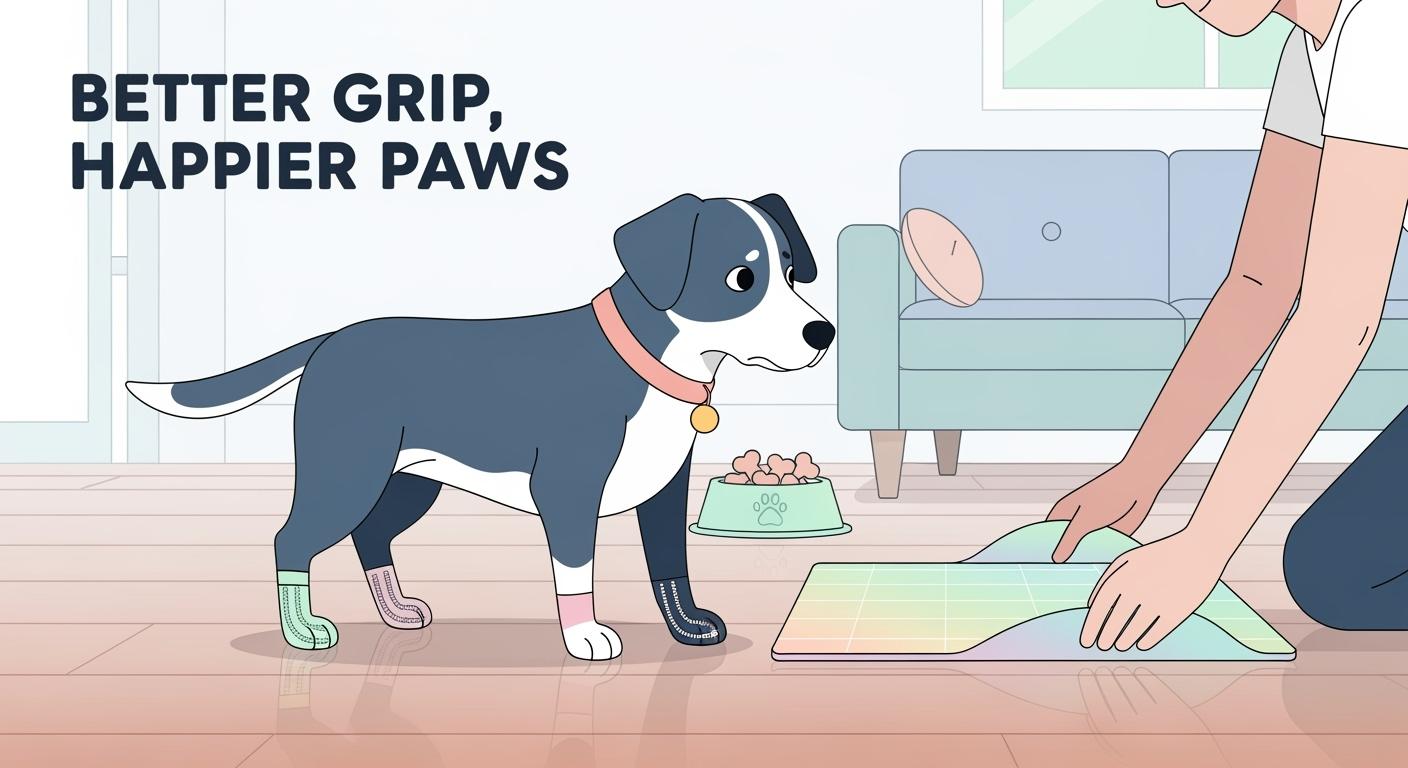
A dog that slips on hardwood or tile does not always need a complicated solution. Start by finding the exact places where grip fails, then create a continuous non-slip route through those areas. Secured runners, stable mats, short nails, trimmed paw-pad fur, and careful use of traction aids can make everyday movement more controlled. These changes improve the environment, but they do not diagnose weakness, pain, or coordination problems. Sudden or worsening slipping still requires veterinary attention.
Key Takeaways
- Build one continuous traction path instead of placing small, isolated mats around the room.
- Secure every runner and mat so the traction surface does not slide, curl, or bunch under the dog.
- Check nail length and fur between the paw pads before adding socks, boots, or other wearable traction aids.
- Use socks or boots only when they stay aligned and the skin remains dry and free of rubbing.
- Contact a veterinarian when slipping begins suddenly, worsens, or appears with pain, knuckling, dragging, collapse, or inability to stand.
Why Dogs Lose Grip on Hardwood and Tile
Smooth flooring gives the paw less surface texture to push against. The problem becomes more noticeable when a dog turns, rises from the floor, crosses a doorway, approaches stairs, or accelerates toward food or an exit. Moisture, floor polish, loose rugs, long nails, and fur covering the paw pads can make the same surface harder to manage.
Some dogs also slip because they cannot place or load a limb normally. Age-related weakness, joint discomfort, recovery after surgery, neurologic changes, and reduced coordination can all affect stability. Floor traction changes may reduce environmental risk, but they should not be used to explain away a new gait change.
Important distinction: a slippery floor is an environmental problem; sudden weakness or abnormal paw placement may be a medical problem. Both can occur at the same time.
Start with a Room-by-Room Traction Map
Watch the dog move through a normal day before buying multiple traction products. Note where the paws slide, where the dog hesitates, and whether the problem happens during straight walking, turning, standing up, or stepping over a threshold. A short phone video can help you compare movement before and after the floor setup changes.
| Area | Common failure | First correction |
|---|---|---|
| Hallway | Paws slide during long straight movement or quick turns | Install a secured runner that covers the full travel line |
| Doorway | Dog slips while accelerating, stopping, or crossing a threshold | Bridge both sides of the threshold with flat, non-slip surfaces |
| Food and water station | Front feet slide while the dog lowers the head | Use a wide mat that extends beyond the bowls and stays dry |
| Bed or crate exit | Dog struggles during the first stand or turn | Place a stable mat directly under the first steps |
| Stairs | Paws slip at the first or last step | Use secured treads and restrict unsupervised access when needed |
For a dog recovering from a procedure, stairs require a separate safety decision rather than a traction fix alone. Review the dog stairs after surgery safety guide and follow the veterinarian or surgeon’s activity restrictions.
Build a Continuous Non-Slip Route
Use Runners for Movement Paths
A runner is usually more useful than several small mats when the dog must cross a hallway or move between rooms. The runner should be wide enough for the dog’s natural stance and long enough to prevent a final step onto bare flooring before the next stable surface.
- Choose a backing or underlay that grips the actual floor surface.
- Keep the runner flat without ripples, lifted corners, or gaps.
- Avoid narrow strips that force the dog to place one side of the body on bare flooring.
- Recheck alignment after cleaning, vacuuming, or moving furniture.
Use Mats for Standing and Turning Zones
Mats work well where a dog stands, turns, eats, drinks, waits at a door, or exits a bed. Select a mat large enough to keep all four paws on the traction surface during the movement. A small mat under only the front feet may not help a dog whose rear feet slide while rising or lowering the head.
Secure Edges and Keep Surfaces Dry
A loose traction product becomes another hazard. Check the underside, corners, and transitions between surfaces. Replace worn backing, flatten curled edges, and remove any mat that moves when pressure is applied. Wipe spills promptly and allow freshly cleaned flooring to dry before the dog walks across it. Avoid leaving oily or waxy residue in the dog’s travel path.
Check Nails, Toe Hair, and Paw Pads
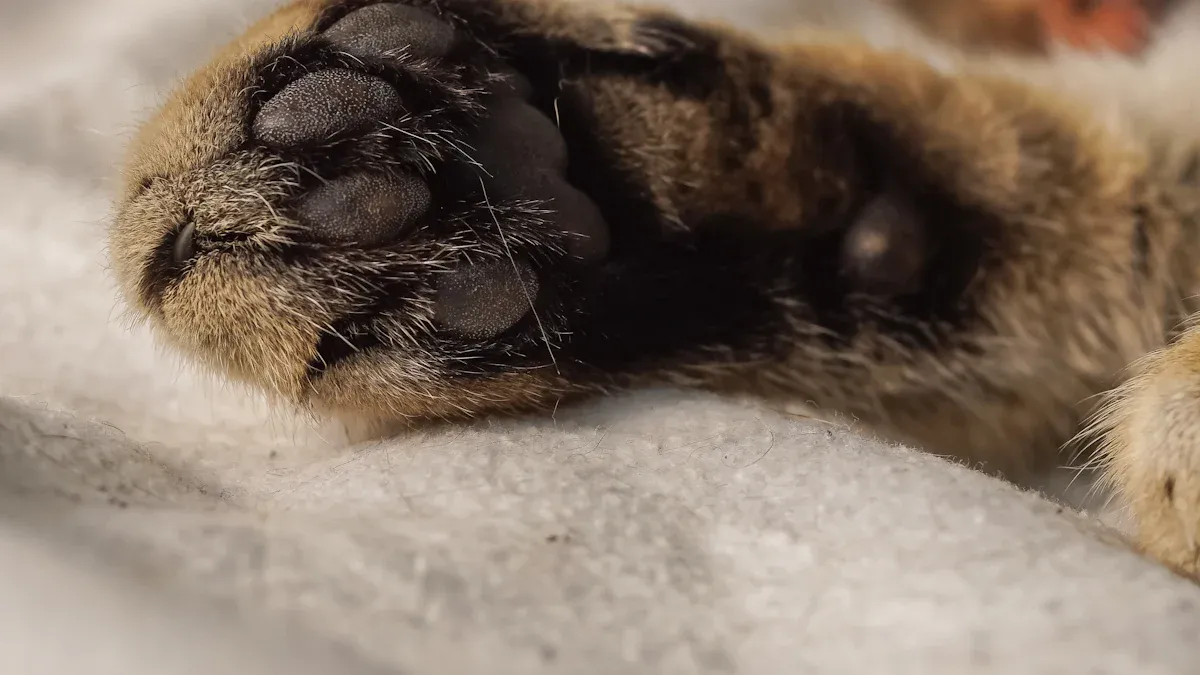
Floor changes work best when the paw can contact the surface normally. Long nails can alter paw placement, and long fur between the pads can reduce direct contact with the floor. Inspect all four paws because the most visible slip may begin with only one limb.
- Nails: ask a groomer or veterinary professional for help if you are unsure how far to trim.
- Toe hair: keep excess fur from covering the weight-bearing paw pads.
- Paw pads: look for cuts, irritation, debris, or unusual wear that may change how the dog loads the paw.
- Topical products: do not apply oily products immediately before the dog walks on smooth flooring.
Socks, Boots, and Paw-Grip Aids
Wearable traction aids may help selected dogs, but they are not automatically safer than a secured floor path. Fit, rotation, heat, moisture, and skin contact all require monitoring. Introduce one product at a time and observe the dog on a short, supervised indoor route.
| Option | Potential use | What to check | Common failure |
|---|---|---|---|
| Traction socks | Short supervised indoor movement | Alignment, dryness, skin condition, cuff pressure | Twisting, sliding down, moisture buildup |
| Indoor boots | Dogs that tolerate a structured paw covering | Size, sole contact, strap pressure, gait change | Rubbing, altered step, boot slipping off |
| Nail or paw-grip aids | Targeted indoor traction when correctly fitted | Placement, wear, paw comfort, product instructions | Incorrect sizing, uneven wear, irritation |
| Adhesive paw products | Temporary traction where appropriate | Skin reaction, residue, secure contact | Early detachment or trapped moisture |
Stop using a wearable aid if the dog develops redness, swelling, persistent licking, a changed gait, or increased reluctance to move. A traction product should not be used to force activity when the dog appears painful or weak.
When Floor Fixes Are Not Enough
A stable floor route may solve an environmental traction problem, but some dogs still need controlled assistance when standing, turning, or crossing a short distance. This is more likely when the dog has generalized weakness, difficulty rising, or cannot keep the body centered even on a non-slip surface. The dog mobility support solution explains how environmental changes, braces, ramps, slings, and harnesses serve different mobility needs.
When supervised lifting or steadying is needed, use the dog lift harness fit and support guide to compare rear-leg, front-support, and full-body designs before choosing a support level. For dogs that need coordinated assistance across the chest, belly, and rear area, review the full-body dog lifting harness product structure and fit points.
A sling or lift harness can help guide part of the dog’s weight, but it does not create grip under the paws. Use support gear together with a stable floor route, not instead of one.
A Seven-Day Traction Setup Plan
| Day | Action | What to record |
|---|---|---|
| 1 | Map every slipping point during normal movement | Location, direction, and movement that triggers the slip |
| 2 | Install one continuous runner through the main route | Whether straight walking becomes more controlled |
| 3 | Add stable mats at standing and turning zones | Changes during rising, lowering the head, and turning |
| 4 | Inspect nails, toe hair, and paw pads | Any uneven wear, irritation, or one-sided problem |
| 5 | Secure edges and remove any surface that shifts | Whether the dog hesitates at transitions |
| 6 | Trial a wearable traction aid only if still needed | Rotation, rubbing, moisture, and gait changes |
| 7 | Compare notes or videos and decide what remains unresolved | Persistent weakness, pain, or instability to discuss with a veterinarian |
For pet brands and distributors: teams developing braces or mobility-support products can review GaitGuard’s OEM/ODM pet orthotics project scope for product adaptation, sample review, sizing logic, branding, and bulk-production coordination.
When Slipping Needs Veterinary Attention
Contact a veterinarian when slipping is new, rapidly worsening, or accompanied by another change in movement or behavior. Seek prompt assessment when a dog:
- cannot stand or repeatedly collapses;
- will not bear weight on a limb;
- drags a limb, knuckles a paw, or crosses the legs abnormally;
- shows obvious pain, swelling, or sudden limping;
- loses bladder or bowel control;
- becomes weak after a fall, possible toxin exposure, or another acute event.
Do not assume these signs are caused only by the floor. Keep the dog in a controlled, non-slip area while arranging professional guidance.
Common Traction Mistakes
- Using scattered small mats: the dog still has to cross bare flooring between them.
- Leaving rug edges unsecured: a moving rug can create a worse fall hazard than the original floor.
- Buying socks before checking nails and paw fur: the underlying contact problem remains.
- Leaving socks on too long: rotation, moisture, and rubbing can go unnoticed.
- Assuming traction fixes weakness: improved flooring cannot replace assessment of pain, nerve changes, or loss of strength.
- Adding too many solutions at once: it becomes difficult to identify which change helped or caused a new problem.
FAQ
What is the fastest way to help a dog on slippery hardwood floors?
Install a secured, non-slip runner along the dog’s main walking route and place stable mats where the dog stands, turns, eats, or exits a bed. Make sure the surfaces do not slide or curl.
Are rugs enough for a dog that keeps slipping?
Rugs may solve an environmental traction problem, but they are not enough when the dog remains weak, painful, uncoordinated, or unable to rise normally on a stable surface. Those changes require veterinary assessment.
Do traction socks work on tile floors?
They may help selected dogs when the grip area stays under the paw and the sock remains dry and aligned. Check the paws and skin frequently, and stop if the sock twists, slides, rubs, or changes the dog’s gait.
Can long nails make a dog slip indoors?
Long nails can interfere with normal paw contact and change how the dog loads the foot. Nail length is one of the first items to check, but a groomer or veterinary professional should help when safe trimming is uncertain.
Should I use a lift harness on a slippery floor?
A lift harness may help steady or partially support a dog that cannot move safely without assistance. It should be used on a stable traction path and under supervision. It does not replace floor grip or veterinary guidance.
Final Checklist
- Cover the full walking route, not only the place where the dog usually falls.
- Secure runners, mats, stair treads, and thresholds.
- Keep floors and traction surfaces dry.
- Check nails, toe hair, and paw pads.
- Monitor wearable traction aids for rotation, rubbing, and moisture.
- Use support gear only when it matches the dog’s handling needs and veterinary plan.
- Arrange veterinary assessment for sudden, worsening, painful, or neurologic changes.
The most reliable dog slippery floor traction plan is usually a simple one: create a stable route, remove moving hazards, correct basic paw-contact problems, and watch how the dog responds. When a dog still struggles on a secure surface, treat that as a mobility concern rather than continuing to add floor products.
