
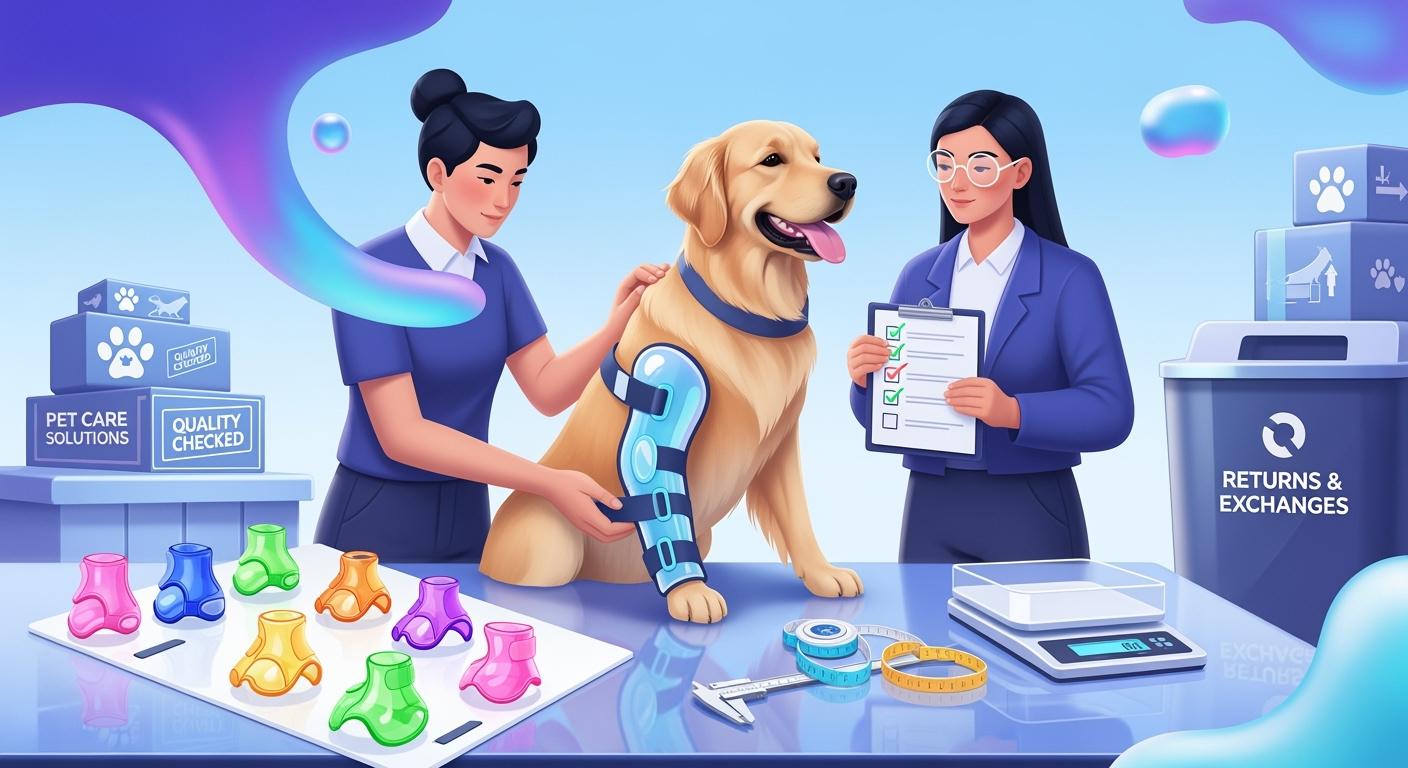
You want fewer returns and safe skin. You also want a good fit for dog braces or recovery wear in your business. Fit control helps lower returns the most. Picking the right OEM dog brace manufacturer makes braces strong and safe. This is true for every brace, sleeve, or harness. You need a pet brace supplier who knows the dog brace market. They should follow strict quality rules. Work with a supplier who cares about measuring right and giving clear instructions. Stop using the brace and call your vet if you see skin breaks, swelling, or more pain.
Key Takeaways
Pick an OEM dog brace manufacturer who knows about fit control. This can help lower returns and keep dogs safe.
Give easy-to-follow measurement guides to pet owners. Getting the right size can cut down returns by up to 72%.
Do skin checks every day for the first week of use. This stops pressure sores and makes sure the brace fits right.
Use good materials and strong stitching in the braces. This makes them more comfortable and helps stop skin irritation.
Teach clinic staff how to fit braces the right way. Staff who know what to do can find fit problems early and make customers happier.
OEM dog brace manufacturer roles and options
OEM vs ODM for dog braces
It is important to know how OEM and ODM are different. This helps you pick the right dog accessories manufacturer for your business. OEM means you give your own designs and details to your partner. You get to choose how the product looks and fits. You can also pick the features you want. This lets you make a dog harness private label that matches your brand. You can ask your partner to change the size, straps, or materials. The oem dog brace manufacturer will follow your plans when making the product. You have more control over what you sell. Fit control is the best way to lower returns. You can work with your partner to make sure the fit is right during the oem process.
ODM is different because the dog accessories manufacturer already has products made. You can put your logo or packaging on them. You do not get to change the design much. You still get good products, but you cannot change how they fit. This is good if you want to sell products fast or try new things. Your partner does most of the work for you.
White label for clinics and retailers
White label means you buy finished products from a dog accessories manufacturer. You add your brand name to them. This is the fastest way to get dog harness private label products for your clinic or store. You do not change how the product looks or fits. You trust your partner to make safe and comfy braces, sleeves, or harnesses. You can spend more time selling and helping customers. Skin checks help stop pressure sores and rubbing. Always check the fit before you let pet owners take products home.
Comparison table: OEM, ODM, white label
Here is a simple table to help you see the differences between dog harness private label options:
Model | Customization Options | Branding Control | Fit Control | Production Steps | Partner Involvement | Best For |
|---|---|---|---|---|---|---|
OEM | High | Full | Full | All | High | Unique products, full control |
ODM | Medium | Medium | Limited | Most | Medium | Fast launch, some changes |
White Label | None | Label only | None | Few | Low | Clinics, quick stock |
Stop using the product and call your vet if you see broken skin, more swelling, or more pain.
Pick the partner model that fits your business goals. The best dog harness private label comes from talking clearly with your partner. You can ask for samples before you order a lot. This helps you check the fit and quality. Your partner should help you at every step. You can lower returns by making sure the fit is good and working with a trusted pet brace supplier.
Product scope for dog braces and recovery wear
Picking the right product for each dog helps lower returns. It also makes dogs more comfortable. There are three main types to know. These are orthopedic braces, lick-prevention sleeves and suits, and mobility support harnesses or slings. Each type has its own fit risks and safety checks.
Orthopedic brace types and fit risks
There are many kinds of braces for dogs. Some are for the knee, hock, carpal, elbow, shoulder, neck, or hip. These braces help dogs with injuries or joint problems. Fit control is the best way to lower returns. If a brace does not fit well, it can hurt the skin. Over half of dogs can get sore skin or pressure spots in just a few weeks. Dogs may chew or try to take off a brace if it feels bad. Small dogs often do okay with braces. Big or very active dogs might need surgery instead. Always look for red or swollen skin after putting on a brace. Checking the skin helps stop sores and rubbing.
[Stop use and call your vet] if you see broken skin, swelling, or more pain.
Aspect | Details |
|---|---|
Skin irritation | Poor fit is common; about half of dogs get it in weeks. |
Pressure sores | Bad fitting causes sores; a pro fit can help stop this. |
Noncompliance | Dogs may chew or pull off braces; owners must watch them. |
Suitability for size | Braces help small dogs; big, active dogs may need surgery. |
Lick-prevention sleeves and suits
These sleeves and suits protect wounds or surgery spots. They are another choice instead of e-collars. Pick the right size so it does not rub or slip. Fit control helps stop chafing. Check your dog’s skin every day to catch problems early. If you see red skin that stays, stop using it and call your vet.
Mobility support harnesses and slings
Lift slings and full body harnesses help dogs after surgery or with walking problems like IVDD. Make sure there is space under the arms and groin to stop rubbing. Try a short walk for 10–15 minutes to check the fit. Look at the skin during the first week to stop sores.
[Fit control] is the best way to lower returns for all recovery wear.
Decision Table
Buyer Situation | Best Product Category | Key Risk to Manage |
|---|---|---|
Post-surgery knee injury | Knee brace | Skin irritation, pressure sores |
Licking surgical site | Recovery sleeve or suit | Chafing, slipping |
Weakness after IVDD | Full body lift harness | Rubbing in armpit/groin |
Chronic hock instability | Hock brace | Chewing, poor fit |
Elderly dog with arthritis | Mobility sling | Slipping, pressure points |
[Skin checks] help stop sores and rubbing. Watch your dog every day during the first week.
OEM spec pack and quality control essentials
When you work with an oem dog brace manufacturer, you need a clear spec pack. This helps you get the right fit and safety for every brace, sleeve, or harness. You must set rules for measurement, materials, labeling, and following laws. These steps help you lower returns and keep dogs safe.
Measurement points and sizing rules
You must give your manufacturer exact spots to measure and sizing rules. This makes sure every brace fits well and is safe. Use a sizing chart and a guide for each style. Fit tolerance should stay between plus or minus 0.5 to 1.0 cm at key spots. This rule helps you control quality and lower returns.
Measurement Point | Instructions |
|---|---|
Chest | Wrap tape around the widest part of the chest, just behind the front legs. Make sure it is snug with space for one finger. |
Height | Measure from the base of the back paw to the top of the hip, keeping the tape straight. |
Thigh | Wrap tape around the thigh, halfway between the knee and groin, making sure it is snug with room for one finger. |
[Fit control] is the best way to lower returns. Always check sizing before you order.
You should ask for samples before making a big order. The usual time for samples is 7 to 14 days after you confirm your specs. This lets you check fit and quality early.
Materials and hardware standards
You must pick materials and hardware that are safe and good quality. Good materials stop chafing, pressure sores, and slipping. They also make braces last longer and feel better for dogs. Your oem partner should follow strict rules for every part.
Material/Technique | Description |
|---|---|
Neoprene | Soft, flexible material that gives support and cushion, resists water, and stretches for fit. |
Breathable Fabrics | Lets air move to keep the dog’s skin cool and dry, stopping irritation. |
Velcro Straps | Adjustable for easy use and custom fit, stopping slipping. |
Hinges | Give extra support for joints and let them move in a controlled way. |
Plastic/Metal Support Parts | Add stability with light materials that balance strength and comfort. |
Foam Padding | Protects skin and lowers the risk of rubbing or pressure sores. |
Cutting | Cutting with care makes sure materials fit right. |
Sewing | Strong stitching keeps the brace together during use. |
Molding | Shapes parts to fit the dog’s body for better support. |
Bonding | Joins materials without sewing, which lowers the risk of irritation. |
Assembly | Skilled assembly makes sure the brace works well and is good quality. |
You should test closures like Velcro to see if they last. Open and close them many times to check if they still work. Always look for strong stitching and smooth edges. These things protect the dog’s skin and make braces safer.
Labeling, care, and warnings
You must add clear labels, care guides, and warnings with every order. This helps owners use braces, sleeves, or harnesses safely. Labels should show size, how to fit, and how to care for the product. Warnings must tell owners to stop use and call the vet if they see skin breaks, swelling, or more pain.
Your oem spec pack should have:
Sizing chart for each style and size
Measurement guide with pictures or diagrams
Fit-check checklist for clinics and owners
Care and wash guide for all materials
Warnings and safety notes
[Skin checks] stop pressure sores and chafing. Owners should look at the skin every day for the first week.
You must set clear rules for quality and following laws. Use an Acceptable Quality Level (AQL) of 2.5 for big problems and 4.0 for small problems. This helps you keep quality high and lower returns. Minimum order quantity (MOQ) is usually 200 to 500 units per style, color, or size. Production time is 30 to 60 days after you approve samples.
MOQ (Minimum Order Quantity) | Lead Time |
|---|---|
200–500 units | 30–60 days |
Sampling | 7–14 days |
You should always check that your manufacturer follows safety and quality rules. Ask for proof that they meet ISO 9001, OEKO-TEX, or other industry rules. This keeps your brand and customers safe.
Sample Evaluation Mini-Protocol
You can use this simple plan to check sample braces before you order:
Measure the sample at all key spots. Check if it matches your spec within plus or minus 0.5 to 1.0 cm.
Put the brace on a dog for 10 minutes. Watch for rubbing, slipping, or red skin.
Open and close all straps and closures 20 times. Check if they still work well.
[Stop use and call your vet] if skin breaks, swelling gets worse, or pain increases.
You must follow these steps for every new style or batch. This routine helps you keep safety and quality high.
Sizing, fit testing, and reducing returns
Proper sizing and fit testing play the biggest role in reducing returns for dog braces, sleeves, and harnesses. You want every product to fit well, feel comfortable, and protect your dog’s skin. Fit control is the biggest return lever for your business. When you follow a clear sizing protocol, you help your customers avoid common mistakes and keep dogs safe.
Owner measurement guides
You need to give owners a simple, step-by-step guide for measuring their dogs. Most returns—up to 72%—happen because of sizing and fit issues. You can lower this number by making your instructions clear and easy to follow. Here is a proven measurement routine used by leading oem dog brace manufacturer teams:
Gather your tools. Use a soft tape measure, a phone camera, a helper, and treats. Pick a well-lit spot with a non-slip mat.
Position your dog. Stand your dog with weight on all four feet. Keep the head in a neutral position. Ask a helper to keep your dog calm.
Take measurements. Measure the thigh circumference, knee circumference, hock to knee length, and lower leg circumference. Write down your dog’s weight and breed.
Record each number. Double-check your measurements for accuracy.
Note any swelling or bandages. If your dog has swelling or wears a bandage, write this down. Measure again after swelling changes.
Match your numbers to the sizing chart. Use your measurements to pick the best size from the manufacturer’s chart.
[Fit control] is the biggest return lever. Always use a sizing chart and measurement guide before you order.
You can include a measuring video script and a printable guide inside your packaging. This helps owners get it right the first time. For more details, see the gaitguard brace sizing guide.
Clinic fit-check checklist
Clinic staff play a key role in making sure braces, sleeves, and harnesses fit well. You can use a standard checklist to check fit and skin safety before sending a product home. This routine helps you catch problems early and lower returns.
Printable Clinic Fit Check + Skin Check Checklist
Strap check: One finger fits under each strap. No pinching or gaps.
Skin check: No redness, sores, or hair loss after removing the brace.
Movement check: Dog walks without tripping, toe drag, or limping.
Comfort check: Dog shows no pain, chewing, or licking at the brace.
Armpit/groin clearance: Harnesses and slings do not rub during movement.
10–15 minute trial wear: Check for redness that fades quickly. Stop use if redness worsens or skin breaks.
Slide test: Brace does not rotate or slip during a slow walk.
Daily skin check: Inspect high-pressure points every day for the first 7–10 days.
[Skin checks] prevent pressure sores and chafing. [Stop use and call your vet] if skin breaks, swelling worsens, or pain increases.
You can include this checklist as a handout for clinics or as a download. Training your staff on adjustments and skin checks improves outcomes and reduces returns.
Common sizing and fit issues
You may see fit issues even when you follow all the steps. Off-the-shelf braces do not always fit every dog perfectly. Small errors in measurement or breed differences can cause problems. Accurate measurements are essential for picking the right size. Some dogs need extra adjustments because of their shape or condition.
Common problems include:
Braces that slip, rotate, or pinch the skin
Straps that are too tight or too loose
Redness, sores, or hair loss under the brace
Dogs chewing or trying to remove the brace
Difficulty walking, tripping, or toe drag
You may need to try more than one size or adjust the straps for the best fit. In some cases, even after several tries, you may still see fit issues. This shows how important it is to have a clear sizing chart, a fit-check checklist, and trained staff.
[Fit control] is the biggest return lever for all recovery wear. [Skin checks] prevent pressure sores and chafing.
You can use a Return Reduction Playbook for your business:
Standardize your sizing chart and include a measuring video script.
Add an owner fit-check checklist inside every package.
Train clinic staff on adjustments and daily skin checks.
You can also download the OEM Dog Brace Supplier Scorecard and Spec Pack Template for knee, hock, and carpal braces, as well as recovery sleeves. These tools help you compare suppliers and set clear oem customization rules.
Always focus on safety. Never make cure claims. Advise owners to consult a veterinarian for post-op care, IVDD, wounds, or skin breakdown. Work with your pet brace supplier and oem dog brace manufacturer to improve fit, quality, and customization for every product.
Safety and skin protection in dog braces
Preventing chafing and pressure sores
You want to keep your dog comfortable and safe when using a brace, sleeve, or harness. The most common risks include skin irritation, pressure sores, and slipping. Up to 91% of dogs may have minor problems like these, especially in the first weeks. You can lower these risks by choosing the right size and checking the fit often. Always use soft padding and breathable materials. These features help protect your dog’s skin and improve safety. [Skin checks] prevent pressure sores and chafing. If you see redness that does not fade, stop use and call your vet.
Strap and padding design
Straps and padding play a big role in safety. Wide straps spread out pressure and lower the chance of rubbing. Soft liners and smooth edges protect sensitive areas like the armpit or groin. You should check that straps are snug but not tight. Try the two-finger test under each strap. Good padding helps stop chafing and keeps the brace in place. [Fit control] is the biggest return lever. Always look for strong stitching and high-quality closures.
Break-in and daily skin checks
Start with short wear times when you first use a new brace or recovery wear. Let your dog wear it for 10–15 minutes, then check the skin. Daily skin checks are essential for the first 7–10 days. Studies show that nearly half of dogs with orthopedic braces get skin problems early on. Early checks help you spot irritation before it gets worse. If you see swelling, sores, or pain, [stop use and call your vet]. You can find more tips in the pressure sore prevention and chafing prevention guides.
[Skin checks] prevent pressure sores and chafing. [Stop use and call your vet] if skin breaks, swelling worsens, or pain increases.
Quality assurance for dog brace manufacturing
You need strong quality checks to keep dog braces safe. Good quality control helps stop returns and skin problems. When you work with an oem dog brace manufacturer, you set the rules for every step. [Fit control] helps your business lower returns.
Inspection points and AQL standards
You should check each batch for important quality points. Use Acceptable Quality Level (AQL) standards to pick how many items to inspect. Lower AQL numbers mean stricter checks. For dog braces, keep AQL at 2.5 for big problems and 4.0 for small ones. Some parts, like stitching or measurement, need even tighter checks.
Inspection Points | AQL Standards |
|---|---|
Stitching inspection | 0.1% – 0.65% for critical components |
Measurement verification | 1.0% – 2.5% for consumer goods |
Webbing alignment checks | 4.0% – 6.5% for less critical items |
Final random inspection | |
Overall product appearance | |
Accurate branding | |
Proper packaging |
Match your inspection plan to the product’s risk. Always check for strong stitching and correct measurements. Make sure packaging is safe. [Skin checks] help stop pressure sores and chafing.
Batch consistency and traceability
You want every batch of oem braces to look and fit the same. Batch consistency means each product meets your rules. Ask your supplier to label each batch with a code. This helps you trace problems back to the source. If you find a defect, you can check which batch it came from. Fixing issues fast protects your brand.
Certifications and compliance
Work only with oem dog brace manufacturers that have top certifications. These show your supplier follows strict safety and quality rules. Look for ISO 9001 for quality management systems. Ask for STANDARD 100 by OEKO-TEX to make sure materials are safe for dogs. BSCI shows your supplier treats workers fairly.
Certification | Description |
|---|---|
STANDARD 100 by OEKO-TEX® | Makes sure materials are safe for dogs. |
ISO 9001 | Shows the supplier has a quality management system. |
BSCI | Proves workers are treated fairly. |
Ask for proof of these certifications before you order a lot. [Stop use and call your vet] if skin breaks, swelling gets worse, or pain increases.
OEM supplier vetting and capacity checks
Sample process and defect handling
You need to see how each supplier deals with samples and mistakes before you buy a lot of dog braces or recovery wear. First, ask for a sample of the product you want, like a knee brace or recovery sleeve. Check the sample for the same size every time, strong stitching, and easy-to-read measurement guides. If you find problems, ask them to fix it. Good suppliers will help you change the sample and set up a final check using AQL rules.
[Fit control] is the biggest return lever.
You should also see how the supplier handles mistakes. Suppliers who get lots of repeat orders and answer fast care about quality and happy customers. The best suppliers answer in less than two hours. They have clear steps for checking products and fix returns quickly. Good reviews talk about fast help and good service. Bad reviews about poor fit or slow returns can warn you about problems later. Always read reviews before you pick a supplier.
Vendor Vetting Checklist
Same brace size every time
Measurement guide and fit-check sheet
Sample change process
Help with final check using AQL rules
[Skin checks] prevent pressure sores and chafing.
Verifying production capacity
You must make sure your supplier can handle your order size and special requests for braces, sleeves, or harnesses. Good suppliers use strict steps to keep batches the same and quality high. Use the table below to help you ask questions:
Method | Description |
|---|---|
Raw Material Selection Standards | Makes sure products are strong, comfy, and safe by using trusted suppliers and testing materials. |
Controlled Production Processes | Uses set steps to keep making products the same way and checks them often. |
Batch Consistency Checks | Checks samples and uses rules to make sure all batches match. |
Export Experience | Packs and ships products safely and meets market needs. |
Long-Term Cooperation | Focuses on steady production and on-time delivery for business growth. |
You should ask about how often they deliver on time and how many repeat orders they get. Partners with at least 97% on-time delivery are best. Always ask for proof of past orders and if they have done custom work before.
[Stop use and call your vet] if skin breaks, swelling worsens, or pain increases.
Buyer terms: MOQ, lead time, warranty, returns
Defining defects vs fit issues
You need to know how a defect is not the same as a fit issue. A defect means something is wrong with the brace from the factory. This could be broken stitching, missing straps, or a closure that does not work. Fit issues happen when the brace does not match the dog’s size, even if you used the sizing chart and guide. You should make clear rules for returns in your contract. Most suppliers want you to order at least 200 to 500 of each style, color, or size. It usually takes 30 to 60 days to make your order after you say the sample is good. The warranty for factory problems is often 6 to 12 months. You can return braces for fit or defect problems for 14 to 30 days after you get them.
[Fit control] is the biggest return lever.
[Stop use and call your vet] if skin breaks, swelling worsens, or pain increases.
Term | Typical Range | What It Covers |
|---|---|---|
200–500 units | Per style, color, or size | |
Lead Time | 30–60 days | After sample approval |
Warranty | 6–12 months | Manufacturing defects only |
Return Window | 14–30 days | Defects or fit issues |
You should always ask your supplier how they handle returns and warranty claims. Talking clearly helps you with custom orders and stops confusion.
Packaging and shipping for braces
Packaging and shipping are important for keeping braces and recovery wear safe. Good packaging keeps every brace safe from damage while it ships. Your supplier should test the packaging to make sure it is strong and works well. Distribution testing checks if braces stay safe in different shipping situations. If the packaging is weak, braces can get bent, dirty, or broken. This means more returns and unhappy customers.
Good packaging keeps braces and sleeves safe.
Tested packaging meets safety and quality rules.
Distribution testing helps stop damage during shipping.
You should ask your supplier how they check their packaging. Make sure they use strong boxes, clear labels, and padding for every brace, sleeve, or harness. Good packaging helps with your custom needs and keeps products looking new.
[Skin checks] prevent pressure sores and chafing.
[Fit control] is the biggest return lever.
Always look at the packaging when your order arrives. If you see damage, tell your supplier right away. Safe shipping and strong packaging help lower returns and keep dogs comfy.
Implementation: pilot to scale
Trial order and clinic feedback
You should start with a small trial order before you scale up. This helps you test the supplier and see how the products work in real clinics. Ask for a mix of sizes and types, such as knee braces, recovery sleeves, and lift harnesses. Give these to a few trusted clinics or rehab centers. Ask staff to use the products on different dogs and fill out a feedback form.
[Fit control] is the biggest return lever.
You want to know if the brace fits well, if the straps stay secure, and if the materials feel soft on the dog’s skin. Ask clinics to check for redness, slipping, or chewing. Collect feedback on the measurement guide and fit-check checklist. Use this information to talk with your supplier about any changes before you place a large order.
Staff training for fitting and troubleshooting
You need to train your staff on how to fit and adjust every product. Hold a short workshop or use a video guide. Show how to measure the dog, pick the right size, and check the fit. Practice using the two-finger test under each strap. Remind staff to do a 10–15 minute trial wear and check the skin for redness.
[Skin checks] prevent pressure sores and chafing.
Teach staff how to spot common problems, like slipping or pinching. Give them a checklist for daily skin checks during the first week. Remind everyone to tell owners: [Stop use and call your vet] if skin breaks, swelling worsens, or pain increases.
You can find more tips in the recovery sleeves/suits and lift harnesses guides. Good training helps you lower returns and keep dogs safe.
You can make smarter choices for your business by using a checklist when you pick an oem dog brace manufacturer. This helps you set clear rules for quality, fit testing, and safety. Working closely with your supplier means you get fewer returns and better results for every brace, sleeve, or harness.
44 owners said their pets had a better life.
83.6% of owners listened to their vet and used the brace longer.
92.3% of dogs got used to the device, so results were better.
[Fit control] is the best way to lower returns. Always ask your supplier questions and look at your guides or talk to an expert before you order. [Stop use and call your vet] if skin breaks, swelling gets worse, or pain increases.
FAQ
How do I choose the right size dog brace for my pet?
You should measure your dog using a soft tape measure. Follow the sizing chart from your supplier. Always check the fit with a two-finger test under each strap. [Fit control] is the biggest return lever.
What should I do if my dog’s skin gets red under the brace?
Stop use and call your vet if you see redness that does not fade, swelling, or pain. [Skin checks] prevent pressure sores and chafing. Always check your dog’s skin every day for the first week.
How long should my dog wear a new brace each day?
Start with 10–15 minutes. Check the skin after each use. Slowly increase the time if there are no problems. [Stop use and call your vet] if skin breaks, swelling worsens, or pain increases.
Why should I work with an oem dog brace manufacturer?
You get custom sizing, better fit, and clear instructions. This helps lower returns and keeps dogs safe. You can ask for samples and set your own quality rules.
